• blog
  • in the shadow of sun mountain
  • buy my books
  • photographs
  • paintings
  • bio
  • cv
  • contact
  • search
Menu

Studio Q Photography

Exploring Human Behavior and Death Anxiety Through Art
  • blog
  • in the shadow of sun mountain
  • buy my books
  • photographs
  • paintings
  • bio
  • cv
  • contact
  • search
×

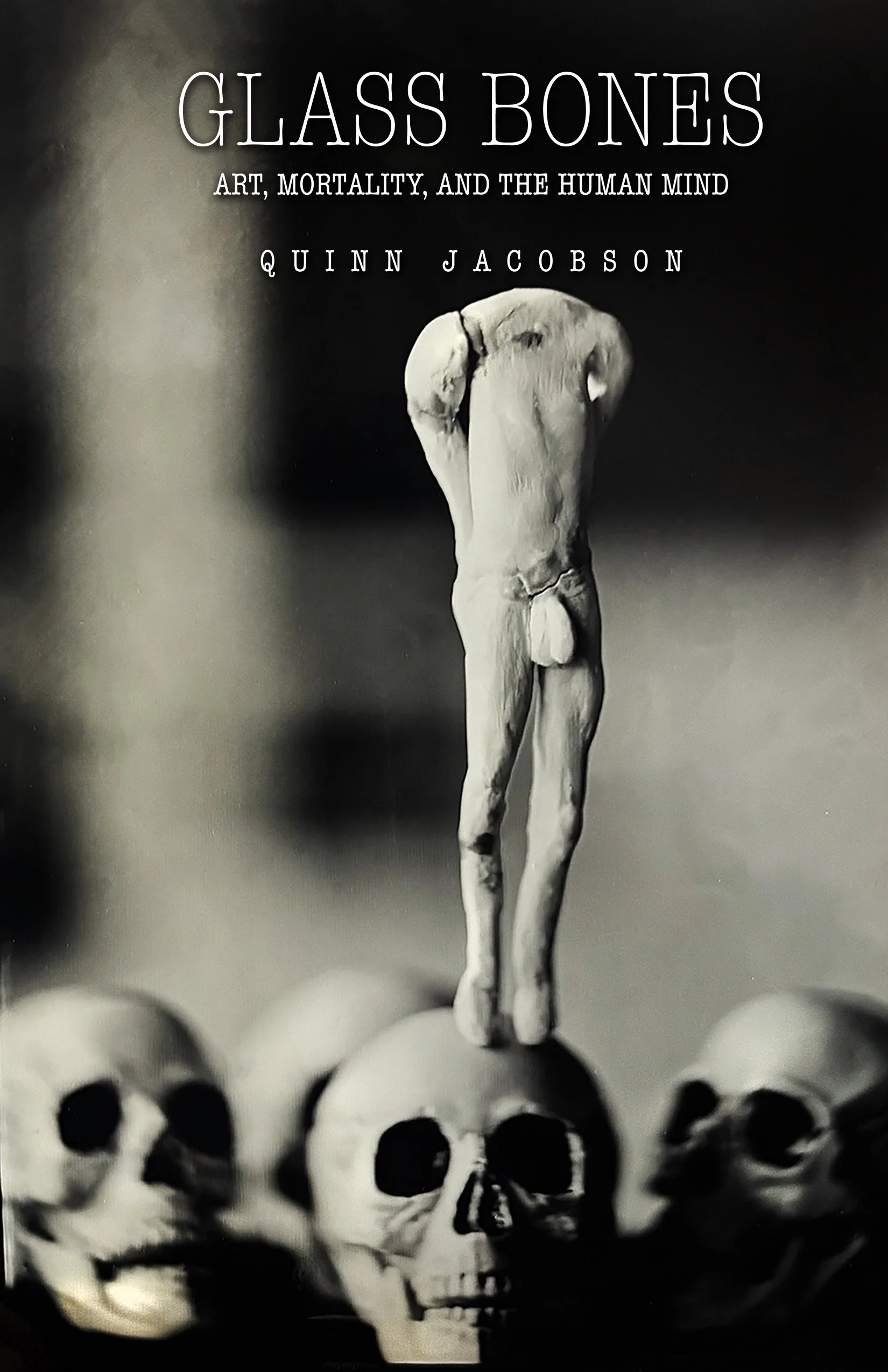
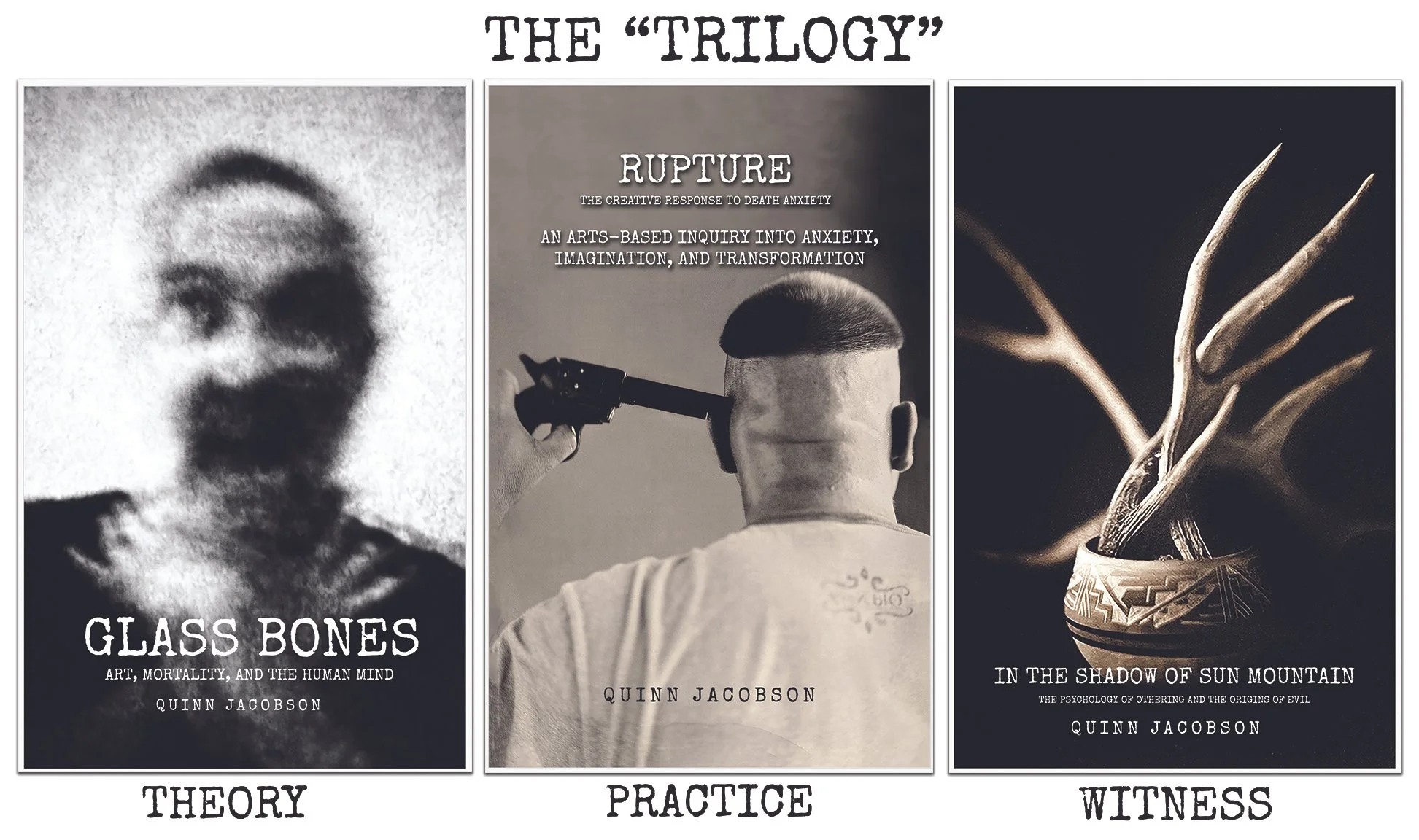
Mockup covers of my new books.

My New Books for 2026

Quinn Jacobson January 27, 2026

Have you ever had an epiphany? An epiphany is a sudden, profound realization or insightful moment where the true meaning or essence of something becomes clear, often from a simple occurrence, stemming from the Greek word for "manifestation" or "appearance.”

I’ve had several over the past few weeks.

I wanted to share how I’m going to unfold these publications this year. I will use some of the 800-900 pages of text in these books for my 2028 thesis/dissertation—these writings will drive my dissertation.

“I’m building a psychology of artistic practice that takes mortality seriously as a formative force. And my three books, Glass Bones, Rupture, and In the Shadow of Sun Mountain, act as a trilogy: Theory → Practice → Witness regarding the theories and creativity.”
— Quinn Jacobson

This is how I see it transpiring:

June 2026: Glass Bones is published.

September 2026: Rupture is published.

November 2026: In the Shadow of Sun Mountain is published.

Allow me to explicate: I'm building a psychology of artistic practice that takes mortality seriously as a formative force—not as metaphor, but as the pressure that shapes how artists see, make, and live. My trilogy examines this from three angles: Glass Bones provides the theoretical framework, drawing on Becker, Rank, and Terror Management Theory to understand death anxiety and cultural defense. Rupture translates theory into practice, exploring the disciplines and orientations that allow artists to transform existential pressure into creative form. In the Shadow of Sun Mountain offers lived witness—thirty years of working with nineteenth-century processes, paint, clay, broken materials, plants, people, and the mountain landscapes as sites where mortality and imagination meet. Together, they map the terrain where awareness becomes art: Theory → Practice → Witness.

This research is situated within liminal space: psychological, material, and cultural thresholds produced by mortality awareness. Rather than resolving death anxiety through symbolic closure, the work asks what becomes possible when creative practice holds the threshold open long enough for transformation to occur.

Mortality awareness places me in a permanently liminal condition. I am alive, but never free of the knowledge that I will not remain so. From a Beckerian perspective, this is not incidental; it is the core destabilizing fact of consciousness. I am an animal capable of symbol-making who cannot fully believe in my own symbols, a being suspended between embodiment and abstraction, presence and disappearance.

I do not experience this condition as episodic or developmental, something to be outgrown or resolved. It is structural. Consciousness itself unfolds at the threshold. What culture often treats as pathology or anxiety to be managed, I understand as the ground from which meaning-making arises. Creative practice, in this sense, is not an escape from liminality but a way of inhabiting it with attention and responsibility, giving form to what cannot be stabilized without distortion.

I will be making new work—photographs, paintings, and mixed media for Glass Bones and Rupture. My work from the mountain will be featured in Sun Mountain.

I think you can wrap your head around that one, right? Just writing this out alleviates some of the “it’s in me, and it has to come out” stuff. To quote John Lee Hooker from Boogie Chillin’ (1948), a natural, internal force that must be expressed. 
In New Books 2026 Tags new books, PhD, Ruptureology, rupture, In the Shadow of Sun Mountain, Glass Bones
4 Comments

The Dimmer Switch Explained

Quinn Jacobson January 26, 2026
In Dimmer Switch, Pigment Printing, Anxiety, Consciousness, Death and Dying, Death Anxiety, Denial of Death, Ernest Becker Tags Dimmer Switch
Comment

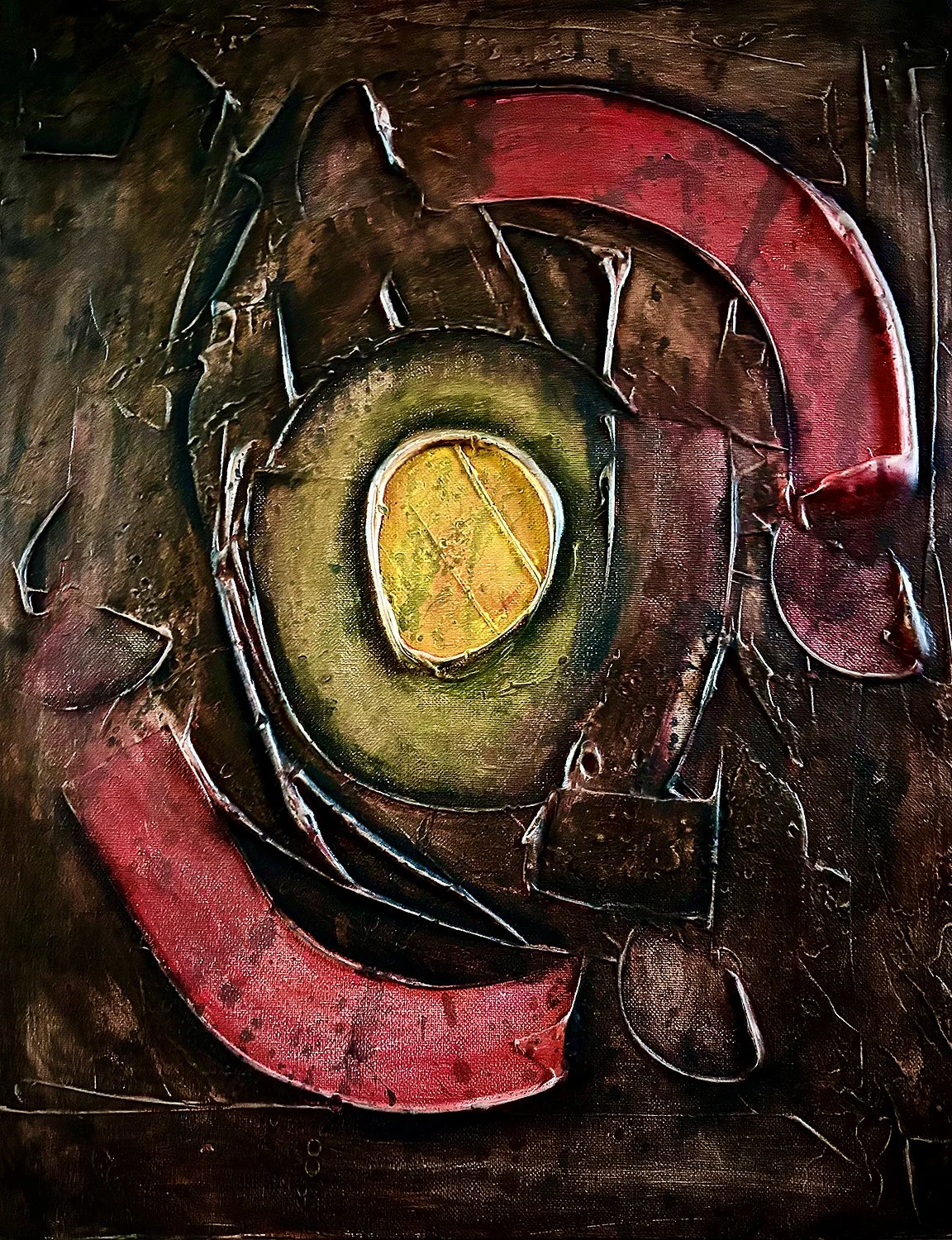
“Holding Pattern,” 16” x 20” acrylic on canvas. January 23, 2026

Holding Pattern

Quinn Jacobson January 24, 2026

I made Holding Pattern without a clear image in mind. What I had was pressure. The sense that something was circling without resolution, asking to be held rather than explained. The painting emerged through accumulation and restraint. Layers were added, scraped back, and redirected. Each decision responded less to intention than to the condition the surface was already carrying. I wasn’t trying to resolve the image. I was trying to stay with it.

Materially, the surface itself is ruptured; cracked, weathered, and refusing integrity. The paint records its own breakdown. This isn't a representation of rupture; it's rupture as material fact. The painting embodies what it's examining by subjecting itself to the same forces of deterioration it's addressing conceptually. The medium becomes inseparable from the inquiry.

As arts-based research methodology, this is knowledge production through making rather than through language. I’m not illustrating a thesis about reproduction-as-death-denial that you arrived at discursively. I’m using paint, surface, gesture, and material breakdown to think through something that can't be fully accessed through writing alone.

The painting knows things my writing can't get to. It enacts the gravitational pull of the drive, the suffocation of the holding pattern, the way ideology fragments bodies even as it organizes them. The counterclockwise inward spiral isn't a metaphor I chose to represent an idea, it's a formal discovery that emerged through material engagement, and it carries meaning that exceeds paraphrase.

Arts-based research treats the artwork as primary data and the making process as an investigative method. The decisions I made; impasto that builds up and cracks, a spiral that compresses rather than expands, colors that register as bodily rather than symbolic, these aren't aesthetic choices decorating research findings. They are the research. The painting generates understanding about death anxiety, compulsion, and cultural reproduction (egg) that exists in formal and material relationships rather than in arguments.

The rupture also functions methodologically as refusal of traditional research's demand for coherence and resolution. Academic writing wants to arrive somewhere, to synthesize, to offer frameworks. The painting refuses. It stays with fragmentation, with irresolution, with the holding pattern itself. That refusal is epistemological; it insists that some truths about mortality and compulsion can only be approached through sustained engagement with what won't cohere.

What I’m doing is using the body's engagement with materials, the physical acts of mixing, applying, scraping, building, and watching paint crack, as a way to metabolize cultural and psychological forces that are otherwise difficult to grasp. The painting becomes a site where those forces can be witnessed and worked through without being explained away.

In ABR, Acrylic Painting, Art & Theory, Psychology, PhD Tags Holding Pattern, acrylic painting, 16x20
2 Comments

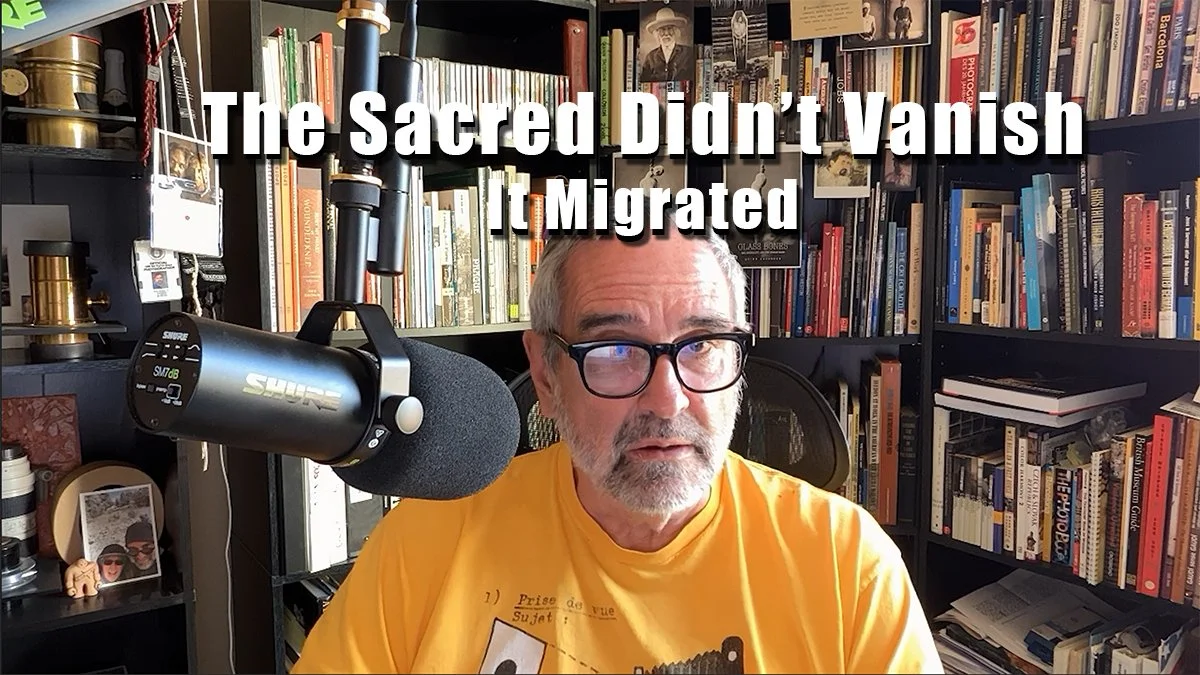
The Sacred Didn’t Vanish - It Migrated

Quinn Jacobson January 19, 2026

Any system that becomes the sole container for existential meaning will behave like a religion, including its pathologies.

That’s not a moral judgment. It’s a psychological observation.

We tend to talk about religion as something people either believe in or reject. But from an existential perspective, that framing misses what religion actually does. Religion isn’t primarily a set of supernatural claims. It’s a symbolic system that helps human beings orient themselves inside chaos. It answers questions we cannot avoid but cannot solve: Why am I here? What matters? How should I live? What do I do with suffering? What happens when I die?

From a Beckerian and Terror Management Theory perspective, those questions are not optional. They emerge the moment a creature becomes aware of its own impermanence. Once that awareness arrives, some form of meaning structure is required just to keep life psychologically livable. The mind does not ask first whether a worldview is true. It asks whether it works.

This is why the story we often tell about secularization is misleading. People haven’t outgrown religion in any deep psychological sense. What they’ve lost trust in are specific institutions. The need for meaning, belonging, ritual, and symbolic continuity hasn’t disappeared. It’s migrated.

That migration explains why so many people, particularly millennials and Gen Z, don’t experience cognitive dissonance when they abandon Christianity but embrace astrology, Tarot, wellness spirituality, social justice activism, or even technology as a source of ultimate meaning. What’s changing isn’t the need itself. It’s the container.

Institutional Christianity, for many, no longer functions as a reliable anxiety buffer. Its moral authority feels compromised. Its hierarchies often feel rigid rather than containing. Its narratives are frequently experienced as entangled with shame, coercion, exclusion, or political capture. Even when the metaphysical ideas remain compelling, the psychological cost of belonging can feel too high.

When a worldview stops regulating death anxiety at an acceptable price, it loses its grip. At that point, coherence becomes secondary. Survival takes over.

Astrology and Tarot step into that vacuum not because they are intellectually stronger systems, but because they are existentially lighter ones. They offer orientation without submission. Ritual without hierarchy. Meaning without moral surveillance. They allow uncertainty to remain open rather than demanding closure. Most importantly, they do not force a direct confrontation with mortality, judgment, or finality.

These systems operate symbolically rather than doctrinally. They don’t insist on being true in an ontological sense. They ask to be useful. A horoscope, a card pull, a full moon ritual, or a crystal doesn’t claim to explain the universe. It offers a way to relate to uncertainty without being overwhelmed by it. From a psychological standpoint, that matters more than logical consistency.

What looks like contradiction from the outside is actually an efficient substitution. The ritual structure remains. The narrative structure remains. The identity structure remains. Only the metaphysical scaffolding has softened.

The same pattern shows up elsewhere.

In transhumanist culture, technology takes on functions once reserved for God. It promises guidance, omniscience, salvation, and escape from biological limits. The language is secular, but the structure is unmistakably religious. There are messianic figures,   sacred objects, and redemption narratives oriented toward immortality or cosmic significance. Death is not accepted. It is treated as a technical problem waiting to be solved.

Social justice movements can function in a similar way when they become the primary source of identity, moral orientation, and meaning. The impulse toward justice, dignity, and liberation is real and necessary. But when a movement becomes the sole container for existential meaning, it begins to develop religious characteristics: purity codes, rituals of confession, heresy boundaries, and forms of exile that replace repair. Moral failure becomes identity failure. Nuance becomes betrayal. Forgiveness becomes rare.

Again, this isn’t about whether these causes are right or wrong. It’s about structure. Any system that carries the full weight of meaning will behave like a religion, whether it admits that or not.

The danger isn’t that these new religions exist. It’s that many of them operate without the stabilizing features that older traditions developed over time: humility, elders, ritualized repair, symbolic depth, and limits on moral absolutism. Without those, belief systems become brittle. When they fracture, they tend to fracture violently inward, producing burnout, shame, or exile.

From this vantage point, secular modernity hasn’t eliminated religion. It has multiplied it. Meaning has been unbundled and redistributed across identity, politics, technology, wellness, and self-expression. The sacred hasn’t vanished. It’s fragmented.

The deeper issue is not belief, but awareness. When people insist they are “non-religious,” they often lose the ability to see how much power their chosen systems hold over them. Unacknowledged belief tends to be more rigid, not less. When meaning systems go unnamed, they can’t be examined. When they can’t be examined, they can’t mature.

This is where artists, thinkers, and creators often occupy a strange middle ground. Creative practice can serve as a way to metabolize existential anxiety without demanding total allegiance to a single belief system. Art doesn’t promise salvation. It leaves residue. It holds ambiguity rather than resolving it. It allows meaning to emerge without pretending it will last.

In a culture struggling to live without shared containers for meaning, that matters.

The question isn’t whether you’re religious. The question is what you’re using to orient yourself inside uncertainty, suffering, and mortality. What stories you live by. What rituals you repeat. What communities you belong to. What promises keep you going when things fall apart.

Any system that becomes the sole container for existential meaning will behave like a religion.

The work, then, is not to escape belief, but to become more conscious of it.

In New Religions Tags new religions, tarot cards, wellness, astrology
2 Comments

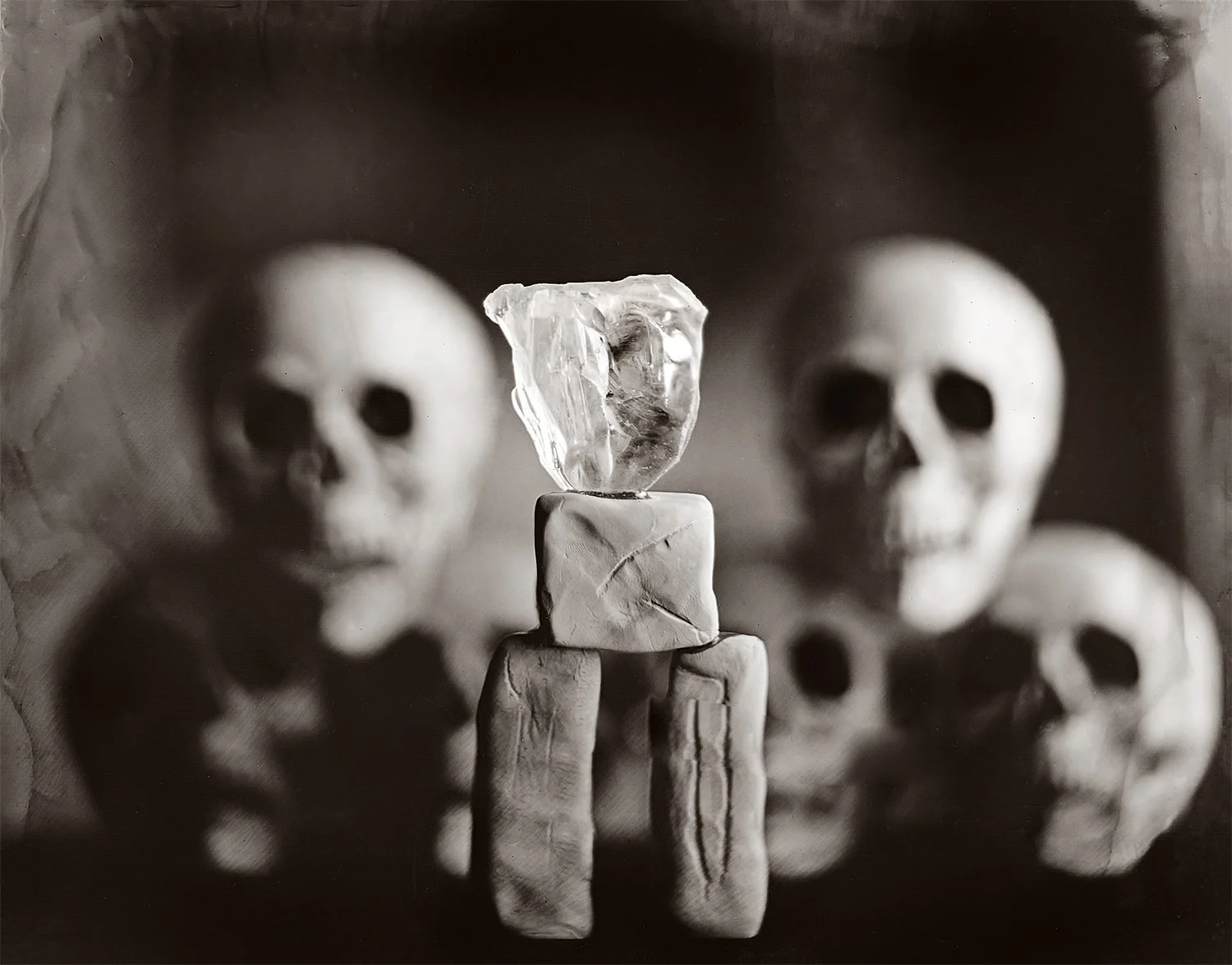
Glasshead–Stoneman (Animality Study)—half-plate wet collodion negative. January 18, 2026
A stone-assembled figure crowned with a fractured glass head stands before blurred skulls, holding the tension between human symbolic striving and our inescapable animal condition.

Animality: The Part of Us We Keep Trying to Forget

Quinn Jacobson January 19, 2026

One of the simplest but hardest ideas for people to accept is that we are animals who know we will die.

That sentence alone has more psychological weight than most of us want to deal with. We are more than just living things that move through time. We are aware of ourselves, and our bodies get older, break down, and disappear. And we know this. That information alters everything.

This is where Ernest Becker begins. In The Denial of Death, Becker posited that human psychology is influenced by a fundamental contradiction. We are biological entities motivated by instinct, hunger, fear, and reproduction; concurrently, we are symbolic entities endowed with imagination, language, and self-reflection. We have bodies that will die, and our minds can picture that death before it happens. The conflict between those two facts never goes away. It just gets taken care of.

That tension is right in the middle of animality.

Being an animal means being weak. People bleed. Bodies decay. Bodies break down. That doesn't change, no matter how smart or culturally accomplished you are. But most of modern life is set up to keep that truth far away. We keep the dying out of sight. We make decay into a medical issue. We raise the mind, the self, the brand, and the legacy as if they could somehow float away from the body.

Terror Management Theory says that this is not a coincidence. When reminders of our animal nature break through, like illness, aging, death, or even some kinds of art, they make us anxious on a deep, often unconscious level. The answer is almost never calm, though. It's protection. We hold on to our identities, beliefs, status, and moral frameworks more tightly when they promise that we are more than just meat that is going to die out.

The skull has always been one of the best ways to show this problem. It takes away everything that makes us who we are, reminding us that we are just physical matter with a time limit. Skulls don't fight. They don't talk about it. They just give testimony.

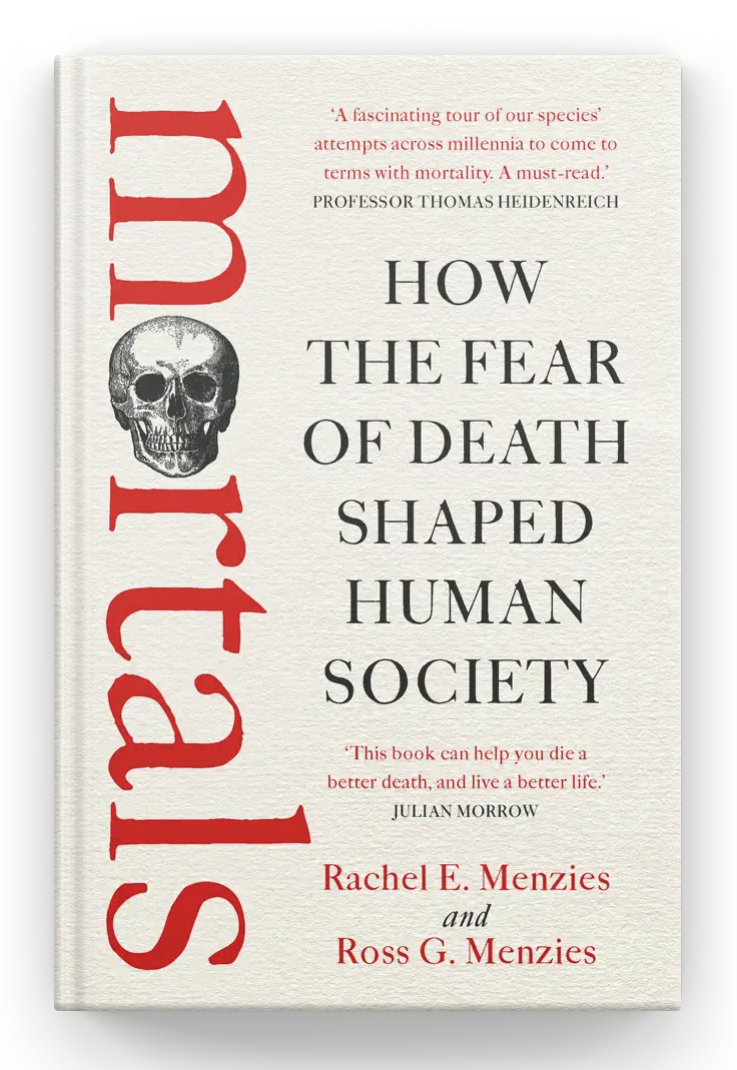
Rachel and Ross Menzies talk about how much of human behavior is based on avoiding this confrontation in their book Mortals. Not just being afraid of dying, but being afraid of being an animal that has to die. We deal with that fear by keeping busy, doing health rituals, telling success stories, and always trying to be better. In most cases, the goal is not to live forever. It is a mental distance from what will happen to the body.

That's what this picture is trying to show.

The Glasshead–Stoneman is standing up, put together, and almost ceremonial. The stone blocks make up a body that looks solid, scarred, planned, and calm. The glass head on top is clear, glowing, broken, and fragile. Skulls float behind it, not quite there and not quite gone. They didn't read as reminders of death, but as witnesses. The truth about animals is there, but it won't stay out of the way.

Glass is important here. Heat and violence make glass. It looks like it will last forever, but it breaks easily. It shows its own cracks while carrying light. It is an uncomfortable material that is between solid and broken. A lot like the human self.

Stone suggests strength. Glass makes things look fragile. The skulls show that something is going to happen.

They make a quiet argument that no amount of structure or symbolic architecture can change our animal nature. We can make identities. We can add meaning. We can give ourselves names. But the body is still there. The animal is still there. Death stays.

Even though it makes people uncomfortable, this is not a negative statement. Becker himself thought that this tension is what makes creativity, art, and meaning come to life. The issue does not stem from our animalistic nature. The issue is that we put so much effort into pretending we aren't.

Art does something important for the mind when it lets animality back into the room without being showy or moralizing. It lowers the defenses just enough for the person to be recognized. Don't panic. Acknowledgment. The kind that says, "This is what we have to work with."

The Glasshead–Stoneman does not fix the problem. It doesn't make you feel better. It just keeps the animal and the symbol in the same frame, not letting either one go away.

That might be enough.

Because confronting our animality does not diminish the significance of life. It makes it sharper. It reminds us that everything we build, love, and make is done inside a body that will eventually fail. And oddly enough, that's what makes those actions important.

In Glasshead, Stoneman, Wet Collodion Negatives, Death Anxiety, Animality, ABR, Art & Theory, Arts-Based Research, Ernest Becker, Mortals Tags Glasshead-Stoneman, half animal and half symbolic, TMT
Comment

Three Figures, One Refusal
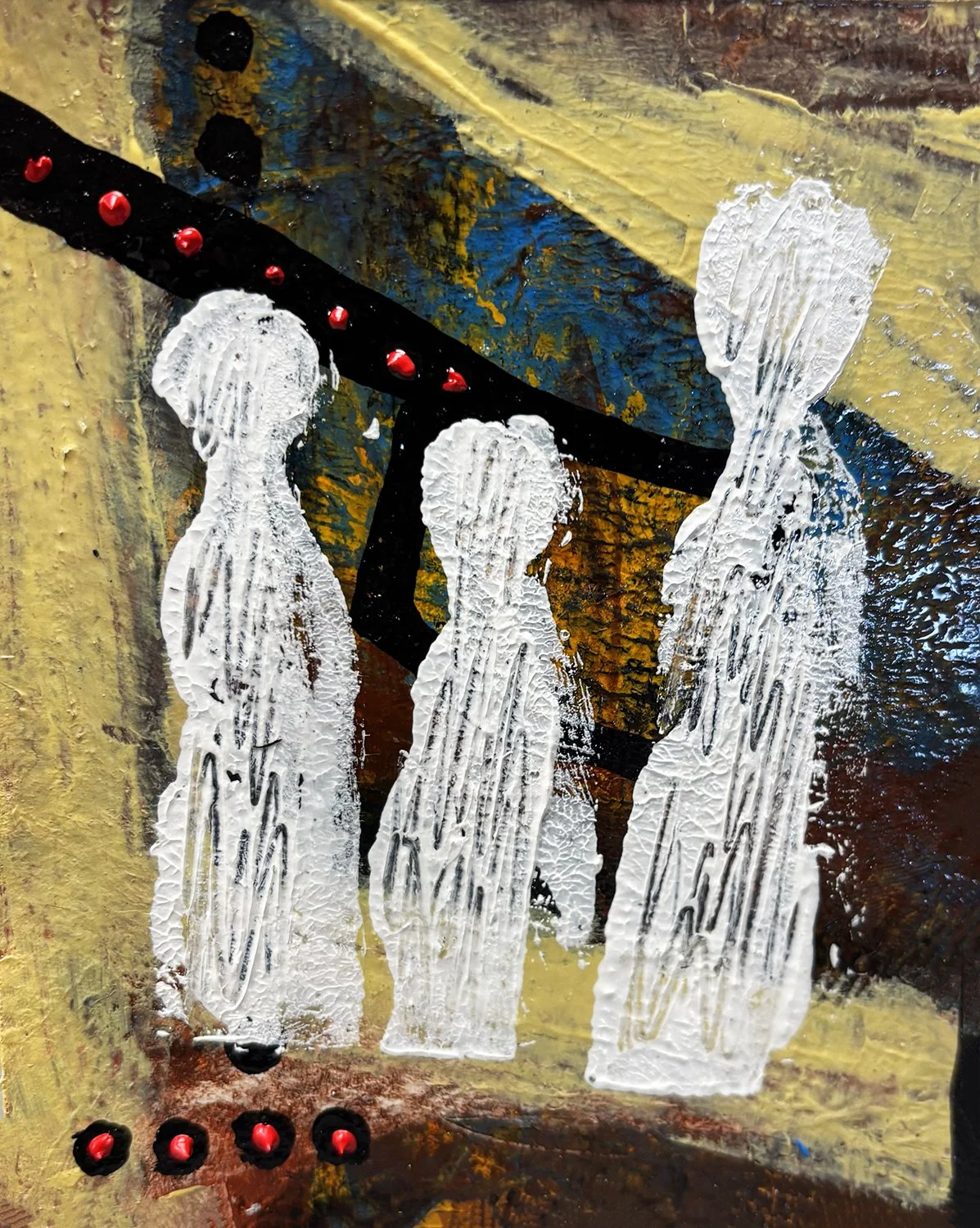
4.25” x 5.25” Acrylic mixed media on paper, journal study.
Three figures stand beneath a shared structure, rendered as residue rather than portrait. The surface holds tension between alignment and separation—together, but not merged. This piece was made during a class reflection on authority, expectation, and the quiet insistence of staying intact while moving through institutional space.

Working With Academia Without Being Rewritten

Quinn Jacobson January 17, 2026

Yes, I’m working on a PhD. But that fact is routinely mistaken for the point.

The degree is not the axis around which my thinking turns. It’s a container. A temporary structure. Useful, sometimes generative, occasionally constraining. What it is not is an origin story, nor a corrective arc meant to sand down who I already am.

One of the tensions I keep encountering in academic spaces is the tendency to read clarity as rigidity. When a student speaks with confidence about what they are doing, why they are doing it, and where they are not willing to go, that clarity is often interpreted as resistance. As if seriousness of intent must signal a closed mind. As if conviction is incompatible with learning.

I don’t experience it that way.

I’m in my sixties. I’ve lived abroad for years at a time. I’ve made art for over three decades, long enough to watch entire theoretical fashions rise, harden, and quietly disappear. I’ve failed publicly. I’ve revised privately. I’ve changed in ways that mattered and refused change when it felt performative or hollow. That history doesn’t make me inflexible; it makes me selective.

There’s a recurring assumption in academia that improvement requires visible transformation. That a “good” student emerges looking markedly different than when they arrived. New language. New posture. New allegiances. Sometimes even a kind of aesthetic conversion. Growth becomes legible only when it announces itself as rupture.

But not all development works that way.

Some learning deepens rather than redirects. Some refinement sharpens what is already there instead of replacing it. For practitioners who come in with a long arc behind them, progress often looks less like reinvention and more like compression. Fewer detours. Cleaner lines. A stronger refusal of what doesn’t belong.

That kind of maturation can read as stubbornness if one expects the student to be plastic.

I actually like my program. I respect the faculty. I value the conversations. I’m not at war with academia. But I am uninterested in being improved in ways that dilute the very work I came to do. I’m here to articulate, not to audition. To clarify, not to contort myself into novelty for novelty’s sake.

If there is change happening, and there is, it’s happening subterraneously. It’s happening in how precisely I can name what matters, how quickly I can discard what doesn’t, and how calmly I can hold my ground when someone suggests that seriousness requires surrender.

I’m pursuing this path in my way. Not despite academia, but not because of its appetite for visible transformation either. I’m not here to become someone else. I’m here to say, with more precision than before, who I already am and why that stance matters.

That distinction feels worth defending.

In Academic, Education, PhD, Perspective Tags academia, PhD, clarity versus rigidity
Comment

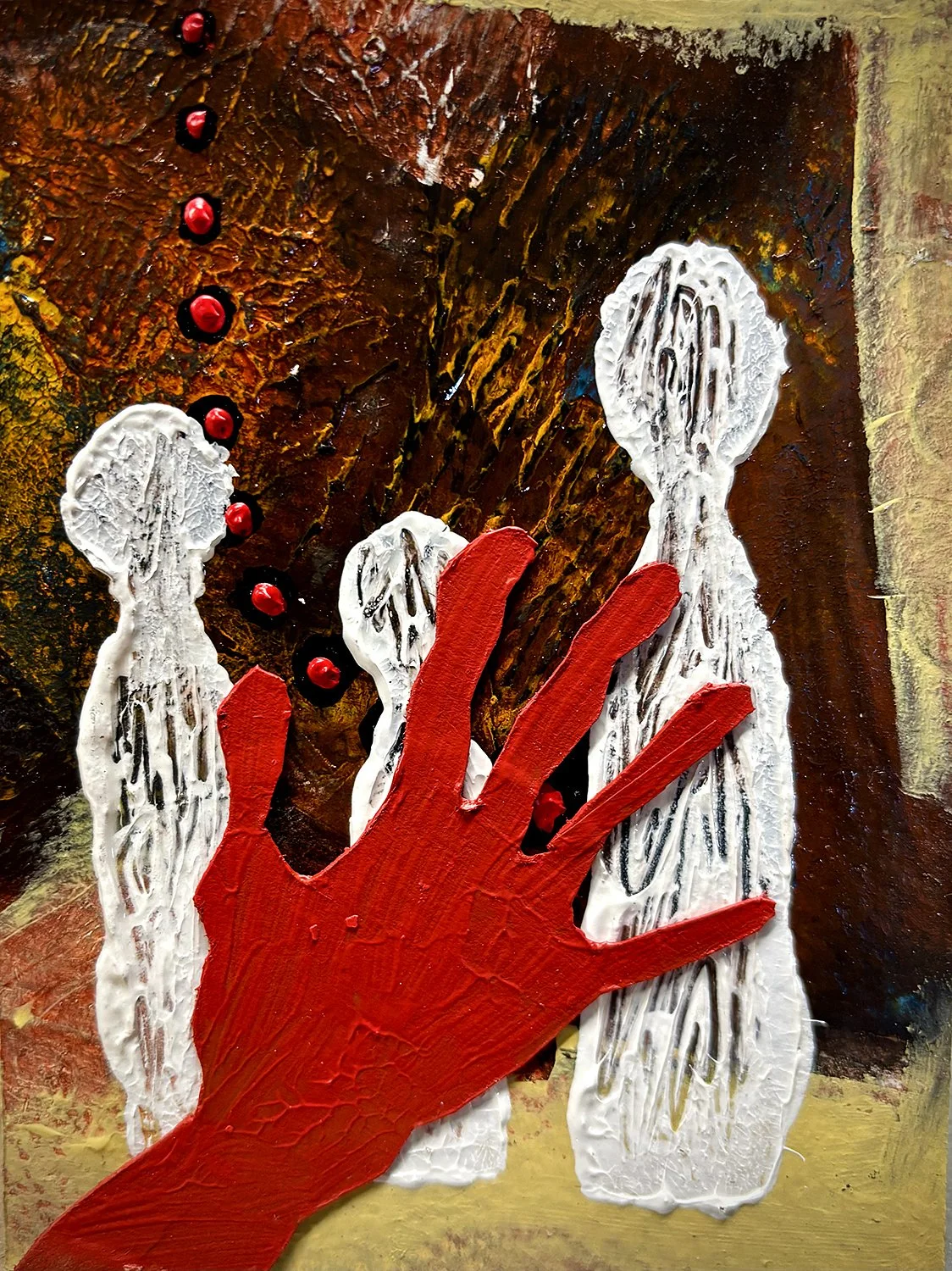
Untitled (Red Hand)
Acrylic mixed media on paper, 4.25" × 5.5"

A red hand interrupts three attenuated figures, marking the moment where existential anxiety is no longer diffuse but made contact—contained, metabolized, and rendered visible through form.

The Red Hand Problem

Quinn Jacobson January 12, 2026

How artists metabolize existential anxiety, and why the work still matters.

I keep returning to the same question, no matter how many theories I read or objects I make: What exactly happens to existential anxiety when it moves through the hands of an artist?

Not rhetorically. Mechanically. Psychologically.

The image above is one attempt to make that process visible. Three pale figures stand upright, stripped of detail, reduced almost to afterimages. They are not portraits so much as placeholders. Awareness has rendered their bodies thin. Over them reaches a red hand, oversized and intrusive, neither comforting nor gentle. It interrupts and intrudes. It stains. It marks.

That hand is not expression. It is intervention.

Most people manage death anxiety by keeping it diffuse, by never letting it fully localize. The artist does the opposite. The anxiety is brought forward, concentrated, and given a task. Creation becomes a site of containment. The fear does not disappear, but it changes state. It becomes workable.

This is what I mean by metabolizing existential anxiety. Not purging it. Not transcending it. Converting it into form.

Psychologically, this matters more than we often admit. The act of making gives the anxious mind boundaries. Time slows. Attention narrows. The self becomes less abstract and more procedural. The question shifts from What does it all mean? to What happens if I put this here? That shift is not trivial. It is regulatory. It allows consciousness to stay in contact with mortality without flooding.

The white figures in the image are not victims. They are witnesses. They stand because the hand is doing something on their behalf.

This is where arts-based research comes into focus for me. ABR is often framed as alternative knowledge production, which is true but incomplete. Its deeper value lies in its psychological function. Making becomes a way of thinking that does not rely exclusively on symbolic abstraction. Image, material, gesture, and repetition—these are not illustrations of insight; they are the insight.

When anxiety stays purely cognitive, it spirals. When it enters the body through making, it circulates. It acquires rhythm. It becomes legible.

This brings me to the harder question: is there any value in writing books like Glass Bones and Rupture?

If the goal were resolution, probably not. No book resolves the fact of death. No theory seals the crack. But that has never been the real task. The value lies in creating sustained containers where anxiety can be held long enough to be examined without collapsing into distraction or denial.

These books are not answers. They are pressure vessels.

Writing them will force me to stay with the material—psychologically and ethically—longer than images alone sometimes allow. It slows the metabolism. It traces the process. It makes visible what is usually hidden: how fear becomes form, how rupture becomes method, and how meaning is provisional but still worth making.

The red hand, then, is also authorship. It is the decision to intervene rather than look away. To touch the thing that makes us uncomfortable and accept the consequences of contact.

Artists do not escape existential anxiety (not at all). They work it. They give it edges. They give it weight. They give it somewhere to go.

That’s not a cure.
But it is a practice.
And in a culture built on denial, practice may be the most honest form of value we have left.

In Abstract Painting, Acrylic Painting, Angst, Anxiety, Art & Theory, Arts-Based Research, Death Anxiety, Existential Art, Fragile, Handmade Print, Neurotic, Painting, PhD, Psychology and Art Tags Existentialism, existential psychology, Existential Art, acrylic painting, Mixed Media
Comment

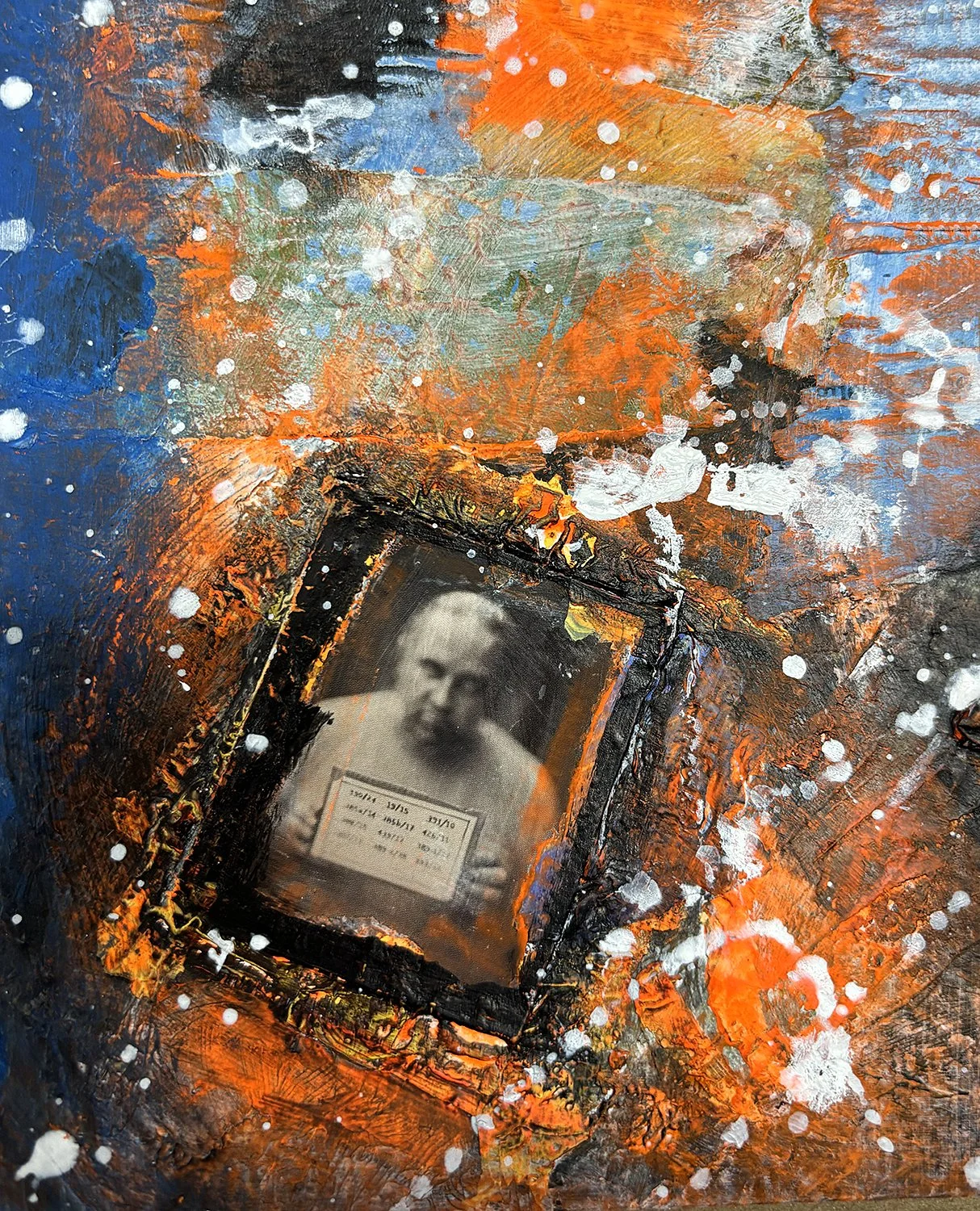
Jewish DNA (small stock board copy) 4.25” x 5.25” acrylic mixed media - December 27, 2025
At the lower center of this painting is a small copy of a whole-plate tintype self-portrait I made in Germany in 2009. I didn’t yet have Ernest Becker or the language of death anxiety and denial, but I was already circling those questions instinctively, the way you do long before theory arrives. The fluorescent orange and yellow push outward like a wound, or like the Stars of David sewn onto camp uniforms, colors that don’t decorate so much as expose and mark. The portrait sits embedded, constrained, half-buried, less an assertion of self than a record of inheritance. The white drops hover between chemical noise, ash, and something more unsettling—what I think of as angel blood: residue from a protection that failed, or perhaps from something that tried to intervene and couldn’t. This work isn’t about identity as a declaration. It’s about identity as pressure, as history carried in the body long before it’s understood.

Immortality Projects and Creative Works

Quinn Jacobson January 4, 2026

What Mortals Gets Right, and Where Artists Complicate the Picture

One of the quiet strengths of Mortals: How the Fear of Death Shaped Human Society is its refusal to treat death anxiety as an abstract philosophical problem. Rachel and Ross Menzies frame it instead as an organizing force that shapes what we build, preserve, admire, and remember. Culture, in this view, is not ornamental. It is defensive architecture.

Chapter 4, “Immortality Projects and Creative Works,” brings that argument into direct contact with art. Here, the authors situate creative production within a long human effort to leave a durable trace—to announce, across time, I was here (Menzies & Menzies, 2021, pp. 63–64). From prehistoric cave hands to frescoes, literature, monuments, and modern celebrity rituals, artistic acts are presented as symbolic bids against erasure.

This framing aligns closely with Ernest Becker’s claim that humans manage mortality awareness through symbolic immortality projects—systems that promise meaning, continuity, or remembrance beyond the body (Becker, 1973). Art, in Mortals, is one such system. It does not transcend death; it negotiates with it.

What the chapter does particularly well is resist romanticism. The authors emphasize that lasting creative immortality is exceedingly rare. Most works disappear. Most names fade. Even figures like Shakespeare or Khufu are treated ambivalently: their symbolic endurance is extraordinary, but its psychological payoff remains uncertain (Menzies & Menzies, 2021, pp. 84–85). The pursuit of permanence, they suggest, often extracts enormous human cost and may ultimately feel hollow.

Where the chapter becomes especially interesting is in its treatment of failed immortality. Across literature and myth—from Gilgamesh to Frankenstein to modern vampire narratives—immortality is repeatedly portrayed as bleak, corrosive, or monstrous. These stories rarely celebrate eternal life. Instead, they expose its emptiness and moral cost, often emerging from grief or loss rather than triumph (Menzies & Menzies, 2021, pp. 73–84).

(Text from Amazon)
Human society is shaped by many things, but underlying them all is one fundamental force - our fear of death. This is the ground-breaking theory explored in Mortals.
The ground-breaking book that uncovers how our fear of death is the hidden driver of most of humankind's endeavours.
The human mind can grapple with the future, visualising and calculating solutions to complex problems, giving us tremendous advantages over other species throughout our evolution. However, this capability comes with a curse. By five to ten years of age, all humans know where they are heading: to the grave.

At one point, the authors make a subtle but important shift. They suggest that rather than chasing permanence through monuments or legacy, a “much simpler form of therapy” may lie in exploring death and mortality within creative works themselves (Menzies & Menzies, 2021, p. 84). Art, here, is not a guarantee of immortality. It is a container for mortality awareness.

This is where the chapter opens onto a question it does not fully pursue.

Throughout Chapter 4, artists are treated as vivid examples of a universal human strategy, not as a psychologically distinct group. Creative work is framed as one form of symbolic defense among many. The book does not claim that artists tolerate death anxiety differently, keep mortality awareness closer to consciousness, or rely less on denial. From a Beckerian perspective, this is consistent: everyone participates in hero-systems; artists simply build theirs in visible form.

Yet the material gestures toward something more complex. When creative work repeatedly stages death, critiques immortality fantasies, or dwells inside impermanence rather than fleeing it, the function of art begins to look less like reassurance and more like exposure. Otto Rank suggested that art could function not merely as denial, but as a disciplined confrontation with finitude—a way of shaping terror rather than anesthetizing it (Rank, 1932).

Mortals does not make that distinction explicit. But it leaves space for it.

The open question, then, is not whether art is an immortality project. The chapter makes that case convincingly. The question is whether some forms of creative practice do something slightly different: not promising permanence, but training attention to stay with impermanence without collapsing. If so, artists may not escape death anxiety—but they may metabolize it differently.

That is not a conclusion Mortals draws. It is a pressure the book invites.

References

Becker, E. (1973). The denial of death. Free Press.

Menzies, R. E., & Menzies, R. G. (2021). Mortals: How the fear of death shaped human society. Allen & Unwin.

Rank, O. (1932). Art and artist. Knopf.

In Mortals: How The Fear, Menzies Tags Mortals: How The Fear of Death Shaped Human Society, Rachel and Ross Menzies
2 Comments

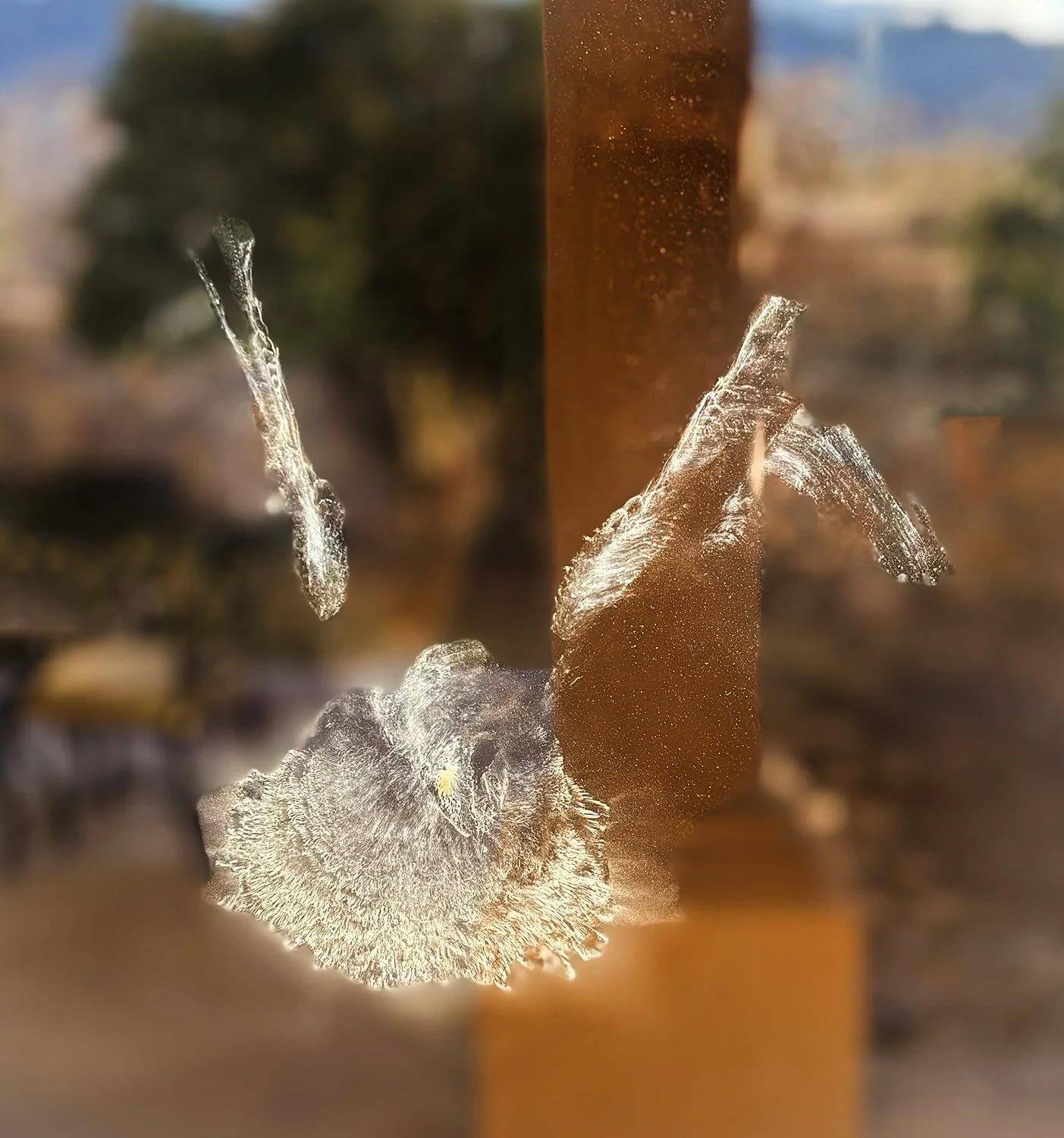
Leaving a trace—the mark of a white-winged dove on my kitchen window. December 28, 2025

A white-winged dove hits the glass, and what’s left behind isn’t the bird but the residue of contact: a powdery bloom, two wing smears, and a ghosted body shape suspended in light. That’s the interview in miniature. Dr. Fisher and I are circling the same problem from different angles: how the most real forces in a human life rarely show up directly. They show up as traces. As misreadings. As displaced language. As the “dimmer switch” doing its job.

I’m interested in what the awareness of an ending does to the living, minute by minute. The dove doesn’t leave a story; it leaves evidence. A mark that asks to be interpreted. It’s rupture without a sermon: meaning fails for a second, the world stutters, and then you’re standing there in your own kitchen looking at a fragile imprint and feeling the entire question come back online.

Interview With Dr. R. Michael Fisher: Careers of Folly and Wisdom

Quinn Jacobson December 29, 2025

In this conversation, I sit down with Dr. R. Michael Fisher for Careers of Folly and Wisdom (Episode 3) at the close of 2025, and we trace the strange overlap between two lives shaped by study, teaching, and the long arc of existential pressure. What begins as a simple introduction quickly becomes a deeper exchange about why some ideas take decades to name and why the hardest work is often learning how to speak those ideas in public without having them reduced to something smaller.

We talk about how we connected through Southwestern College’s Visionary Practice & Regenerative Leadership doctoral program and why I went searching for faculty whose work could actually hold what I’m building: an arts-based inquiry into creativity, mortality, and the psychological machinery of denial. I share my early “folly” at residency, where I became “the death guy” despite my real focus being the opposite: what happens inside the dash between birth and death, and how the knowledge of impermanence reshapes a human life. That misreading became a kind of field experiment in real time, revealing how quickly people reroute mortality talk into safer channels like grief, loss, or therapeutic language. It also forced me to sharpen my communication, not by diluting the thesis, but by learning how to meet the audience where the “dimmer switch” is already working.

From there, the conversation widens. Dr. Fisher pushes on the themes of education, fallibility, and maturity: how a person with deep content and lived experience learns to teach without preaching, and how humility becomes an actual method. I bring in two foundational touchstones that anchor my work: Becker’s insistence that death terror is a mainspring of human activity and Rank’s claim (via Becker) that the artist takes in the world and reworks it rather than being crushed by it. That tension is the engine of my research question: if most of culture is organized to keep death out of view, what do artists do differently with that same pressure, consciously or unconsciously?

A major thread running through the interview is that denial is not just a personal quirk. It’s cultural, political, and historical. I talk about early experiences that formed my worldview, including family stories that complicate simple narratives of “normal” American life, and how those early exposures shaped my sensitivity to power, erasure, and the stories nations tell themselves. We also move into my military background, where I describe the kind of learning you don’t go looking for: the collision between youthful exceptionalism and the realities of violence, trauma, and institutional harm, including witnessing suicide deaths while working as a photographer. The folly, as I name it, is the arrogance of certainty; the wisdom is the painful clarity that comes after the myth breaks.

In the final stretch, we pivot to Dr. Fisher’s work in fearology and his reframing of Terror Management Theory as, in many ways, a kind of “fear management education.” That exchange matters because it shows the real stakes of language: fear, terror, anxiety, and denial. These aren’t interchangeable terms, and both of us have been forced to grapple with how quickly audiences collapse complex ideas into familiar clichés. We end with a concise statement of my own working thesis, offered almost like a poem: artists tend to give anxiety form rather than discharge it through denial; material practice slows experience enough for mortality to move into objects; rupture is where meaning fails, and art often happens there; the ethic is not to “fix” the break, but to stay present with it.

The conversation closes on an honest note about the cost of passion. We talk about parenting, devotion to work, and the ways even meaningful lives leave blind spots in their wake. If this episode has a through-line, it’s that wisdom is rarely clean. It comes out of misfires, misreadings, and the slow work of learning how to hold the real without turning it into a brand, a sermon, or a therapy session.

I really enjoyed the conversation, and I look forward to working with Dr. Fisher. Check out his YouTube channel and his other interviews and commentary.

In ABR, Academic, Art & Theory, Art History, Autobiography, Core Values, Death Anxiety, Denial of Death, Denial: Self Deception Tags R. Michael Fisher, Interview
Comment

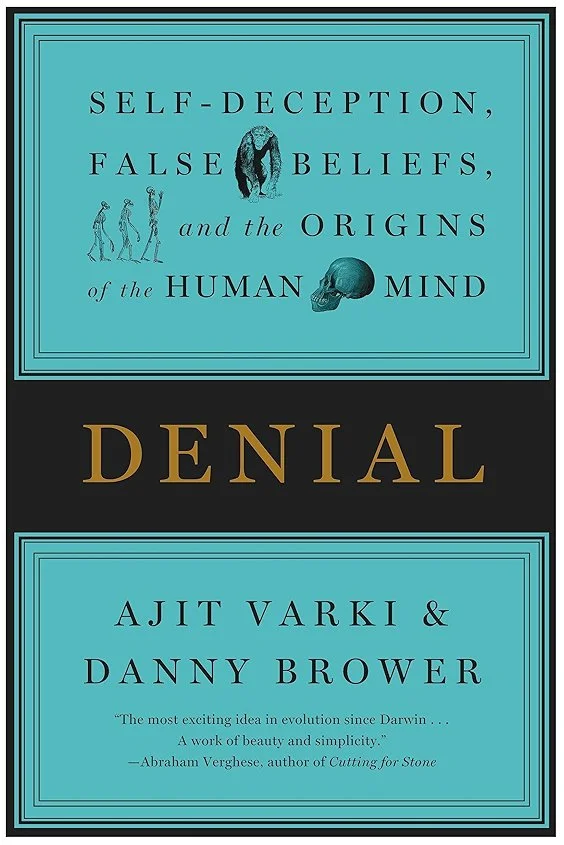
Mockup cover of a public-facing book I’ll be writing this year,

Denial: Self-Deception, False Beliefs, and the Origins of the Human Mind

Quinn Jacobson December 27, 2025

“An organism that fully comprehends the inevitability of its own death should be at a severe evolutionary disadvantage.”

Ajit Varki & Danny Brower

Denial: Self-Deception, False Beliefs, and the Origins of the Human Mind


I want to start by saying why Varki and Brower’s work matters so much to me and why it landed with such force when I first encountered it.

When I talk about their theory, I’m really talking about anthropogeny (an-thro-poge-nee). Not anthropogeny as a list of fossils, dates, or branching diagrams, but anthropogeny as a psychological crossing.

A moment when a creature stops merely responding to the world and begins to recognize itself inside it. When experience turns inward. When danger stops being episodic and becomes existential. When the mind realizes that every threat ends the same way.

Most stories we tell about human evolution focus on our successes. Intelligence. Language. Cooperation. Ingenuity. All of that is real, and all of it matters. But those stories usually glide past a more disturbing question: what happens when a creature becomes capable of knowing that it will die?

If mortality is taken seriously as a psychological event, not just a biological fact, then becoming human is not a clean victory.

It’s a rupture.

Awareness overshoots what an organism should be able to tolerate. Varki and Brower approach this problem not as philosophers or poets, but as biologists asking a brutally simple question: how did a species survive once it could clearly comprehend its own annihilation?

Their answer is denial.

Not denial as ignorance. Not denial as constant delusion. But denial as an evolved capacity. A way of softening reality just enough to stay functional.

In their view, human consciousness did not emerge cleanly at all. It arrived with a built-in workaround. A mechanism that allows unbearable truths to be known without being allowed to dominate awareness completely.

They call this moment the Mind Over Reality Transition, or M.O.R.T. It names the point in human evolution when the mind became powerful enough to override raw perception in order to stay alive.

Before this transition, animals respond directly to reality.

Danger appears, the body reacts.

Hunger arises, the organism seeks food.

There is fear, but there is no sustained awareness of an inevitable end.

Reality is immediate and actionable.

M.O.R.T. marks the moment when human cognition crossed a threshold.

Our ancestors became capable of understanding not just threats, but outcomes. Not just danger, but inevitability.

They could imagine the future, reflect on themselves, and recognize that no amount of intelligence, strength, or cooperation ultimately prevents death.

That level of awareness should have been catastrophic. A creature that fully understands its own unavoidable extinction should freeze, withdraw from risk, fail to reproduce, and disappear from the evolutionary record.

According to Varki and Brower, we didn’t disappear because something else evolved at the same time. The ability to let the mind partially override reality. To soften, distort, postpone, or symbolically reframe what is known: M.O.R.T.

M.O.R.T. is not about denying facts. It’s about regulating attention. It allows the mind to know something is true without holding it at full intensity. Mortality is understood, but kept in the background.

Present, but not paralyzing.

This is why humans can plan for the future, take risks, fall in love, make art, raise children, and build civilizations while fully aware that all of it ends. The mind learns to place symbolic meaning, narrative, and purpose between itself and raw reality.

In this sense, M.O.R.T. is not a flaw. It’s an adaptive solution. A psychological buffer that makes consciousness livable.

And once that buffer exists, everything we call culture becomes possible. These aren’t secondary inventions layered on top of survival. They are how survival continues in the presence of unbearable knowledge.

If the full weight of mortality stayed fully present all the time, the system would collapse. Panic. Paralysis. Withdrawal from risk. Failure to function.

That softening is everywhere once you know how to look for it. You can recognize it in yourself, too.

This is where Varki and Brower quietly meet Ernest Becker. Becker argued that culture is a defense against death.

Varki and Brower push the idea deeper. They suggest that the capacity for defense is built into the structure of consciousness itself. We don’t just learn denial through culture. We inherit the ability to manage reality through it.

Once that sinks in, creativity stops looking like decoration.

It stops looking like leisure or self-expression.

It begins to look like a survival strategy.

Making images.

Telling stories.

Leaving traces.

Building meaning systems.

These are not optional human add-ons. They are how a symbolic animal stays operational while knowing the end is coming.

This is where my own work keeps pressing.

Artists tend to stand close to that fault line.

We turn the dimmer switch up more often than most.

We look longer.

We tolerate more exposure.

Sometimes we manage to metabolize what we see into form.

And sometimes it nearly breaks us.

In plain terms, Varki and Brower are saying this: humans survived not because we learned the truth, but because we learned how to live near the truth without being destroyed by it.

That tension, between knowing and not knowing too much, is the thread I keep following. It’s where consciousness fractures, culture begins, and art becomes necessary.

In Denial: Self Deception, Evolutionary Psychology, M.O.R.T. Tags Denial: Self-Deception, Ajit Varki, Danny Brower, Lies, Mind Over Reality Transition (MORT)
2 Comments
← NewerOlder →

Search Posts


Featured Posts

Featured
Apr 6, 2026
Worldviews: The Stories That Hold Us Together
Apr 6, 2026
Apr 6, 2026
Apr 1, 2026
The Creative Mind & Mortality Podcast - S1 E7: Culture As Armor
Apr 1, 2026
Apr 1, 2026
Mar 30, 2026
Holding the Unresolvable: Mortality and Form in a Kallitype Portrait
Mar 30, 2026
Mar 30, 2026
Mar 28, 2026
Arts-Based Research Methodology
Mar 28, 2026
Mar 28, 2026
Mar 25, 2026
The Creative Mind & Mortality Podcast—S1E6: The Beginning of Denial
Mar 25, 2026
Mar 25, 2026
Mar 24, 2026
Ocotillo, Chihuahuan Desert
Mar 24, 2026
Mar 24, 2026
Mar 23, 2026
Metabolizing the Polycrisis: The Rupture Field Approach
Mar 23, 2026
Mar 23, 2026
Mar 20, 2026
The Creative Mind & Mortality – S1: Glass Bones, E5, Why Awareness Alone Wasn’t Enough
Mar 20, 2026
Mar 20, 2026
Mar 18, 2026
The Creative Mind & Mortality Podcast: S1E4
Mar 18, 2026
Mar 18, 2026
Mar 13, 2026
Quick Darkroom Studio Tour (Real Quick)
Mar 13, 2026
Mar 13, 2026