
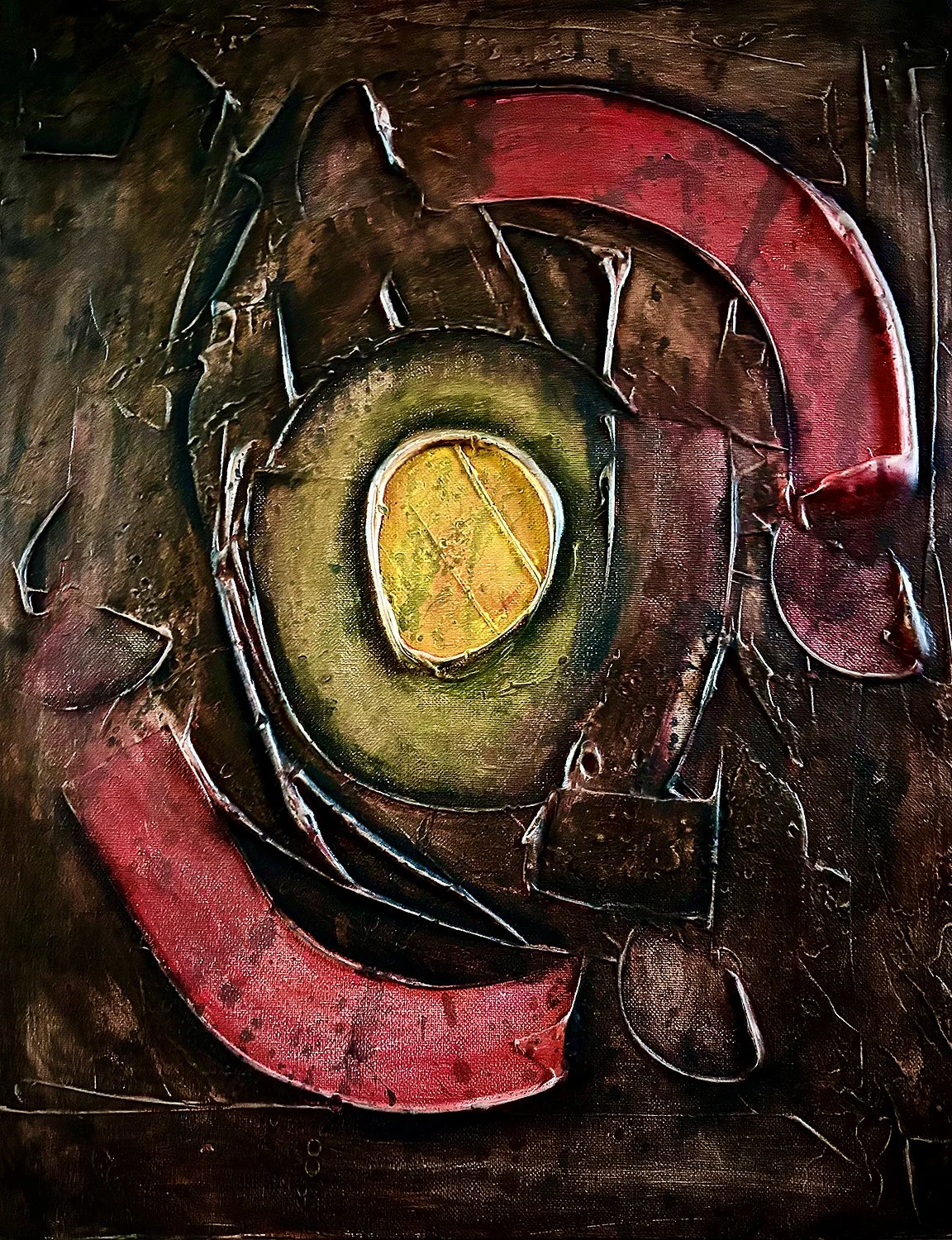
I made Holding Pattern without a clear image in mind. What I had was pressure. The sense that something was circling without resolution, asking to be held rather than explained. The painting emerged through accumulation and restraint. Layers were added, scraped back, and redirected. Each decision responded less to intention than to the condition the surface was already carrying. I wasn’t trying to resolve the image. I was trying to stay with it.
Materially, the surface itself is ruptured; cracked, weathered, and refusing integrity. The paint records its own breakdown. This isn't a representation of rupture; it's rupture as material fact. The painting embodies what it's examining by subjecting itself to the same forces of deterioration it's addressing conceptually. The medium becomes inseparable from the inquiry.
As arts-based research methodology, this is knowledge production through making rather than through language. I’m not illustrating a thesis about reproduction-as-death-denial that you arrived at discursively. I’m using paint, surface, gesture, and material breakdown to think through something that can't be fully accessed through writing alone.
The painting knows things my writing can't get to. It enacts the gravitational pull of the drive, the suffocation of the holding pattern, the way ideology fragments bodies even as it organizes them. The counterclockwise inward spiral isn't a metaphor I chose to represent an idea, it's a formal discovery that emerged through material engagement, and it carries meaning that exceeds paraphrase.
Arts-based research treats the artwork as primary data and the making process as an investigative method. The decisions I made; impasto that builds up and cracks, a spiral that compresses rather than expands, colors that register as bodily rather than symbolic, these aren't aesthetic choices decorating research findings. They are the research. The painting generates understanding about death anxiety, compulsion, and cultural reproduction (egg) that exists in formal and material relationships rather than in arguments.
The rupture also functions methodologically as refusal of traditional research's demand for coherence and resolution. Academic writing wants to arrive somewhere, to synthesize, to offer frameworks. The painting refuses. It stays with fragmentation, with irresolution, with the holding pattern itself. That refusal is epistemological; it insists that some truths about mortality and compulsion can only be approached through sustained engagement with what won't cohere.
What I’m doing is using the body's engagement with materials, the physical acts of mixing, applying, scraping, building, and watching paint crack, as a way to metabolize cultural and psychological forces that are otherwise difficult to grasp. The painting becomes a site where those forces can be witnessed and worked through without being explained away.