
• blog
  • in the shadow of sun mountain
  • buy my books
  • photographs
  • paintings
  • bio
  • cv
  • contact
  • search
Menu

Studio Q Photography

Exploring Human Behavior and Death Anxiety Through Art
  • blog
  • in the shadow of sun mountain
  • buy my books
  • photographs
  • paintings
  • bio
  • cv
  • contact
  • search
×

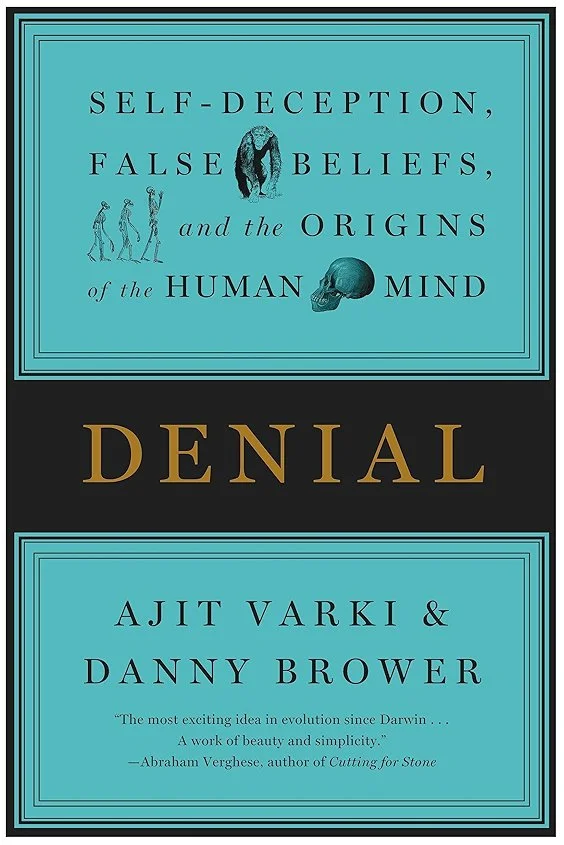
Mockup cover of a public-facing book I’ll be writing this year,

Denial: Self-Deception, False Beliefs, and the Origins of the Human Mind

Quinn Jacobson December 27, 2025

“An organism that fully comprehends the inevitability of its own death should be at a severe evolutionary disadvantage.”

Ajit Varki & Danny Brower

Denial: Self-Deception, False Beliefs, and the Origins of the Human Mind


I want to start by saying why Varki and Brower’s work matters so much to me and why it landed with such force when I first encountered it.

When I talk about their theory, I’m really talking about anthropogeny (an-thro-poge-nee). Not anthropogeny as a list of fossils, dates, or branching diagrams, but anthropogeny as a psychological crossing.

A moment when a creature stops merely responding to the world and begins to recognize itself inside it. When experience turns inward. When danger stops being episodic and becomes existential. When the mind realizes that every threat ends the same way.

Most stories we tell about human evolution focus on our successes. Intelligence. Language. Cooperation. Ingenuity. All of that is real, and all of it matters. But those stories usually glide past a more disturbing question: what happens when a creature becomes capable of knowing that it will die?

If mortality is taken seriously as a psychological event, not just a biological fact, then becoming human is not a clean victory.

It’s a rupture.

Awareness overshoots what an organism should be able to tolerate. Varki and Brower approach this problem not as philosophers or poets, but as biologists asking a brutally simple question: how did a species survive once it could clearly comprehend its own annihilation?

Their answer is denial.

Not denial as ignorance. Not denial as constant delusion. But denial as an evolved capacity. A way of softening reality just enough to stay functional.

In their view, human consciousness did not emerge cleanly at all. It arrived with a built-in workaround. A mechanism that allows unbearable truths to be known without being allowed to dominate awareness completely.

They call this moment the Mind Over Reality Transition, or M.O.R.T. It names the point in human evolution when the mind became powerful enough to override raw perception in order to stay alive.

Before this transition, animals respond directly to reality.

Danger appears, the body reacts.

Hunger arises, the organism seeks food.

There is fear, but there is no sustained awareness of an inevitable end.

Reality is immediate and actionable.

M.O.R.T. marks the moment when human cognition crossed a threshold.

Our ancestors became capable of understanding not just threats, but outcomes. Not just danger, but inevitability.

They could imagine the future, reflect on themselves, and recognize that no amount of intelligence, strength, or cooperation ultimately prevents death.

That level of awareness should have been catastrophic. A creature that fully understands its own unavoidable extinction should freeze, withdraw from risk, fail to reproduce, and disappear from the evolutionary record.

According to Varki and Brower, we didn’t disappear because something else evolved at the same time. The ability to let the mind partially override reality. To soften, distort, postpone, or symbolically reframe what is known: M.O.R.T.

M.O.R.T. is not about denying facts. It’s about regulating attention. It allows the mind to know something is true without holding it at full intensity. Mortality is understood, but kept in the background.

Present, but not paralyzing.

This is why humans can plan for the future, take risks, fall in love, make art, raise children, and build civilizations while fully aware that all of it ends. The mind learns to place symbolic meaning, narrative, and purpose between itself and raw reality.
In this sense, M.O.R.T. is not a flaw. It’s an adaptive solution. A psychological buffer that makes consciousness livable.

And once that buffer exists, everything we call culture becomes possible. These aren’t secondary inventions layered on top of survival. They are how survival continues in the presence of unbearable knowledge.

If the full weight of mortality stayed fully present all the time, the system would collapse. Panic. Paralysis. Withdrawal from risk. Failure to function.

That softening is everywhere once you know how to look for it. You can recognize it in yourself, too.

This is where Varki and Brower quietly meet Ernest Becker. Becker argued that culture is a defense against death.

Varki and Brower push the idea deeper. They suggest that the capacity for defense is built into the structure of consciousness itself. We don’t just learn denial through culture. We inherit the ability to manage reality through it.

Once that sinks in, creativity stops looking like decoration.

It stops looking like leisure or self-expression.

It begins to look like a survival strategy.

Making images.

Telling stories.

Leaving traces.

Building meaning systems.

These are not optional human add-ons. They are how a symbolic animal stays operational while knowing the end is coming.

This is where my own work keeps pressing.

Artists tend to stand close to that fault line.

We turn the dimmer switch up more often than most.

We look longer.

We tolerate more exposure.

Sometimes we manage to metabolize what we see into form.

And sometimes it nearly breaks us.

In plain terms, Varki and Brower are saying this: humans survived not because we learned the truth, but because we learned how to live near the truth without being destroyed by it.

That tension, between knowing and not knowing too much, is the thread I keep following. It’s where consciousness fractures, culture begins, and art becomes necessary.

In Denial: Self Deception, Evolutionary Psychology, M.O.R.T. Tags Denial: Self-Deception, Ajit Varki, Danny Brower, Lies, Mind Over Reality Transition (MORT)
2 Comments

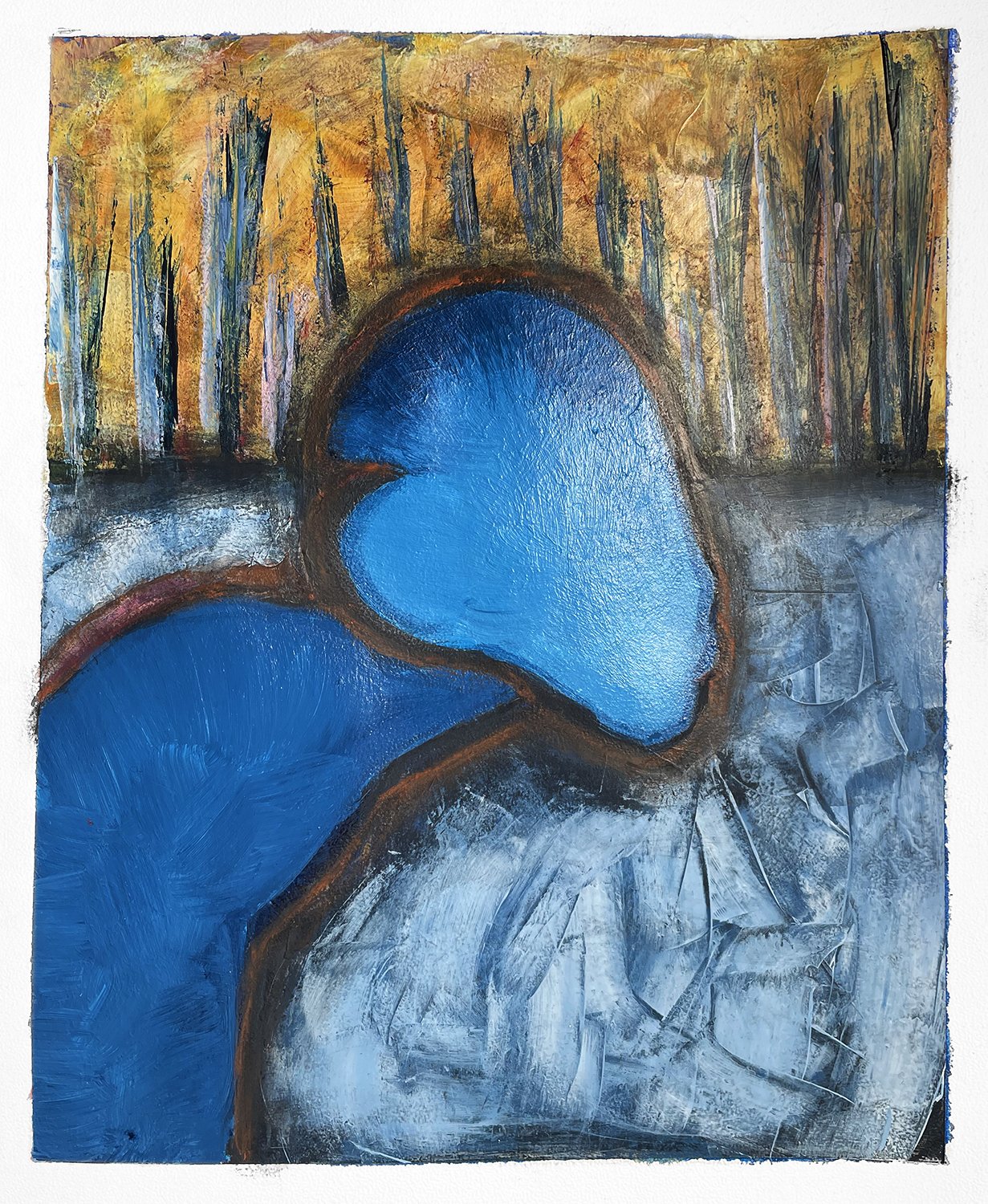
“Ice Fish,” 9” x 12” acrylic on paper.

The title, "Ice Fish," evokes a creature navigating a hostile, frozen environment, which can be read as a metaphor for the human condition: a delicate being striving to survive and find purpose in a world fraught with existential threats. The ice itself, often associated with stasis or preservation, could symbolize the human desire to "freeze" or immortalize moments of life—an act that speaks to our efforts to transcend impermanence through art, culture, and memory.

"Ice Fish" captures the psychological landscape of death anxiety, presenting viewers with a visual meditation on how we confront and manage the tension between life's fragility and our yearning for meaning and permanence. It becomes not just a painting but an existential narrative—a reminder of both our vulnerability and our resilience in the shadow of mortality.

Denial: Self-Deception, False Beliefs, and the Origins of the Human Mind

Quinn Jacobson January 1, 2025

Denial: Self-Deception, False Beliefs, and the Origins of the Human Mind by Ajit Varki and Danny Brower

Happy 2025! I hope this year is a good year for you.

A couple of years ago, I read a book called Denial: Self-Deception, False Beliefs, and the Origins of the Human Mind, by Ajit Varki and Danny Brower. I’ve written about it before here. It played an important role in my studies. It deals with our evolutionary psychology. Evolutionary psychology is something rarely considered when thinking about why we are the way we are. This book gives some very interesting and plausible explanations for our behavior.

They propose a provocative hypothesis that marries the Theory of Mind (TOM) with Mortality Awareness through the Mind Over Reality Transition (MORT) to explain one of humanity’s most perplexing characteristics: the denial of death. Their central argument is rooted in the paradox that human beings, uniquely aware of their own mortality, have also evolved mechanisms to suppress the existential terror this awareness entails. This duality, they argue, is a key to understanding not just human psychology but also the evolutionary processes that shaped our species.

The Evolutionary Conundrum of Awareness and Denial

Human beings possess an extraordinary ability to recognize that others have minds—a skill encompassed in the Theory of Mind. This capacity enables us to infer the intentions, beliefs, and emotions of others, facilitating complex social interactions and cooperation. However, TOM is not merely an interpersonal tool; it also turns inward, allowing us to imagine our future selves. This introspective ability inevitably leads to the realization of our own mortality. An organism's realization that it will eventually die marks both an evolutionary milestone and a potential psychological roadblock.

Varki and Brower posit that this acute awareness of mortality could have been paralyzing. A creature consumed by the fear of its own inevitable demise might struggle to survive, let alone reproduce. Natural selection, however, provided a solution: the cognitive ability to deny uncomfortable truths. This capacity for self-deception—what Varki and Brower term the "Mind Over Reality Transition" (MORT)—allowed early humans to sidestep the crippling anxiety of mortality while retaining the evolutionary advantages of self-awareness and social cognition.

Denial as a Survival Mechanism

The denial of death operates as an adaptive mechanism that balances the benefits of self-awareness against its existential costs. This balance is crucial. Without an understanding of mortality, humans would lack the foresight and caution necessary to avoid life-threatening dangers. But without denial, the dread of death could lead to apathy, despair, or an inability to take risks—all of which would hinder survival and reproductive success.

This interplay between TOM and MORT reveals an elegant evolutionary solution: our minds are hardwired to accept a paradoxical truth. We know, intellectually, that we are mortal, but we also possess the psychological mechanisms to compartmentalize, suppress, or distort this knowledge. This is not a flaw, but a feature that allows us to concentrate on the tasks of life—building relationships, raising children, creating art, and seeking meaning—without succumbing to the overwhelming presence of death.

The Role of Culture and Terror Management

While evolution provided the foundation for denying death, culture built the scaffolding. Varki and Brower’s ideas resonate strongly with Terror Management Theory (TMT), which suggests that cultural worldviews and symbolic systems are human constructs designed to mitigate death anxiety. Religion, art, philosophy, and even societal norms function as buffers against the existential terror of mortality. They provide frameworks that promise continuity—whether through an afterlife, a legacy, or the enduring influence of one’s creations.

“Existential Dread #9,” 9” x 12” acrylic and charcoal on paper.

This painting serves as a visual exploration of the TOM-MORT hypothesis. The abstraction invites viewers to project their fears and hopes, echoing the way denial itself operates. By obscuring the harsh edges of reality, the mind creates space for connection, creativity, and meaning. Yet, the tension in the painting suggests that denial is not absolute; the void beneath remains visible, demanding contemplation.

It’s both a personal and universal expression of the struggle with mortality. It asks us to confront the void while acknowledging the evolutionary and cultural scaffolding that has allowed us to thrive in its shadow. This piece does not offer resolution but instead invites the viewer into the complex interplay of awareness, denial, and the human condition—a visual testament to the insights into the mind’s delicate dance with reality.

These cultural constructs do more than soothe individual fears; they reinforce social cohesion. Shared beliefs about life and death foster unity, enabling groups to work together toward common goals. In this sense, denial of death is not merely a personal defense mechanism but a social glue that holds communities together.

Implications for Understanding Human Behavior

The TOM-MORT hypothesis invites us to reconsider many aspects of human behavior through the lens of denial. It explains why humans are uniquely capable of both profound creativity and devastating self-destruction. Our ability to deny death enables us to take risks, innovate, and envision futures that might never come to pass. But it also blinds us to long-term consequences, fueling behaviors that threaten our survival, such as environmental degradation and warfare.

Understanding the evolutionary roots of death denial also sheds light on the psychological struggles of modern life. In a world where traditional cultural buffers are eroding, individuals are increasingly confronted with unmediated mortality awareness. The resulting anxiety manifests in various ways, from existential despair to compulsive consumption. Yet, the same cognitive flexibility that enables denial also holds the potential for growth. By confronting the void and integrating our awareness of mortality into our lives, we can find new ways to navigate the human condition.

Varki and Brower’s TOM-MORT hypothesis offers a profound insight into the evolutionary origins of death denial. It reminds us that our ability to deny uncomfortable truths is not a weakness but a survival strategy—one that has allowed us to thrive in the face of existential uncertainty. At the same time, it challenges us to recognize the limitations of this denial. In a world where our actions increasingly have global and long-term consequences, the time may have come to reconcile our evolutionary heritage with the demands of modern existence. Only by understanding the roots of our denial can we hope to transcend it, transforming the fear of death into a catalyst for living fully and responsibly.

In Anxiety, Death Anxiety, Death, death denial, Denial of Death, Denial, False Beliefs, Varki and Brower, Self-Deception, MORT, TOM Tags Denial: Self-Deception, False Beliefs, and the Origins of the Human Mind, Mind Over Reality Transition (MORT), Theory of Mind (TOM), Ajit Varki, Danny Brower
Comment

“Three Aspens” - Whole Plate Kallitype from a wet collodion negative. Here in the Rocky Mountains of Colorado, aspens are known as “fire-breaks” because of their high moisture content. They will help stop the spread of a wildfire. They act as a guard against fire tornadoes and absolute destruction during a wildfire. Native Americans used aspen trees to make Sun Dance lodges, dugout canoes, and deadfall traps for bears. Poles provided tepee frames and scrapers for deer hides. Knots could be made into cups, and bark could be made into cording.

Denial: Self-Deception, False Beliefs, and the Origins of the Human Mind

Quinn Jacobson January 17, 2023

I just finished reading the book "Denial: Self-Deception, False Beliefs, and the Origins of the Human Mind" by Ajit Varki and Danny Brower. It’s an amazing book that posits a profound theory about how the human mind evolved and the obstacles it overcame that allowed us to be the way we are today—intelligent, creative, and innovative. It’s all based on our denial of reality. “The potent combination of our powerful intelligence with our massive reality denial has led to a dangerous world…” (Denial page 221)

It seems that we’ve been asking the wrong questions about human evolution and the evolution of the mind. The questions put forth in the book are, "Why is there no humanlike elephant or humanlike dolphin, despite millions of years of evolutionary opportunity?" And, "Why is it that humans alone can understand the minds of others?" The theory in the book is directly related to my project—how death anxiety and the repression mechanisms we use came to be, and the functions they served in the history of human evolution.

This is not a book review; I’m just connecting the dots with my work and sharing some insights as they pertain to death anxiety and the denial of death. It gets to the core of my project about denial. It addresses why we are “wired” to deny reality and how that leads to malignant manifestations of death anxiety, which is the crux of my work and project.

It’s important for me to understand the origins of the denial of death and death anxiety. These ideas are the mainspring of my book. I’ve been trying to find answers to these questions for a while. Fortunately, I received an email from a person who shares similar interests (Thanks, Tim!). He recommended that I read the book. Sheldon Solomon mentioned the book on a podcast I was listening to, and I made a mental note to look into it but never got around to buying the book. I’m very happy that I finally did.

It’s given me a lot of fodder for my endeavor and answered a lot of questions for me. Not to mention, I learned a lot about the evolutionary origin of humans and the cognitive psychology and evolution of the human mind.

Varki makes it very clear that these are not falsifiable theories and that he speculates a lot about them. I like that he’s approached it in an honest and scientific manner. I respect that. It leaves the proverbial door open to being proven wrong and to making better “guesses” in the future. This is how science works.

Varki relates an interesting and sad story about how he met Dr. Danny Brower. It was Brower’s theory that piqued Varki’s interest. The book was born from a conversation that lasted less than two hours. How it all came about is too lengthy to go into here, but it was fascinating and sad.

One of the main topics of the book is the Theory of Mind (ToM) or as some might call it, “consciousness.” As the author points out, there are so many definitions of that word that it’s better to be more definitive. Some may call it “self-awareness,” and it is to a degree. As the author says, this is a continuum from rudimentary self-awareness to full ToM. ToM is the ability to infer and understand another's mental state—their beliefs, thoughts, intentions, and feelings—and use this information to explain and predict human behavior. The book explains why denial is a key to being human. Varki posits that we separated ourselves from the other creatures because we grasped self-awareness of ours and others’ mortality (ToM) and then just as quickly developed a way to deny that mortality. And that’s what my writing is about: the way we deal with death anxiety and what that can lead to (racism, bigotry, genocide, and crimes against humanity).

The theory posited in this book can be summed up this way: Mind Over Reality Transition (MORT) theory. MORT is the evolutionary adaptation in response to gaining theory of mind (ToM) by simultaneously evolving denial of reality. There it is: a few words that describe the essence of a 300-page book. Obviously, the details are important, but that’s the ultra-condensed version of the book.

We deny reality—that reality being our mortality (among a lot of other things). In order for us to be so intelligent, we needed to develop a full theory of mind (ToM). What comes along with ToM is the awareness of death. If the animal has no mechanism to deal with that—to deny it—they will not survive. Varki believes that other animals have repeatedly crossed the barrier over millions of years, having full ToM but not the mechanism to deny mortality. This leads to an evolutionary dead end. The only animal that has successfully crossed over is us, (behaviorally) modern homo sapiens.

So how did early (modern) humans gain a full theory of mind and a denial mechanism at the same time—something that no other animal has been able to accomplish? Varki and Brower present the idea that a denial mechanism was starting to form before full ToM arrived. It came in the form of lying. The main drive was to create offspring before MORT, so lying was a great way to get the best partner to make babies. I'm not sure how they lied; perhaps they claimed to have killed the largest lion or provided the most meat; who knows, but as a theory, it makes sense to pre-MORT. The ability to lie to others led to the ability to lie to oneself. Self-deception led to denying reality, and denying reality led to full ToM and MORT.

What a great story of evolutionary biology and evolutionary psychology! It’s really put things in perspective for me. I know there are a lot of ideas in this theory that I’ll use for my book, connecting evolutionary biology and psychology to the actions of genocide and crimes against humanity. It ties in so nicely and explains so much of human behavior. It does give a great foundation for my studies and interests.

In Books, Death Anxiety, Denial of Death, Philosophy, Psychology, Evolution, The Human Mind Tags Denial: Self-Deception, False Beliefs, and the Origins of the Human Mind, Ajit Varki, Danny Brower, death anxiety, denial of death, evolution, evolutionary psychology, existential psychology
Comment

Search Posts

Archive Block
This is example content. Double-click here and select a page to create an index of your own content. Learn more
Post Archive
  • Photography
 

Featured Posts

Featured
Dec 29, 2025
Interview With Dr. R. Michael Fisher: Careers of Folly and Wisdom
Dec 29, 2025
Dec 29, 2025
Dec 27, 2025
Denial: Self-Deception, False Beliefs, and the Origins of the Human Mind
Dec 27, 2025
Dec 27, 2025
Dec 26, 2025
The Fragile Self Behind Big Achievements
Dec 26, 2025
Dec 26, 2025
Dec 21, 2025
Living With The Dimmer Switch
Dec 21, 2025
Dec 21, 2025
Dec 15, 2025
A Reading: Introduction In the Shadow of Sun Mountain
Dec 15, 2025
Dec 15, 2025
Dec 10, 2025
Where My Work Is Heading
Dec 10, 2025
Dec 10, 2025
Nov 30, 2025
Notes From the Studio: Staring at the Sun
Nov 30, 2025
Nov 30, 2025
Nov 20, 2025
A Salt Print From Another Life
Nov 20, 2025
Nov 20, 2025
Nov 20, 2025
A Coyote in the Desert, and What It Taught Me Today
Nov 20, 2025
Nov 20, 2025
Nov 13, 2025
Living Truthfully Inside Impermanence
Nov 13, 2025
Nov 13, 2025