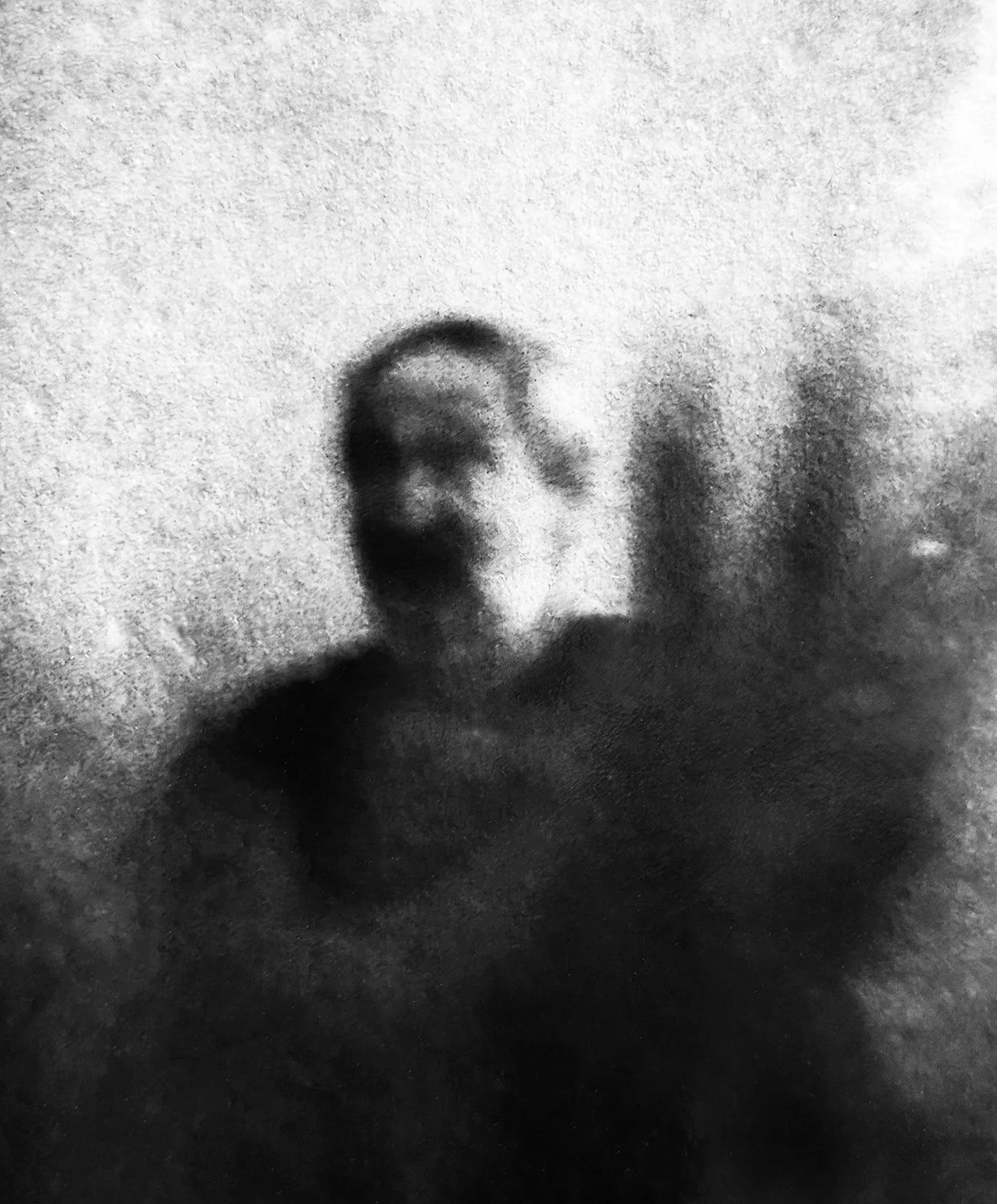
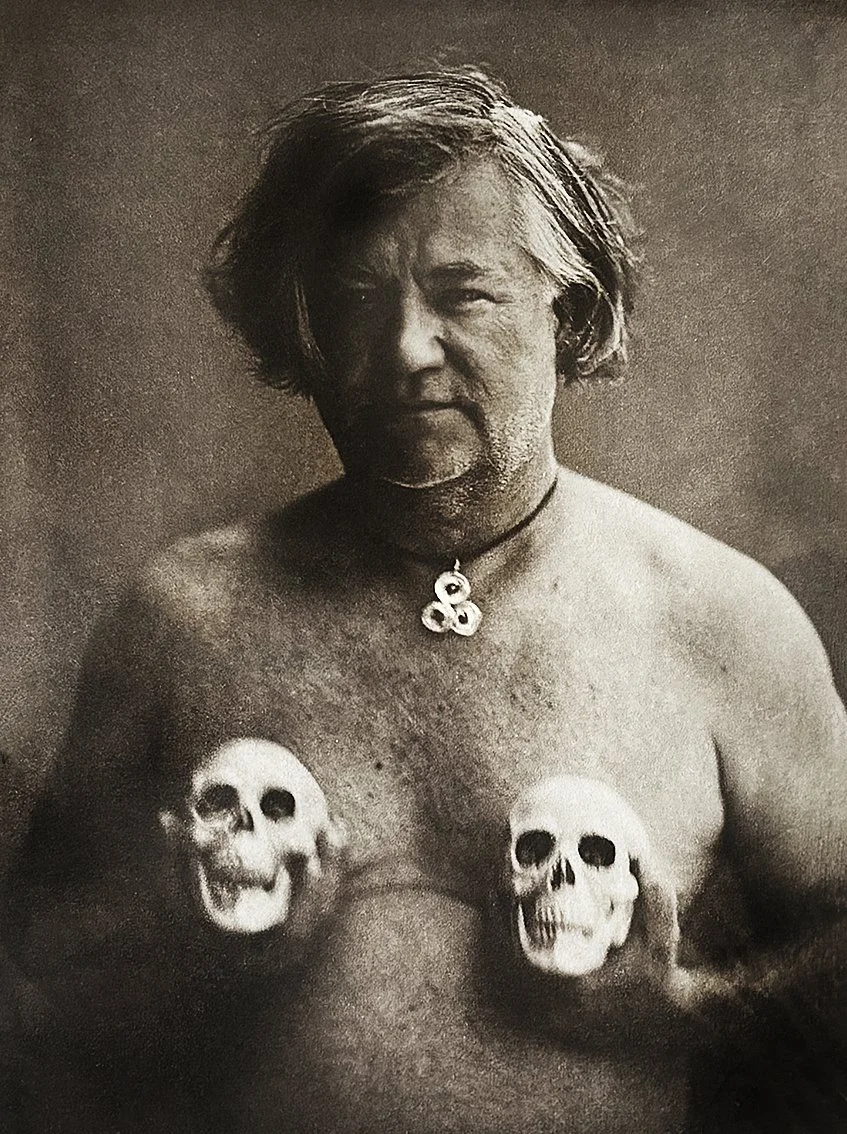
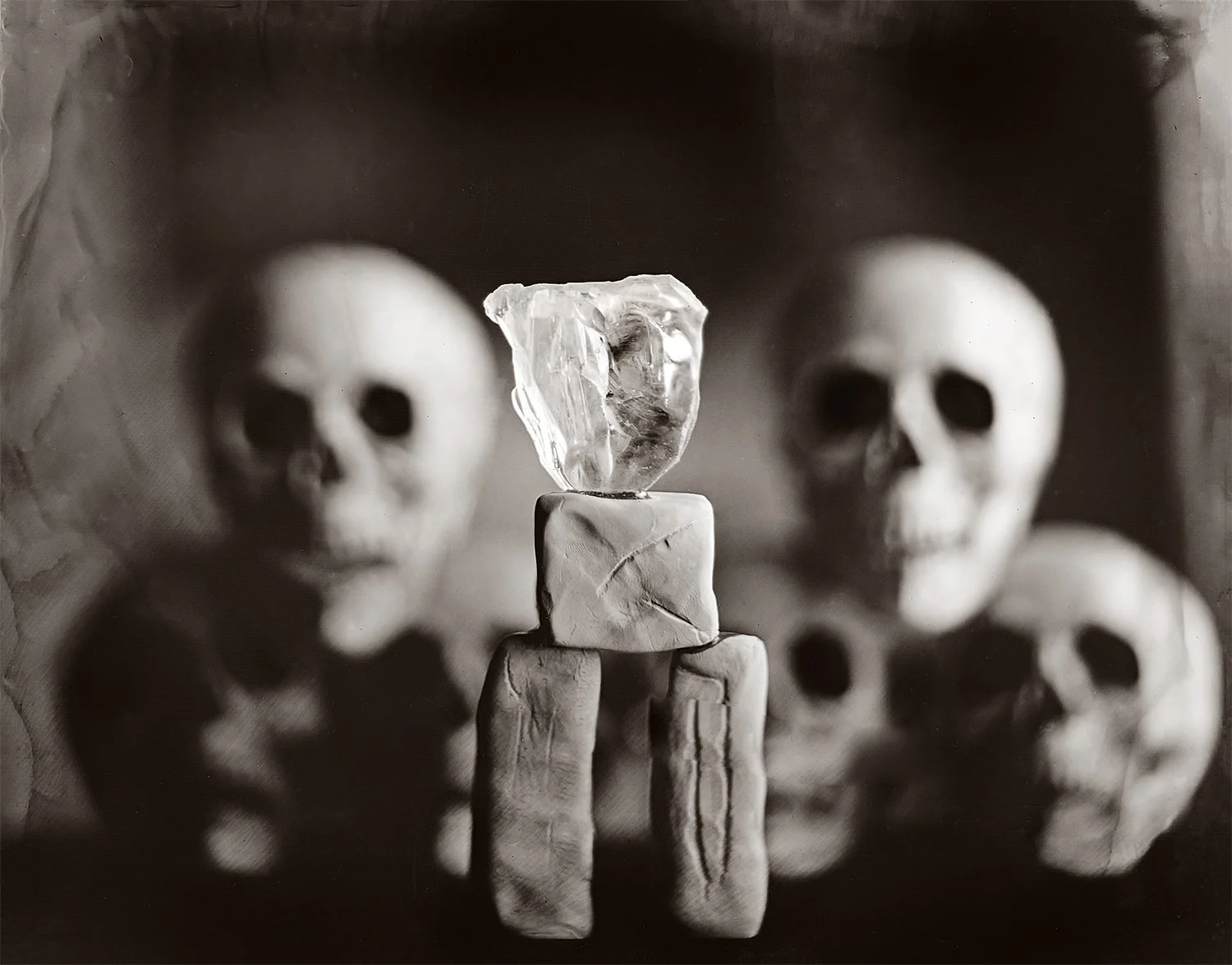
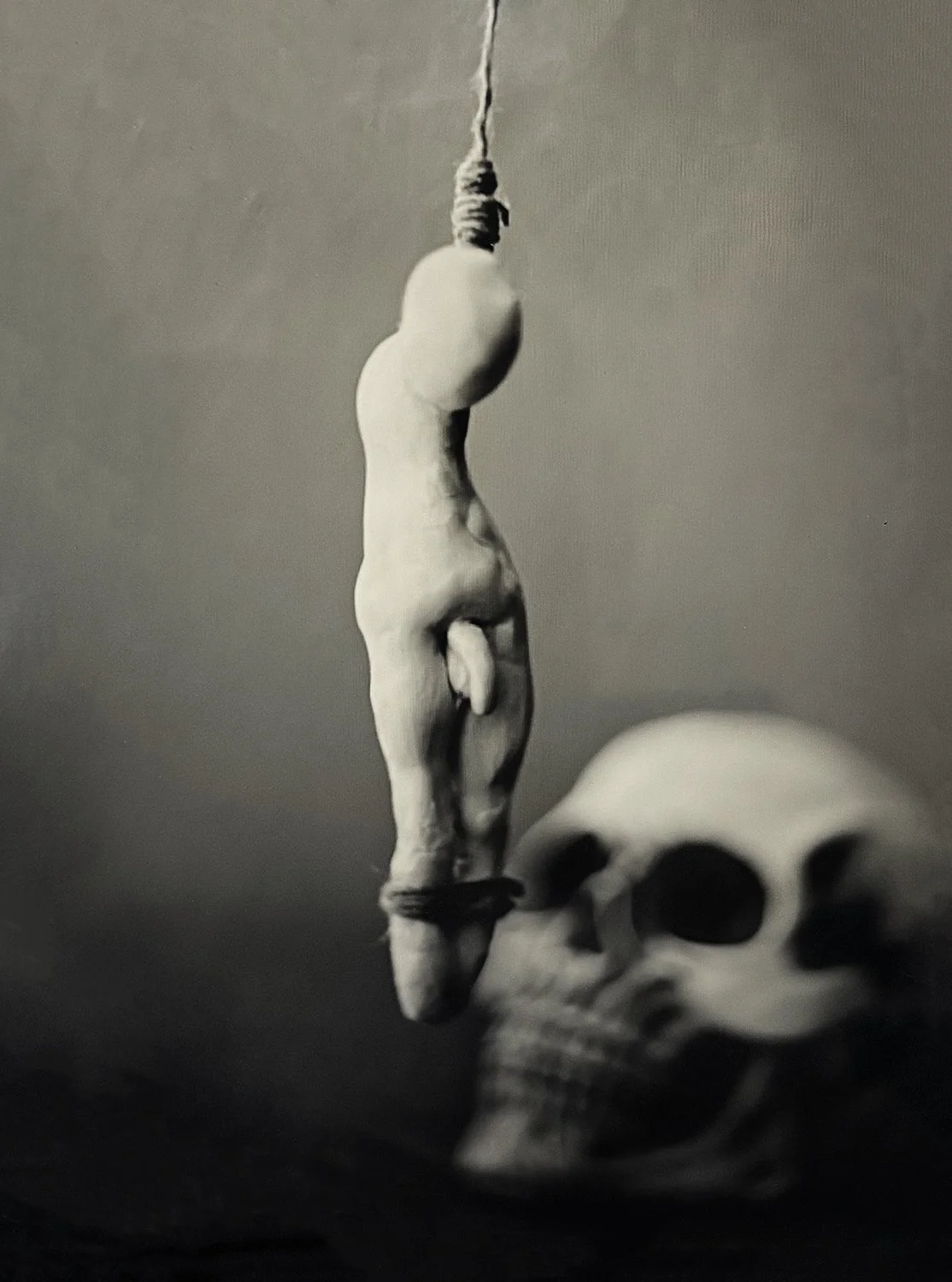
Glasshead–Stoneman (Animality Study)—half-plate wet collodion negative. January 18, 2026
A stone-assembled figure crowned with a fractured glass head stands before blurred skulls, holding the tension between human symbolic striving and our inescapable animal condition.
Animality: The Part of Us We Keep Trying to Forget
One of the simplest but hardest ideas for people to accept is that we are animals who know we will die.
That sentence alone has more psychological weight than most of us want to deal with. We are more than just living things that move through time. We are aware of ourselves, and our bodies get older, break down, and disappear. And we know this. That information alters everything.
This is where Ernest Becker begins. In The Denial of Death, Becker posited that human psychology is influenced by a fundamental contradiction. We are biological entities motivated by instinct, hunger, fear, and reproduction; concurrently, we are symbolic entities endowed with imagination, language, and self-reflection. We have bodies that will die, and our minds can picture that death before it happens. The conflict between those two facts never goes away. It just gets taken care of.
That tension is right in the middle of animality.
Being an animal means being weak. People bleed. Bodies decay. Bodies break down. That doesn't change, no matter how smart or culturally accomplished you are. But most of modern life is set up to keep that truth far away. We keep the dying out of sight. We make decay into a medical issue. We raise the mind, the self, the brand, and the legacy as if they could somehow float away from the body.
Terror Management Theory says that this is not a coincidence. When reminders of our animal nature break through, like illness, aging, death, or even some kinds of art, they make us anxious on a deep, often unconscious level. The answer is almost never calm, though. It's protection. We hold on to our identities, beliefs, status, and moral frameworks more tightly when they promise that we are more than just meat that is going to die out.
The skull has always been one of the best ways to show this problem. It takes away everything that makes us who we are, reminding us that we are just physical matter with a time limit. Skulls don't fight. They don't talk about it. They just give testimony.
Rachel and Ross Menzies talk about how much of human behavior is based on avoiding this confrontation in their book Mortals. Not just being afraid of dying, but being afraid of being an animal that has to die. We deal with that fear by keeping busy, doing health rituals, telling success stories, and always trying to be better. In most cases, the goal is not to live forever. It is a mental distance from what will happen to the body.
That's what this picture is trying to show.
The Glasshead–Stoneman is standing up, put together, and almost ceremonial. The stone blocks make up a body that looks solid, scarred, planned, and calm. The glass head on top is clear, glowing, broken, and fragile. Skulls float behind it, not quite there and not quite gone. They didn't read as reminders of death, but as witnesses. The truth about animals is there, but it won't stay out of the way.
Glass is important here. Heat and violence make glass. It looks like it will last forever, but it breaks easily. It shows its own cracks while carrying light. It is an uncomfortable material that is between solid and broken. A lot like the human self.
Stone suggests strength. Glass makes things look fragile. The skulls show that something is going to happen.
They make a quiet argument that no amount of structure or symbolic architecture can change our animal nature. We can make identities. We can add meaning. We can give ourselves names. But the body is still there. The animal is still there. Death stays.
Even though it makes people uncomfortable, this is not a negative statement. Becker himself thought that this tension is what makes creativity, art, and meaning come to life. The issue does not stem from our animalistic nature. The issue is that we put so much effort into pretending we aren't.
Art does something important for the mind when it lets animality back into the room without being showy or moralizing. It lowers the defenses just enough for the person to be recognized. Don't panic. Acknowledgment. The kind that says, "This is what we have to work with."
The Glasshead–Stoneman does not fix the problem. It doesn't make you feel better. It just keeps the animal and the symbol in the same frame, not letting either one go away.
That might be enough.
Because confronting our animality does not diminish the significance of life. It makes it sharper. It reminds us that everything we build, love, and make is done inside a body that will eventually fail. And oddly enough, that's what makes those actions important.
Punished for Embodiment. Half-plate tintype (4.25 × 5.5 in.). December 2025.
Western art has long tried to discipline the body—shrinking it, idealizing it, and denying its animality. This work pushes back. The figure is restrained not for what he has done, but for what he is: a vulnerable organism aware of its own end. The skull waits behind him, already finished with the struggle.
Living With The Dimmer Switch
One of the biggest challenges I face when I talk about Becker, Rank, Zapffe, or Terror Management Theory isn’t that the ideas are too complex. It’s that they’re describing the very psychological machinery that makes them difficult to understand in the first place. (Becker, 1973; Greenberg et al., 1986; Rank, 1932; Zapffe, 1933/2010).
That’s the paradox.
From an evolutionary perspective, human consciousness didn’t just give us language, imagination, and culture. It gave us a problem no other animal has to solve: we know we’re going to die, and we know it with enough clarity to make life unbearable if that awareness stayed fully online all the time (Becker, 1973; Solomon et al., 2015). So evolution didn’t eliminate the problem. It built a workaround.
These thinkers essentially suggest that the human mind evolved a dimmer switch mechanism. This is not an on-off switch, but rather a regulator (Jacobson, 2025). With too much awareness of death, the organism freezes, panics, or collapses. Too little, and life loses urgency, meaning, and care (Becker, 1973; Yalom, 2008).
So the psyche learned to keep mortality awareness just low enough to function and just high enough to motivate (Greenberg et al., 1986; Solomon et al., 2015).
That’s why so many people genuinely believe they don’t think about death or aren’t afraid of dying. They’re not lying. The system is working exactly as it’s supposed to (Greenberg et al., 1986; Pyszczynski et al., 2015). These defenses operate beneath conscious awareness, the same way breathing or balance does. You don’t feel yourself regulating your blood pressure either, but that doesn’t mean it isn’t happening.
In fact, one of the clearest signs that death anxiety is present is the firm belief that it isn’t (Solomon et al., 2015).
Becker’s insight was never that people walk around consciously terrified. It was that culture exists to make sure they don’t have to (Becker, 1973). Worldviews, identities, careers, religions, politics, moral certainty, and even the idea of being a “good person” quietly serve the same psychological function: they tell us we matter in a universe that otherwise wouldn’t notice our disappearance (Becker, 1973; Greenberg et al., 1986). Once those structures are in place, the fear drops out of awareness. The dimmer switch does its job (Jacobson, 2025).
This is also why these ideas often provoke irritation or dismissal instead of curiosity. When someone encounters them for the first time, they aren’t just learning new information. They’re brushing up against the scaffolding that holds their sense of reality together. The mind doesn’t experience that as insight. It experiences it as a threat (Greenberg et al., 1986; Pyszczynski et al., 2015). The response isn’t “Is this true?” so much as “Why does this feel wrong?”
Zapffe pushed this even further and suggested that consciousness itself may be over-equipped for the world it inhabits. We see too much, anticipate too far ahead, and know too well how the story ends (Zapffe, 1933/2010). The defenses he described—isolation, distraction, anchoring, and sublimation—aren’t moral failures. They’re survival strategies (Zapffe, 1933/2010). Without them, the weight of existence would be crushing. So when people recoil from these ideas, they’re doing exactly what the human animal evolved to do.
This is where my work sits.
Artists tend to live closer to that fault line. It's not because we're braver or more enlightened, but rather because creative practice weakens the dimmer switch (Jacobson, 2025; Rank, 1932). Making art requires attention, dwelling, repetition, and exposure. Over time, some of the automatic defenses erode. You keep looking where others glance away. That doesn’t make life easier. It makes it more honest.
This is why arts-based research matters so much to me (Barone & Eisner, 2012). I’m not trying to convince anyone with arguments alone. I’m showing what happens when someone lives with the dimmer turned slightly higher than average and then tries to metabolize what comes into view. The artifacts aren’t illustrations of theory. They are the evidence of a nervous system and a psyche working under different conditions.
So when someone says, “I don’t have death anxiety,” I hear, “My defenses are intact.” And when they say, “This feels abstract,” I hear, “This is getting too close to something I’ve spent my life not naming.”
That isn’t a failure of communication. It’s the terrain.
My work isn’t about forcing understanding. It’s about creating conditions where understanding can happen without overwhelming the person encountering it (Barone & Eisner, 2012; Jacobson, 2025). That’s why I move through story, image, material, land, and memory. I’m not avoiding theory. I’m respecting the psychology that makes theory hard to hear in the first place (Becker, 1973; Solomon et al., 2015).
And in that sense, the difficulty isn’t a flaw in these ideas.
It’s the sound the dimmer switch makes when you try to turn it up.
The resistance.
The discomfort.
The urge to look away.
Those aren’t misunderstandings.
They’re the evidence.
References
Barone, T., & Eisner, E. W. (2012). Arts-based research. SAGE.
Becker, E. (1973). The denial of death. Free Press.
Greenberg, J., Pyszczynski, T., & Solomon, S. (1986). The causes and consequences of a need for self-esteem: A terror management theory. In R. F. Baumeister (Ed.), Public self and private self (pp. 189–212). Springer.
Jacobson, Q. (2025). Living with the dimmer switch [Blog post manuscript]. Unpublished.
Pyszczynski, T., Solomon, S., & Greenberg, J. (2015). Thirty years of terror management theory: From genesis to revelation. In J. M. Olson & M. P. Zanna (Eds.), Advances in experimental social psychology (Vol. 52, pp. 1–70). Academic Press.
Rank, O. (1932). Art and artist: Creative urge and personality development. W. W. Norton.
Solomon, S., Greenberg, J., & Pyszczynski, T. (2015). The worm at the core: On the role of death in life. Random House.
Yalom, I. D. (2008). Staring at the sun: Overcoming the terror of death. Jossey-Bass.
Zapffe, P. W. (2010). The last messiah. (Original work published 1933)
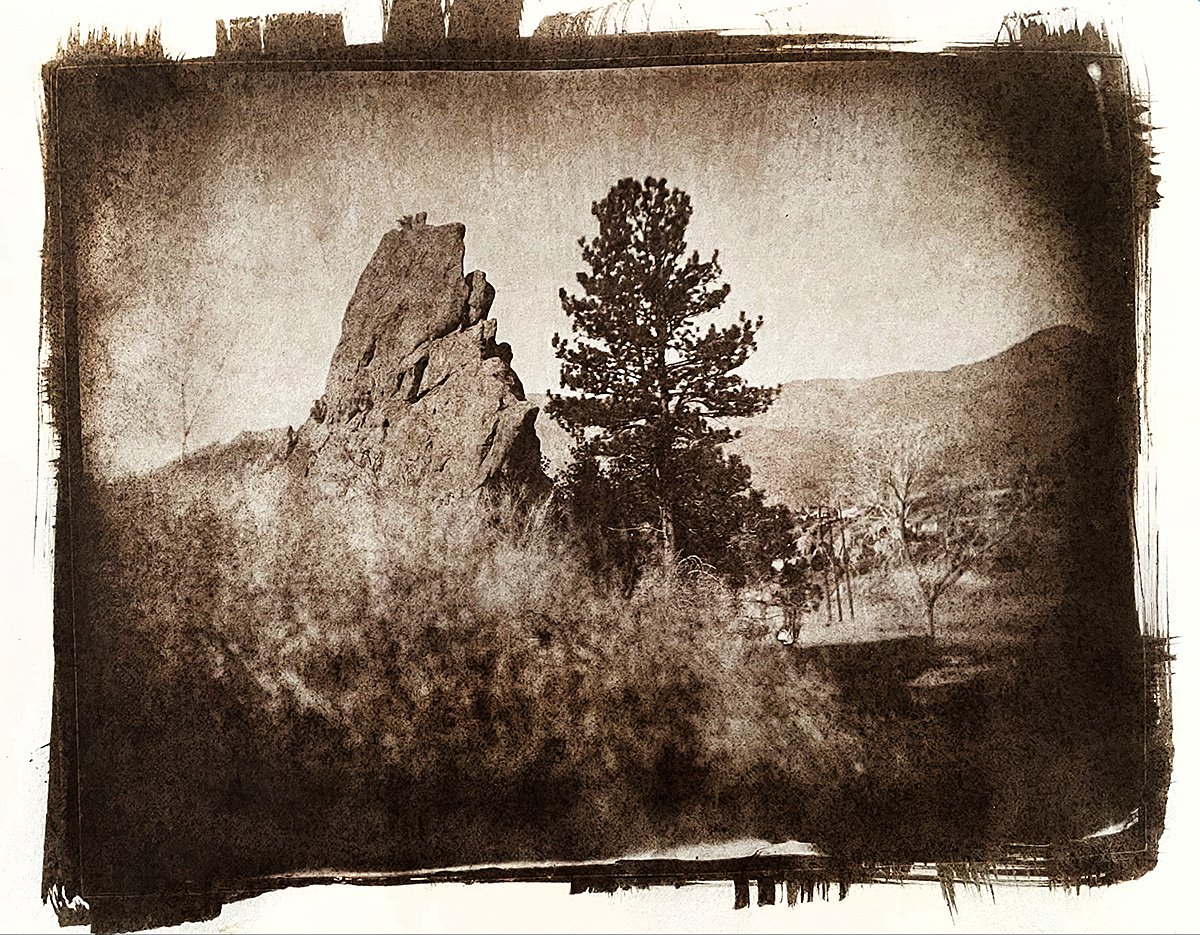
Garden of the Gods, Colorado Springs, Colorado, U.S.A. Whole Plate Argyrotype from a collodion dry plate negative printed on 16 lb drafting vellum paper— In the Shadow of Sun Mountain. 2022
A Reading: Introduction In the Shadow of Sun Mountain
Introduction
In the Shadow of Sun Mountain (2020–2024)
I lived for years on twelve acres in the mountains of central Colorado, on land where the (Tabeguache) Ute had lived, traveled, gathered medicine, and buried their dead for thousands of years. That fact was not abstract to me. It was present every day. In the plants that grew around the house. In the way the light moved across the ground. In the silence that settled at dusk. The land didn’t feel empty. It felt inhabited by memory.
Sun Mountain rose nearby, not dramatically, not as a monument, but as a constant presence. Its shadow crossed the land in long, slow arcs. I began to understand that shadow less as an absence than as a reminder. Something persisted there, something unresolved. The land wasn’t haunted in the theatrical sense. It was honest. It held the residue of belief, fear, violence, endurance, and the stories that try to make those things bearable.
The plants themselves became teachers. This work is grounded in ethnobotany and spiritual ecology, not as metaphor, but as epistemology. The (Tabeguache) Ute understood land through use, relationship, and attention: which plants heal, which harm, which alter perception, which open ritual space, which return the body to the ground. Medicine was not separate from cosmology. Knowledge was embedded in practice, repetition, and care. Working among these plants, photographing them, painting them, and incorporating them into mixed media was a way of entering that lineage of attention, however imperfectly. The work does not claim that knowledge as mine, but it does acknowledge that plants carry memory and instruction, and that ways of knowing grounded in land and body predate and quietly challenge the abstractions that made conquest and erasure possible.
This work began with a question I couldn’t shake: why do human beings need an enemy to feel secure?
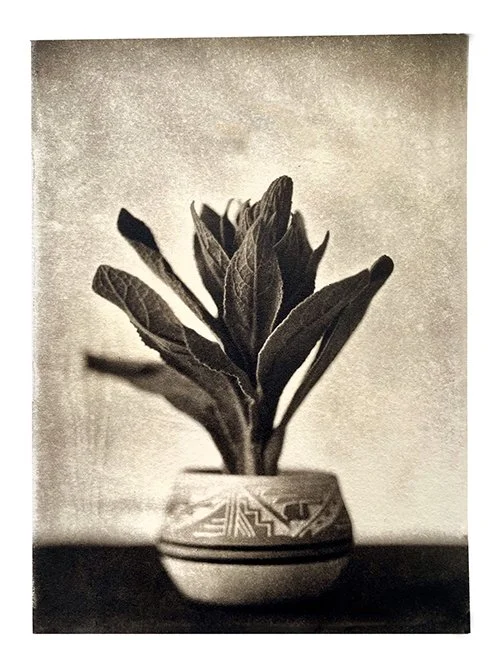
The Great Mullein Plant—Palladiotype from a wet collodion negative. 2022
I’d spent years photographing sites where violence had taken place, standing in spaces where something irreparable had occurred and sensing that the story told about those events was never the whole story. Living on that land intensified the question. The history of the (Tabeguache) Ute was not distant. It was botanical. Ecological. Embedded in place. Their knowledge of medicinal plants, spiritual botany, seasonal movement, and relationship to land was not a footnote to history. It was a worldview that had been violently interrupted.
The longer I lived there, the clearer it became that the question wasn’t only historical. It was psychological. What allows people to draw a line between “us” and “them” with such confidence? Why does that line harden so quickly? And what does our buried awareness of being temporary have to do with it?
My studio practice kept circling the same terrain. I worked with wet-collodion photography, color reversal prints, painting, and mixed media not out of nostalgia, but because these materials resist control. Collodion is unstable. A glass plate can appear solid and fail without warning. Silver remembers everything. Chemistry responds to temperature, breath, humidity, and time. You don’t dominate the process; you negotiate with it.
That instability mattered. It mirrored something I recognized in the human mind when it tries to manage fear, especially fear it refuses to name. What began as an old photographic process became a form of inquiry. The fractures in the plates, the fogging, the lifting emulsion, the breakage, they echoed the fractures I was seeing in our collective imagination.
Ernest Becker helped sharpen that connection. He argued that culture itself is a defense system built around the fact that we will die (Becker, 1973). We build worldviews to seem steady. We cling to identity because it promises continuity. And when those stories feel threatened, we look outward for someone to blame.
Othering is not an accident. It’s a psychological survival strategy. A way to redirect fear so we don’t have to feel it directly.
In the Shadow of Sun Mountain grew from that realization. What began as an artistic investigation rooted in land, plants, and material practice expanded into a broader inquiry into how death anxiety shapes behavior, morality, and the human capacity for cruelty. Starting a PhD in my sixties didn’t create this path. It helped me name it. Becker, Rank, and the existentialists gave language to what I had been sensing intuitively for decades: that creativity is not separate from mortality, and that artists often work at the fault line where denial begins to crack.
The chapters that follow trace how fear becomes ideology. How ideology becomes violence. How violence becomes history. And how history becomes a story we repeat so we don’t have to confront what made the violence possible in the first place.
This isn’t a moral lesson. It isn’t a condemnation delivered from a safe distance. It’s an examination of the ordinary human mind and what it does with the knowledge that life is short, unpredictable, and finite. It’s about the psychological architecture we inherit, the beliefs we defend, and the places where those beliefs fail.
Sun Mountain is both literal ground and conceptual ground. The plants, the landscapes, the objects, the materials, and the photographic processes are not illustrations of theory. They are part of the thinking itself. The shadow it casts represents what we push away: the parts of ourselves we disown, project, or punish in others.
If there is any hope here, it’s a quiet one. That facing impermanence might soften the need to harden ourselves against difference. Artists understand that tension intimately. We work every day between creation and loss. We accept what breaks. We learn from what cannot be repaired.
This book is an invitation into that space. It begins with a question and refuses to resolve it too quickly. It follows it through land, material, history, psychology, and lived experience, toward a clearer understanding of what we do in the presence of death, and what might change if we learned to see ourselves more honestly.
References
Becker, E. (1973). The denial of death. Free Press.
Untitled—Whole Plate Salt Print from a wet collodion negative.
When I pull a print like this from the wash, I think about presence, the way it clings for a moment before fading (not fixed). The chemistry stains, the brush strokes at the edges, and the paper that curls in my hands—none of it is meant to last. That’s what I love about it. It’s a print that remembers its making. The figure still feels fragile, but now it’s suspended in a kind of quiet acceptance.
Living Truthfully Inside Impermanence
Rupture is not simply a wound; it’s the generative moment when denial collapses and creation begins. It’s the place where death anxiety, cultural myth, and personal memory are transmuted into presence. Within rupture, the artist becomes a witness rather than a defender, turning from the fantasy of permanence toward the truth of impermanence. In that shift, art no longer seeks to outlive death; it becomes a form of living with it.
Otto Rank’s distinction between the artist and the neurotic illuminates this process. Both encounter rupture, the psychic shattering that comes when one’s symbolic world no longer holds, but only the artist metabolizes it. Where the neurotic internalizes and chokes on anxiety, the artist transforms it into form. The creative act becomes a means of surviving truth, of remaking coherence in the face of its undoing. Ernest Becker described culture as a shield against mortality; I see art as the moment that shield cracks. The fracture is not failure but revelation, an aperture where something honest can enter.
My work with wet collodion lives inside that aperture. The process itself enacts rupture: collodion, glass, silver, and time. Each plate holds the risk of loss. The collodion might peel, the image might fog, and the light might fail. Yet those failures become evidence of life. The surface bears the marks of both fragility and endurance, transparency and strength. Each plate is a negotiation between control and surrender, between the impulse to preserve and the inevitability of decay. To work in this way is to accept that every act of making is also an act of unmaking. I’m connecting deeply to these ideas and am excited to see where it takes me.
“Choking on Rocks.” Whole-plate wet collodion negative, made in the New Mexico desert, 2025. The plate holds the brief intersection of flesh, glass, and stone, an encounter with what endures and what disappears.
Between Presence and Absence
This new whole-plate wet collodion negative feels less like a photograph and more like a question: what does it mean to hold presence and impermanence in the same breath? The man, the bottle, and the rocks: are they material, or are they ghosts caught in the alchemy of silver and collodion? The glass doesn’t just capture an image; it captures the residue of time passing. What remains when the moment is gone? What does the plate remember that we forget?
Collodion always reminds me that everything we try to fix eventually fades. The process is slow and ritualistic; it forces me into a state of attention. Light becomes a witness, not just a means. This plate, like so many I make, isn’t about nostalgia; it’s about the impossibility of permanence. It’s about standing inside the paradox that Becker, Rank, and Yalom each described in their own way: to create in the face of death is both defiance and surrender.
In that sense, this image is elegiac. The man’s presence feels temporary, the bottle reflective, and the rocks ancient and indifferent. Together they form a kind of visual equation, human transience measured against geological time. The silver surface, with its imperfections and streaks, becomes a metaphor for the self: luminous, decaying, still reaching toward meaning.
Coyote carcass on desert dirt, Las Cruces, New Mexico, November 2025. Photograph by Quinn Jacobson.
The Coyote That Died on My Land
A couple of days ago, I caught a strong smell outside while working on a photograph. It was sharp, pungent, and unmistakable. Death has a particular odor that bypasses thought and goes straight to the gut. It made me queasy for a moment. Human death is worse; its scent lingers in your psyche as much as your senses, but this was still hard to shake.
I live on two acres, so it could’ve been anywhere. But the breeze was steady from the south, and the smell was heavy enough to trace. I didn’t walk a hundred feet before I saw it: a coyote, fully grown, laid out in the dirt as if sleep had taken it mid-motion. I hear them often at 4 a.m. Their calls ricocheting through the desert, a chorus of wild life that reminds me I’m not alone out here. They’re ghosts most of the time, heard but rarely seen.
My first instinct was to call animal control. But after thinking about it, I decided to leave the body where it was. Nature doesn’t need me to manage it. I’ll let it return to itself. When the flesh is gone and the bones are bare, I’ll bring them into my studio and make photographs.
For me, that act isn’t about morbidity; it’s about continuity. As Ernest Becker wrote, “All organisms are torn between the desire to live and the knowledge that they must die.” This coyote’s death is part of the same existential equation that drives art. Otto Rank saw art as the individual’s answer to mortality, a symbolic act of defiance, and an assertion that something of us can endure. Terror Management Theory later confirmed it empirically: the awareness of death propels us to create meaning, to build culture, and to leave traces that say we were here.
The coyote reminds me that no creature escapes this truth. Yet, there’s a strange grace in its stillness. The desert will do what it’s always done; it will metabolize the body, slowly, beautifully, until there’s only bone and dust. In that process, I see a mirror of the creative act: transformation through decay.
In time, I’ll photograph what remains—not as documentation of death, but as witness to the cycle that keeps everything alive.
Theory Note: Death, Art, and the Creative Instinct
Becker believed that culture, and by extension, art, is humanity’s way of managing the terror of mortality. We build symbolic worlds to convince ourselves that our lives matter, that something of us endures beyond the grave. Otto Rank expanded this idea, seeing the artist as a kind of “hero of creation,” transforming existential anxiety into symbolic immortality through the act of making. Terror Management Theory offers the scientific echo: when reminded of death, people turn to creativity, meaning, and worldview defense to restore equilibrium.
This coyote, in its silent return to the earth, embodies what Becker, Rank, and the TMT researchers all touch upon: the dance between decay and creation. In death’s presence, we’re reminded why we make anything at all.
“Bird Bones or Spewing Out My Introversions,” 2013 - Half Plate Gelatin Chloride Print from a wet collodion negative.
Bird Bones
“Rank asked why the artist so often avoids clinical neurosis when he is so much a candidate for it because of his vivid imagination, his openness to the finest and broadest aspects of experience, his isolation from the cultural world-view that satisfies everyone else. The answer is that he takes in the world, but instead of being oppressed by it he reworks it in his own personality and recreates it in the work of art. The neurotic is precisely the one who cannot create—the “artiste-manque,” as Rank so aptly called him. We might say that both the artist and the neurotic bite off more than they can chew, but the artist spews it back out again and chews it over in an objectified way, as an external, active, work project. The neurotic can’t marshal this creative response embodied in a specific work, and so he chokes on his introversions. The artist has similar large-scale introversions, but he uses them as material.”
―Ernest Becker
The Denial of Death
Racism isn’t innate – Here are Five Psychological Stages that may Lead to It
I encourage you to take a look at this article from The Conversation. It references Terror Management Theory, which to me is one of the most overlooked—and ignored—frameworks for understanding the problems we face today.
From racism to war, from bigotry and xenophobia to jingoism and religious dogma, we seem almost determined to find “the other.” As the old saying goes, I’ll hate you for the color of your shirt or the shape of your nose. Anything will do, so long as it puts someone in the “out group.” America has been marinating in this for a long time, and at this moment, I don’t see the future looking particularly bright. If anything, I’d caution people to prepare themselves for more, and larger, terrible events ahead.
You can already see it unfolding: Russia’s war in Ukraine, the genocide in Gaza, and climate disasters that grow more relentless each year—wildfires, hurricanes, and flooding. These events are not only catastrophic in themselves, but they remind us, again and again, of our own fragility and mortality. And when we are forced to face that, death anxiety tends to boil over into hostility, scapegoating, and division.
“We spend endless energy on the ‘what’ of our problems but rarely ask the ‘why.’ It’s like treating a cough while ignoring the virus that causes it.”
Add to this the terrible political divide in America: the Kirk assassination, Trump sending troops into American cities, and the daily drumbeat of culture war rhetoric. Political party loyalties—red and blue alike—are tearing at the fabric of our society. Even in our everyday lives, people seem more standoffish, impatient, and cold (I’ve felt this for a few years). It’s as if the collective weight of death anxiety is bubbling up everywhere, pushing us further into our corners.
This is what my studies and interests revolve around: what the fear of non-existence means for people and how it runs outside of conscious awareness. Terror Management Theory and Ernest Becker’s work hold so much explanatory power, I can’t understand why more people don’t embrace them—don’t bring them into their lives. Our world would be a much better place if we did.
Sheldon Solomon, building on Becker, put it bluntly: We will always need a designated group of inferiors.
What do you think? Do you see this drive to divide and “other” playing out in your own circles, communities, or even in the way strangers treat each other on the street? I’d love to hear your perspective.
And yet, I can’t help but believe there’s another path. If we had the courage to face death honestly, maybe we wouldn’t need enemies at all.
Ernest Becker - 1924-1974
Read This Article
This is a wonderful article that succinctly covers Becker’s ideas, TMT, and the state of the world:
https://newrepublic.com/article/199347/1-fear-death-wreaking-havoc-world