• blog
  • in the shadow of sun mountain
  • buy my books
  • photographs
  • paintings
  • bio
  • cv
  • contact
  • search
Menu

Studio Q Photography

Exploring Human Behavior and Death Anxiety Through Art
  • blog
  • in the shadow of sun mountain
  • buy my books
  • photographs
  • paintings
  • bio
  • cv
  • contact
  • search
×

“Glasshead-Stoneman,” collodio-chloride printed on glass and backed with gold pigment,
Half-plate. January 30, 2026 Las Cruces, New Mexico for the book, Glass Bones (ABR)

Glass and Gold - Glass Prints

Quinn Jacobson January 31, 2026

This piece grew out of a technical curiosity, but it didn’t stay there for long.

I’ve been experimenting with collodio-chloride on glass, using a wet collodion half-plate negative as the source image. What interested me initially was the reversal: taking a process already defined by fragility and asking it to exist as an object rather than an image alone. Printing onto glass changes the relationship immediately. The photograph no longer sits on a surface; it hovers within one. It becomes something you look into rather than at. I’ve printed on glass before—carbon, oil, and collodio-chloride. This gold addition was new.

That shift matters to me. My work is often in the unstable space between presence and absence, between what can be held and what can't. Collodio-chloride amplifies that tension. The image is there, but it never fully settles. It feels provisional, as if it could just as easily slip away.

Exposed, pre-fix.

After the print was finished, I backed the glass with gold. That decision wasn’t decorative. Gold carries a long cultural history of sanctification, permanence, value, and transcendence. Gold is what we use to signify that something matters and endures. In this context, it felt closer to a defense mechanism. A thin layer of assurance applied to something fundamentally unstable. The gold doesn’t resolve the fragility of the glass or the image; it frames it and maybe even tries to protect it. That tension is the point.

I’m aware that backing photographic images with gold carries the history of the orotone, a process designed to heighten luminosity and permanence. I’m interested in that lineage, but not in reviving it. Here, the gold isn’t about brilliance or finish. It functions more like a psychological gesture, an attempt to stabilize what can’t be stabilized, to sanctify something that is already slipping.

The skull forms in the background weren’t meant to announce themselves. They emerge slowly, almost reluctantly. That’s how mortality functions most of the time. It isn’t usually dramatic or explicit. It sits behind us, watching, shaping our behavior without demanding our attention. I wanted that presence to feel ambient rather than symbolic, something you notice only after spending time with the image.

The central figure feels assembled rather than organic. Stacked. Held together. I think of it less as a subject and more as a structure, a self-constructed one under pressure. The translucence of the collodio-chloride allows it to exist somewhere between solidity and dissolution, which mirrors the psychological space I’m often working in. Identity here isn’t fixed. It’s maintained.

From an arts-based research perspective, this piece feels important because the process itself is doing the thinking. I’m not illustrating theory after the fact. The materials are pushing back. Glass breaks. Chemistry misbehaves. The image resists control. Those risks aren’t incidental; they’re where the knowledge lives. The work knows something because it could fail.

What consistently resonates with me is the delicate boundary between reverence and denial. The gold can read as a halo or a shield. I’m interested in that ambiguity. It reflects the way we often try to stabilize what we know is unstable—through meaning, through ritual, through objects that promise endurance.

This piece doesn’t try to solve anything. It holds a condition. It sits with fragility rather than sealing it over. That feels honest to me.

Much more exploring ahead! I might break these and see what that produces. And I’m in the process of getting some front-surface mirror material to experiment with; I mention the technique in my book to make “faux” daguerreotypes. I’m going to use collodio-chloride to see what happens.

In Collodio-Chloride Glass, Glass Bones Tags collodio-chloride on glass, Glass Bones
6 Comments

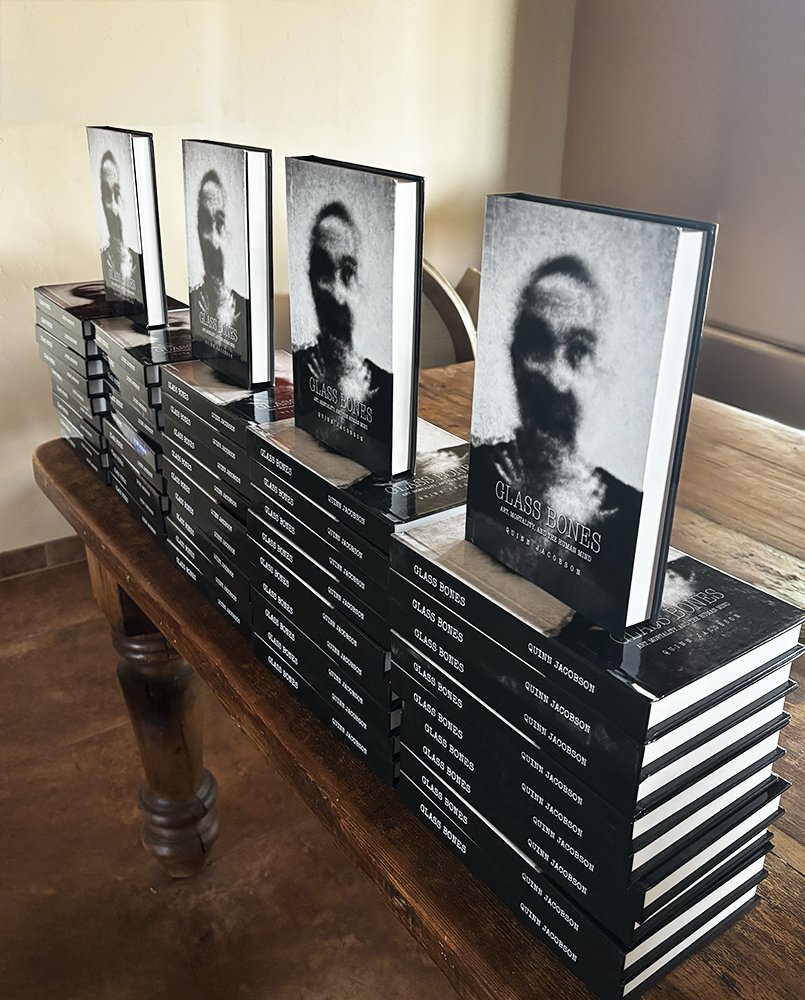
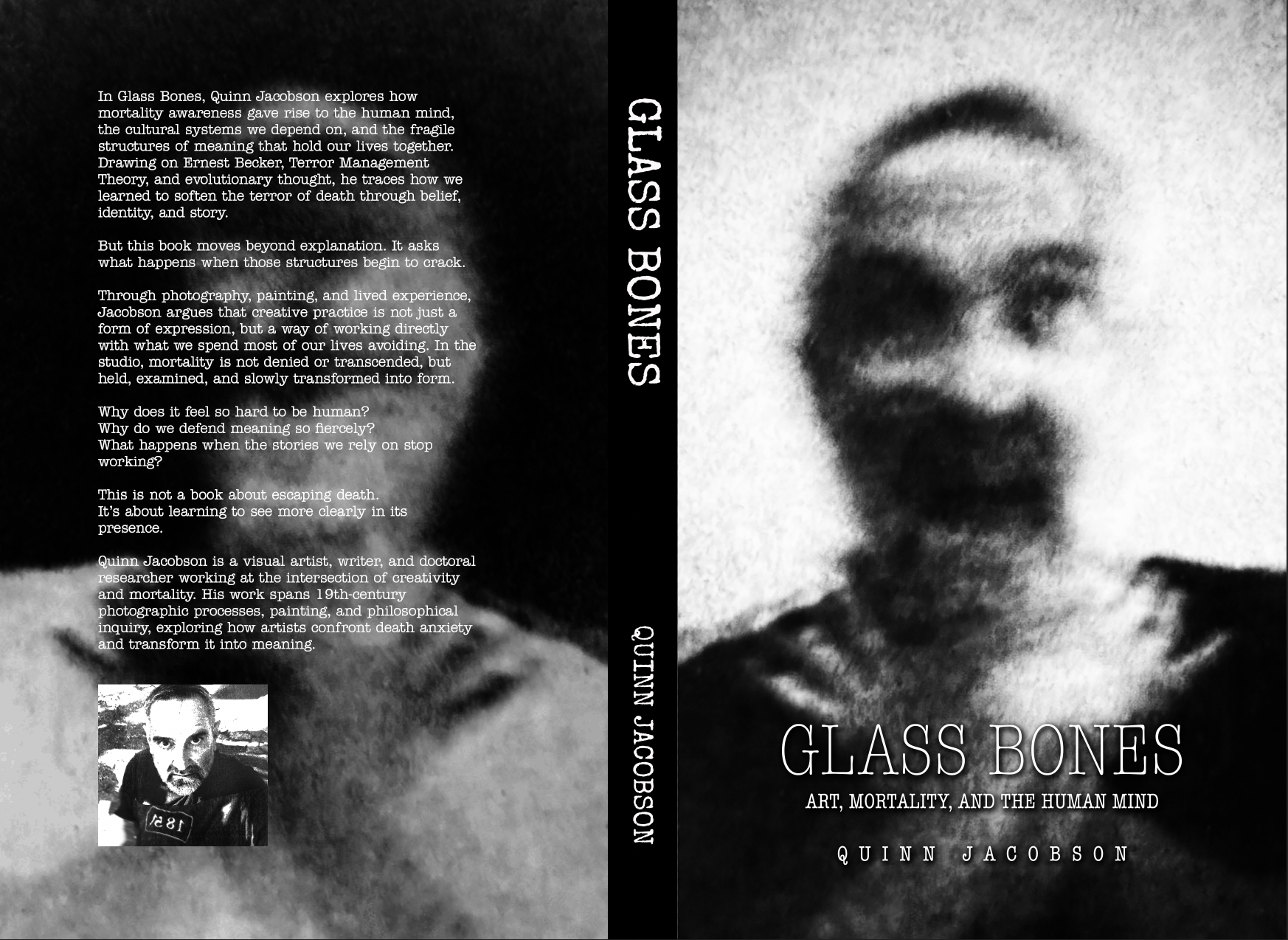
Mockup covers of my new books.

My New Books for 2026

Quinn Jacobson January 27, 2026

Have you ever had an epiphany? An epiphany is a sudden, profound realization or insightful moment where the true meaning or essence of something becomes clear, often from a simple occurrence, stemming from the Greek word for "manifestation" or "appearance.”

I’ve had several over the past few weeks.

I wanted to share how I’m going to unfold these publications this year. I will use some of the 800-900 pages of text in these books for my 2028 thesis/dissertation—these writings will drive my dissertation.

“I’m building a psychology of artistic practice that takes mortality seriously as a formative force. And my three books, Glass Bones, Rupture, and In the Shadow of Sun Mountain, act as a trilogy: Theory → Practice → Witness regarding the theories and creativity.”
— Quinn Jacobson

This is how I see it transpiring:

June 2026: Glass Bones is published.

September 2026: Rupture is published.

November 2026: In the Shadow of Sun Mountain is published.

Allow me to explicate: I'm building a psychology of artistic practice that takes mortality seriously as a formative force—not as metaphor, but as the pressure that shapes how artists see, make, and live. My trilogy examines this from three angles: Glass Bones provides the theoretical framework, drawing on Becker, Rank, and Terror Management Theory to understand death anxiety and cultural defense. Rupture translates theory into practice, exploring the disciplines and orientations that allow artists to transform existential pressure into creative form. In the Shadow of Sun Mountain offers lived witness—thirty years of working with nineteenth-century processes, paint, clay, broken materials, plants, people, and the mountain landscapes as sites where mortality and imagination meet. Together, they map the terrain where awareness becomes art: Theory → Practice → Witness.

This research is situated within liminal space: psychological, material, and cultural thresholds produced by mortality awareness. Rather than resolving death anxiety through symbolic closure, the work asks what becomes possible when creative practice holds the threshold open long enough for transformation to occur.

Mortality awareness places me in a permanently liminal condition. I am alive, but never free of the knowledge that I will not remain so. From a Beckerian perspective, this is not incidental; it is the core destabilizing fact of consciousness. I am an animal capable of symbol-making who cannot fully believe in my own symbols, a being suspended between embodiment and abstraction, presence and disappearance.

I do not experience this condition as episodic or developmental, something to be outgrown or resolved. It is structural. Consciousness itself unfolds at the threshold. What culture often treats as pathology or anxiety to be managed, I understand as the ground from which meaning-making arises. Creative practice, in this sense, is not an escape from liminality but a way of inhabiting it with attention and responsibility, giving form to what cannot be stabilized without distortion.

I will be making new work—photographs, paintings, and mixed media for Glass Bones and Rupture. My work from the mountain will be featured in Sun Mountain.

I think you can wrap your head around that one, right? Just writing this out alleviates some of the “it’s in me, and it has to come out” stuff. To quote John Lee Hooker from Boogie Chillin’ (1948), a natural, internal force that must be expressed. 

In New Books 2026 Tags new books, PhD, Ruptureology, rupture, In the Shadow of Sun Mountain, Glass Bones
4 Comments

“Staring at the Sun,” Whole Plate Tintype—November 30, 2025 - Las Cruces, New Mexico

Notes From the Studio: Staring at the Sun

Quinn Jacobson November 30, 2025

I made a new tintype today (I made several, actually)—something small, simple, and unexpectedly revealing. It began as a response to reading Yalom’s Staring at the Sun. I sculpted a tiny figure and a rough, spiked “sun” and set them up in the studio to explore that familiar tension between awe, fear, and the search for meaning.

But once the plate dried, the image took on a different life. The “sun” started to resemble a virus, and the little figure looked like he was trying to negotiate with a force he couldn’t quite name. It shifted the whole feeling of the piece. It’s strange when a photograph teaches you something you didn’t intend, but that’s usually a sign you’re on the right track.


“Staring at the Sun—V.2,” Whole Plate Tintype—November 30, 2025 - Las Cruces, New Mexico

The chemistry added its own voice, too. I shot it wide open with an 1872 Dallmeyer 3B lens, using natural New Mexico light. Because the developer had no alcohol in it, the plate is full of sweeping, ghostlike marks, patterns that feel like turbulence or weather. Those imperfections have become one of the things I trust most about collodion. They reveal the atmosphere of the moment in a way nothing else can.

This little setup feels like the start of a new thread, a kind of still-life cosmology. Small figures, simple objects, big questions. I won’t say more yet, but I’m excited about where this can go.

I’ll keep at it and see what develops ;-)

In Glass Bones, Wet Collodion, Tintype, Yalom Tags Yalom, Staring at the Sun, virus, Tintype, Glass Bones
Comment

Search Posts

Archive Block
This is example content. Double-click here and select a page to create an index of your own content. Learn more
Post Archive
  • Photography
 

Featured Posts

Featured
Feb 17, 2026
The 12 Steps of Rupturelogy
Feb 17, 2026
Feb 17, 2026
Feb 7, 2026
What Remains: On Meaning, Mortality, and Making in the Age of Artificial Intelligence
Feb 7, 2026
Feb 7, 2026
Feb 5, 2026
The Outline and the Drift
Feb 5, 2026
Feb 5, 2026
Feb 4, 2026
Ruptureology
Feb 4, 2026
Feb 4, 2026
Jan 31, 2026
Glass and Gold - Glass Prints
Jan 31, 2026
Jan 31, 2026
Jan 28, 2026
A Film You Should Watch
Jan 28, 2026
Jan 28, 2026
Jan 27, 2026
My New Books for 2026
Jan 27, 2026
Jan 27, 2026
Jan 26, 2026
The Dimmer Switch Explained
Jan 26, 2026
Jan 26, 2026
Jan 24, 2026
Holding Pattern
Jan 24, 2026
Jan 24, 2026
Jan 19, 2026
The Sacred Didn’t Vanish - It Migrated
Jan 19, 2026
Jan 19, 2026