
• blog
  • in the shadow of sun mountain
  • buy my books
  • photographs
  • paintings
  • bio
  • cv
  • contact
  • search
Menu

Studio Q Photography

Exploring Human Behavior and Death Anxiety Through Art
  • blog
  • in the shadow of sun mountain
  • buy my books
  • photographs
  • paintings
  • bio
  • cv
  • contact
  • search
×

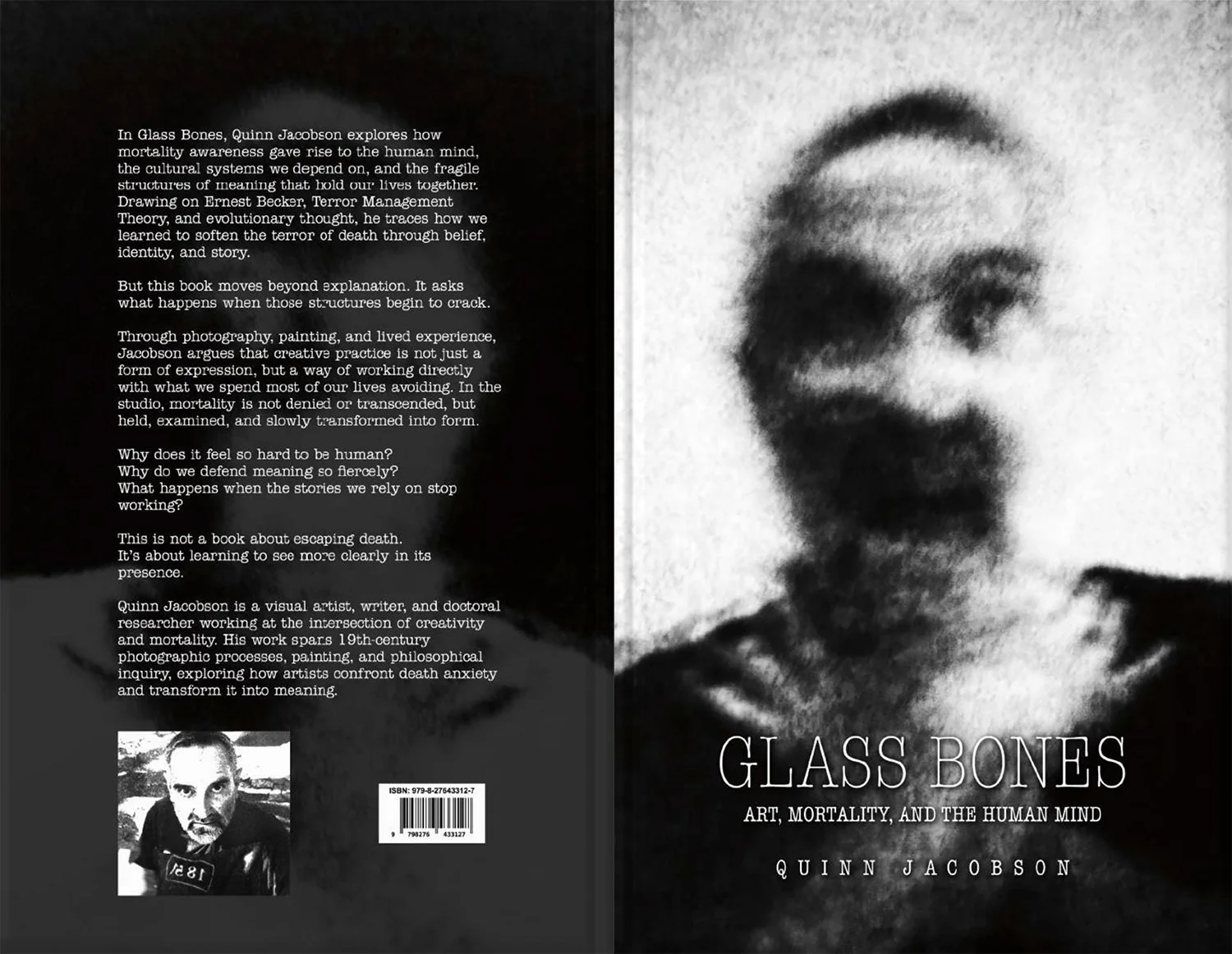
Front and back cover.

My Book: The Final Stages of Glass Bones

Quinn Jacobson April 16, 2026

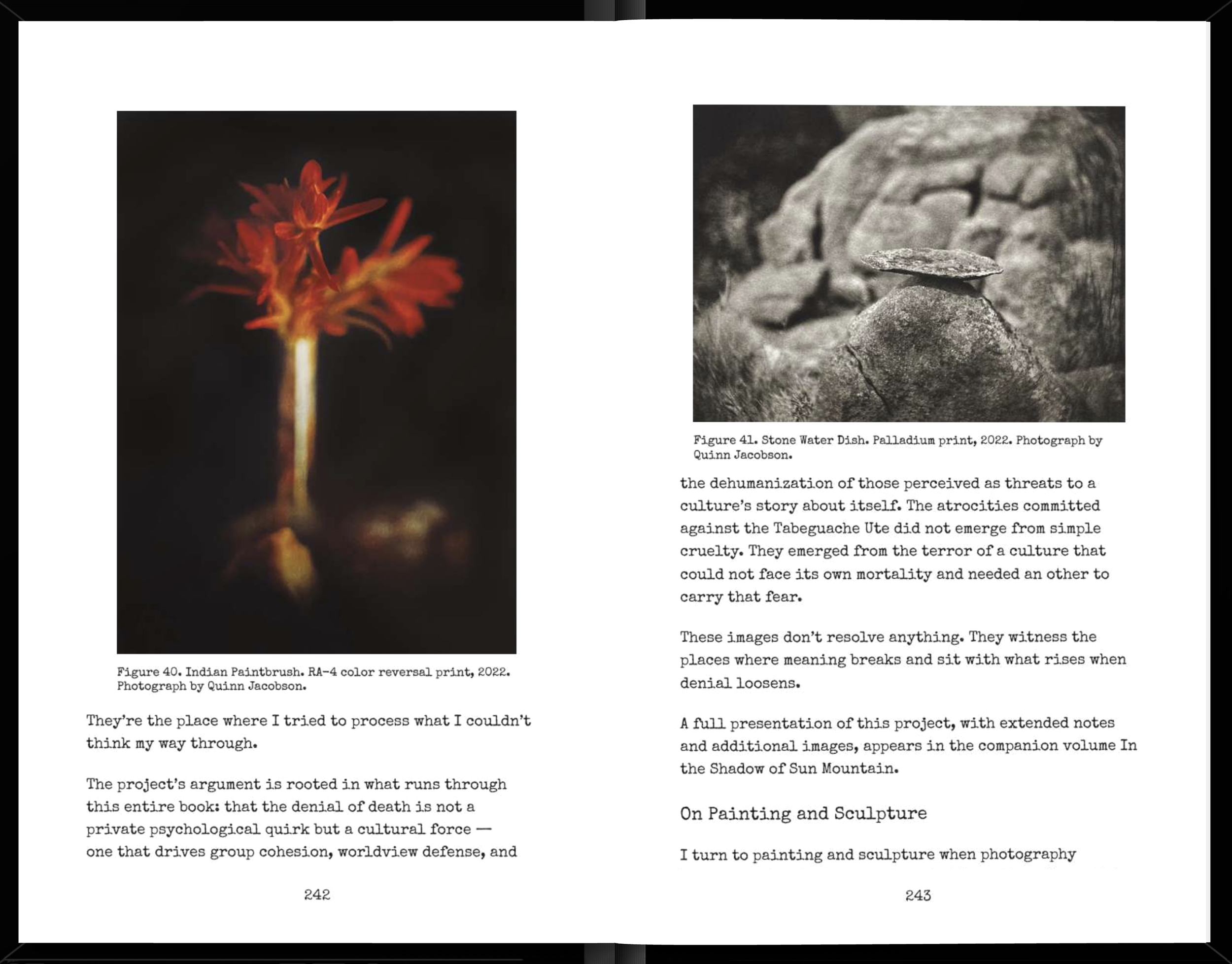
I wanted to share a few pages from Glass Bones—a glimpse into how the book is beginning to take shape as a physical object.

I’m still working. Still in the darkroom, still at the canvas, still refining the manuscript. Every day. But it’s close now. Close enough that I can begin to think less about what it is becoming and more about where it might live once it leaves my hands.

Right now, I’m planning a small hardback run (5.5” x 8.5”)—somewhere in the range of 250 to 300 copies. Not because I expect a large audience, but because I’m more interested in placement than scale. This isn’t a commercial project. It moves in the opposite direction.

What I keep returning to is the idea of libraries, especially at art schools. It’s a niche path, but that’s always been where this work lives.

There’s something compelling about the possibility that this book could sit quietly on a shelf, embedded within a larger system of knowledge, waiting for the right kind of encounter. Not driven by visibility or promotion, but by proximity. Someone searches for a keyword—mortality, art, psychology, violence, or meaning—and this object appears. They take it down. Spend time with it. Or don’t. But the encounter remains possible.

In that sense, distribution becomes part of the work.

If Becker is even partially right that culture functions as a buffer against the anxiety of death, then placing a book like this into public collections may operate as a small countercurrent. Not as a corrective, exactly, but as an opening. A space where the usual defenses are not reinforced but perhaps loosened.

Because this project doesn’t offer resolution.

Much of the work moves through sites of rupture—historical, psychological, and cultural. The violence enacted against the Tabeguache Ute, for example, is not framed as an aberration of cruelty but as something emerging from a deeper structure. A culture unable to face its own mortality displaces that terror outward, producing an “other” to carry what it cannot hold itself.

The images that follow don’t attempt to resolve that. They witness it.

They sit in the places where meaning breaks down and remain there long enough for something else to surface—something less stable, but perhaps more honest.

There will be a digital version. An audiobook as well. Both extend access, which matters. But they inevitably flatten part of the experience. The scale of the images, the pacing, the way text and image occupy the same field—those things don’t translate cleanly.

This has always been a hybrid project. Part book, part object. Something meant to be read but also handled. Something that lives not just in circulation but in place.

More soon.
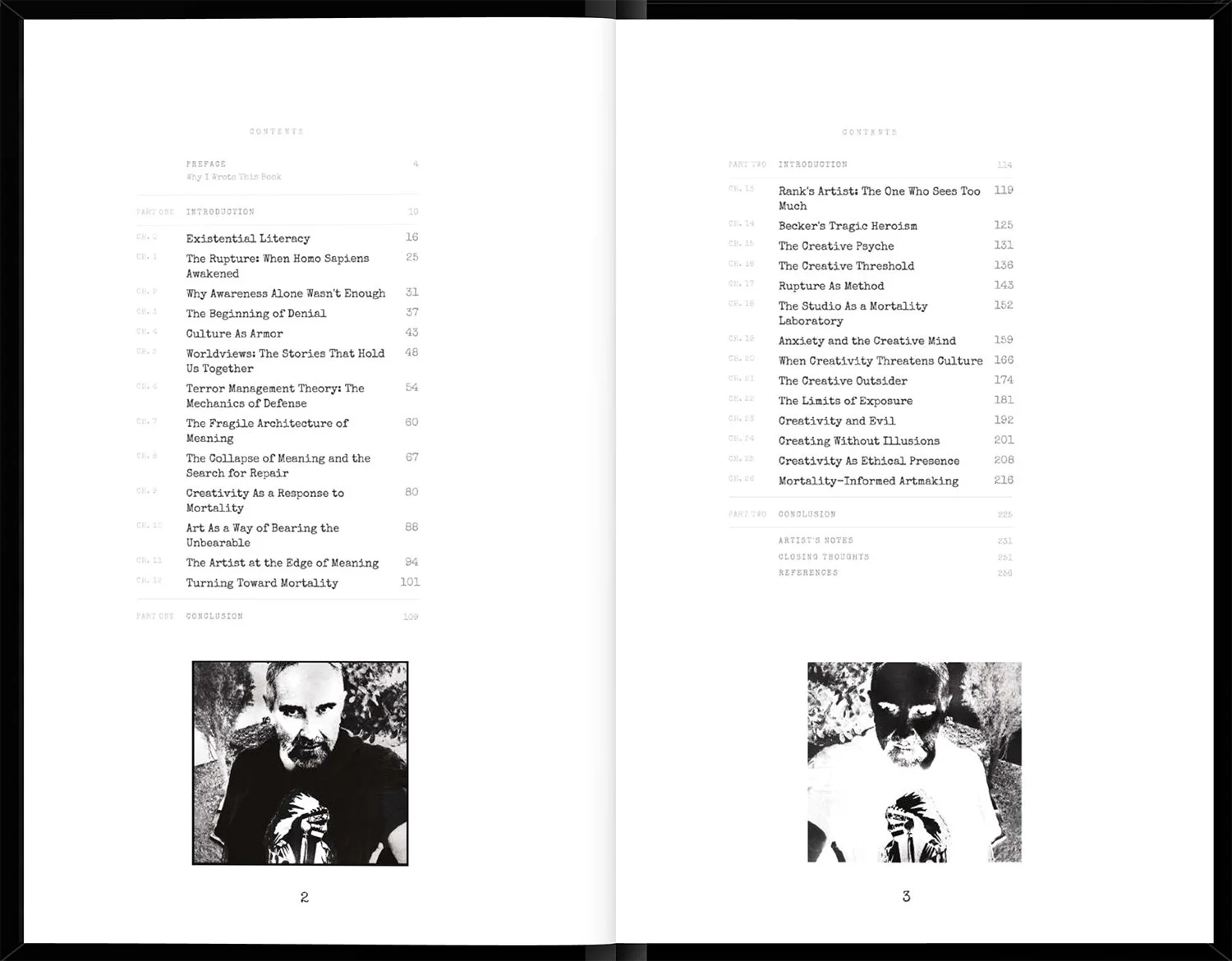
Table of contents.
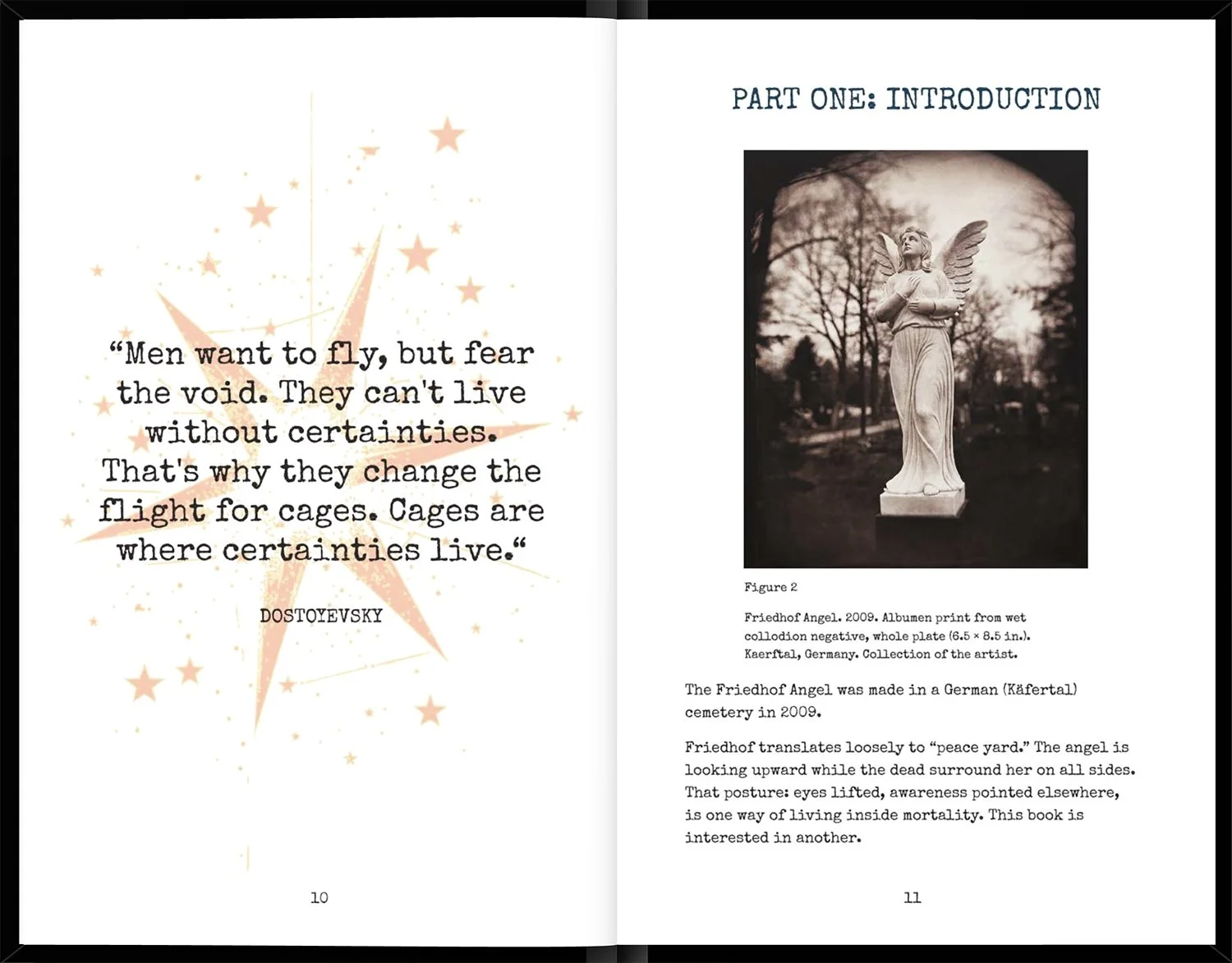
How each chapter begins: a quote and an image somewhere within the chapter or at the end.
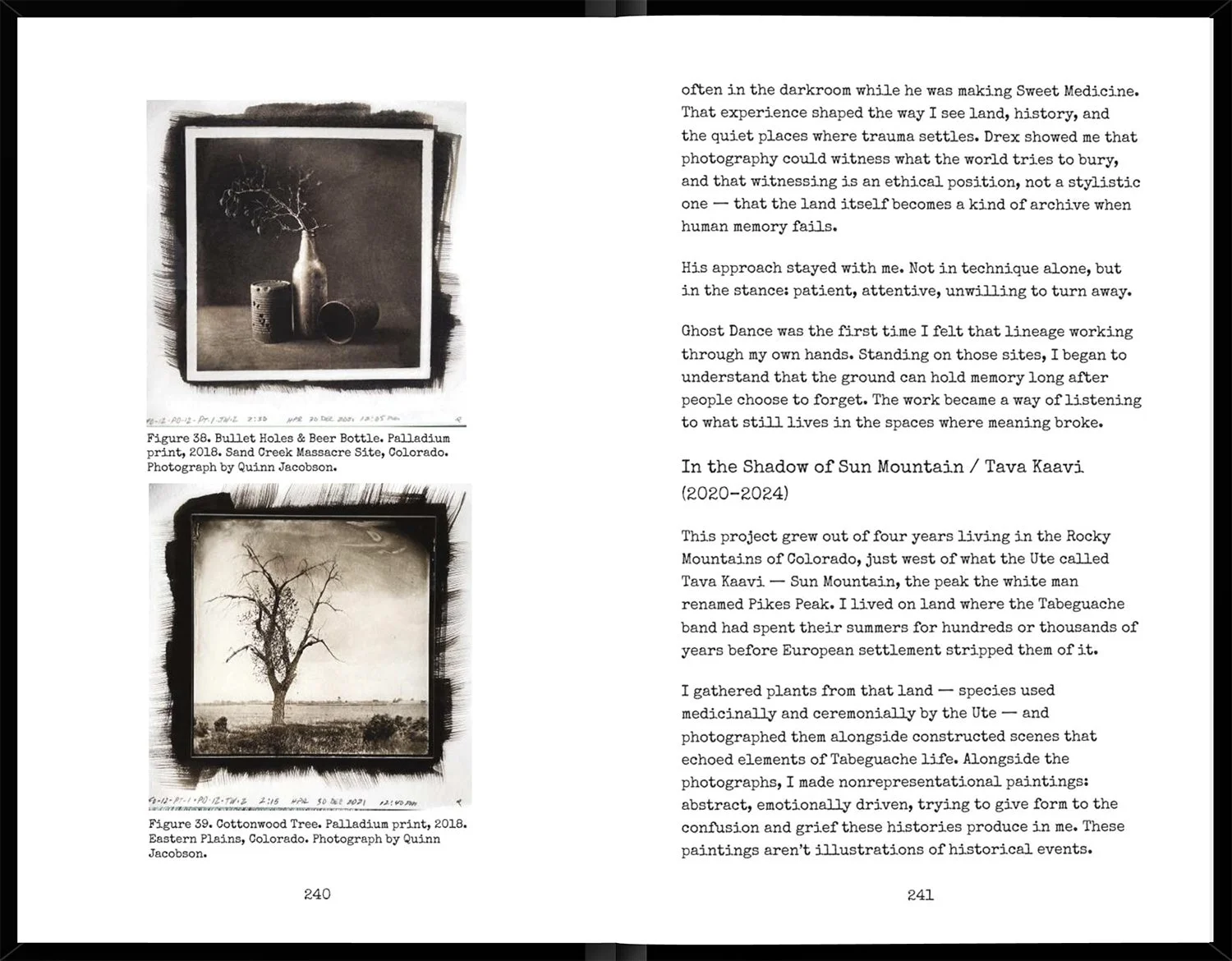
At the end of the book, I cover my work over the past 30+ years.
In Glass Bones Tags Glass Bones, new books
2 Comments

Mockup covers of my new books.

My New Books for 2026

Quinn Jacobson January 27, 2026

Have you ever had an epiphany? An epiphany is a sudden, profound realization or insightful moment where the true meaning or essence of something becomes clear, often from a simple occurrence, stemming from the Greek word for "manifestation" or "appearance.”

I’ve had several over the past few weeks.

I wanted to share how I’m going to unfold these publications this year. I will use some of the 800-900 pages of text in these books for my 2028 thesis/dissertation—these writings will drive my dissertation.

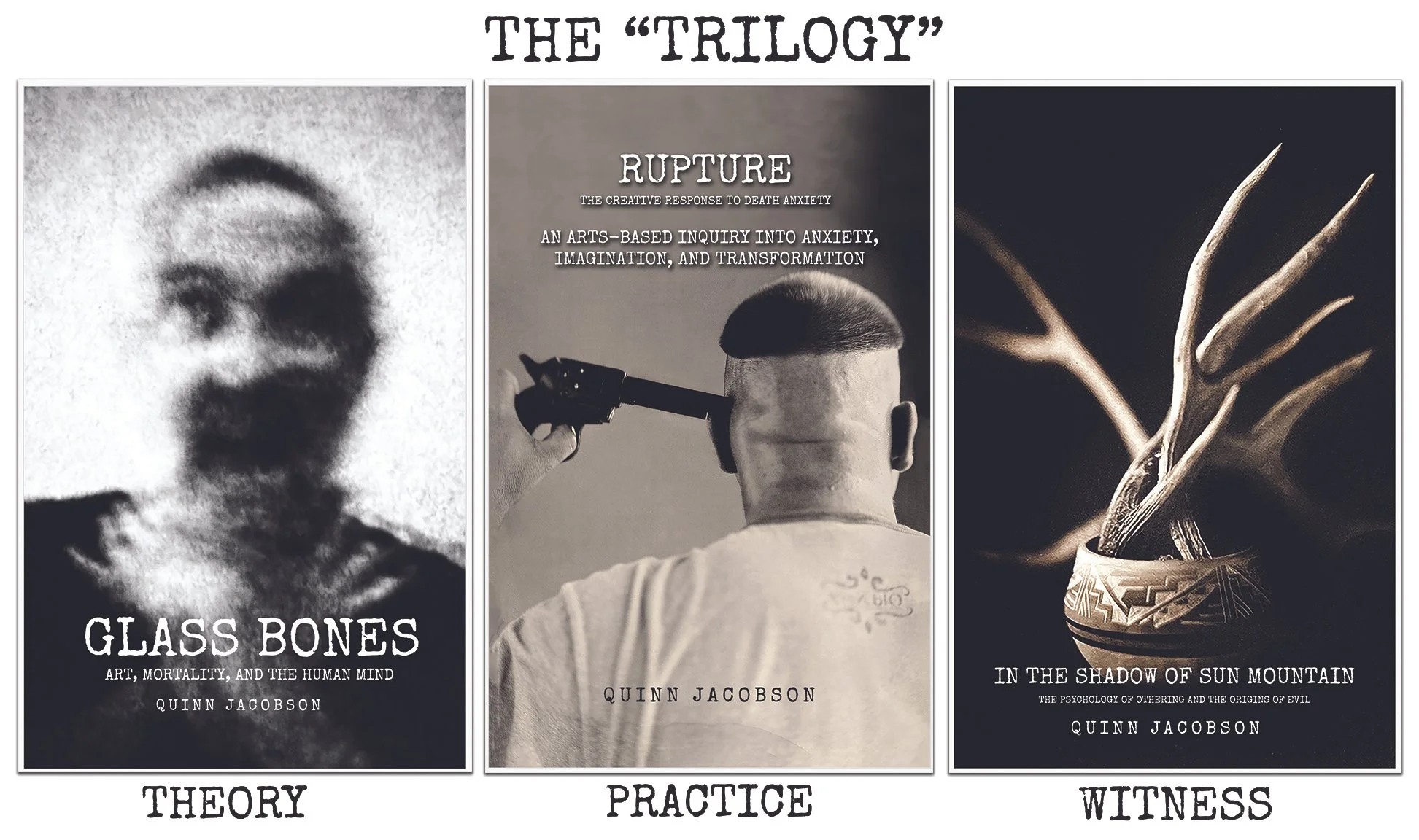
“I’m building a psychology of artistic practice that takes mortality seriously as a formative force. And my three books, Glass Bones, Rupture, and In the Shadow of Sun Mountain, act as a trilogy: Theory → Practice → Witness regarding the theories and creativity.”
— Quinn Jacobson

This is how I see it transpiring:

June 2026: Glass Bones is published.

September 2026: Rupture is published.

November 2026: In the Shadow of Sun Mountain is published.

Allow me to explicate: I'm building a psychology of artistic practice that takes mortality seriously as a formative force—not as metaphor, but as the pressure that shapes how artists see, make, and live. My trilogy examines this from three angles: Glass Bones provides the theoretical framework, drawing on Becker, Rank, and Terror Management Theory to understand death anxiety and cultural defense. Rupture translates theory into practice, exploring the disciplines and orientations that allow artists to transform existential pressure into creative form. In the Shadow of Sun Mountain offers lived witness—thirty years of working with nineteenth-century processes, paint, clay, broken materials, plants, people, and the mountain landscapes as sites where mortality and imagination meet. Together, they map the terrain where awareness becomes art: Theory → Practice → Witness.

This research is situated within liminal space: psychological, material, and cultural thresholds produced by mortality awareness. Rather than resolving death anxiety through symbolic closure, the work asks what becomes possible when creative practice holds the threshold open long enough for transformation to occur.

Mortality awareness places me in a permanently liminal condition. I am alive, but never free of the knowledge that I will not remain so. From a Beckerian perspective, this is not incidental; it is the core destabilizing fact of consciousness. I am an animal capable of symbol-making who cannot fully believe in my own symbols, a being suspended between embodiment and abstraction, presence and disappearance.

I do not experience this condition as episodic or developmental, something to be outgrown or resolved. It is structural. Consciousness itself unfolds at the threshold. What culture often treats as pathology or anxiety to be managed, I understand as the ground from which meaning-making arises. Creative practice, in this sense, is not an escape from liminality but a way of inhabiting it with attention and responsibility, giving form to what cannot be stabilized without distortion.

I will be making new work—photographs, paintings, and mixed media for Glass Bones and Rupture. My work from the mountain will be featured in Sun Mountain.

I think you can wrap your head around that one, right? Just writing this out alleviates some of the “it’s in me, and it has to come out” stuff. To quote John Lee Hooker from Boogie Chillin’ (1948), a natural, internal force that must be expressed. 

In New Books 2026 Tags new books, PhD, Ruptureology, rupture, In the Shadow of Sun Mountain, Glass Bones
4 Comments

Search Posts


Featured Posts

Featured
Apr 16, 2026
My Book: The Final Stages of Glass Bones
Apr 16, 2026
Apr 16, 2026
Apr 13, 2026
Terror Management Theory: The Mechanics Beneath Belief
Apr 13, 2026
Apr 13, 2026
Apr 11, 2026
To Buffer or Not to Buffer?
Apr 11, 2026
Apr 11, 2026
Apr 6, 2026
Worldviews: The Stories That Hold Us Together
Apr 6, 2026
Apr 6, 2026
Apr 1, 2026
The Creative Mind & Mortality Podcast - S1 E7: Culture As Armor
Apr 1, 2026
Apr 1, 2026
Mar 30, 2026
Holding the Unresolvable: Mortality and Form in a Kallitype Portrait
Mar 30, 2026
Mar 30, 2026
Mar 28, 2026
Arts-Based Research Methodology
Mar 28, 2026
Mar 28, 2026
Mar 25, 2026
The Creative Mind & Mortality Podcast—S1E6: The Beginning of Denial
Mar 25, 2026
Mar 25, 2026
Mar 24, 2026
Ocotillo, Chihuahuan Desert
Mar 24, 2026
Mar 24, 2026
Mar 23, 2026
Metabolizing the Polycrisis: The Rupture Field Approach
Mar 23, 2026
Mar 23, 2026