
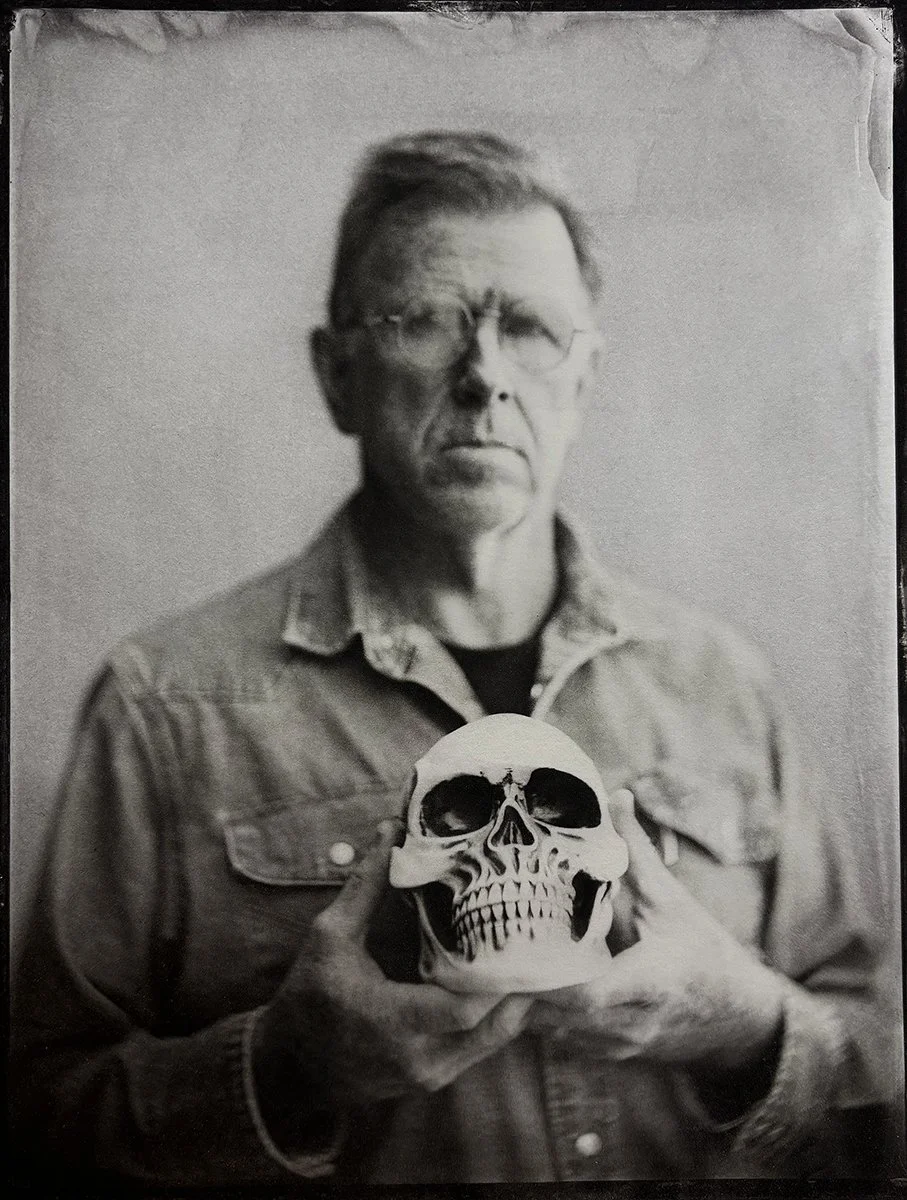
Two Skulls, 2026. Whole plate platinum print from a wet collodion negative, 6.5 × 8.5 in. Las Cruces, New Mexico, November 6, 2026.
A man holds a skull at his sternum with both hands. His fingers wrap under the jaw and around the back of the cranium. It sits where his heart is, a second face about ten inches below his own.
The skull is the brightest thing in the frame. Collodion sees blue and ultraviolet light and reads the red in skin as dark. His face comes out weathered, every year on it accounted for. The skull has no blood in it, so it prints clean and white. The process ages the living face and leaves the dead one alone.
He’s wearing glasses. The skull has sockets. Both of them face my lens, and only one of them needs help seeing it.
I’m behind the camera. Barthes wrote Camera Lucida as a Spectator and said he couldn’t speak as the Operator. He did describe what posing does to a person. In front of the lens he feels himself turning into an object, and he calls that a small version of death (Barthes, 1980/1981). I pour the plate, sensitize it, load it in the holder, and pull the dark slide. The man holds still for an 8-second exposure. I’m the one who asks him to. I stop the old Dallmeyer lens down to f/5.6 to make sure the front skull was sharp and let the man fade.
Barthes also says every photograph carries a death that’s already happened and one that’s still coming (Barthes, 1980/1981). He finds it in the sitter’s face. Here it’s been pulled out of the face and put in the man’s hands.
His hands know the skull by touch. They can find the brow ridge and the hinge of the jaw. Merleau-Ponty describes the body as the thing that touches and gets touched in the same moment (Merleau-Ponty, 1945/2012). The man’s own skull is the one he can’t get to. If he presses on his forehead, all he finds is skin. The object in his hands is as close as touch will take him.
It’s a cast. It was never anyone. Heidegger says nobody can take a person’s dying from him, and that the only death any of us witnesses belongs to someone else (Heidegger, 1927/1962). A cast puts the man one step further out. He’s holding a model of a death that didn’t happen, and he’s looking at me while he does it.
Becker’s whole argument fits in the vertical line of this print. Up top is the self with a name and a history. Below it is the anatomy that self rides around in (Becker, 1973). I’ve spent years reading that as theory. On the plate it’s a matter of where a man’s hands are.
The negative is glass. It can crack. The print is platinum sunk into the fibers of the paper, with no gelatin holding it. It’ll outlast both of us by a few hundred years. Becker would call that an immortality project, and he’d be right (Becker, 1973). I made the most permanent print I know how to make, and the subject is a man who won’t be here to see it last.
The top edge carries the marks of the collodion. The platinum prints them as faithfully as it prints his face.
References
Barthes, R. (1981). Camera lucida: Reflections on photography (R. Howard, Trans.). Hill and Wang. (Original work published 1980)
Becker, E. (1973). The denial of death. Free Press.
Heidegger, M. (1962). Being and time (J. Macquarrie & E. Robinson, Trans.). Harper & Row. (Original work published 1927)
Merleau-Ponty, M. (2012). Phenomenology of perception (D. A. Landes, Trans.). Routledge. (Original work published 1945)