
How artists metabolize existential anxiety, and why the work still matters.
I keep returning to the same question, no matter how many theories I read or objects I make: What exactly happens to existential anxiety when it moves through the hands of an artist?
Not rhetorically. Mechanically. Psychologically.
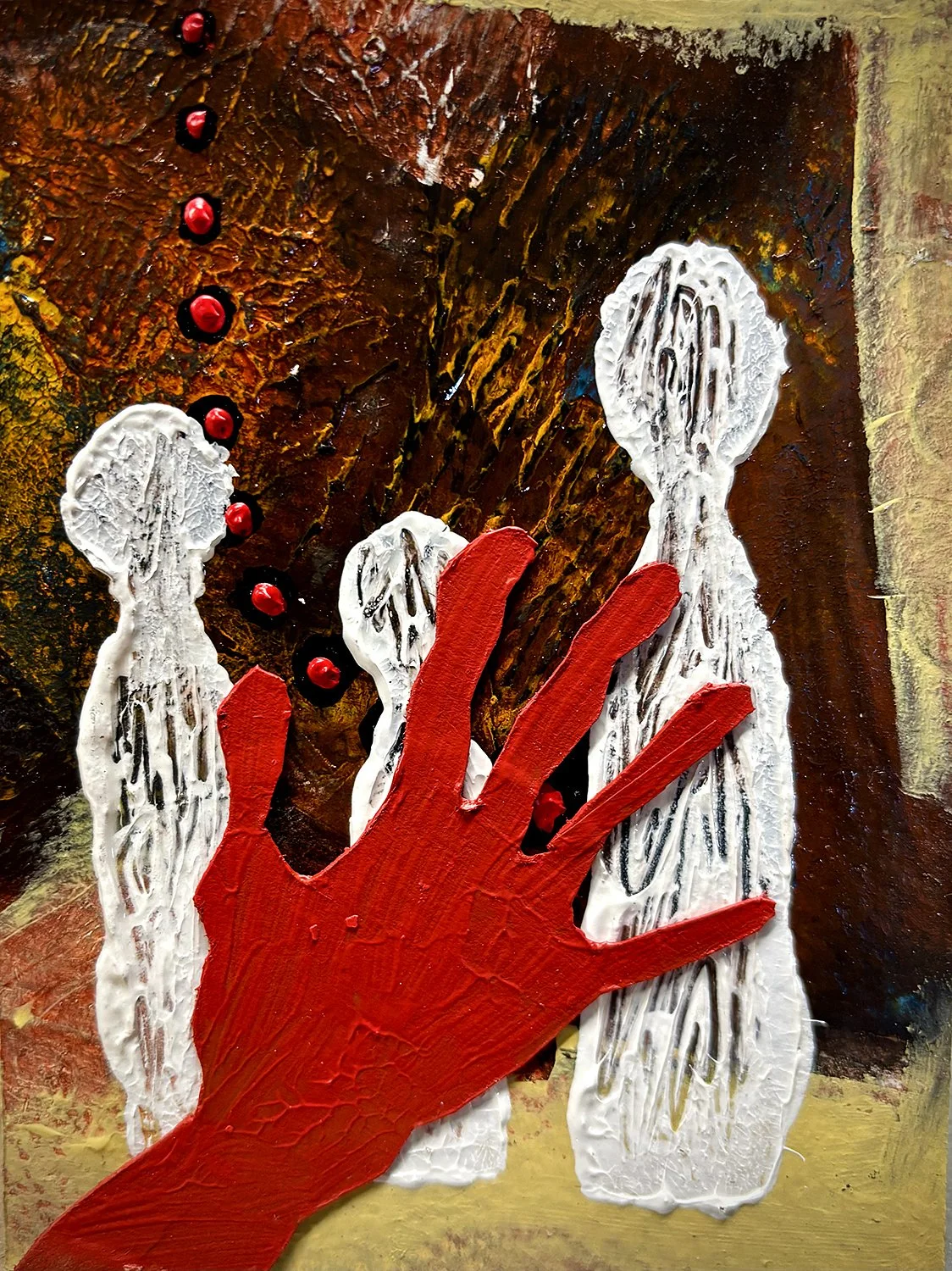
The image above is one attempt to make that process visible. Three pale figures stand upright, stripped of detail, reduced almost to afterimages. They are not portraits so much as placeholders. Awareness has rendered their bodies thin. Over them reaches a red hand, oversized and intrusive, neither comforting nor gentle. It interrupts and intrudes. It stains. It marks.
That hand is not expression. It is intervention.
Most people manage death anxiety by keeping it diffuse, by never letting it fully localize. The artist does the opposite. The anxiety is brought forward, concentrated, and given a task. Creation becomes a site of containment. The fear does not disappear, but it changes state. It becomes workable.
This is what I mean by metabolizing existential anxiety. Not purging it. Not transcending it. Converting it into form.
Psychologically, this matters more than we often admit. The act of making gives the anxious mind boundaries. Time slows. Attention narrows. The self becomes less abstract and more procedural. The question shifts from What does it all mean? to What happens if I put this here? That shift is not trivial. It is regulatory. It allows consciousness to stay in contact with mortality without flooding.
The white figures in the image are not victims. They are witnesses. They stand because the hand is doing something on their behalf.
This is where arts-based research comes into focus for me. ABR is often framed as alternative knowledge production, which is true but incomplete. Its deeper value lies in its psychological function. Making becomes a way of thinking that does not rely exclusively on symbolic abstraction. Image, material, gesture, and repetition—these are not illustrations of insight; they are the insight.
When anxiety stays purely cognitive, it spirals. When it enters the body through making, it circulates. It acquires rhythm. It becomes legible.
This brings me to the harder question: is there any value in writing books like Glass Bones and Rupture?
If the goal were resolution, probably not. No book resolves the fact of death. No theory seals the crack. But that has never been the real task. The value lies in creating sustained containers where anxiety can be held long enough to be examined without collapsing into distraction or denial.
These books are not answers. They are pressure vessels.
Writing them will force me to stay with the material—psychologically and ethically—longer than images alone sometimes allow. It slows the metabolism. It traces the process. It makes visible what is usually hidden: how fear becomes form, how rupture becomes method, and how meaning is provisional but still worth making.
The red hand, then, is also authorship. It is the decision to intervene rather than look away. To touch the thing that makes us uncomfortable and accept the consequences of contact.
Artists do not escape existential anxiety (not at all). They work it. They give it edges. They give it weight. They give it somewhere to go.
That’s not a cure.
But it is a practice.
And in a culture built on denial, practice may be the most honest form of value we have left.