• blog
  • in the shadow of sun mountain
  • buy my books
  • photographs
  • paintings
  • bio
  • cv
  • contact
  • search
Menu

Studio Q Photography

Exploring Human Behavior and Death Anxiety Through Art
  • blog
  • in the shadow of sun mountain
  • buy my books
  • photographs
  • paintings
  • bio
  • cv
  • contact
  • search
×

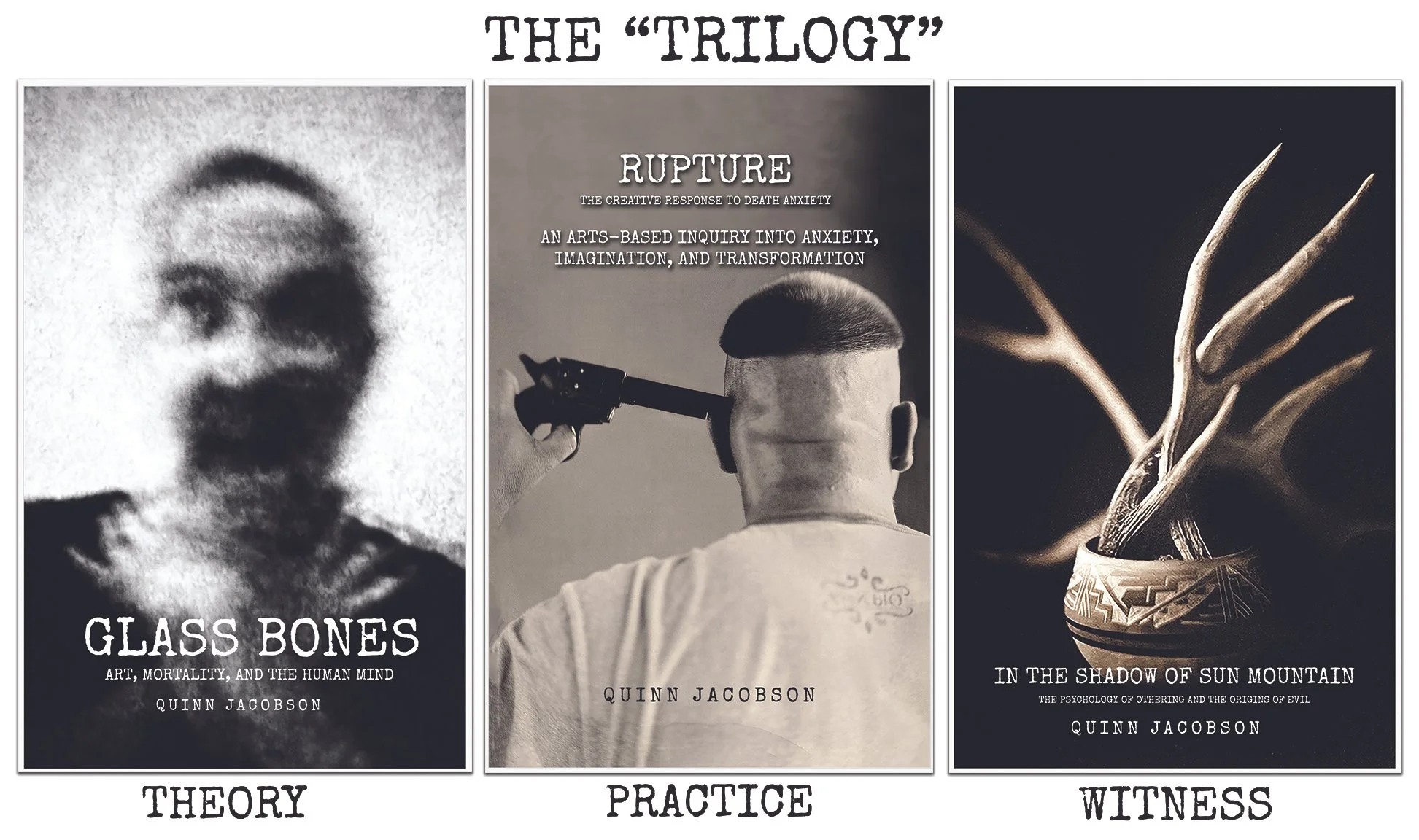
Mockup covers of my new books.

My New Books for 2026

Quinn Jacobson January 27, 2026

Have you ever had an epiphany? An epiphany is a sudden, profound realization or insightful moment where the true meaning or essence of something becomes clear, often from a simple occurrence, stemming from the Greek word for "manifestation" or "appearance.”

I’ve had several over the past few weeks.

I wanted to share how I’m going to unfold these publications this year. I will use some of the 800-900 pages of text in these books for my 2028 thesis/dissertation—these writings will drive my dissertation.

“I’m building a psychology of artistic practice that takes mortality seriously as a formative force. And my three books, Glass Bones, Rupture, and In the Shadow of Sun Mountain, act as a trilogy: Theory → Practice → Witness regarding the theories and creativity.”
— Quinn Jacobson

This is how I see it transpiring:

June 2026: Glass Bones is published.

September 2026: Rupture is published.

November 2026: In the Shadow of Sun Mountain is published.

Allow me to explicate: I'm building a psychology of artistic practice that takes mortality seriously as a formative force—not as metaphor, but as the pressure that shapes how artists see, make, and live. My trilogy examines this from three angles: Glass Bones provides the theoretical framework, drawing on Becker, Rank, and Terror Management Theory to understand death anxiety and cultural defense. Rupture translates theory into practice, exploring the disciplines and orientations that allow artists to transform existential pressure into creative form. In the Shadow of Sun Mountain offers lived witness—thirty years of working with nineteenth-century processes, paint, clay, broken materials, plants, people, and the mountain landscapes as sites where mortality and imagination meet. Together, they map the terrain where awareness becomes art: Theory → Practice → Witness.

This research is situated within liminal space: psychological, material, and cultural thresholds produced by mortality awareness. Rather than resolving death anxiety through symbolic closure, the work asks what becomes possible when creative practice holds the threshold open long enough for transformation to occur.

Mortality awareness places me in a permanently liminal condition. I am alive, but never free of the knowledge that I will not remain so. From a Beckerian perspective, this is not incidental; it is the core destabilizing fact of consciousness. I am an animal capable of symbol-making who cannot fully believe in my own symbols, a being suspended between embodiment and abstraction, presence and disappearance.

I do not experience this condition as episodic or developmental, something to be outgrown or resolved. It is structural. Consciousness itself unfolds at the threshold. What culture often treats as pathology or anxiety to be managed, I understand as the ground from which meaning-making arises. Creative practice, in this sense, is not an escape from liminality but a way of inhabiting it with attention and responsibility, giving form to what cannot be stabilized without distortion.

I will be making new work—photographs, paintings, and mixed media for Glass Bones and Rupture. My work from the mountain will be featured in Sun Mountain.

I think you can wrap your head around that one, right? Just writing this out alleviates some of the “it’s in me, and it has to come out” stuff. To quote John Lee Hooker from Boogie Chillin’ (1948), a natural, internal force that must be expressed. 

In New Books 2026 Tags new books, PhD, Ruptureology, rupture, In the Shadow of Sun Mountain, Glass Bones
4 Comments

Untitled—Whole Plate Salt Print from a wet collodion negative.

When I pull a print like this from the wash, I think about presence, the way it clings for a moment before fading (not fixed). The chemistry stains, the brush strokes at the edges, and the paper that curls in my hands—none of it is meant to last. That’s what I love about it. It’s a print that remembers its making. The figure still feels fragile, but now it’s suspended in a kind of quiet acceptance.

Living Truthfully Inside Impermanence

Quinn Jacobson November 13, 2025

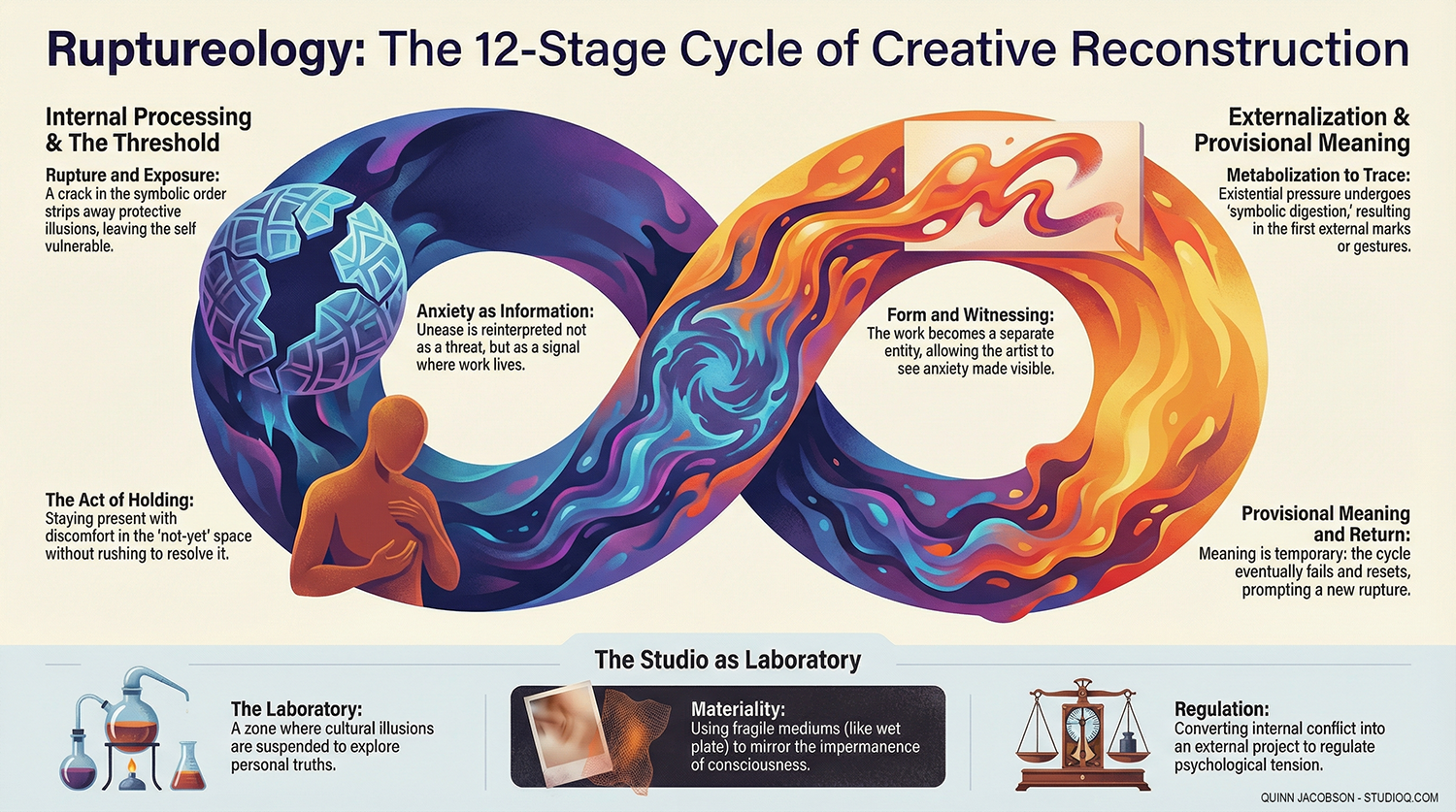
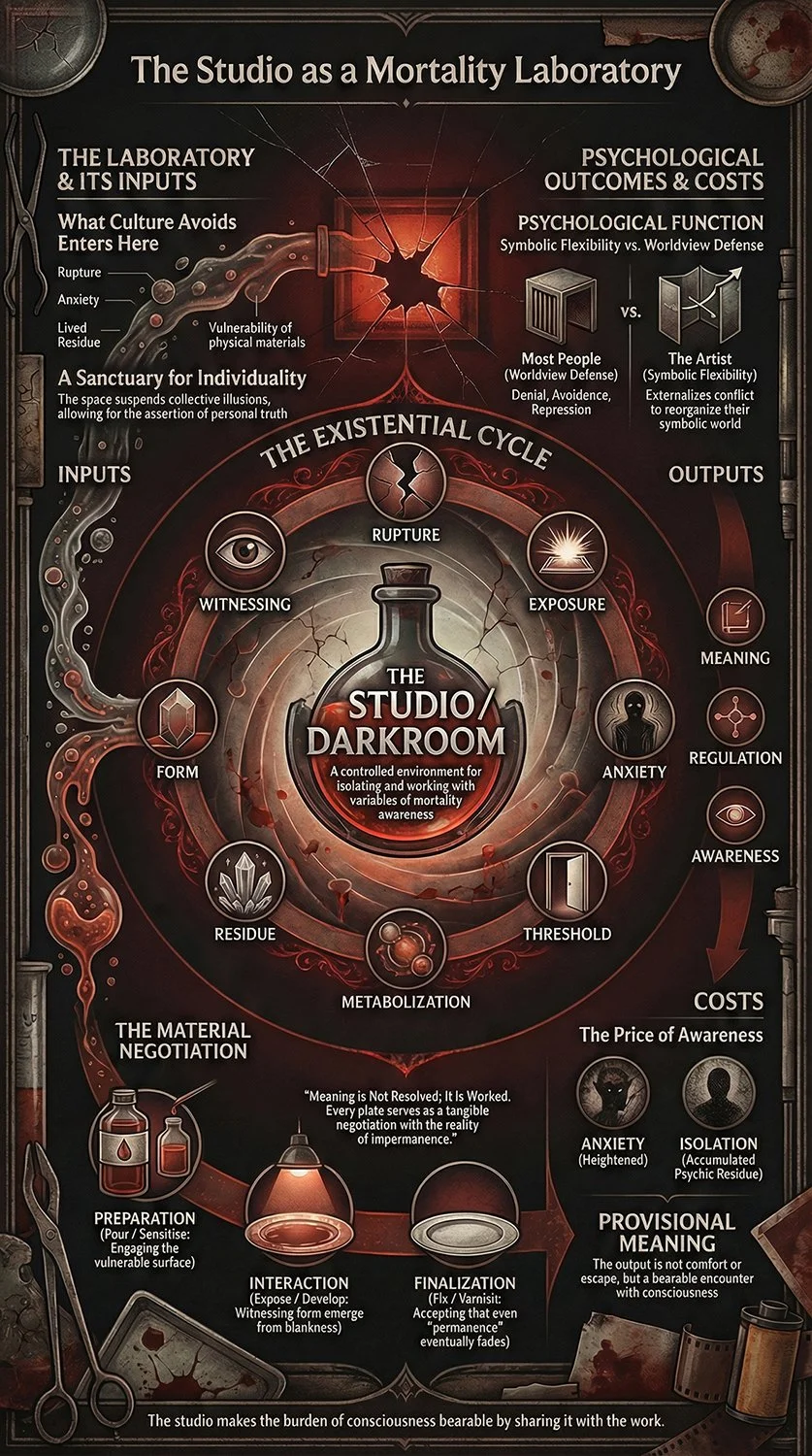
Rupture is not simply a wound; it’s the generative moment when denial collapses and creation begins. It’s the place where death anxiety, cultural myth, and personal memory are transmuted into presence. Within rupture, the artist becomes a witness rather than a defender, turning from the fantasy of permanence toward the truth of impermanence. In that shift, art no longer seeks to outlive death; it becomes a form of living with it.

Otto Rank’s distinction between the artist and the neurotic illuminates this process. Both encounter rupture, the psychic shattering that comes when one’s symbolic world no longer holds, but only the artist metabolizes it. Where the neurotic internalizes and chokes on anxiety, the artist transforms it into form. The creative act becomes a means of surviving truth, of remaking coherence in the face of its undoing. Ernest Becker described culture as a shield against mortality; I see art as the moment that shield cracks. The fracture is not failure but revelation, an aperture where something honest can enter.

My work with wet collodion lives inside that aperture. The process itself enacts rupture: collodion, glass, silver, and time. Each plate holds the risk of loss. The collodion might peel, the image might fog, and the light might fail. Yet those failures become evidence of life. The surface bears the marks of both fragility and endurance, transparency and strength. Each plate is a negotiation between control and surrender, between the impulse to preserve and the inevitability of decay. To work in this way is to accept that every act of making is also an act of unmaking. I’m connecting deeply to these ideas and am excited to see where it takes me.

In Art & Theory, Arts-Based Research, Collodion Negatives, Death Anxiety, Ernest Becker, Existential Art, Metabolizing anxiety, New Mexico, Otto Rank, PhD, Salt Prints Tags Ruptureology, rupture, Rupturegenesis, Wet Plate Collodion Negatve, Salt Print
Comment

Search Posts

Archive Block
This is example content. Double-click here and select a page to create an index of your own content. Learn more
Post Archive
  • Photography
 

Featured Posts

Featured
Jan 31, 2026
Glass and Gold - Glass Prints
Jan 31, 2026
Jan 31, 2026
Jan 28, 2026
A Film You Should Watch
Jan 28, 2026
Jan 28, 2026
Jan 27, 2026
My New Books for 2026
Jan 27, 2026
Jan 27, 2026
Jan 26, 2026
The Dimmer Switch Explained
Jan 26, 2026
Jan 26, 2026
Jan 24, 2026
Holding Pattern
Jan 24, 2026
Jan 24, 2026
Jan 19, 2026
The Sacred Didn’t Vanish - It Migrated
Jan 19, 2026
Jan 19, 2026
Jan 19, 2026
Animality: The Part of Us We Keep Trying to Forget
Jan 19, 2026
Jan 19, 2026
Jan 17, 2026
Working With Academia Without Being Rewritten
Jan 17, 2026
Jan 17, 2026
Jan 12, 2026
The Red Hand Problem
Jan 12, 2026
Jan 12, 2026
Jan 4, 2026
Immortality Projects and Creative Works
Jan 4, 2026
Jan 4, 2026