“Army Targets (Uncle Sam in the Fog of War),” acrylic and mixed media on canvas, 2025 (detail from the larger 30” x 40” canvas)
A Question To Contemplate
Question: What if we didn't know we were going to die?
I've been wrestling with this question for a while now. I’m sitting in my studio surrounded by my large-format cameras, lenses, and half-finished canvases, drawings, and pieces of ideas, feeling the persistent hum of mortality that seems to drive every mark I make and every plate I expose.
Becker wrote about our knowledge of death as the fundamental human condition—the thing that separates us from every other creature on this planet. But what if that knowledge simply wasn't there? Like your dog sprawled in the afternoon sun, or your cat stalking a shadow, or a lion moving through the African grasslands. They have no concept that they're finite beings. All they know is the immediate drive to survive and reproduce (and we have that too).
Imagine it. Really imagine it. You wake up tomorrow with no concept that your body will one day stop working, that your consciousness will end, that there's a finite number of sunrises ahead of you. How would you move through the world? What would the world look like?
I think about my own creative practice, how much of it is driven by the need to leave something behind to create meaning in the face of the void. Would I still feel that urgent pull to the canvas and the darkroom if death weren't whispering over my shoulder? Would any of us create anything at all?
Consider this: Would we still build monuments? The pyramids exist because pharaohs knew they would die and wanted to transcend that fate. Would we have cathedrals, symphonies, novels—these desperate attempts to touch immortality through art? Or would we live in a world of immediate gratification, where nothing needed to outlast us because we couldn't conceive of not lasting?
Think about love, too. So much of our romantic intensity comes from knowing our time together is limited. "Till death do us part" only has meaning because we understand death exists. Would we love as fiercely if we believed we had infinite time with someone? Would we love at all, or would relationships become casual arrangements since there'd be no urgency, no preciousness born from scarcity?
What about progress? Every scientific breakthrough, every medical advance, every technological leap forward—aren't these all responses to our limitations, including our ultimate limitation of mortality? We cure diseases because we fear death. We explore space because we dream of transcending our earthly expiration date. We pass knowledge to our children because we know we won't be here forever to guide them.
Without death consciousness, would we become a species of eternal children, living only in the present moment like animals do? There'd be no anxiety about wasting time because we wouldn't understand that time could be wasted. No existential dread, no midnight terrors, no desperate searches for meaning. But also no urgency, no drive to become more than we are.
I keep coming back to this in my work. Every painting I create carries within it the knowledge that both the artist and the viewer will someday be gone. That tension between permanence and impermanence—it's what gives art its power. Strip away death awareness, and do we lose the very thing that makes us human?
But here's what really haunts me: Would we be happier? Becker argued that our knowledge of death creates neurosis, depression, and the endless search for ways to deny our mortality through heroism and meaning-making. Without that knowledge, would we live in a state of pure being, untroubled by the existential weight that crushes so many of us?
Or would something else emerge to fill that void? Some other awareness, some other source of meaning and motivation that we can't even imagine because death looms so large in our current consciousness?
I want to hear from you. Sit with this question for a moment. Let it unsettle you the way it's unsettled me.
What do you think would change? What would we lose? What might we gain?
Would art exist without death anxiety driving it? Would you have the same intensity? Would we still reach for the stars, or would we be content to never leave the ground?
Share your thoughts. Challenge my assumptions. Push this question further than I have. Because if there's one thing I've learned in exploring these ideas, it's that the most profound questions are meant to be wrestled with together, not solved in isolation.
What would we become if we didn't know we were going to die?

“The Rejection of Freedom,” 2005
For Albert Camus, suicide was the rejection of freedom. He thought that fleeing from the absurdity of reality into illusions, religion, or death was not the way out. Instead of fleeing the absurd meaninglessness of life, he thought that we should embrace life passionately.
Putting Lipstick On a Pig
You’ve heard the saying, right? “Putting lipstick on a pig.” Trying to dress something up to make it more palatable or appealing when, deep down, it’s still just a pig (no offense to pigs). No matter how much gloss or glitter you apply, the truth remains stubbornly beneath the surface. It’s a futile act of denial. Yet, we do it anyway. Why? Because facing reality, raw and unfiltered, is terrifying.
Let’s get real for a moment. What are you putting lipstick on? Your art? Your career? Your relationships? Maybe even yourself? I’d bet there’s at least one thing in your life you’re trying to disguise, hoping it’ll pass muster under closer scrutiny. But here’s the uncomfortable truth: if you know, others probably do too. We’re not as good at hiding as we think we are.
For years, I tried to dress things up to make my work—and myself—look more appealing, more acceptable. It’s exhausting. Worse, it’s dishonest. The turning point for me came through my obsession with art, philosophy, and psychology. They handed me an unexpected gift: the ability to toss the lipstick in the trash and embrace life for what it is—fully and unconditionally.
There’s a strange, profound freedom in stripping everything down to its essence. It’s about knowing who you are, what you’re doing, and most importantly, why you’re doing it. It’s about standing firmly in your truth—warts, wrinkles, and all. Of course, none of this erases the existential dread we all carry. But it lets you face it head-on, without pretense.
Don’t get me wrong. I’m not a sage possessing all the answers; far from it. I’m as susceptible to the human condition as anyone else. Death anxiety, self-doubt, the gnawing ache of impermanence—it’s all there. But here’s the difference: I’ve stopped fighting it. I’ve stopped pretending it’s not there. Instead, I acknowledge it, sit with it, and even let it guide me. It’s not about triumphing over these fears but learning to live with them, unvarnished and unapologetic.
So, what would happen if you ditched the lipstick? What would your art, your life, or your relationships look like if you let them be exactly what they are? No dressing up, no cover-ups, just the raw, unadulterated truth. It’s scary, sure. But maybe, just maybe, it’s also the most honest and liberating thing you’ll ever do.
Jean-Paul Sartre said, "Man is condemned to be free." That freedom, for Sartre, is both exhilarating and terrifying because it comes with the weight of full responsibility. There’s no script, no preordained path—just the choices we make and the truths we embrace. In the context of ditching the lipstick, Sartre’s idea of freedom means owning your life completely, without excuses or illusions. It’s not about perfection or acceptance from others; it’s about the radical act of living authentically, no matter how messy or unpolished it looks.
When you accept this freedom, you also accept the burden of it. You’re no longer hiding behind societal expectations or personal delusions. You’re standing in the open, exposed, with all your imperfections on display. But in that vulnerability lies the real beauty. Because when you create—whether it’s art, relationships, or meaning itself—from a place of authenticity, you’re not just living; you’re transcending. That’s the kind of freedom Sartre was talking about. And maybe that’s the kind of freedom we all need to stop putting lipstick on pigs and start facing life as it really is—can you imagine?
Dance in the mystery of it all! Embrace the absurd—revolt against the meaninglessness!
The Studio Q Show LIVE! August 3, 2024 at 1000 MST
Join Quinn on Saturday, August 3, 2024, for an hour and explore the relationship between creative and non-creative people and how they cope with mortality. Quinn will cover some of Ernest Becker's thoughts on Otto Rank's breakdown of how artists manage their anxiety about death.
Stream Yard: https://streamyard.com/rdy5fe8ipy
YouTube: https://www.youtube.com/live/FPPpLUQFz7U?si=uJZIftVEZFMVHzHs
“Existential Dread No. 5,” 8” x 10” acrylic and charcoal on paper.
Existential Dread No. 5
There is something that I find both intriguing and fascinating about non-objective abstracts. Yesterday, I posted my representational abstract, “The Ballad of Curtis Loew,” based on a song and memory. This is a painting I did today based on an idea from within me—nothing representational or based on anything physical, at least when I started the painting. I’ll let the viewer decide what they see or feel in reference to the title. I have to say, I do love the underpainting on this. It gives the piece a lot of depth. It looks really nice in real life.
In the context of evolution, human existential crises may arise from our heightened cognitive abilities and self-awareness. As humans developed intricate thinking processes and self-reflective capacities, an increased awareness of mortality, the quest for meaning, and contemplation of one's existence became more pronounced. While an existential crisis isn't necessarily a flaw, it can be viewed as a consequence of our advanced cognitive functions. It might function as a mechanism for individuals to scrutinize and assess their position in the world, fostering personal growth and the formulation of coping strategies. In this regard, it can be perceived as a beneficial function that motivates individuals to explore purpose and meaning in their lives.
Ernest Becker said, “What does it mean to be a self-conscious animal? The idea is ludicrous if it is not monstrous. It means to know that one is food for worms. This is the terror: to have emerged from nothing, to have a name, a consciousness of self, deep inner feelings, an excruciating inner yearning for life and self-expression, and with all this yet to die. It seems like a hoax, which is why one type of cultural man rebels openly against the idea of God. What kind of deity would crate such complex and fancy worm food?” (The Denial of Death)
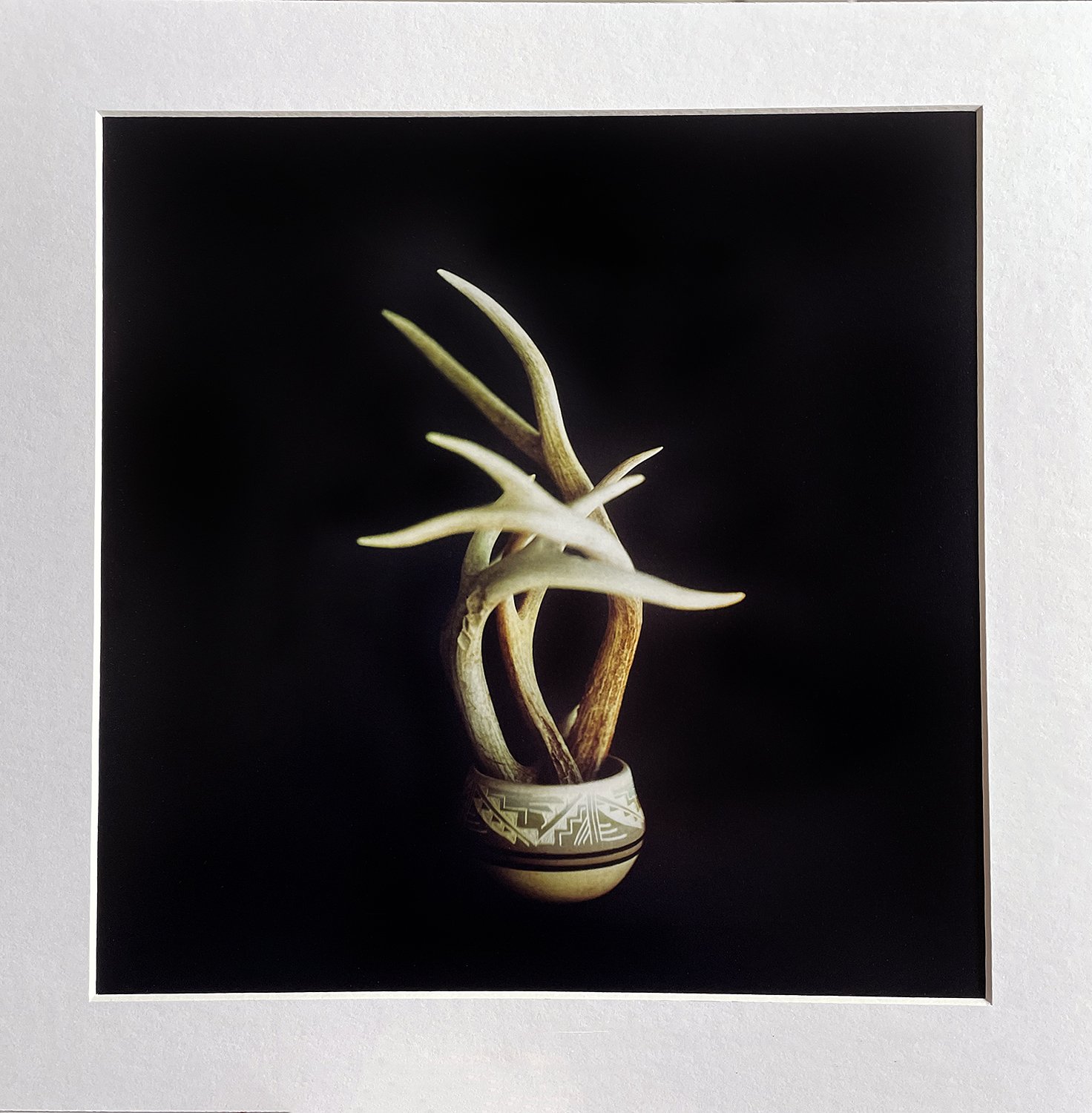
“Deer Antlers in Ute Pot: Print #1,” 10” x 10” (25,4 x 25,4 cm) RA-4 Reversal Direct Color Print August 5, 2023
I’ve always found the shape of antlers interesting. The function of them fascinates me too. Mule deer are all around me in this area. I see them every day. All of the bucks are in "velvet" now. Velvet antler is defined as a growing antler that contains abundant blood and nerve supply and has fully intact skin with a covering of soft, fine hair. As the antlers develop, they're covered by a nourishing coat of blood vessels, skin, and short hair known as velvet—this supplies nutrients and minerals to the growing bone. When antlers reach their full size in late August or September, the velvet is no longer needed.
Shaping Objects With Light and Making Ideas Real
Art gives us the ability to create ideas and physically manifest them. Think about that: the ability to make something that exists only as a thought or an idea. That is mind-twisting! In my opinion, it’s a good definition of the word magic. See Becker’s quote below.
“Man has “a mind that soars out to speculate about atoms and infinity, who can place himself imaginatively at a point in space and contemplate bemusedly his own planet. This immense expansion, this dexterity, this ethereality, this self-consciousness gives to man literally the status of a small god in nature... Yet, at the same time... man is a worm and food for worms.”
It can be any form of expression—writing, sculpting, painting, music, photography, etc. Something that engages one or several of our senses. When I was young—10 or 12 years old—I wanted to be a figure sculptor. I got very interested in wax as a material. I visited a wax museum in Orlando, Florida, and I believe it was converted to Madame Tussauds a few years ago.
I was hooked. It was something about seeing the human figure re-created in such a way that you could really study it—almost feel its presence. There were Star Trek figures there; that’s what got me. I had my Polaroid portrait made with Spock. I still have that picture. It moved me tremendously.
One of my favorite things to do is use light to shape objects and bring out the essence of what they are or could be. So many people simply expose a picture and hope for the best. I think that takes so much of the creativity away. It turns creating something into a mechanical exercise.
“Deer Antlers in Ute Pot: Print #2,” 10” x 10” (25,4 x 25,4 cm) RA-4 Reversal Direct Color Print August 5, 2023
"The tragedy of a species becoming unfit for life by over-evolving one ability is not confined to humankind. Thus, it is thought, for instance, that certain deer in paleontological times succumbed as they acquired overly-heavy horns. The mutations must be considered blind; they work and are thrown forth without any contact of interest with their environment. In depressive states, the mind may be seen in the image of such an antler, in all its fantastic splendor, pinning its bearer to the ground."
Peter Zapffe, The Last Messiah
The species of deer that Zapffe has in mind is the Irish elk (Megaloceros giganteus), which thrived throughout Eurasia during the ecological epoch known as the Pleistocene (2.6 million to 11,700 years ago). The Irish elk had the largest antlers of any known deer, with a maximum span of 3.65 meters. Historically, the explanation given for the extinction of the Irish elk was that its antlers grew too large: the animals could no longer hold up their heads or feed properly; their antlers, according to this explanation, would also get entangled in trees, such as when trying to flee human hunters through forests.
A surplus of consciousness and intellect is the default state of affairs for the human species, although unlike the case of the deer that Zapffe alludes to, we have been able to save ourselves from going extinct. Zapffe posits that humans have come to cope and survive by repressing this surplus of consciousness. Without restricting our consciousness, Zapffe believed the human being would fall into “a state of relentless panic” or a ‘feeling of cosmic panic’, as he puts it. This follows a person’s realization that “[h]e is the universe’s helpless captive”; it comes from truly understanding the human predicament. In the 1990 documentary To Be a Human Being, he stated:
"Man is a tragic animal. Not because of his smallness, but because he is too well endowed. Man has longings and spiritual demands that reality cannot fulfill. We have expectations of a just and moral world. Man requires meaning in a meaningless world."
The Irish elk (Megaloceros giganteus), which thrived throughout Eurasia during the ecological epoch known as the Pleistocene (2.6 million to 11,700 years ago). The Irish elk had the largest antlers of any known deer, with a maximum span of 3.65 meters.
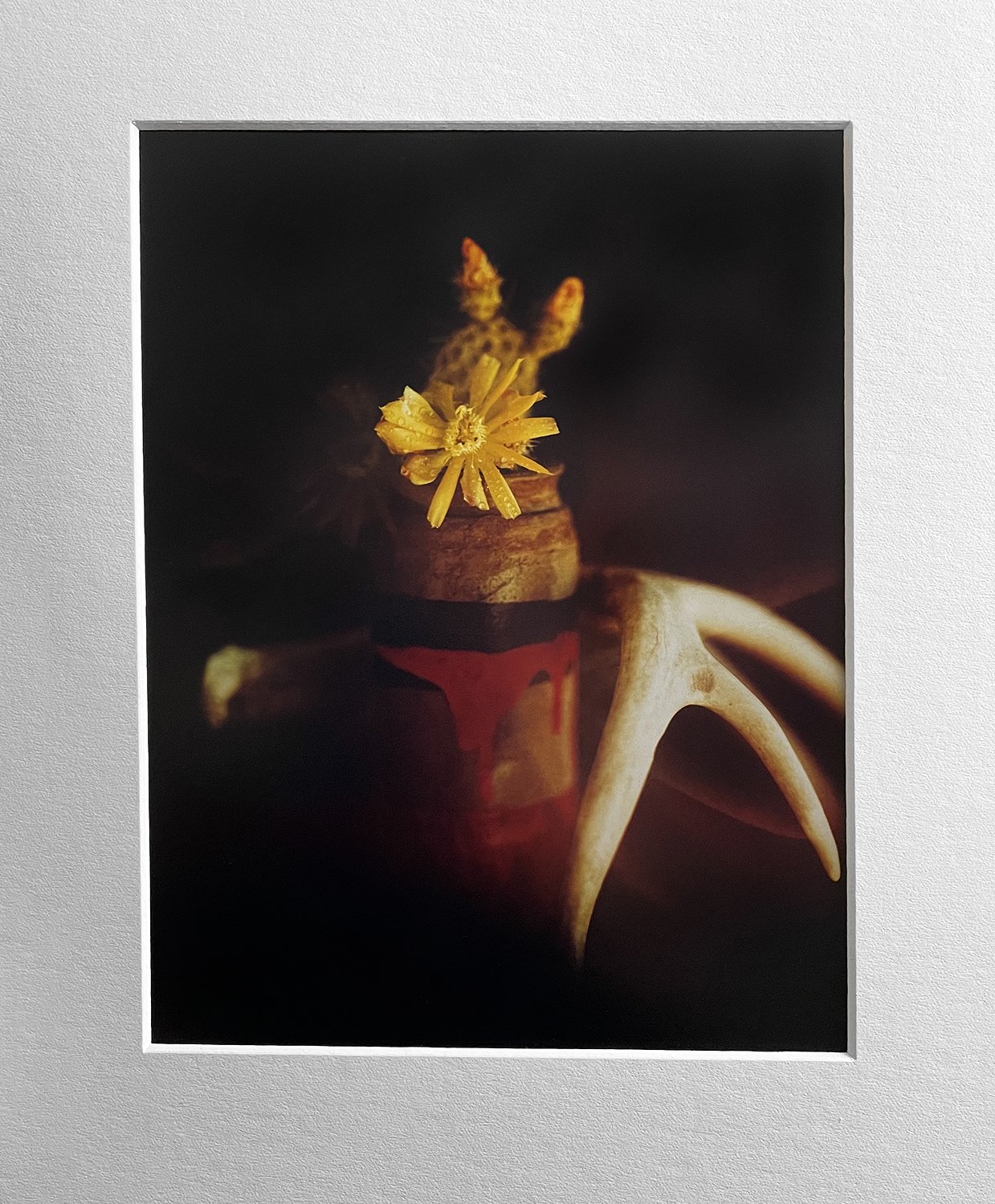
“Flowering Prickly Pear Cactus, Water Vase, and Antlers,” 10” x 10” (25,4 x 25,4 cm), RA-4 Reversal Direct Color Print, July 7, 2023. If you look close, you can see what I’m experimenting with. I exposed the paper backwards—exposing through the paper—and then exposed it again with the emulsion forward. It looks really great in your hand.
Meaning and Significance: Why We Need It and How We Find It
“Did you know the uniquely human fear of death has a pervasive effect on human beings’ thoughts, feelings, and behavior? Humans manage the terror of death by adhering to culturally constructed beliefs about reality that provide a sense that one is a person of value in a world of meaning and thus eligible for either literal or symbolic immortality. The quest for immortality underlies some of humankind’s most noble achievements. It also, however, engenders some of our most ignominious affectations, including hostility and disdain for people with different beliefs; attraction to ideological demagogues; indifference to, or contempt for, the natural environment; and the mindless pursuit of material possessions—which, if unchecked, may render humans the first form of life responsible for their own extinction.”
Sheldon Solomon, PhD, Author of "The Worm at the Core: On the Role of Death in Life"
Last year, I had Sheldon as a guest on my YouTube channel. We had a discussion about the importance of Becker's theories for creative individuals, especially photographers. It was a great conversation, and I would like to have him on again.
I have two main objectives for my book: firstly, I want to explain these theories in simple terms that anyone can understand. Secondly, I want to show how these theories were directly involved in the mass killings and massacres of Native Americans during the nineteenth and twentieth centuries in the western United States. Additionally, I explore how these theories impact artists and other creative people, albeit in a slightly different way.
“Did you know the uniquely human fear of death has a pervasive effect on human beings’ thoughts, feelings, and behavior? Humans manage the terror of death by adhering to culturally constructed beliefs about reality that provide a sense that one is a person of value in a world of meaning and thus eligible for either literal or symbolic immortality. The quest for immortality underlies some of humankind’s most noble achievements. It also, however, engenders some of our most ignominious affectations, including hostility and disdain for people with different beliefs; attraction to ideological demagogues; indifference to, or contempt for, the natural environment; and the mindless pursuit of material possessions—which, if unchecked, may render humans the first form of life responsible for their own extinction.”
I’m making most of these color flora prints with the 10” x 10” Chamonix camera and an 1874 Dallmeyer 3B lens.
Let's talk about the concept of meaning in life. For me, meaning implies that our existence has a purpose and makes sense. On the other hand, significance refers to being noticed and considered important. Our greatest fear is to live in a world that lacks meaning and significance, often referred to as "death anxiety." Essentially, we are unconsciously terrified of impermanence and insignificance.
Throughout thousands of years, humans have undergone psychological evolution as part of their overall development. Our brains have evolved to have a large neocortex, but we have also suppressed the awareness of our mortality in order to function in our daily lives. Thomas Ligotti, in his book "The Conspiracy Against the Human Race," said, "For the rest of the earth’s organisms, existence is relatively uncomplicated. Their lives are about three things: survival, reproduction, death—and nothing else. But we know too much to content ourselves with surviving, reproducing, dying—and nothing else. We know we are alive and know we will die. We also know we will suffer during our lives before suffering—slowly or quickly—as we draw near to death. This is the knowledge we “enjoy” as the most intelligent organisms to gush from the womb of nature. And being so, we feel shortchanged if there is nothing else for us than to survive, reproduce, and die. We want there to be more to it than that, or to think there is. This is the tragedy: Consciousness has forced us into the paradoxical position of striving to be unself-conscious of what we are—hunks of spoiling flesh on disintegrating bones." It is a paradox. We possess incredible intelligence, yet we are aware that we will eventually die. This is a difficult reality to accept, and we tend to deny and reject it. However, death is an inevitable part of life for all of us.
The “scene” photographed with an iPhone to give you an idea of my working environment.
So, how do we deal with this existential dilemma? The answer lies in culture. Every culture, and there are countless diverse cultures around the world, provides its people with ways to alleviate their death anxiety or existential dread. These "cultural worldviews," as Becker calls them, serve as intricate distractions or illusions that prevent us from consciously dwelling on the subject of death (especially our own). You may be reading this right now and thinking, "What is he talking about? I rarely think about death; I don’t have death anxiety!" Exactly. That means you have a cultural worldview you are clinging to tightly and are ensconced in—protected from the thoughts of death by the cultural constructs you believe in and participate in—and it works well!
What are these cultural worldviews? They are anything that your in-group shares as reality. It’s what you and the people around you believe to be important. The most potent are religion, politics, nationalism, family (having children), money, fame, looks, etc. These worldviews usually provide ways to gain symbolic or literal immortality and give us a road map to follow in our lives. Ernest Becker said, "No wonder men go into a rage over fine points of belief: if your adversary wins the argument about truth, you die. Your immortality system has been shown to be fallible; your life becomes fallible." Cultures reward good behavior (things that the group believes in) and punish bad behavior. Remember, what’s “good” or “bad” in your culture may be very different from someone else's. Read about the “Flute Ceremony” versus the “Bar Mitzvah” in Sheldon’s book “The Worm at the Core: On the Role of Death in Life.” This is where the conflict begins.
In order for us to get out of bed in the morning, we need meaning. And we need to feel like we are part of something important. If we don’t have meaning and significance, there’s a good chance we’ll fall into depression and other mental health issues. The takeaway is this: Be conscious of what you’re choosing to lean on—your cultural worldview—to bolster your self-esteem and stave off existential dread; it can lead to good things or bad things. It’s very easy to adopt the malignant worldviews of racism, hate, scapegoating, and othering. It’s easy to fall into the cultural trap of treating people who are different from you badly. If we’re conscious of these psychological pressures, we can make good choices and allow other people to find good, healthy, non-destructive ways to buffer their death anxiety. Awe, gratitude, and humility go a long way as buffers and do no warm to other people.
“For the rest of the earth’s organisms, existence is relatively uncomplicated. Their lives are about three things: survival, reproduction, death—and nothing else. But we know too much to content ourselves with surviving, reproducing, dying—and nothing else. We know we are alive and know we will die. We also know we will suffer during our lives before suffering—slowly or quickly—as we draw near to death. This is the knowledge we “enjoy” as the most intelligent organisms to gush from the womb of nature. And being so, we feel shortchanged if there is nothing else for us than to survive, reproduce, and die. We want there to be more to it than that, or to think there is. This is the tragedy: Consciousness has forced us into the paradoxical position of striving to be unself-conscious of what we are—hunks of spoiling flesh on disintegrating bones.”
“Flowering Prickly Pear Cactus and Water Vase,” 10” x 10” (25,4 x 25,4 cm), RA-4 Reversal Direct Color Print, July 7, 2023. If you look close, you can see what I’m experimenting with. I exposed the paper backwards—exposing through the paper—and then exposed it again with the emulsion forward. It looks really great in your hand.
“An Eruption from Quartz,” May 10, 2023, 10” x 10” (25,4 x 25.4 cm) (Made in camera, no negative) RA-4 Reversal Color Direct Print. I’m using 19th-century Petzval lenses to make these images. I’m looking at consciousness from a visual perspective, and I find myself pondering the Full Theory of Mind and the first time humans became aware of death.
Understanding the Relationship Between Words and Pictures
There are some people who believe you don’t need any words or explanations (context) with art. Period. I understand that, at least to a certain extent. However, that statement lacks context, to put it mildly. It’s too broad of a statement to include all art.
I would argue that it depends on your goal and who your audience is, or who you want to see the work and who speaks your language (creative language). If you want to make pictures and say nothing, simply post them, publish them, or exhibit them, you can. You’re allowing the audience to interpret or create a narrative for the work. Remember, text taken out of context is pretext. In other words, people will make up context for your work or ignore it completely. Imagine trying to read a book or watch a movie with no plot, no beginning, middle, or end. No story. In my opinion, few people would be interested in that kind of material unless it was connected to a larger concept in some meaningful way.
I believe all artists (and humans in general) are storytellers at their core. We create stories, or illusions, to explain our lives, to make sense of them, and primarily to repress our existential dread. We need to tell stories; they make us human (Homo sapiens). Artists are acutely aware of this need. They pursue it with purpose and meaning, trying to squeeze everything out of life that they can. Expressing their greatest fears, their biggest questions, and their greatest joy and love of beauty.
“An Eruption from Quartz-Detail,” May 10, 2023, 10” x 10” (25,4 x 25.4 cm) (Made in camera, no negative) RA-4 Reversal Color Direct Print. I’m using 19th-century Petzval lenses to make these images. Thinking about death evokes a flood of dread and terror for most people. Death awareness seems antithetical to our existence. Humans have evolved psychologically to repress death awareness and embrace their cultural illusions.
There is no “rule” or set way to tell a story. You can drizzle and drip paint on a canvas, or even paint a canvas black or white and reveal or tell a story. You can make abstract, blurry pictures or shape clay into some abstract form. It’s about context. It comes down to your narrative and your audience. All art is not for everyone—it’s never “one size fits all.” It’s a language as unique as spoken and written languages. If your “art” is appealing to the masses, it’s probably some form of “commercial art” consumable by most everyone. This essay is about personal, fine art work.
The artist has a specific audience that will understand and appreciate the art. Some audiences understand and appreciate documentary work. This is probably more of a stretch than most would make, but I think of Diane Arbus, Richard Avedon, Mary Ellen Mark, and many more who worked in the blurry (no pun) area between art and documentary work. No one, at least I think no one, would argue their pictures are art; they tell a story and are powerful pieces of work. And then there are artists like Jackson Pollock or Mark Rothko who demand more interpretation and investigation. Pollock’s work is about the paint itself and his movement. We’re used to seeing paint represent something, but Pollock challenges us with his work. Rothko believed that his paintings could communicate a spiritual or emotional experience to the viewer, and he often titled his works with evocative, poetic titles that suggested a deeper meaning beyond the surface of the canvas. Many of his paintings are untitled, however, leaving the interpretation up to the viewer. His paintings are a powerful exploration of color, form, and emotion, and they continue to captivate and inspire viewers today. These artists are on the other end of the spectrum of what I’m talking about, but they still adhere to my thesis. Most people won’t spend time with work like theirs; it’s too abstract, and the viewer feels they have no context for the work, which is true. In reality, the viewer isn’t equipped to appreciate or understand the work. Part of it is interest in the work, and the other part is education. Learning their language so you can appreciate their work is a big part of it. Like I said, art consists of as many languages as there are artists. Not everyone speaks that many languages.
“Fireworks in Red and Yellow,” May 10, 2023, 10” x 10” (25,4 x 25.4 cm) (Made in camera, no negative) RA-4 Reversal Color Direct Print. I’m using 19th-century Petzval lenses to make these images. Awareness of death has such a pervasive influence on our lives. Most people rarely think about their deaths. They embrace their culture, bolster their self-esteem, and numb themselves to life’s reality: death.
“Dead Daisies: A Firework of Consciousness,” May 8, 2023, RA-4 Reversal Color Direct Print, 10” x 10” (25,4 x 25,4 cm). This image is a metaphor for consciousness for me—a visual of how we “expand” our awareness, a “firework” of consciousness. Death is such a mystery. That’s why we fear it so much—we don’t know what happens, if anything, after we die.
We do know that we have what the philosophers call “existential guilt” for making decisions in our lives, good or bad, or not making them. Existential guilt is a feeling of guilt or remorse that arises from a sense of responsibility for one's own existence and the choices one has made in life. It is a form of guilt that is related to the realization that one's actions, or inaction, have contributed to the course of one's life and the lives of those around them.
Existential guilt is often associated with the philosophical concept of existentialism, which emphasizes individual freedom and choice, and the responsibility that comes with it. The feeling of existential guilt can arise when an individual realizes that their choices have led them down a path that is not aligned with their values or when they feel that they have failed to live up to their own expectations.
Existential guilt can also arise from a sense of guilt about one's own mortality or the inevitability of death. This can be a difficult emotion to deal with, as it can lead to feelings of anxiety, depression, and a sense of futility. However, by acknowledging and accepting these feelings, individuals can work towards finding meaning and purpose in their lives.
Culturally Constructed Meat Puppets and Martin Heidegger
Reading through The Worm at the Core brings awareness to so many other ideas and extensions of these theories. I’ve been getting into Martin Heidegger and his ideas lately. His book (a set of lectures), “Being and Time” is available on archive.org. Forewarning: It’s a difficult book to read. It’s dense, and I don’t understand a lot of it. It was originally written in German, and the translator claimed that it was very difficult to translate into English (some say it’s impossible to translate). He was an extraordinary thinker—way beyond my capabilities to understand. There are some “nuggets” in the book. One of them, pointed out by Sheldon Solomon, is the quote in this essay. That’s what I’m most intrigued by.
Having lived in Germany and having a basic understanding of the language, the word “angst” is used a lot in his writing. I’ve always understood the word to mean “fear.” Most translate it to “anxiety.” What it really means is a feeling of uneasiness, or "dis-ease," or a feeling of not “being at home” (not in the literal sense of home, but psychologically). Heidegger gives a clear and compelling solution to overcoming, or at least coming to terms with, death and death anxiety. Kierkegaard offered a solution of taking a “leap into faith,” and Heidegger offers the same idea, but instead of faith, he says, “take a leap into life.” You can read the deconstruction of his philosophy below.
Another thing that I’ve been giving thought to is a “flowchart” of terror management theory. Breaking it down into a simple, line-by-line evolution of what happens to human beings in life as it applies to coping with the knowledge of death:
You were born.
You cry, scream, and shake; miraculously, a “deity figure(s)" (parents or caregivers) appears and your diaper is changed, you’re fed, or you're cuddled. Life is good.
You grow older and lean on your parents or caregivers for psychological security as well as all of your Maslow needs (shelter, food, warmth, etc.).
You grow through childhood and the teenage years, learning how to bolster your self-esteem. Your parents or caregivers provide the framework and reward for this. For example, when you learn to use the toilet, “Good boy or girl!” You earn top grades on your schoolwork. “Great job!” You go to the school prom, and everyone says, “You look so pretty or handsome!” This bolsters your self-esteem; you feel significant and have meaning in your life. Death anxiety is held at bay.
You learn how to respect and honor your country or tribe (Americans put their hands over their hearts and say “the pledge of allegiance”) and the important symbols from your culture: a flag, a cross, a star, a uniform, etc.
You attend religious services with your parents and learn how to be a “good person” and how to achieve immortality through a religion; this provides psychological security and buffers death anxiety. You know that you will never really die! Life is meaningful, and I have a purpose; my religion says so!
You separate from your parents or caregivers as a young adult. Now, you look to your culture for the same psychological security that your parents or caregivers provided.
You quickly learn what your culture rewards and what it doesn’t. This is how your cultural worldview is established and maintained. For example, you might belong to a particular religion you strongly believe in or a political group you adamantly embrace. You might get a promotion at your job, be recognized as “employee of the month,” get a degree from higher education, earn a lot of money, drive a fancy car, live in a big house, get a lot of “likes” on social media, etc. These all provide self-esteem for you. Self-esteem buffers death anxiety. It’s kept repressed and buried deep in your unconscious. In fact, some of you reading this will proclaim, “What are you talking about? This doesn’t apply to me; I don’t think about death!” Exactly. See how well it works? When you’re ensconced in your cultural worldview, it will keep thoughts of death repressed, at least for the most part.
You go through life wrapped in the illusions that your culture provides—religion, community, politics, relationships, etc. They give you a feeling of significance in a meaningful world (psychological security). This keeps existential anxiety at bay, for the most part.
You are, at this point, a culturally constructed meat puppet.
If you are one of the unlucky ones or live in a culture that either doesn’t provide ways for you to bolster your self-esteem or that offers ways that are unattainable for the average person, i.e., not everyone can be a movie star, a rock star, a professional athlete, or the president of the United States, this can, and often does, extend to physical appearance as well. If you’re not thin (especially women) and stay young forever, the culture can be harsh and not only prevent you from getting self-esteem, it will point out your faults and shortcomings: you’re fat, you’re old, you're the wrong color, you have wrinkly skin and gray hair, etc.
When a person cannot find ways to bolster their self-esteem, they will often turn to drugs, alcohol, eating, shopping, narcissistic behavior, social media, and different kinds of risky behaviors. The 19th-century philosopher Soren Kierkegaard called this “tranquilizing with the trivial.” One of the reasons the United States has such a high rate of drug abuse, depression, anxiety, and deaths of despair, including those that die by suicide, is because the culture sets standards for attaining self-esteem that are not attainable for the average American.
According to Martin Heidegger, if one ceases to numb oneself to the knowledge of one's own mortality, known as "flight from death," and instead undergoes what he termed a "turning," they may discover a newfound sense of ease with death anxiety and the inherent truths of the human condition. This turning leads to a greater appreciation for life's simple yet profound pleasures, such as recognizing the beauty in virtuous individuals, the finite nature of humanity, the majesty of nature, or even something as seemingly mundane as a refreshing breeze on a sweltering day.
Both Frederick Nietzsche and Ernest Becker discussed the concept of the "authentic man" in their respective philosophical works.
Nietzsche believed that the authentic man was one who lived according to his own values and ideals, rather than those imposed upon him by society or tradition. For Nietzsche, the authentic man was a "free spirit," unencumbered by conventional morality or religious dogma. He argued that the authentic man was capable of creating his own values and living a fulfilling life, rather than being constrained by the values of others.
Becker, on the other hand, believed that the authentic man was one who had come to terms with his own mortality and the inevitability of death. He argued that in order to live a meaningful life, one must confront the reality of death and the limitations of human existence. For Becker, the authentic man was one who had overcome the fear of death and embraced life fully, without illusions or delusions.
In both cases, the authentic man is someone who is true to himself and lives a life that is genuinely his own. Nietzsche emphasizes the importance of individuality and creativity in this process, while Becker emphasizes the importance of confronting one's mortality and accepting the limitations of human existence. This is the antithesis of a culturally constructed meat puppet.
Culturally Constructed Meat Puppet
The Terror Management Theory (TMT), which is based on Becker's ideas, suggests that individuals cope with the inevitability of death by developing their self-esteem and identifying with their cultural group. This allows them to feel significant and have a sense of purpose and meaning in their lives.
However, there is a risk associated with this approach, as individuals may become "culturally constructed meat puppets" who are entirely dependent on their roles and conform to cultural standards for their sense of self-worth.
Becker's theory also explains why people tend to fear and dislike those who hold different beliefs or belong to different groups. When reminded of their mortality, people often become more strongly identified with their own groups and view outsiders as the embodiment of evil. This can result in animosity and even violence toward those who are different.
The idea of a “culturally constructed meat puppet” is meant to highlight the tension between our biological nature and our cultural aspirations. On the one hand, we are flesh-and-blood creatures that are subject to the laws of nature. On the other hand, we are aware that we need to create meaning and purpose through our engagement with our culture.
Are you a culturally constructed meat puppet? Humans are like hamsters on a wheel, spinning around and around and going nowhere—or like Sisyphus pushing the rock up the mountain only to have it roll back down over and over again. We do these things every day to distract ourselves from the knowledge of death. Beware of insatiable desires—money and stuff.
Martin Heidegger
Martin Heidegger (1889–1976) was a German philosopher who is widely regarded as one of the most important and influential philosophers of the 20th century. He is known for his highly original and complex philosophy, which deals with a wide range of topics including ontology (the study of being), phenomenology, hermeneutics (the study of interpretation), and existentialism.
Heidegger's most famous work is Being and Time, published in 1927, which is widely regarded as one of the most important philosophical works of the 20th century. In this book, Heidegger explores the nature of human existence and the relationship between being and time. He argues that human beings are fundamentally "thrown" into the world, meaning that we find ourselves in a particular time and place, and we must make sense of this situation through our own existence.
Heidegger's philosophy is highly influenced by his interest in ancient Greek philosophy as well as his experiences living in Germany during the 20th century. His political views, which included membership in the Nazi party in the early 1930s, have been the subject of controversy and criticism, but his philosophical ideas continue to be studied and debated by scholars and philosophers around the world.
“Turning away from a flight from death, you see a horizon of opportunity that puts you in a state of anticipatory resoluteness with solicitous regard for others that makes your life seem like an adventure perfused with unshakeable joy.”
This quote is a reflection of Martin Heidegger's philosophy, which places great emphasis on the concept of "being toward death." For Heidegger, death is not simply an event that happens to us at some point in the future but rather an essential aspect of our being. In other words, our mortality is not something we can escape or ignore; it is a fundamental part of who we are.
The quote suggests that if one confronts their mortality and does not try to flee from it, they may see a horizon of opportunities that can give their life a sense of purpose and direction. By embracing the inevitability of death, one can live with a sense of "anticipatory resoluteness," meaning that they are ready and willing to face whatever challenges come their way.
Additionally, Heidegger suggests that this attitude should be accompanied by "solicitous regard for others," meaning that we should also be concerned with the well-being of those around us. By living with this kind of awareness and consideration for others, one's life can become an "adventure perfused with unshakeable joy," filled with meaning and purpose.
Heidegger's quote highlights the importance of confronting our mortality and living with a sense of purpose and concern for others. It's a beautiful idea that everyone should work toward. The first step is to understand the true nature of your condition, without doing that, nothing changes.
Body and Soul: An Uneasy Alliance
“The body is the closest that we come to touching any kind of reality. And yet we have the desire to flee the body: many religions are based entirely on disembodiment, because the body brings with it mortality, fear of death. If you accept the body as reality, then you have to accept mortality and people are very afraid to do that.”
“Body and Soul: An Uneasy Alliance” is chapter 8 from “The Worm at the Core: On the Role of Death in Life,” by Sheldon Solomon, Jeff Greenberg, and Tom Pyszczynski (co-creators of terror management theory).
If you join me on Saturdays (on my YouTube channel), you’ll know that we’re going through this wonderful book and learning a tremendous amount about how knowledge of our impending deaths drives so much of our behavior, good and bad. I’m posting this as a follow-up to the reading and for those who have watched or listened to the video.
Sub-Chapters and Notes
DISTANCING FROM AND DISPARAGING ANIMALS
We regulate activities that remind us of our corporeal nature.
We alter and adorn our bodies.
We scrub ourselves to eradicate any scents except those that come from bottles or spray cans.
We use “rest” rooms to discretely dispose of bodily excretions.
We recoil in sophomoric mirth (amusement) at the sight of animals copulating.
Disgust: We are “disgusted” by far more than rotting flesh.
Bodily secretions like blood, vomit, urine, and feces are more disgusting after thinking about death.
We are determined to deny our animality. We want to separate ourselves from animals; we want to be special and superior to the “lowly” animals. Animals remind us that we will die. We hide all of our animal behavior; we have toilets, plates, forks, spoons, and cups; we shave, we wear clothes, and we disguise sex as “love.”
THE MORTIFICATION OF THE FLESH
We believe we are superior to all other life forms (Bible, created in the image of God, etc.).
Scourging purifications. Whipping the flesh, conquering the flesh—Saint Paul, “Live by the flesh, you will die, put the deeds of the body to death, and you will live.”
FOR BEAUTY, WE MUST SUFFER
We decorate our flesh with ink, piercings, scarring, etc.
We distinguish between the world of culture and the world of nature (man vs. animal).
We have a need to reduce our resemblance to animals; animals remind us of death.
Eating from the Tree of Knowledge made the naked human body shameful; it revealed the “worm at the core." - death
We go to great lengths not to look old—cosmetics, surgery, etc.
Hair: Hairy bodies have always been associated with uncivilized, amoral, sexually promiscuous, and perverted animality.
Transforming from animal to human through modifications—piercings, tattoos, and scarification—reinforces that we are more than mere animals.
Neck rings, feet, waist, and head binding permanently disable people for “beauty” and “status.”
Millions of Americans get plastic surgery every year; the need for a “youthful appearance” is paramount!
“SEX AND DEATH ARE TWINS”
Sex is both exhilarating and frightening to us.
Ernest Becker said, “Sex is of the body, and the body is of death.”
Sex is a potent symbol of our creaturely, corporeal, and ephemeral conditions.
Sex is first and foremost a glaring reminder that we are animals; next to urination and defecation, it is the closest human beings come to acting like beasts.
We recognize that animals and humans have sex in the same way.
Reproduction makes us painfully aware that we are transient ambulatory gene repositories (pass it on and die).Ernest Becker was right then when he proclaimed that “sex and death are twins." Thinking about death makes the physical aspects of sex unappealing, and considering the physical aspects of sex nudges death thoughts closer to consciousness.
We manage our death-fueled anxiety about sex by imbuing it with symbolic meaning, transforming it from the creaturely to the sublime, thereby making it psychologically safer.
We transform sex into a cultural ritual, making it less animalistic.
Animal lust becomes human love.
LA FEMME FATALE
Women’s bodies and sexual behavior are especially subject to rules and regulations.
Men have always made the rules, and women arouse sexual lust in them.
Disgust with menstruation and lactation: a lab study
From time immemorial, men have utilized their superior physical strength, political power, and economic clout to dominate, denigrate, and control women, as well as using women to serve as designated inferiors in order to prop up their self-esteem.
Women make men hard, and this makes it hard for men to ignore their own animality.
The reason so many men are misogynistic is because they are reminded of sex when encountering women, they are threatened by this.
Men are reminded of their animality through the sexual arousal of women and are reminded of their impending death.
Many major religions belittle women, making them subject to men.
Widespread patterns of violence against women may well be partially rooted in men’s sexual ambivalence; the conflict between lust and the need to deny animality makes men uncomfortable with their own sexual arousal.
Being an embodied animal aware of death is indeed difficult. We simply cannot bear the thought that we are biological creatures, no different from dogs, cats, fish, or worms. Accordingly, people are generally partial to views of humans as different from and superior to animals. We adorn and modify our bodies, transforming our animal carcasses into cultural symbols. Rather than thinking of ourselves as hormonally regulated gene reproduction machines bumping and grinding our way toward oblivion, we “make love” to transform copulation into romance. And when women ooze hormones, blood, and babies, men blame them for their own lustful urges, which serves to perpetuate negative stereotypes about and justify abuse of women.
The terror of death is thus at the heart of human estrangement from our animal nature. It isolates us from our own bodies, from each other, and from the other creatures with whom we share noses, lips, eyes, teeth, and limbs everywhere on the planet.
“Humans cannot live without illusions. For the men and women of today, an irrational faith in progress may be the only antidote to nihilism. Without the hope that the future will be better than the past, they could not go on...
Humanists like to think they have a rational view of the world; but their core belief in progress is a superstition, further from the truth about the human animal than any of the world’s religions. Outside of science, progress is simply a myth.”