
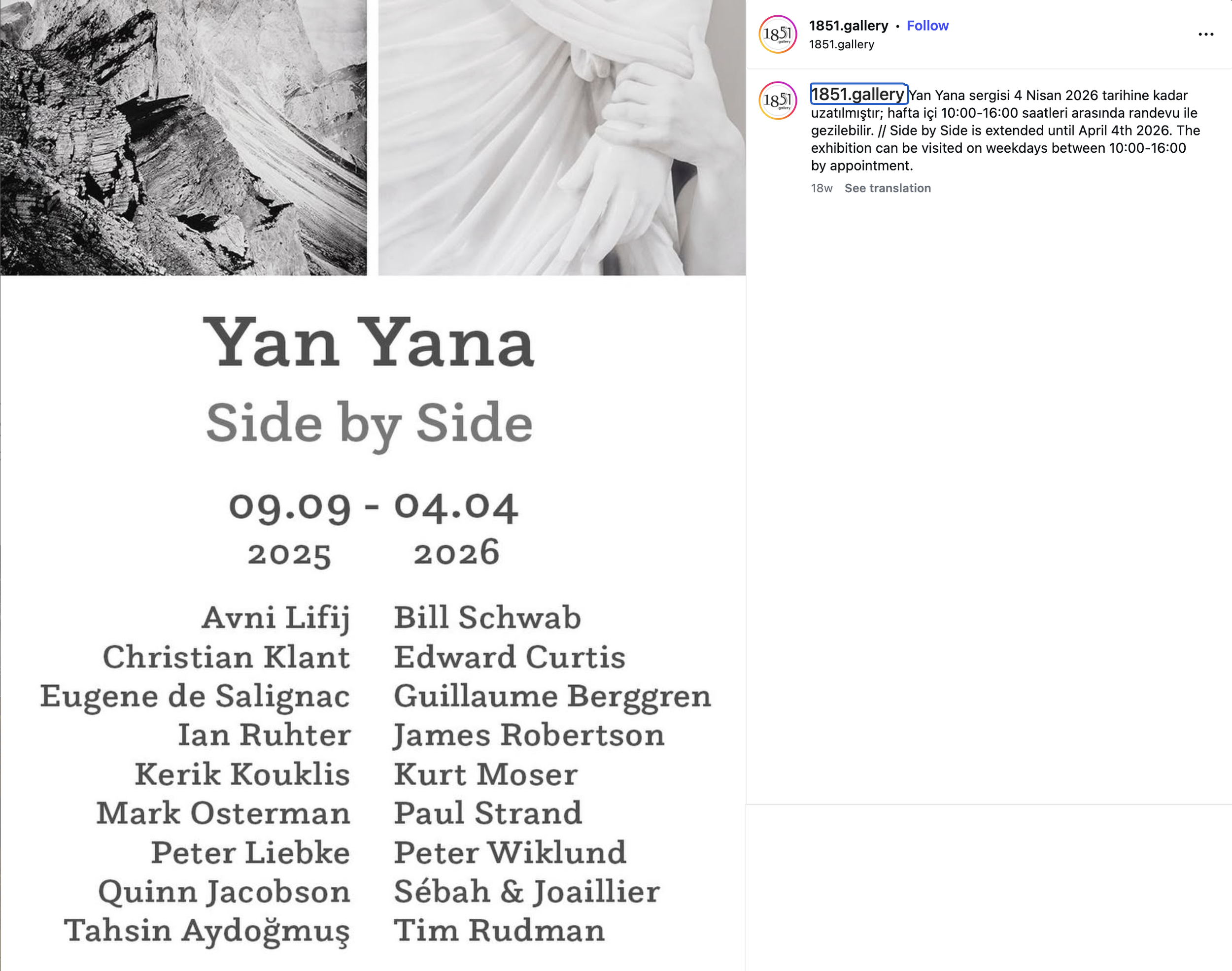
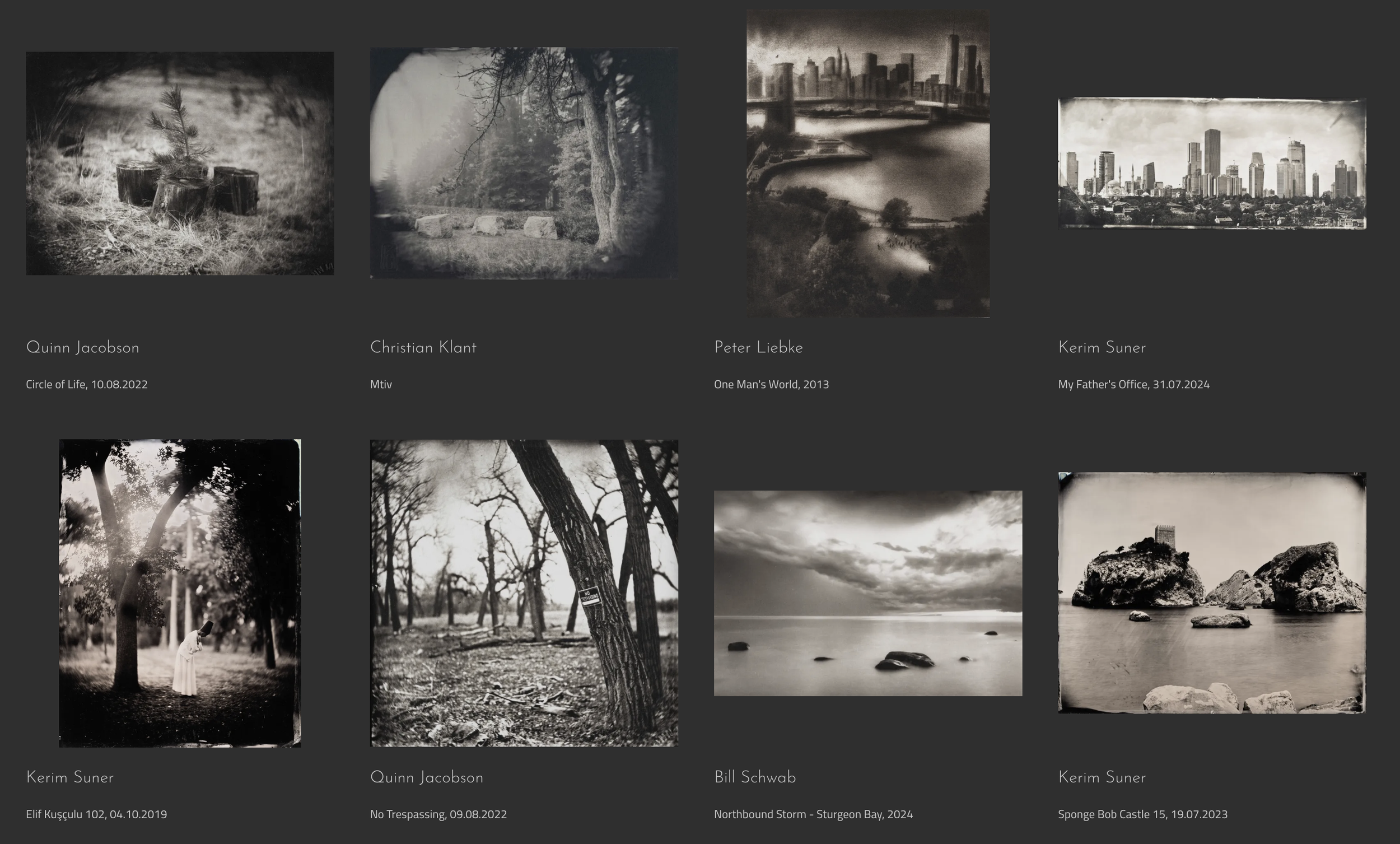
I was surprised to find two prints of mine in this show in Istanbul, Turkey. I know Kerim, the owner of the gallery, he owns both of the prints, but he never informed me about the exhibition.
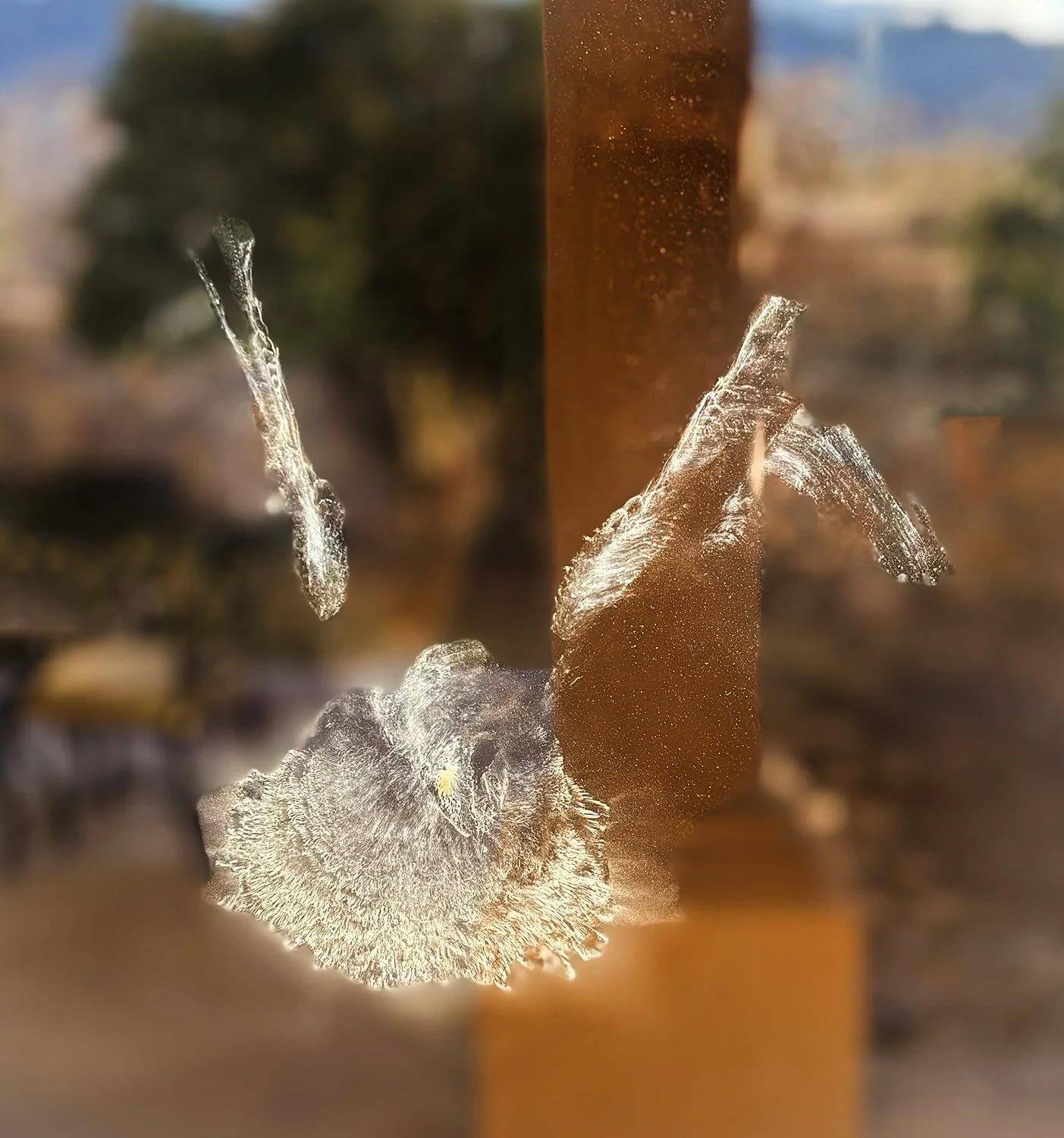
Leaving a trace—the mark of a white-winged dove on my kitchen window. December 28, 2025
A white-winged dove hits the glass, and what’s left behind isn’t the bird but the residue of contact: a powdery bloom, two wing smears, and a ghosted body shape suspended in light. That’s the interview in miniature. Dr. Fisher and I are circling the same problem from different angles: how the most real forces in a human life rarely show up directly. They show up as traces. As misreadings. As displaced language. As the “dimmer switch” doing its job.
I’m interested in what the awareness of an ending does to the living, minute by minute. The dove doesn’t leave a story; it leaves evidence. A mark that asks to be interpreted. It’s rupture without a sermon: meaning fails for a second, the world stutters, and then you’re standing there in your own kitchen looking at a fragile imprint and feeling the entire question come back online.
Interview With Dr. R. Michael Fisher: Careers of Folly and Wisdom
In this conversation, I sit down with Dr. R. Michael Fisher for Careers of Folly and Wisdom (Episode 3) at the close of 2025, and we trace the strange overlap between two lives shaped by study, teaching, and the long arc of existential pressure. What begins as a simple introduction quickly becomes a deeper exchange about why some ideas take decades to name and why the hardest work is often learning how to speak those ideas in public without having them reduced to something smaller.
We talk about how we connected through Southwestern College’s Visionary Practice & Regenerative Leadership doctoral program and why I went searching for faculty whose work could actually hold what I’m building: an arts-based inquiry into creativity, mortality, and the psychological machinery of denial. I share my early “folly” at residency, where I became “the death guy” despite my real focus being the opposite: what happens inside the dash between birth and death, and how the knowledge of impermanence reshapes a human life. That misreading became a kind of field experiment in real time, revealing how quickly people reroute mortality talk into safer channels like grief, loss, or therapeutic language. It also forced me to sharpen my communication, not by diluting the thesis, but by learning how to meet the audience where the “dimmer switch” is already working.
From there, the conversation widens. Dr. Fisher pushes on the themes of education, fallibility, and maturity: how a person with deep content and lived experience learns to teach without preaching, and how humility becomes an actual method. I bring in two foundational touchstones that anchor my work: Becker’s insistence that death terror is a mainspring of human activity and Rank’s claim (via Becker) that the artist takes in the world and reworks it rather than being crushed by it. That tension is the engine of my research question: if most of culture is organized to keep death out of view, what do artists do differently with that same pressure, consciously or unconsciously?
A major thread running through the interview is that denial is not just a personal quirk. It’s cultural, political, and historical. I talk about early experiences that formed my worldview, including family stories that complicate simple narratives of “normal” American life, and how those early exposures shaped my sensitivity to power, erasure, and the stories nations tell themselves. We also move into my military background, where I describe the kind of learning you don’t go looking for: the collision between youthful exceptionalism and the realities of violence, trauma, and institutional harm, including witnessing suicide deaths while working as a photographer. The folly, as I name it, is the arrogance of certainty; the wisdom is the painful clarity that comes after the myth breaks.
In the final stretch, we pivot to Dr. Fisher’s work in fearology and his reframing of Terror Management Theory as, in many ways, a kind of “fear management education.” That exchange matters because it shows the real stakes of language: fear, terror, anxiety, and denial. These aren’t interchangeable terms, and both of us have been forced to grapple with how quickly audiences collapse complex ideas into familiar clichés. We end with a concise statement of my own working thesis, offered almost like a poem: artists tend to give anxiety form rather than discharge it through denial; material practice slows experience enough for mortality to move into objects; rupture is where meaning fails, and art often happens there; the ethic is not to “fix” the break, but to stay present with it.
The conversation closes on an honest note about the cost of passion. We talk about parenting, devotion to work, and the ways even meaningful lives leave blind spots in their wake. If this episode has a through-line, it’s that wisdom is rarely clean. It comes out of misfires, misreadings, and the slow work of learning how to hold the real without turning it into a brand, a sermon, or a therapy session.
I really enjoyed the conversation, and I look forward to working with Dr. Fisher. Check out his YouTube channel and his other interviews and commentary.
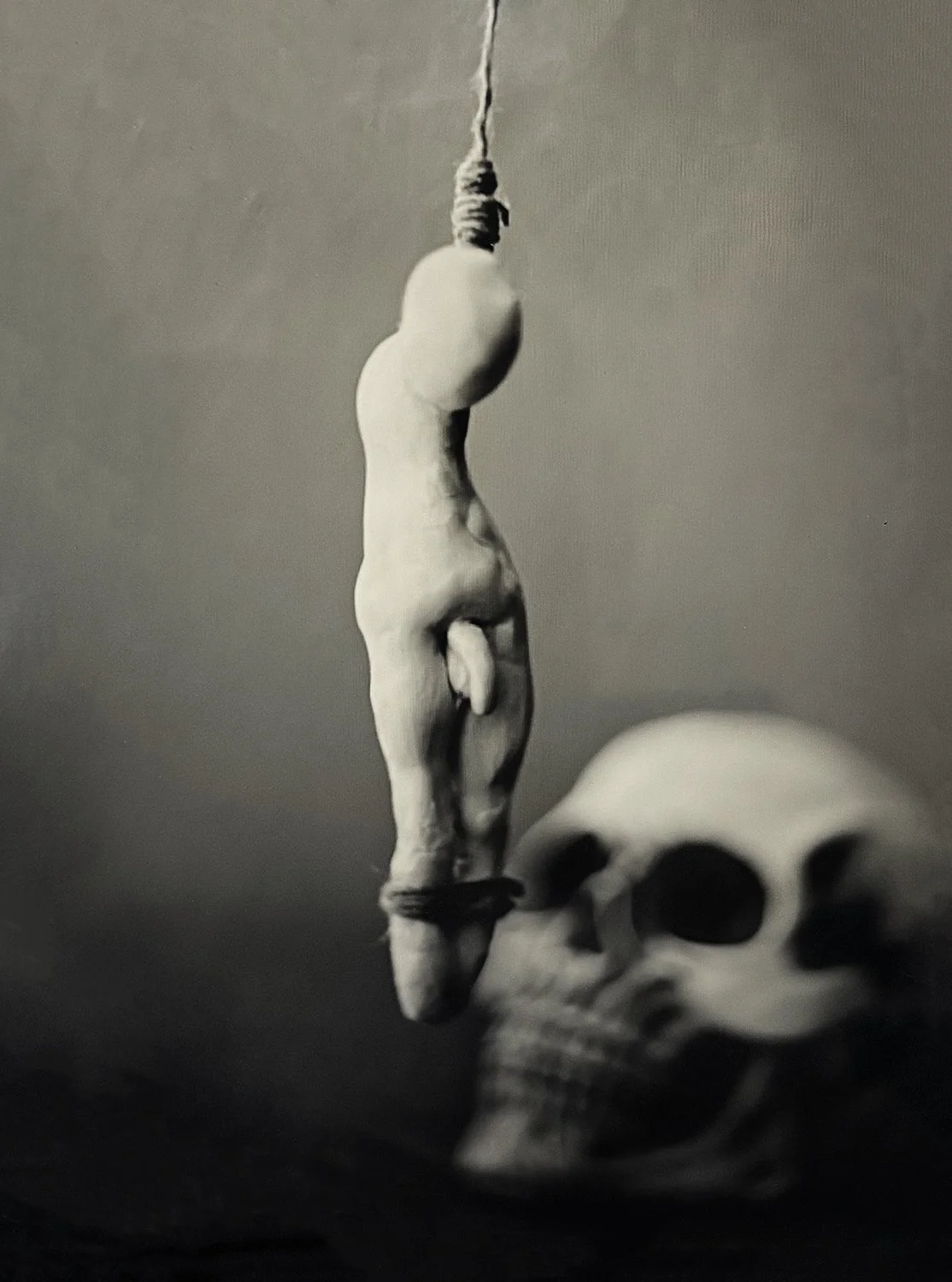
Punished for Embodiment. Half-plate tintype (4.25 × 5.5 in.). December 2025.
Western art has long tried to discipline the body—shrinking it, idealizing it, and denying its animality. This work pushes back. The figure is restrained not for what he has done, but for what he is: a vulnerable organism aware of its own end. The skull waits behind him, already finished with the struggle.
Living With The Dimmer Switch
One of the biggest challenges I face when I talk about Becker, Rank, Zapffe, or Terror Management Theory isn’t that the ideas are too complex. It’s that they’re describing the very psychological machinery that makes them difficult to understand in the first place. (Becker, 1973; Greenberg et al., 1986; Rank, 1932; Zapffe, 1933/2010).
That’s the paradox.
From an evolutionary perspective, human consciousness didn’t just give us language, imagination, and culture. It gave us a problem no other animal has to solve: we know we’re going to die, and we know it with enough clarity to make life unbearable if that awareness stayed fully online all the time (Becker, 1973; Solomon et al., 2015). So evolution didn’t eliminate the problem. It built a workaround.
These thinkers essentially suggest that the human mind evolved a dimmer switch mechanism. This is not an on-off switch, but rather a regulator (Jacobson, 2025). With too much awareness of death, the organism freezes, panics, or collapses. Too little, and life loses urgency, meaning, and care (Becker, 1973; Yalom, 2008).
So the psyche learned to keep mortality awareness just low enough to function and just high enough to motivate (Greenberg et al., 1986; Solomon et al., 2015).
That’s why so many people genuinely believe they don’t think about death or aren’t afraid of dying. They’re not lying. The system is working exactly as it’s supposed to (Greenberg et al., 1986; Pyszczynski et al., 2015). These defenses operate beneath conscious awareness, the same way breathing or balance does. You don’t feel yourself regulating your blood pressure either, but that doesn’t mean it isn’t happening.
In fact, one of the clearest signs that death anxiety is present is the firm belief that it isn’t (Solomon et al., 2015).
Becker’s insight was never that people walk around consciously terrified. It was that culture exists to make sure they don’t have to (Becker, 1973). Worldviews, identities, careers, religions, politics, moral certainty, and even the idea of being a “good person” quietly serve the same psychological function: they tell us we matter in a universe that otherwise wouldn’t notice our disappearance (Becker, 1973; Greenberg et al., 1986). Once those structures are in place, the fear drops out of awareness. The dimmer switch does its job (Jacobson, 2025).
This is also why these ideas often provoke irritation or dismissal instead of curiosity. When someone encounters them for the first time, they aren’t just learning new information. They’re brushing up against the scaffolding that holds their sense of reality together. The mind doesn’t experience that as insight. It experiences it as a threat (Greenberg et al., 1986; Pyszczynski et al., 2015). The response isn’t “Is this true?” so much as “Why does this feel wrong?”
Zapffe pushed this even further and suggested that consciousness itself may be over-equipped for the world it inhabits. We see too much, anticipate too far ahead, and know too well how the story ends (Zapffe, 1933/2010). The defenses he described—isolation, distraction, anchoring, and sublimation—aren’t moral failures. They’re survival strategies (Zapffe, 1933/2010). Without them, the weight of existence would be crushing. So when people recoil from these ideas, they’re doing exactly what the human animal evolved to do.
This is where my work sits.
Artists tend to live closer to that fault line. It's not because we're braver or more enlightened, but rather because creative practice weakens the dimmer switch (Jacobson, 2025; Rank, 1932). Making art requires attention, dwelling, repetition, and exposure. Over time, some of the automatic defenses erode. You keep looking where others glance away. That doesn’t make life easier. It makes it more honest.
This is why arts-based research matters so much to me (Barone & Eisner, 2012). I’m not trying to convince anyone with arguments alone. I’m showing what happens when someone lives with the dimmer turned slightly higher than average and then tries to metabolize what comes into view. The artifacts aren’t illustrations of theory. They are the evidence of a nervous system and a psyche working under different conditions.
So when someone says, “I don’t have death anxiety,” I hear, “My defenses are intact.” And when they say, “This feels abstract,” I hear, “This is getting too close to something I’ve spent my life not naming.”
That isn’t a failure of communication. It’s the terrain.
My work isn’t about forcing understanding. It’s about creating conditions where understanding can happen without overwhelming the person encountering it (Barone & Eisner, 2012; Jacobson, 2025). That’s why I move through story, image, material, land, and memory. I’m not avoiding theory. I’m respecting the psychology that makes theory hard to hear in the first place (Becker, 1973; Solomon et al., 2015).
And in that sense, the difficulty isn’t a flaw in these ideas.
It’s the sound the dimmer switch makes when you try to turn it up.
The resistance.
The discomfort.
The urge to look away.
Those aren’t misunderstandings.
They’re the evidence.
References
Barone, T., & Eisner, E. W. (2012). Arts-based research. SAGE.
Becker, E. (1973). The denial of death. Free Press.
Greenberg, J., Pyszczynski, T., & Solomon, S. (1986). The causes and consequences of a need for self-esteem: A terror management theory. In R. F. Baumeister (Ed.), Public self and private self (pp. 189–212). Springer.
Jacobson, Q. (2025). Living with the dimmer switch [Blog post manuscript]. Unpublished.
Pyszczynski, T., Solomon, S., & Greenberg, J. (2015). Thirty years of terror management theory: From genesis to revelation. In J. M. Olson & M. P. Zanna (Eds.), Advances in experimental social psychology (Vol. 52, pp. 1–70). Academic Press.
Rank, O. (1932). Art and artist: Creative urge and personality development. W. W. Norton.
Solomon, S., Greenberg, J., & Pyszczynski, T. (2015). The worm at the core: On the role of death in life. Random House.
Yalom, I. D. (2008). Staring at the sun: Overcoming the terror of death. Jossey-Bass.
Zapffe, P. W. (2010). The last messiah. (Original work published 1933)
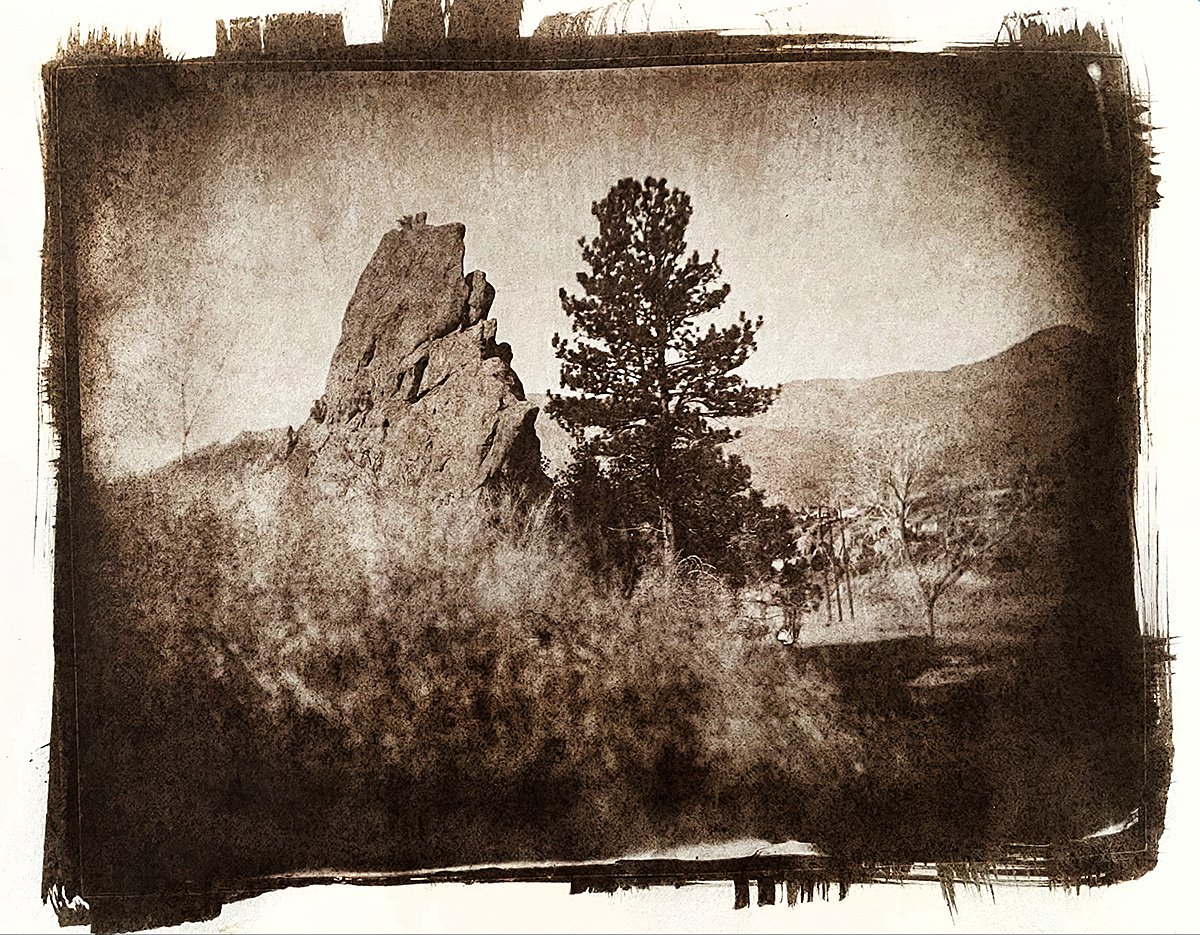
Garden of the Gods, Colorado Springs, Colorado, U.S.A. Whole Plate Argyrotype from a collodion dry plate negative printed on 16 lb drafting vellum paper— In the Shadow of Sun Mountain. 2022
A Reading: Introduction In the Shadow of Sun Mountain
Introduction
In the Shadow of Sun Mountain (2020–2024)
I lived for years on twelve acres in the mountains of central Colorado, on land where the (Tabeguache) Ute had lived, traveled, gathered medicine, and buried their dead for thousands of years. That fact was not abstract to me. It was present every day. In the plants that grew around the house. In the way the light moved across the ground. In the silence that settled at dusk. The land didn’t feel empty. It felt inhabited by memory.
Sun Mountain rose nearby, not dramatically, not as a monument, but as a constant presence. Its shadow crossed the land in long, slow arcs. I began to understand that shadow less as an absence than as a reminder. Something persisted there, something unresolved. The land wasn’t haunted in the theatrical sense. It was honest. It held the residue of belief, fear, violence, endurance, and the stories that try to make those things bearable.
The plants themselves became teachers. This work is grounded in ethnobotany and spiritual ecology, not as metaphor, but as epistemology. The (Tabeguache) Ute understood land through use, relationship, and attention: which plants heal, which harm, which alter perception, which open ritual space, which return the body to the ground. Medicine was not separate from cosmology. Knowledge was embedded in practice, repetition, and care. Working among these plants, photographing them, painting them, and incorporating them into mixed media was a way of entering that lineage of attention, however imperfectly. The work does not claim that knowledge as mine, but it does acknowledge that plants carry memory and instruction, and that ways of knowing grounded in land and body predate and quietly challenge the abstractions that made conquest and erasure possible.
This work began with a question I couldn’t shake: why do human beings need an enemy to feel secure?
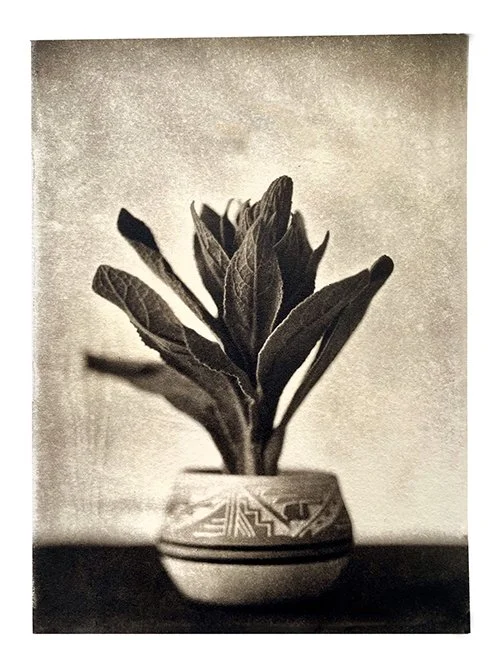
The Great Mullein Plant—Palladiotype from a wet collodion negative. 2022
I’d spent years photographing sites where violence had taken place, standing in spaces where something irreparable had occurred and sensing that the story told about those events was never the whole story. Living on that land intensified the question. The history of the (Tabeguache) Ute was not distant. It was botanical. Ecological. Embedded in place. Their knowledge of medicinal plants, spiritual botany, seasonal movement, and relationship to land was not a footnote to history. It was a worldview that had been violently interrupted.
The longer I lived there, the clearer it became that the question wasn’t only historical. It was psychological. What allows people to draw a line between “us” and “them” with such confidence? Why does that line harden so quickly? And what does our buried awareness of being temporary have to do with it?
My studio practice kept circling the same terrain. I worked with wet-collodion photography, color reversal prints, painting, and mixed media not out of nostalgia, but because these materials resist control. Collodion is unstable. A glass plate can appear solid and fail without warning. Silver remembers everything. Chemistry responds to temperature, breath, humidity, and time. You don’t dominate the process; you negotiate with it.
That instability mattered. It mirrored something I recognized in the human mind when it tries to manage fear, especially fear it refuses to name. What began as an old photographic process became a form of inquiry. The fractures in the plates, the fogging, the lifting emulsion, the breakage, they echoed the fractures I was seeing in our collective imagination.
Ernest Becker helped sharpen that connection. He argued that culture itself is a defense system built around the fact that we will die (Becker, 1973). We build worldviews to seem steady. We cling to identity because it promises continuity. And when those stories feel threatened, we look outward for someone to blame.
Othering is not an accident. It’s a psychological survival strategy. A way to redirect fear so we don’t have to feel it directly.
In the Shadow of Sun Mountain grew from that realization. What began as an artistic investigation rooted in land, plants, and material practice expanded into a broader inquiry into how death anxiety shapes behavior, morality, and the human capacity for cruelty. Starting a PhD in my sixties didn’t create this path. It helped me name it. Becker, Rank, and the existentialists gave language to what I had been sensing intuitively for decades: that creativity is not separate from mortality, and that artists often work at the fault line where denial begins to crack.
The chapters that follow trace how fear becomes ideology. How ideology becomes violence. How violence becomes history. And how history becomes a story we repeat so we don’t have to confront what made the violence possible in the first place.
This isn’t a moral lesson. It isn’t a condemnation delivered from a safe distance. It’s an examination of the ordinary human mind and what it does with the knowledge that life is short, unpredictable, and finite. It’s about the psychological architecture we inherit, the beliefs we defend, and the places where those beliefs fail.
Sun Mountain is both literal ground and conceptual ground. The plants, the landscapes, the objects, the materials, and the photographic processes are not illustrations of theory. They are part of the thinking itself. The shadow it casts represents what we push away: the parts of ourselves we disown, project, or punish in others.
If there is any hope here, it’s a quiet one. That facing impermanence might soften the need to harden ourselves against difference. Artists understand that tension intimately. We work every day between creation and loss. We accept what breaks. We learn from what cannot be repaired.
This book is an invitation into that space. It begins with a question and refuses to resolve it too quickly. It follows it through land, material, history, psychology, and lived experience, toward a clearer understanding of what we do in the presence of death, and what might change if we learned to see ourselves more honestly.
References
Becker, E. (1973). The denial of death. Free Press.