
One of the simplest but hardest ideas for people to accept is that we are animals who know we will die.
That sentence alone has more psychological weight than most of us want to deal with. We are more than just living things that move through time. We are aware of ourselves, and our bodies get older, break down, and disappear. And we know this. That information alters everything.
This is where Ernest Becker begins. In The Denial of Death, Becker posited that human psychology is influenced by a fundamental contradiction. We are biological entities motivated by instinct, hunger, fear, and reproduction; concurrently, we are symbolic entities endowed with imagination, language, and self-reflection. We have bodies that will die, and our minds can picture that death before it happens. The conflict between those two facts never goes away. It just gets taken care of.
That tension is right in the middle of animality.
Being an animal means being weak. People bleed. Bodies decay. Bodies break down. That doesn't change, no matter how smart or culturally accomplished you are. But most of modern life is set up to keep that truth far away. We keep the dying out of sight. We make decay into a medical issue. We raise the mind, the self, the brand, and the legacy as if they could somehow float away from the body.
Terror Management Theory says that this is not a coincidence. When reminders of our animal nature break through, like illness, aging, death, or even some kinds of art, they make us anxious on a deep, often unconscious level. The answer is almost never calm, though. It's protection. We hold on to our identities, beliefs, status, and moral frameworks more tightly when they promise that we are more than just meat that is going to die out.
The skull has always been one of the best ways to show this problem. It takes away everything that makes us who we are, reminding us that we are just physical matter with a time limit. Skulls don't fight. They don't talk about it. They just give testimony.
Rachel and Ross Menzies talk about how much of human behavior is based on avoiding this confrontation in their book Mortals. Not just being afraid of dying, but being afraid of being an animal that has to die. We deal with that fear by keeping busy, doing health rituals, telling success stories, and always trying to be better. In most cases, the goal is not to live forever. It is a mental distance from what will happen to the body.
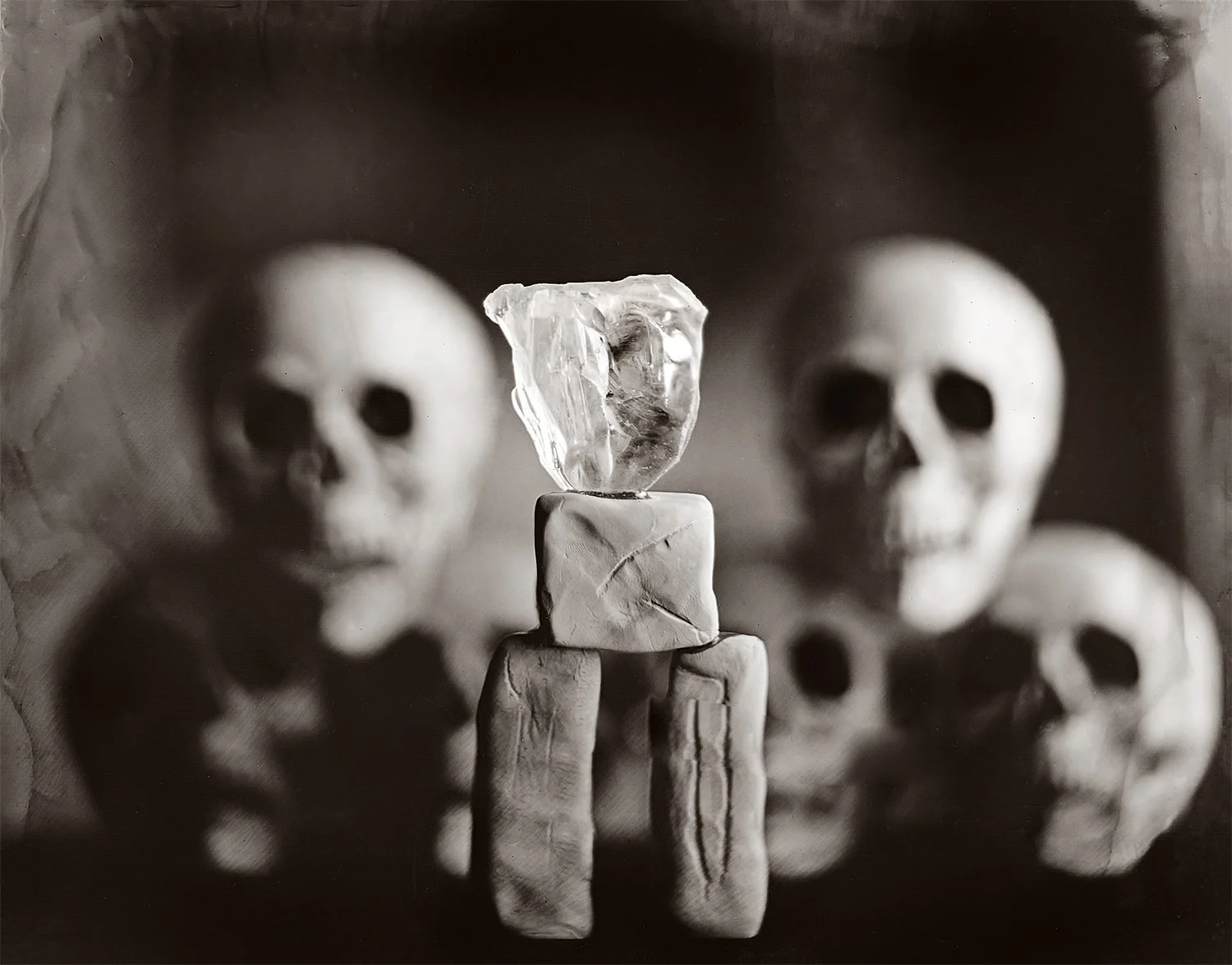
That's what this picture is trying to show.
The Glasshead–Stoneman is standing up, put together, and almost ceremonial. The stone blocks make up a body that looks solid, scarred, planned, and calm. The glass head on top is clear, glowing, broken, and fragile. Skulls float behind it, not quite there and not quite gone. They didn't read as reminders of death, but as witnesses. The truth about animals is there, but it won't stay out of the way.
Glass is important here. Heat and violence make glass. It looks like it will last forever, but it breaks easily. It shows its own cracks while carrying light. It is an uncomfortable material that is between solid and broken. A lot like the human self.
Stone suggests strength. Glass makes things look fragile. The skulls show that something is going to happen.
They make a quiet argument that no amount of structure or symbolic architecture can change our animal nature. We can make identities. We can add meaning. We can give ourselves names. But the body is still there. The animal is still there. Death stays.
Even though it makes people uncomfortable, this is not a negative statement. Becker himself thought that this tension is what makes creativity, art, and meaning come to life. The issue does not stem from our animalistic nature. The issue is that we put so much effort into pretending we aren't.
Art does something important for the mind when it lets animality back into the room without being showy or moralizing. It lowers the defenses just enough for the person to be recognized. Don't panic. Acknowledgment. The kind that says, "This is what we have to work with."
The Glasshead–Stoneman does not fix the problem. It doesn't make you feel better. It just keeps the animal and the symbol in the same frame, not letting either one go away.
That might be enough.
Because confronting our animality does not diminish the significance of life. It makes it sharper. It reminds us that everything we build, love, and make is done inside a body that will eventually fail. And oddly enough, that's what makes those actions important.