• blog
  • in the shadow of sun mountain
  • buy my books
  • photographs
  • paintings
  • bio
  • cv
  • contact
  • search
Menu

Studio Q Photography

Exploring Human Behavior and Death Anxiety Through Art
  • blog
  • in the shadow of sun mountain
  • buy my books
  • photographs
  • paintings
  • bio
  • cv
  • contact
  • search
×

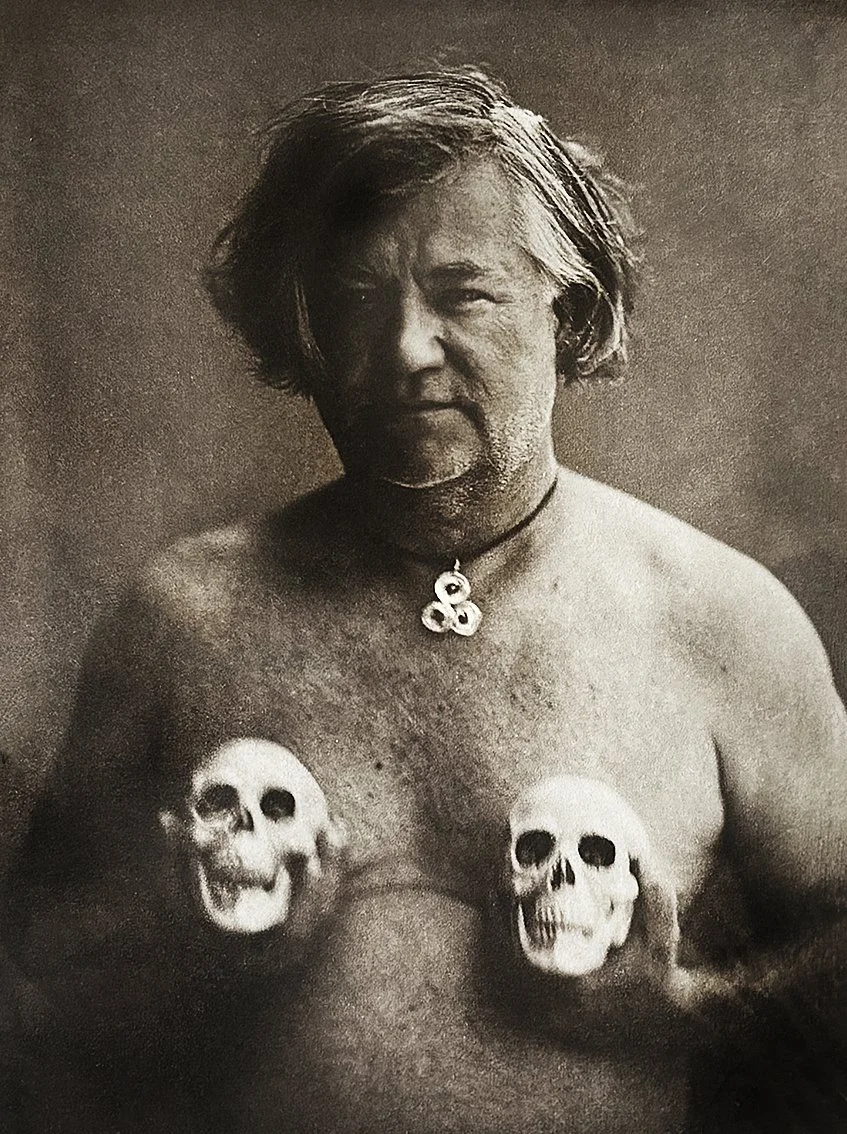
Holding the Unresolvable, 2026. Whole-plate kallitype, gold-toned, printed from wet collodion negative on Revere Platinum paper.
March 28, 2026, Las Cruces, New Mexico — ©Quinn Jacobson

Holding the Unresolvable: Mortality and Form in a Kallitype Portrait

Quinn Jacobson March 30, 2026

I made this image over the weekend. A friend, a fellow doctoral student, sitting in front of the camera. Bare-chested. Two skulls held against the torso, or resting there, or emerging from it. The preposition doesn’t quite hold, which is part of the point.

What you see is simple. What the image is doing is not.

I've been thinking for years about where images actually come from, not technically but psychologically. What pressures give rise to them. What gets carried into the frame, intended or not. This portrait didn't begin as a concept about mortality. It began as a feeling I've been circling a long time: that death isn't something we encounter occasionally, from a safe distance, but something we are already inside of. Always. The awareness held at arm's length. Functional, buffered, but never fully absent.

Ernest Becker called this the negotiated space of human existence—knowing, but not fully feeling (Becker, 1973). Culture itself, he argued, is largely a structure built to manage what we can't afford to fully face. We live between awareness and denial, close enough to the fact of mortality to be shaped by it and far enough to keep moving. This image tries to make that band visible. Not as argument. As form.

The Body as Pressure

The first decision was compositional: a frontal, centered figure. The kind of formal stability that early photographic portraiture used to convey dignity, legibility, and presence. That stability matters here because it sets up what follows.

Then the disruption.

The skulls aren't beside the body or held out for display. They're not props arranged for symbolic effect. They hover in the uncertain space between inside and outside the torso—not quite organs, not quite objects. The ambiguity is the point. If they were clearly internal, the image would collapse into anatomy. If they were clearly external, it would resolve too quickly into symbol. What I wanted was something less settled, something closer to what Becker describes as the ongoing, never-quite-finished negotiation between awareness and denial. Death not repressed, but not integrated either. Present, but unstable.

What I didn't anticipate until I saw the finished print was the gaze.

He isn't looking at the camera. He's looking past it, slightly—not evasively, but as if what he's attending to exists just outside the frame. That deflection changes the image's register entirely. It doesn't become a confrontation between viewer and subject. It becomes something more like shared witness: two figures—the one in the frame and the one looking at it—both oriented toward something that isn't fully visible. Something that hasn't arrived yet, or hasn't been named.

Trace, Not Symbol

There's always a risk with the skull. It's one of the most overdetermined objects in the history of art. From vanitas painting forward, it carries a ready-made meaning: mortality, transience, and memento mori.

That's not what I'm after. Or at least, not that way.

What I'm trying to do is shift the skull away from symbol and toward trace. The distinction matters. A symbol points toward meaning. A trace is the residue of a process already underway. Not a sign placed onto the surface to indicate death, but something more like the visible remains of a metabolic struggle that hasn't resolved.

In the framework I've been developing around rupture—what I'm calling the Rupture Field—this image sits somewhere between exposure and trace. The rupture has already occurred. Mortality awareness has exceeded the capacity of ordinary denial to contain it. What remains aren't conclusions. They're fragments. Partial forms. Something that couldn't be fully metabolized and so became visible instead.

That's what these skulls feel like to me. Not imposed onto the body from outside but surfaced from within it. The pressure finding form.

The Material Is Part of the Argument

The process here isn't incidental.

Kallitype, especially gold-toned, has a tonal range that is long, compressed, and quiet. Nothing leaps forward. The image doesn't announce itself—it accrues. There's something about the way the shadows pool and the highlights hold that makes the image feel like it already belongs to another time, even as it depicts someone sitting in front of a camera in the present.

And the paper—Revere Platinum—has a weight and tooth that digital processes can't replicate. You're aware that you're holding something. That the image exists on a surface that will age, fade, and eventually fail.

Otto Rank argued that the creative act is bound up with the desire to stabilize experience against loss—to produce something that persists beyond the individual life (Rank, 1932/1989). But I want to be careful here, because I don't think that's exactly what's happening in this print. The kallitype isn't trying to outlast anyone. It's not an immortality project in Rank's sense.

It's something closer to metabolization: making the pressure of mortality awareness visible while it is still being lived. Not preservation. Not transcendence. Processing. The print as a site where the rupture is held, turned over, and examined—without being resolved.

The difference matters. Preservation seals the wound. Metabolization keeps it open long enough to learn something from it.

The Necklace

I didn't plan for the necklace to do what it does. I noticed it after the print was finished, when I was looking at the full image for the first time.

Barthes would call this the punctum—the detail that arrives uninvited and redirects the image's meaning. But what interests me methodologically is something slightly different: not that the necklace pierced me as a viewer, but that it revealed itself to me as a researcher. The practice had generated something the conceptual framework hadn't predicted. The studio was thinking.

What it introduced was a different register entirely: relation, identity, and continuity. Something cultural and personal and chosen, against all the elements in the frame that belong to no one—the anonymous skulls, the bare torso, the ambiguous dark ground. The necklace says: this is a particular person. He has a history. He is located in a world of meaning.

And then everything around it reasserts: he is also mortal.

Rank makes a distinction that I keep returning to here. Religion, he suggests, emerges from collective belief in immortality—the promise that death will be overcome. Art arises from the individual's confrontation with impermanence—the refusal of that promise, or at least the refusal to look away from it (Rank, 1932/1989). This image seems to live between those poles. The necklace carries something like religious weight—continuity, relation, belonging—while everything surrounding it insists on the mortal body.

The body is no longer singular. It's carrying multiple realities at once: biological, relational, symbolic, and mortal. Not in sequence. Simultaneously.

What the Image Knows

I want to say something about methodology, because it matters here and I don't want to leave it implicit.

This image is not an illustration of a theoretical argument. It's not Becker made visual, or Rank translated into form. If it were, the essay would be sufficient and the image redundant. What I'm claiming—and what arts-based research methodology asks us to take seriously—is that the image produces a different kind of knowledge than the writing does. Not the same knowledge in a different register. Something the writing cannot replicate without remainder.

Propositional language can describe the negotiated space between awareness and denial. It can name it, analyze it, and situate it theoretically. What it cannot do is construct one. The kallitype doesn't point toward that space. It builds an instance of it. The viewer who stays with this image long enough, who lets the tonal range accrue rather than scanning for meaning, is briefly inside the condition the writing can only describe from outside.

That's not a claim about aesthetic experience. It's an epistemological one.

Practice-led research proceeds from the assumption that making is a form of inquiry, that the studio generates knowledge the conceptual framework hasn't yet predicted, and that this excess is methodologically significant rather than incidental. The necklace is my clearest evidence. I didn't plan for it to do what it does. I didn't theorize it in advance. It arrived in the finished print as something the process had produced independently of my intentions, and it changed what the image knew. That's the practice thinking. The researcher's job, afterward, is to follow where it went.

What the image knows that this essay doesn't: what it feels like to not be met by the subject's gaze. To stand in front of a figure who is looking past you, toward something outside the frame, and to realize that you are not the recipient of a statement but a fellow witness. The essay can describe that experience. It cannot produce it. The image produces it every time, for anyone willing to look long enough.

That gap, between what the writing can say and what the image can do, is not a limitation of the research. It's the point of it.

Condition, Not Conclusion

What I notice more and more in my own work is that I'm less interested in making statements than in staging conditions. This image doesn't explain anything. It doesn't arrive at a conclusion. It doesn't argue.

It presents a situation: a person, standing there, holding themselves together. With something else present. Not named. Not integrated. Not fully metabolized.

That feels honest to me.

If Becker is right, and I believe he is, then most of life unfolds precisely in that space. Not in full awareness, and not in complete denial. In the narrow band between them, where we can continue to function without being overwhelmed by what we know. The task isn't to resolve that tension. The task is to stay inside it long enough to make something true.

That's what I was trying to do here.

Not to illustrate mortality. Not to comfort anyone, including myself.

But to make the pressure visible. To let it take form. And to see what that form had to say.

References

Barthes, R. (1980). Camera Lucida: Reflections on Photography (R. Howard, Trans.). Hill and Wang.

Becker, E. (1973). The Denial of Death. Free Press.

Rank, O. (1989). Art and Artist: Creative Urge and Personality Development (C. F. Atkinson, Trans.). Agathon Press. (Original work published 1932)
In ABR, Art & Theory, Arts-Based Research, Creative Mind Mortality, Death Anxiety, Denial of Death, Ernest Becker, Existential Art, Existential Literacy, Handmade Print, Kallitype, New Mexico, PhD Tags Kallitype, Wet Plate Collodion Negatve, skulls, mortality
2 Comments

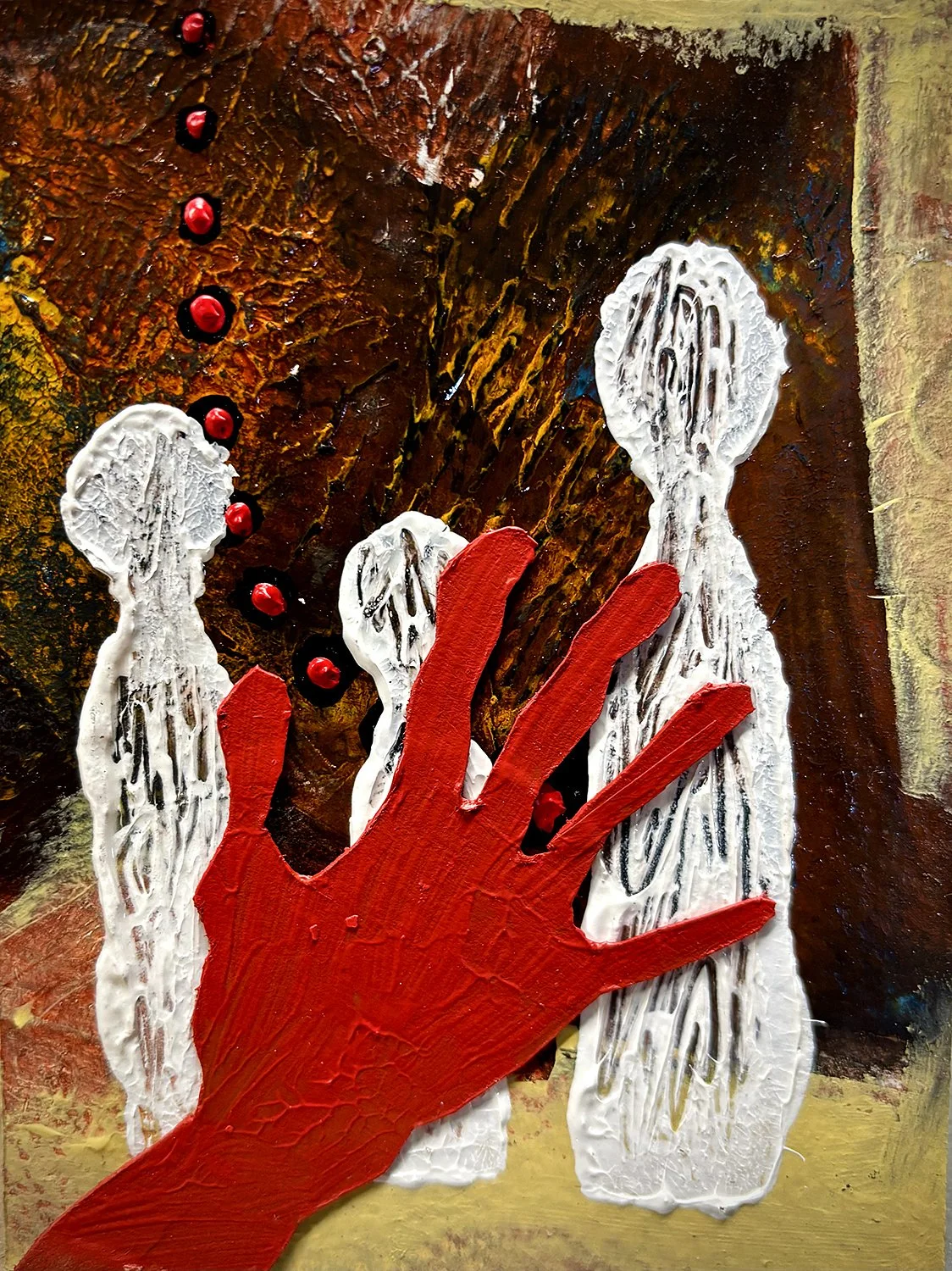
Untitled (Red Hand)
Acrylic mixed media on paper, 4.25" × 5.5"

A red hand interrupts three attenuated figures, marking the moment where existential anxiety is no longer diffuse but made contact—contained, metabolized, and rendered visible through form.

The Red Hand Problem

Quinn Jacobson January 12, 2026

How artists metabolize existential anxiety, and why the work still matters.

I keep returning to the same question, no matter how many theories I read or objects I make: What exactly happens to existential anxiety when it moves through the hands of an artist?

Not rhetorically. Mechanically. Psychologically.

The image above is one attempt to make that process visible. Three pale figures stand upright, stripped of detail, reduced almost to afterimages. They are not portraits so much as placeholders. Awareness has rendered their bodies thin. Over them reaches a red hand, oversized and intrusive, neither comforting nor gentle. It interrupts and intrudes. It stains. It marks.

That hand is not expression. It is intervention.

Most people manage death anxiety by keeping it diffuse, by never letting it fully localize. The artist does the opposite. The anxiety is brought forward, concentrated, and given a task. Creation becomes a site of containment. The fear does not disappear, but it changes state. It becomes workable.

This is what I mean by metabolizing existential anxiety. Not purging it. Not transcending it. Converting it into form.

Psychologically, this matters more than we often admit. The act of making gives the anxious mind boundaries. Time slows. Attention narrows. The self becomes less abstract and more procedural. The question shifts from What does it all mean? to What happens if I put this here? That shift is not trivial. It is regulatory. It allows consciousness to stay in contact with mortality without flooding.

The white figures in the image are not victims. They are witnesses. They stand because the hand is doing something on their behalf.

This is where arts-based research comes into focus for me. ABR is often framed as alternative knowledge production, which is true but incomplete. Its deeper value lies in its psychological function. Making becomes a way of thinking that does not rely exclusively on symbolic abstraction. Image, material, gesture, and repetition—these are not illustrations of insight; they are the insight.

When anxiety stays purely cognitive, it spirals. When it enters the body through making, it circulates. It acquires rhythm. It becomes legible.

This brings me to the harder question: is there any value in writing books like Glass Bones and Rupture?

If the goal were resolution, probably not. No book resolves the fact of death. No theory seals the crack. But that has never been the real task. The value lies in creating sustained containers where anxiety can be held long enough to be examined without collapsing into distraction or denial.

These books are not answers. They are pressure vessels.

Writing them will force me to stay with the material—psychologically and ethically—longer than images alone sometimes allow. It slows the metabolism. It traces the process. It makes visible what is usually hidden: how fear becomes form, how rupture becomes method, and how meaning is provisional but still worth making.

The red hand, then, is also authorship. It is the decision to intervene rather than look away. To touch the thing that makes us uncomfortable and accept the consequences of contact.

Artists do not escape existential anxiety (not at all). They work it. They give it edges. They give it weight. They give it somewhere to go.

That’s not a cure.
But it is a practice.
And in a culture built on denial, practice may be the most honest form of value we have left.

In Abstract Painting, Acrylic Painting, Angst, Anxiety, Art & Theory, Arts-Based Research, Death Anxiety, Existential Art, Fragile, Handmade Print, Neurotic, Painting, PhD, Psychology and Art Tags Existentialism, existential psychology, Existential Art, acrylic painting, Mixed Media
Comment

“Large Red Rock Formation, Fremont County, Colorado,” 10"x10" (25,4 x 25,4cm) RA-4 Reversal Direct Color Print, July 15, 2023

I couldn’t be more pleased with this image. What a color shift!! And the clouds!! I love it. This is the same large rock formation I made wet and dry collodion negatives and POP prints from - I’ll show them side-by-side in the book. The vignetting is beautiful on this too.

The Challenge of Doing Something Different: Examining the Creative Life

Quinn Jacobson July 17, 2023

Without matte, a full 10” square

MAKING STUFF
I often think about the act of creating something and what it means—a photograph, making a knife (blade-smiting and blacksmithing), or writing something meaningful. What is it that drives us to create? I’ve been reading and thinking about this question for some time. It falls right in line with Becker’s theories; in fact, it’s right at home with terror management theory. Otto Rank believed that art and creativity were essential for human psychological health and development. He argued that art serves as a way for individuals to express their innermost desires, fears, and conflicts. According to Rank, the artist is a heroic figure who confronts and transcends the existential anxieties and limitations of human existence through the act of creation.

“Nothing exists until or unless it is observed. An artist is making something exist by observing it. And his hope for other people is that they will also make it exist by observing it. I call it ‘creative observation.’ Creative viewing.”
— William S. Burroughs, Ports of Entry: William S. Burroughs and the Arts

In reality, there are many reasons human beings create “things.” Most of the reasons are somewhat superficial or commercial. I feel the predominant one is rooted in the quest for immortality. We fear dying, mostly because we fear being forgotten and our lives being insignificant. Becker said, “What man really fears is not so much extinction, but extinction with insignificance.” I can understand that, at least intellectually. At times, I feel like my creative life and the objects that I create are meant for another time or different people in a different time. In the same way, I look at work created long ago that resonates deeply with me. Maybe it’s just me justifying a fear or a desire, but I think it’s rooted in my unconscious desire for symbolic immorality. There is also an immediate and significant reward; it gives my life meaning and significance. I can see the short- and long-term anxiety buffer in having a creative life.

"Three Mountain Coneflowers in Moon Rocks," 10"x10" (25,4 x 25,4cm) RA-4 Reversal Direct Color Print, July 13, 2023

Tea was made from the leaves and flower heads. Native Americans boiled prairie coneflower leaves and stems to make a solution that was applied externally to draw the poison out of rattlesnake bites. An infusion was used to relieve the pain of headaches and treat stomachaches and fevers.

BEING YOURSELF AND CREATING SOMETHING UNIQUE
Different is good, right? We hear that often. Why do we think that being different is good? It’s usually applied to people who are pushing the boundaries and challenging the status quo of something. We hear it chanted often because mediocrity breeds contempt. Meaning that the more familiar you are with something or someone, the more likely you are to find fault with it or them. Human beings thrive on diversity and uniqueness. However, a lot of people resist anything different and want things to remain known, comfortable, and predictable. The truth is that we are at our best when we challenge ourselves and get out of our comfort zones. Most people know that, but most are afraid to do it. They’re afraid to fail.

“ An artist, a man truly worthy of this great name, must possess something essentially his own, thanks to which he is what he is and no one else.” This applies to women as well - remember the context of the time.”
— Charles Baudelaire

How can artists challenge themselves? Hasn’t it all been done before? For the most part, yes, it has all been done before in one way or another. What’s unique is how YOU are applying the concepts, ideas, processes, methods, etc. to the work and the narrative as a whole. You are the difference. Period.

You are something that’s never been before and will never be again. That’s what makes artwork unique—its creator. So, if you copy or emulate someone or something else, you lose that edge—you lose the only thing that will make your work different or unique. I know it’s tempting to always make images that are familiar and that people can easily connect to, but remember, it breeds contempt! Thinking through a compelling idea, question, or concern is the only thing that will make you stand out from all of the others making photographs of the same old stuff or trying to “wow” people by working in some obscure process or using expensive or rare equipment (especially without context or a narrative or story).

This is the reason that I rant so often about the physicality (hand-made or deeply involved connection) of making artwork. It’s the best way to ensure that human beings (you) did the work, not a machine, computer, or software—but that’s an argument for another day.

Charles Baudelaire said, "An artist, a man truly worthy of this great name, must possess something essentially his own, thanks to which he is what he is and no one else." This applies to women as well; remember the context of the time. This quote sums up the ideas that I’m talking about in this essay.

If you want to challenge yourself or push yourself, do something that you never thought you’d do. At least try it. Break some rules and try to tell your story in a different, unconventional way. Don’t follow the advice of the masses: “It’s supposed to look like this or that.” Make it yours; make it fit your story in a new and unique way. Be true to yourself; don’t allow the pressures of tradition to dictate how you express yourself. In the end, your audience is just one: YOU! It’s great if other people “get it” or appreciate it, but it’s more important that you create it in your own unique style, authentic and true, whatever that looks like.

"White Poppy," 10"x10" (25,4 x 25,4cm) RA-4 Reversal Direct Color Print, July 13, 2023

Long before Europeans discovered North America, Native Americans were aware of the biological activities of extractions from poppies and using Argemoneas source of medicines. They used concoctions derived from poppies for anesthetizing fish, sedating humans, removing warts, treating cold sores, cuts, scrapes, and congestion associated with colds and flu, and as a soporific, an emetic, and a laxative. The first Americans had other uses for poppies as well, including dyes for fabrics and tattoos.

"White Poppy," 6.5” x 8.5” Palladiotype from a Paper Negative (Calotype), September 21, 2022

Long before Europeans discovered North America, Native Americans were aware of the biological activities of extractions from poppies and using Argemonea as a source of medicines. They used concoctions derived from poppies for anesthetizing fish, sedating humans, removing warts, treating cold sores, cuts, scrapes, and congestion associated with colds and flu, and as a soporific, an emetic, and a laxative. The first Americans had other uses for poppies as well, including dyes for fabrics and tattoos.

"Three Mountain Coneflowers, Antlers (as bleached bones), Rocky Mountain Wheat Grass and European Silver," 10"x10" (25,4 x 25,4cm) RA-4 Reversal Direct Color Print, July 13, 2023

Tea was made from the leaves and flower heads. Native Americans boiled mountain coneflower leaves and stems to make a solution that was applied externally to draw the poison out of rattlesnake bites. An infusion was used to relieve the pain of headaches and treat stomachaches and fevers.

I’m starting to put these images together as diptychs. They look beautiful together—different languages saying the same thing. I love it.

“Damaged Willow Tree, Fremont County, Colorado,” 10"x10" (25,4 x 25,4cm) RA-4 Reversal Direct Color Print, July 15, 2023

The iPhone snap of this isn’t that great, but the print looks wonderful. I’m very happy with the results of this process. Lightning struck or a wind storm tore this willow tree apart. It was a very dramatic scene. I love how the clouds show up in the image. This is a very painterly image to me.

Without matte, a full 10” square

“White Poppies In a Field in Fremont County, Colorado,” 10"x10" (25,4 x 25,4cm) RA-4 Reversal Direct Color Print, July 15, 2023

I never really know exactly what I’m going to get with this color reversal process. What I hope for is either muted colors or shifted colors. Colors that are just enough to seem real or accurate but shifted just enough to make you wonder about what you’re seeing.

I was very pleased in the darkroom today to see this appear in the developer. I’m reminded of an old Polaroid or expired film from the 1960s. I really like how it evokes memories with its aesthetic. The white poppies are blooming everywhere right now. They look wonderful on the landscape.

In Art & Theory, Book Publishing, Calotype, Color Prints, Death Anxiety, Denial of Death, Handmade Print, Palladiotype, Paper Negatives, Philosophy, POP, Psychology, Quinn Jacobson, RA-4 Reversal Positive, Shadow of Sun Mountain, Tabeguache Ute Tags In the Shadow of Sun Mountain, white poppie, color direct prints, making unique work, being different
Comment

“Medicine Wheel on a Large Granite Stone” whole plate palladiotype from a wet collodion negative—this is a symbol that was used by the Tabeguache-Ute. They would set up one of these at the center of each place they lived. They would travel widely over the year and hunt, fish, and gather plants at different locations. They spent the summer months where I live now.

Summary of My Project: In the Shadow of Sun Mountain: The Psychology of Othering

Quinn Jacobson March 5, 2023

DEATH ANXIETY & THE DENIAL OF DEATH
This project has a level of complexity in communicating what it is, what it’s about, and the objective of the work. It is very complex in one sense and, in another, very simple and straightforward. It’s simply expounding on theories of human behavior (Becker et al.) that affect all of us and the implications of them. I would sum up the objective of the work using Carl Jung’s idea of making the unconscious conscious. That’s what I would like to have happen: The average person would be able to accommodate and assimilate these ideas and understand their universal implications.

From the book, “The Worm at the Core: The Role of Death in Life,” by Sheldon Solomon, Jeff Greenberg, and Tom Pyszczynski. This is a great book. I encourage you to read it.

This is what I've written as a short description of the project. I would like to hear your feedback if you're willing to share. Does it make sense? Do you think you understand the work or the goals of the project? Do you feel that you have a basic understanding of the theories I'm working with?

SUMMARY STATEMENT OF THE WORK
Drawing inspiration from the seminal work of cultural anthropologist Ernest Becker, my book, "In the Shadow of Sun Mountain: The Psychology of Othering" (2024), aims to challenge the dominant cultural narratives that deny the reality of death and the ways in which this denial contributes to the oppression and eradication of marginalized cultures, specifically the Tabeguache-Ute of the Rocky Mountains in Colorado. By embracing Becker's insights into terror management theory and the role of death anxiety in shaping human behavior, this project seeks to provoke reflection and dialogue about the urgent need to come to terms with our mortality and its implications for our relationships with one another and the planet.

In Artist Statement, Art & Theory, Collodion Negatives, Creating A Body Of Work, Death Anxiety, Denial of Death, Ernest Becker, Handmade Print, Palladiotype, Palladium, Philosophy, Project Wor\k, Psychology, Shadow of Sun Mountain, Tabeguache Ute, Writing Tags medicine wheel, tabeguache, palladiotype, wet collodion negatives, Ernest Becker, summary statement, In the Shadow of Sun Mountain
2 Comments

Search Posts


Featured Posts

Featured
Apr 16, 2026
My Book: The Final Stages of Glass Bones
Apr 16, 2026
Apr 16, 2026
Apr 13, 2026
Terror Management Theory: The Mechanics Beneath Belief
Apr 13, 2026
Apr 13, 2026
Apr 11, 2026
To Buffer or Not to Buffer?
Apr 11, 2026
Apr 11, 2026
Apr 6, 2026
Worldviews: The Stories That Hold Us Together
Apr 6, 2026
Apr 6, 2026
Apr 1, 2026
The Creative Mind & Mortality Podcast - S1 E7: Culture As Armor
Apr 1, 2026
Apr 1, 2026
Mar 30, 2026
Holding the Unresolvable: Mortality and Form in a Kallitype Portrait
Mar 30, 2026
Mar 30, 2026
Mar 28, 2026
Arts-Based Research Methodology
Mar 28, 2026
Mar 28, 2026
Mar 25, 2026
The Creative Mind & Mortality Podcast—S1E6: The Beginning of Denial
Mar 25, 2026
Mar 25, 2026
Mar 24, 2026
Ocotillo, Chihuahuan Desert
Mar 24, 2026
Mar 24, 2026
Mar 23, 2026
Metabolizing the Polycrisis: The Rupture Field Approach
Mar 23, 2026
Mar 23, 2026