
“Some day soon, perhaps in forty years, there will be no one alive who has ever known me. That’s when I will be truly dead – when I exist in no one’s memory. I thought a lot about how someone very old is the last living individual to have known some person or cluster of people. When that person dies, the whole cluster dies, too, vanishes from the living memory. I wonder who that person will be for me. Whose death will make me truly dead?”
Irvin D. Yalom, Love’s Executioner and Other Tales of Psychotherapy
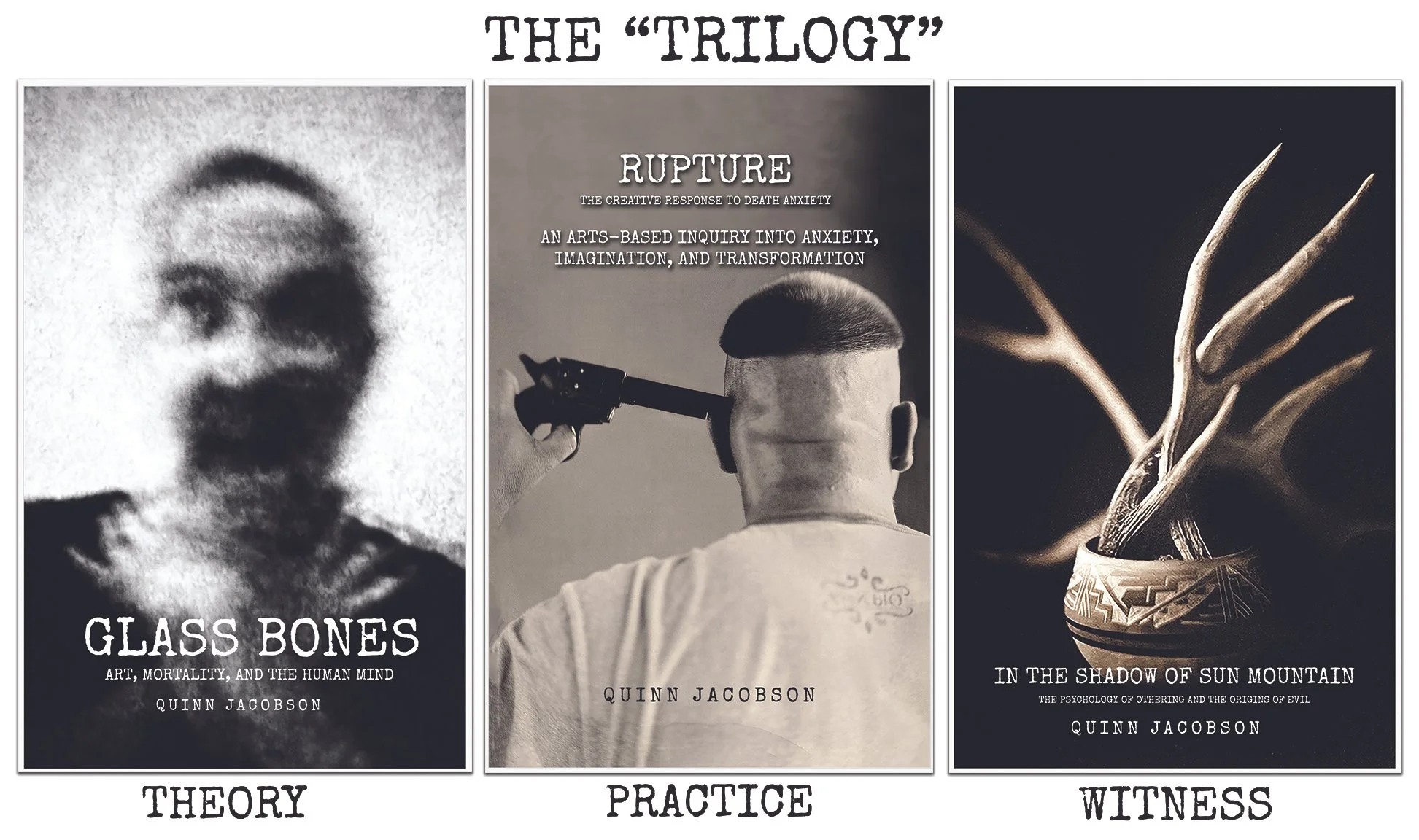
Mockup covers of my new books.
My New Books for 2026
Have you ever had an epiphany? An epiphany is a sudden, profound realization or insightful moment where the true meaning or essence of something becomes clear, often from a simple occurrence, stemming from the Greek word for "manifestation" or "appearance.”
I’ve had several over the past few weeks.
I wanted to share how I’m going to unfold these publications this year. I will use some of the 800-900 pages of text in these books for my 2028 thesis/dissertation—these writings will drive my dissertation.
“I’m building a psychology of artistic practice that takes mortality seriously as a formative force. And my three books, Glass Bones, Rupture, and In the Shadow of Sun Mountain, act as a trilogy: Theory → Practice → Witness regarding the theories and creativity.”
This is how I see it transpiring:
June 2026: Glass Bones is published.
September 2026: Rupture is published.
November 2026: In the Shadow of Sun Mountain is published.
Allow me to explicate: I'm building a psychology of artistic practice that takes mortality seriously as a formative force—not as metaphor, but as the pressure that shapes how artists see, make, and live. My trilogy examines this from three angles: Glass Bones provides the theoretical framework, drawing on Becker, Rank, and Terror Management Theory to understand death anxiety and cultural defense. Rupture translates theory into practice, exploring the disciplines and orientations that allow artists to transform existential pressure into creative form. In the Shadow of Sun Mountain offers lived witness—thirty years of working with nineteenth-century processes, paint, clay, broken materials, plants, people, and the mountain landscapes as sites where mortality and imagination meet. Together, they map the terrain where awareness becomes art: Theory → Practice → Witness.
This research is situated within liminal space: psychological, material, and cultural thresholds produced by mortality awareness. Rather than resolving death anxiety through symbolic closure, the work asks what becomes possible when creative practice holds the threshold open long enough for transformation to occur.
Mortality awareness places me in a permanently liminal condition. I am alive, but never free of the knowledge that I will not remain so. From a Beckerian perspective, this is not incidental; it is the core destabilizing fact of consciousness. I am an animal capable of symbol-making who cannot fully believe in my own symbols, a being suspended between embodiment and abstraction, presence and disappearance.
I do not experience this condition as episodic or developmental, something to be outgrown or resolved. It is structural. Consciousness itself unfolds at the threshold. What culture often treats as pathology or anxiety to be managed, I understand as the ground from which meaning-making arises. Creative practice, in this sense, is not an escape from liminality but a way of inhabiting it with attention and responsibility, giving form to what cannot be stabilized without distortion.
I will be making new work—photographs, paintings, and mixed media for Glass Bones and Rupture. My work from the mountain will be featured in Sun Mountain.
I think you can wrap your head around that one, right? Just writing this out alleviates some of the “it’s in me, and it has to come out” stuff. To quote John Lee Hooker from Boogie Chillin’ (1948), a natural, internal force that must be expressed.

Untitled—Whole Plate Salt Print from a wet collodion negative.
When I pull a print like this from the wash, I think about presence, the way it clings for a moment before fading (not fixed). The chemistry stains, the brush strokes at the edges, and the paper that curls in my hands—none of it is meant to last. That’s what I love about it. It’s a print that remembers its making. The figure still feels fragile, but now it’s suspended in a kind of quiet acceptance.
Living Truthfully Inside Impermanence
Rupture is not simply a wound; it’s the generative moment when denial collapses and creation begins. It’s the place where death anxiety, cultural myth, and personal memory are transmuted into presence. Within rupture, the artist becomes a witness rather than a defender, turning from the fantasy of permanence toward the truth of impermanence. In that shift, art no longer seeks to outlive death; it becomes a form of living with it.
Otto Rank’s distinction between the artist and the neurotic illuminates this process. Both encounter rupture, the psychic shattering that comes when one’s symbolic world no longer holds, but only the artist metabolizes it. Where the neurotic internalizes and chokes on anxiety, the artist transforms it into form. The creative act becomes a means of surviving truth, of remaking coherence in the face of its undoing. Ernest Becker described culture as a shield against mortality; I see art as the moment that shield cracks. The fracture is not failure but revelation, an aperture where something honest can enter.
My work with wet collodion lives inside that aperture. The process itself enacts rupture: collodion, glass, silver, and time. Each plate holds the risk of loss. The collodion might peel, the image might fog, and the light might fail. Yet those failures become evidence of life. The surface bears the marks of both fragility and endurance, transparency and strength. Each plate is a negotiation between control and surrender, between the impulse to preserve and the inevitability of decay. To work in this way is to accept that every act of making is also an act of unmaking. I’m connecting deeply to these ideas and am excited to see where it takes me.
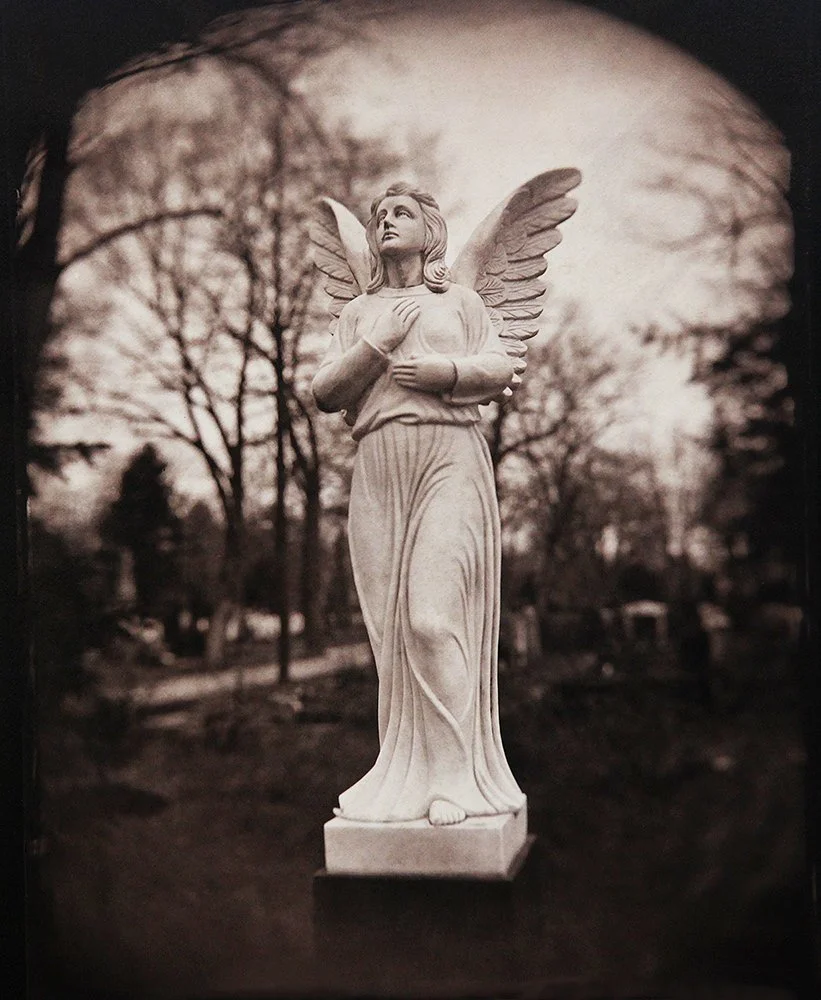
„Engel auf dem Käfertaler Friedhof“, 2009 – Gold toned salt print from a whole plate wet collodion negative.
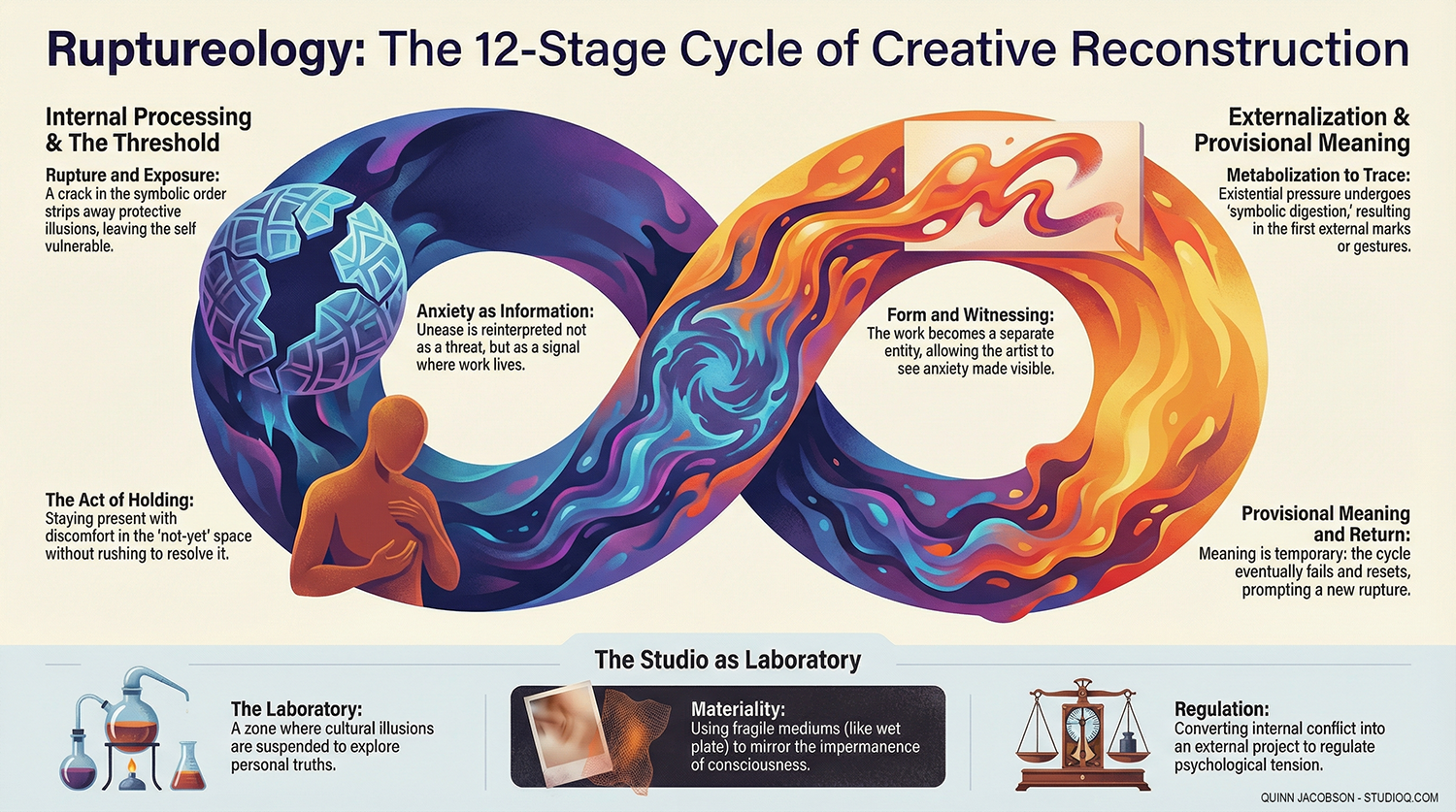
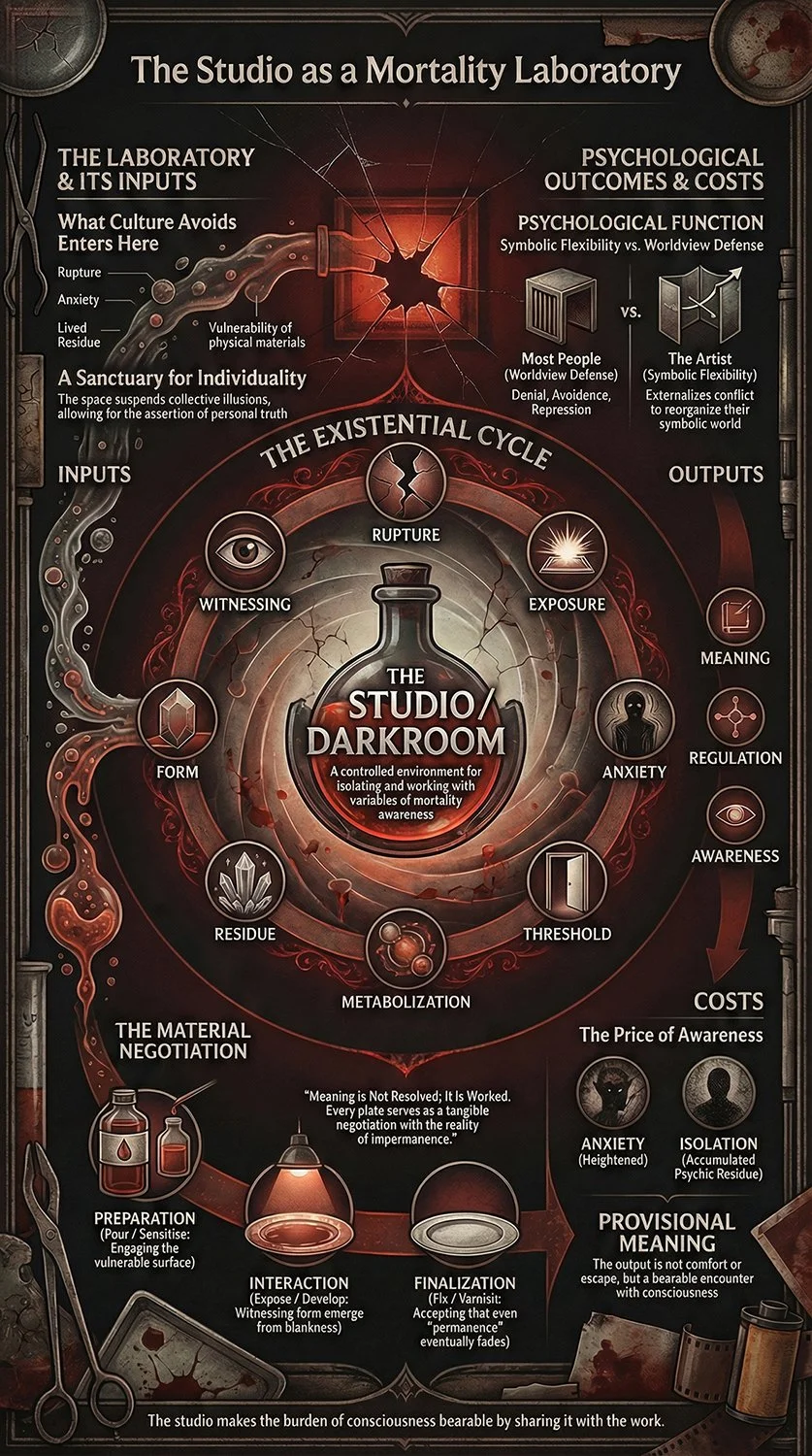
Ruptureology and Rupturegenesis
Have you ever heard of those words? Probably not.
“Ruptureology” and “rupturegenesis” are words that I’ve created to use with my study of creativity and mortality.
Here are some of my notes on this topic as well as part of a self-directed study on the topic (all draft forms).
Ruptureology
The study and practice of living and creating through rupture.
Ruptureology examines what happens when existential defenses collapse—when illusions, cultural buffers, or inherited meanings no longer hold. It asks: how do we metabolize that collapse into form, meaning, and transformation?
In essence, ruptureology is both a psychology and a poetics of confrontation. It studies the processes—psychological, creative, and cultural—by which individuals and societies either deny or integrate death anxiety. The artist, for example, does not seek to repair rupture but to work within it, turning fragmentation into insight, and terror into trace.
“I don’t condemn the illusions people construct to buffer death anxiety. My interest is in what happens when those illusions collapse—whether creative practice can transform the raw terror of mortality into meaning, rather than violence or denial.” Jacobson, Response to Anxiety (n.d., p. 1)
Rupturegenesis
The generative aftermath of rupture—the birth that follows breakdown.
If ruptureology studies the terrain of collapse, rupturegenesis is the alchemical process by which something new emerges from it. It is the transmutation of existential dread into symbolic residue—art, insight, empathy, or ethical awareness.
Rupturegenesis is not redemption or transcendence; it is the slow, embodied making of meaning within finitude. It is how the artist metabolizes death anxiety into creative output—how “terror becomes trace.”
Alchemy
The symbolic process of transformation. In creative and psychological terms, alchemy is how matter—chemical, emotional, or symbolic—is transmuted into meaning. In the collodion process, silver becomes image through ritual and risk. In ruptureology, anxiety becomes insight through creation.
“The transformation of silver salts into an image isn’t just chemistry; it’s alchemy. That alchemical act becomes a metaphor for the way artists transmute existential terror into meaning.” — Jacobson, SDS Overview or Concept (2025, p. 1)
Collapse
The psychic and cultural moment when death anxiety breaches denial. Collapse reveals the fragility of our worldviews and the insufficiency of our myths. It is the point where symbolic immortality fails—and the raw void becomes visible.
But collapse can also mark the beginning of rupturegenesis: the opening through which new forms of meaning emerge. Artists dwell here—between fracture and formation.
Metabolize
The internal reworking of existential anxiety into creative or ethical form. To metabolize is to take in the unbearable and convert it into expression rather than repression. This word bridges Rank’s distinction between the artist and the neurotic: one chokes on the world, the other chews it into meaning.
“By transforming terror into form, the artist reworks rupture into creative output: an external trace, a witness to mortality.” Jacobson, SDS Overview or Concept (2025, p. 1)
Residue / Trace
The tangible and symbolic remainder of an encounter with mortality. Residue is the mark left behind—the plate, the scar, the sentence, the memory. It is both evidence and echo, proof that meaning once passed through matter. I’ve said these words for years. The art happens in the making. The plate itself is residue; it captures the essence of the moment, the shadow of the sitter (or still life), and the fragility of life.
Witness
The conscious act of seeing and staying with what culture denies. Witnessing is both artistic and ethical; it resists erasure by turning the gaze toward suffering, mortality, and historical trauma. In my practice, witness is not documentation—it’s participation. To witness is to stand in relation to the void and refuse to look away.
Immanence
Meaning found within finitude. Immanence rejects transcendence or escape; it roots significance in the here and now. In ruptureology, immanence is the field in which all transformation occurs—the realization that nothing lies beyond death and that creation itself is the sacred act.
Collapse → Rupture → Metabolize → Trace → Witness → Immanence → Rupturegenesis
This is my through line of rupture—a living process of descent and creation. It maps the cycle through which anxiety becomes art, illusion gives way to insight, and denial is replaced by presence.
Otto Rank’s Personality Types
Rank’s Three Personality Types
Adapted (the “normal” person): Finds security in culture, tradition, religion, consumerism, or ideology. Adapted individuals manage their fear of death by adhering to social norms. Creativity, if expressed, stays within socially approved channels.
Neurotic: Overwhelmed by existential fear. The individual withdraws inward, unable to sublimate their anxiety. “Chokes” on mortality awareness, unable to transform it into external work.
Creative / Artist: Equally exposed to death anxiety, but metabolizes it through art or thought. Reworks inner terror into external form (art, philosophy, writing). They exist in a state of tension with culture, frequently stepping outside its protective illusions.
This framework clarifies that the "normal/adapted" person is not absent; rather, they represent the cultural baseline.
Rank’s Types Through the Lens of Ruptureology (my conversion)
Adapted (Buffered): Aligns with the dominant worldview to avoid rupture. The individual utilizes cultural shields such as religion, nationalism, and consumerism to suppress their awareness of death. Lives are “protected” inside the illusion—death anxiety is smoothed over rather than faced.
Neurotic (Collapsed): The rupture breaks through without mediation. The individual feels overwhelmed by mortality and struggles to transform it into meaning. Anxiety implodes inward, leading to paralysis or dysfunction.
Creative / Artist (Metabolizing Rupture): Confronts the rupture rather than fully denying or collapsing under it. Death anxiety becomes raw material—transformed into art, philosophy, ritual, or resistance. Lives on the edge between denial and confrontation, where meaning is forged.
This dovetails with my Through Line of Rupture:
Buffer → Collapse → Metabolize
The adapted “normal” person lives buffered.
The neurotic collapses under rupture.
The artist metabolizes rupture into creation.
Proximal and distal terror management defenses
Rank (1932/1989) distinguished between the adapted person, the neurotic, and the artist in relation to how each responds to existential anxiety:
“The average man avoids the worst effects of the fear of life and of death by complete adaptation to the collective. He lives not in himself, but in society; he seeks not his own immortality, but to participate in the immortality of the group” (p. 34).
“The neurotic suffers from the same increased consciousness of self as the artist, but he cannot objectify and render it harmless in creative work. He chokes on his own introversions” (pp. 55–56).
“The artist lives the double conflict of the individual and the collective more consciously than others, but he overcomes it in the work of art which creates a new unity of his personality with nature and with humanity. … The artist is able to overcome introversion by projecting his fears into the work of art, where they are mastered, objectified, and given form” (pp. 58, 70).
References:
Jacobson, Q. (n.d.). Response to anxiety [Unpublished manuscript].
Jacobson, Q. (2025, October 3). SDS overview or concept [Unpublished manuscript].
Rank, O. (1989). Art and artist: Creative urge and personality development (C. F. Atkinson, Trans.). W. W. Norton. (Original work published 1932)