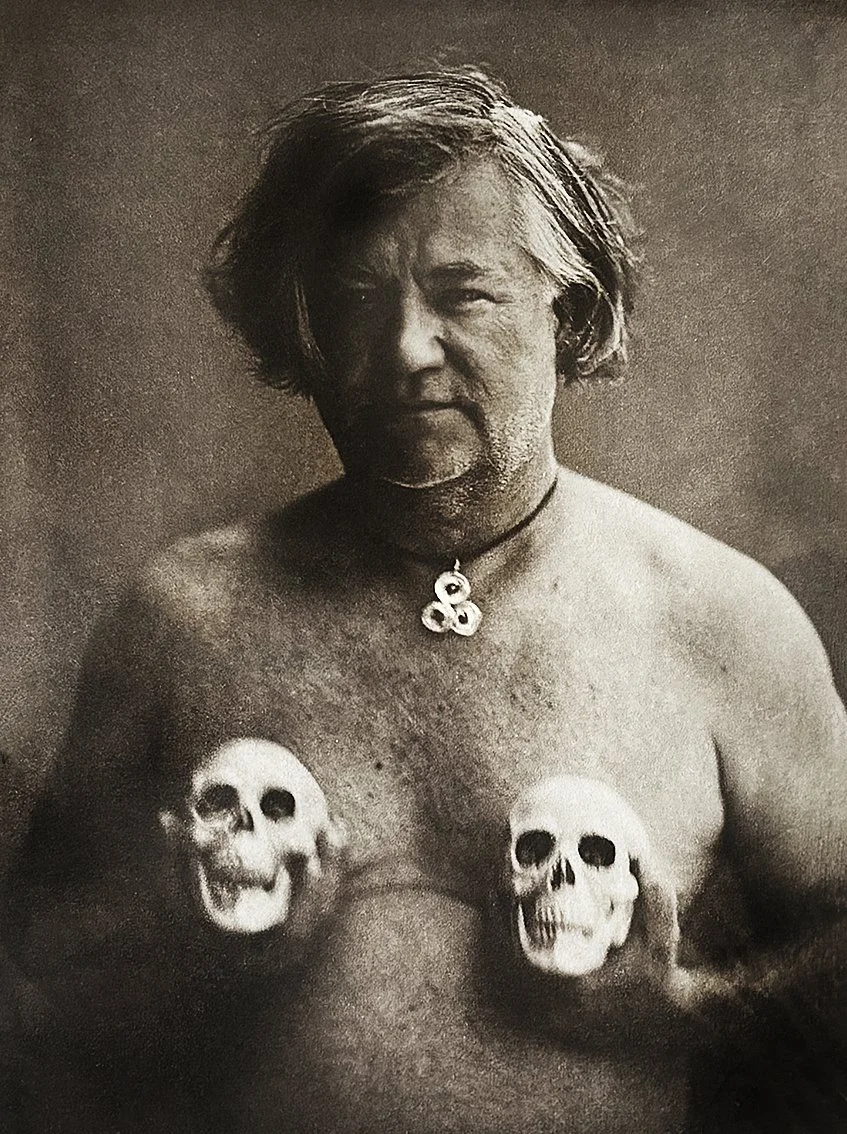
I made this image over the weekend. A friend, a fellow doctoral student, sitting in front of the camera. Bare-chested. Two skulls held against the torso, or resting there, or emerging from it. The preposition doesn’t quite hold, which is part of the point.
What you see is simple. What the image is doing is not.
I've been thinking for years about where images actually come from, not technically but psychologically. What pressures give rise to them. What gets carried into the frame, intended or not. This portrait didn't begin as a concept about mortality. It began as a feeling I've been circling a long time: that death isn't something we encounter occasionally, from a safe distance, but something we are already inside of. Always. The awareness held at arm's length. Functional, buffered, but never fully absent.
Ernest Becker called this the negotiated space of human existence—knowing, but not fully feeling (Becker, 1973). Culture itself, he argued, is largely a structure built to manage what we can't afford to fully face. We live between awareness and denial, close enough to the fact of mortality to be shaped by it and far enough to keep moving. This image tries to make that band visible. Not as argument. As form.
The Body as Pressure
The first decision was compositional: a frontal, centered figure. The kind of formal stability that early photographic portraiture used to convey dignity, legibility, and presence. That stability matters here because it sets up what follows.
Then the disruption.
The skulls aren't beside the body or held out for display. They're not props arranged for symbolic effect. They hover in the uncertain space between inside and outside the torso—not quite organs, not quite objects. The ambiguity is the point. If they were clearly internal, the image would collapse into anatomy. If they were clearly external, it would resolve too quickly into symbol. What I wanted was something less settled, something closer to what Becker describes as the ongoing, never-quite-finished negotiation between awareness and denial. Death not repressed, but not integrated either. Present, but unstable.
What I didn't anticipate until I saw the finished print was the gaze.
He isn't looking at the camera. He's looking past it, slightly—not evasively, but as if what he's attending to exists just outside the frame. That deflection changes the image's register entirely. It doesn't become a confrontation between viewer and subject. It becomes something more like shared witness: two figures—the one in the frame and the one looking at it—both oriented toward something that isn't fully visible. Something that hasn't arrived yet, or hasn't been named.
Trace, Not Symbol
There's always a risk with the skull. It's one of the most overdetermined objects in the history of art. From vanitas painting forward, it carries a ready-made meaning: mortality, transience, and memento mori.
That's not what I'm after. Or at least, not that way.
What I'm trying to do is shift the skull away from symbol and toward trace. The distinction matters. A symbol points toward meaning. A trace is the residue of a process already underway. Not a sign placed onto the surface to indicate death, but something more like the visible remains of a metabolic struggle that hasn't resolved.
In the framework I've been developing around rupture—what I'm calling the Rupture Field—this image sits somewhere between exposure and trace. The rupture has already occurred. Mortality awareness has exceeded the capacity of ordinary denial to contain it. What remains aren't conclusions. They're fragments. Partial forms. Something that couldn't be fully metabolized and so became visible instead.
That's what these skulls feel like to me. Not imposed onto the body from outside but surfaced from within it. The pressure finding form.
The Material Is Part of the Argument
The process here isn't incidental.
Kallitype, especially gold-toned, has a tonal range that is long, compressed, and quiet. Nothing leaps forward. The image doesn't announce itself—it accrues. There's something about the way the shadows pool and the highlights hold that makes the image feel like it already belongs to another time, even as it depicts someone sitting in front of a camera in the present.
And the paper—Revere Platinum—has a weight and tooth that digital processes can't replicate. You're aware that you're holding something. That the image exists on a surface that will age, fade, and eventually fail.
Otto Rank argued that the creative act is bound up with the desire to stabilize experience against loss—to produce something that persists beyond the individual life (Rank, 1932/1989). But I want to be careful here, because I don't think that's exactly what's happening in this print. The kallitype isn't trying to outlast anyone. It's not an immortality project in Rank's sense.
It's something closer to metabolization: making the pressure of mortality awareness visible while it is still being lived. Not preservation. Not transcendence. Processing. The print as a site where the rupture is held, turned over, and examined—without being resolved.
The difference matters. Preservation seals the wound. Metabolization keeps it open long enough to learn something from it.
The Necklace
I didn't plan for the necklace to do what it does. I noticed it after the print was finished, when I was looking at the full image for the first time.
Barthes would call this the punctum—the detail that arrives uninvited and redirects the image's meaning. But what interests me methodologically is something slightly different: not that the necklace pierced me as a viewer, but that it revealed itself to me as a researcher. The practice had generated something the conceptual framework hadn't predicted. The studio was thinking.
What it introduced was a different register entirely: relation, identity, and continuity. Something cultural and personal and chosen, against all the elements in the frame that belong to no one—the anonymous skulls, the bare torso, the ambiguous dark ground. The necklace says: this is a particular person. He has a history. He is located in a world of meaning.
And then everything around it reasserts: he is also mortal.
Rank makes a distinction that I keep returning to here. Religion, he suggests, emerges from collective belief in immortality—the promise that death will be overcome. Art arises from the individual's confrontation with impermanence—the refusal of that promise, or at least the refusal to look away from it (Rank, 1932/1989). This image seems to live between those poles. The necklace carries something like religious weight—continuity, relation, belonging—while everything surrounding it insists on the mortal body.
The body is no longer singular. It's carrying multiple realities at once: biological, relational, symbolic, and mortal. Not in sequence. Simultaneously.
What the Image Knows
I want to say something about methodology, because it matters here and I don't want to leave it implicit.
This image is not an illustration of a theoretical argument. It's not Becker made visual, or Rank translated into form. If it were, the essay would be sufficient and the image redundant. What I'm claiming—and what arts-based research methodology asks us to take seriously—is that the image produces a different kind of knowledge than the writing does. Not the same knowledge in a different register. Something the writing cannot replicate without remainder.
Propositional language can describe the negotiated space between awareness and denial. It can name it, analyze it, and situate it theoretically. What it cannot do is construct one. The kallitype doesn't point toward that space. It builds an instance of it. The viewer who stays with this image long enough, who lets the tonal range accrue rather than scanning for meaning, is briefly inside the condition the writing can only describe from outside.
That's not a claim about aesthetic experience. It's an epistemological one.
Practice-led research proceeds from the assumption that making is a form of inquiry, that the studio generates knowledge the conceptual framework hasn't yet predicted, and that this excess is methodologically significant rather than incidental. The necklace is my clearest evidence. I didn't plan for it to do what it does. I didn't theorize it in advance. It arrived in the finished print as something the process had produced independently of my intentions, and it changed what the image knew. That's the practice thinking. The researcher's job, afterward, is to follow where it went.
What the image knows that this essay doesn't: what it feels like to not be met by the subject's gaze. To stand in front of a figure who is looking past you, toward something outside the frame, and to realize that you are not the recipient of a statement but a fellow witness. The essay can describe that experience. It cannot produce it. The image produces it every time, for anyone willing to look long enough.
That gap, between what the writing can say and what the image can do, is not a limitation of the research. It's the point of it.
Condition, Not Conclusion
What I notice more and more in my own work is that I'm less interested in making statements than in staging conditions. This image doesn't explain anything. It doesn't arrive at a conclusion. It doesn't argue.
It presents a situation: a person, standing there, holding themselves together. With something else present. Not named. Not integrated. Not fully metabolized.
That feels honest to me.
If Becker is right, and I believe he is, then most of life unfolds precisely in that space. Not in full awareness, and not in complete denial. In the narrow band between them, where we can continue to function without being overwhelmed by what we know. The task isn't to resolve that tension. The task is to stay inside it long enough to make something true.
That's what I was trying to do here.
Not to illustrate mortality. Not to comfort anyone, including myself.
But to make the pressure visible. To let it take form. And to see what that form had to say.
References
Barthes, R. (1980). Camera Lucida: Reflections on Photography (R. Howard, Trans.). Hill and Wang.
Becker, E. (1973). The Denial of Death. Free Press.
Rank, O. (1989). Art and Artist: Creative Urge and Personality Development (C. F. Atkinson, Trans.). Agathon Press. (Original work published 1932)