
• blog
  • in the shadow of sun mountain
  • buy my books
  • photographs
  • paintings
  • bio
  • cv
  • contact
  • search
Menu

Studio Q Photography

Exploring Human Behavior and Death Anxiety Through Art
  • blog
  • in the shadow of sun mountain
  • buy my books
  • photographs
  • paintings
  • bio
  • cv
  • contact
  • search
×

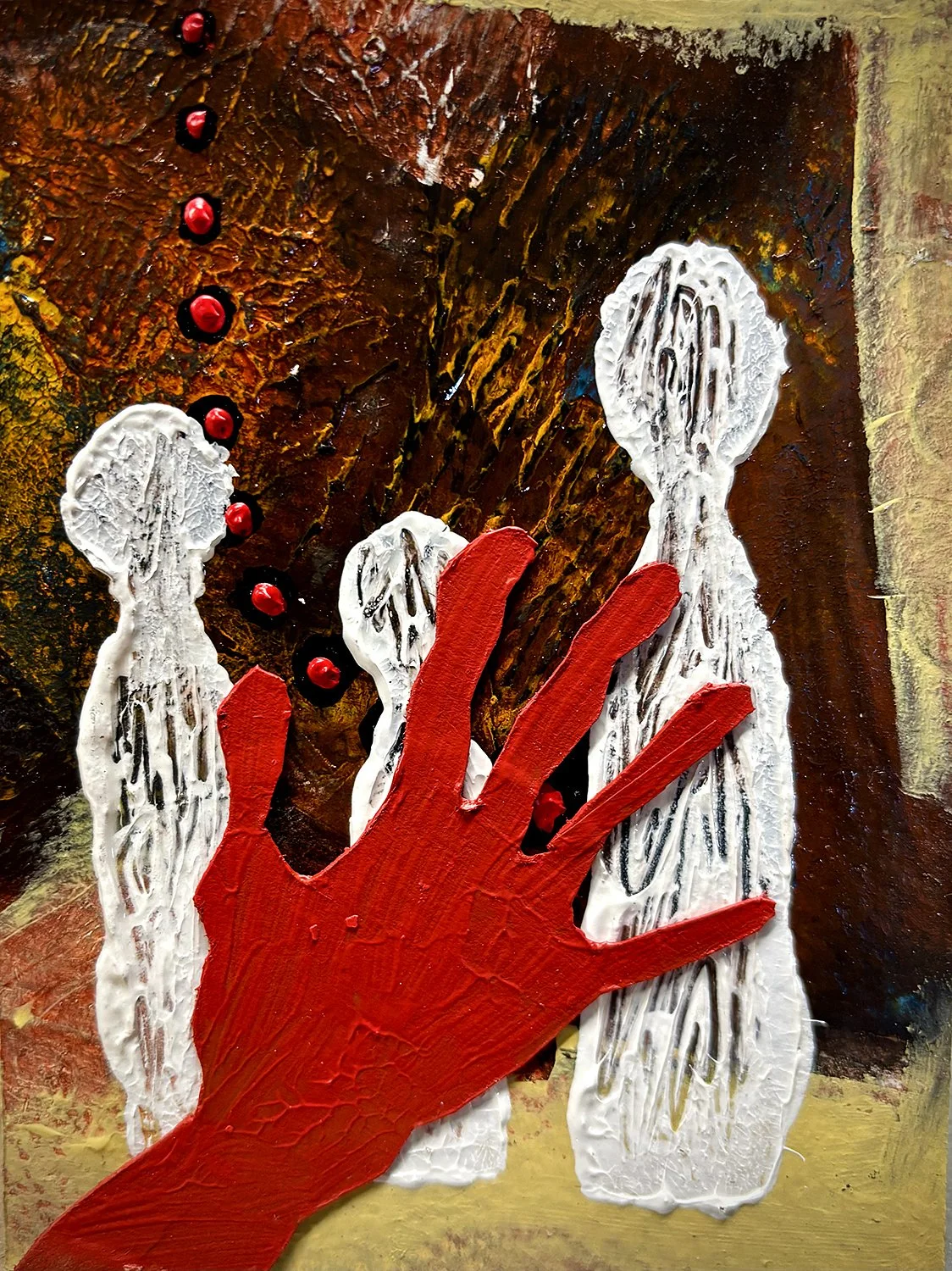
Untitled (Red Hand)
Acrylic mixed media on paper, 4.25" × 5.5"

A red hand interrupts three attenuated figures, marking the moment where existential anxiety is no longer diffuse but made contact—contained, metabolized, and rendered visible through form.

The Red Hand Problem

Quinn Jacobson January 12, 2026

How artists metabolize existential anxiety, and why the work still matters.

I keep returning to the same question, no matter how many theories I read or objects I make: What exactly happens to existential anxiety when it moves through the hands of an artist?

Not rhetorically. Mechanically. Psychologically.

The image above is one attempt to make that process visible. Three pale figures stand upright, stripped of detail, reduced almost to afterimages. They are not portraits so much as placeholders. Awareness has rendered their bodies thin. Over them reaches a red hand, oversized and intrusive, neither comforting nor gentle. It interrupts and intrudes. It stains. It marks.

That hand is not expression. It is intervention.

Most people manage death anxiety by keeping it diffuse, by never letting it fully localize. The artist does the opposite. The anxiety is brought forward, concentrated, and given a task. Creation becomes a site of containment. The fear does not disappear, but it changes state. It becomes workable.

This is what I mean by metabolizing existential anxiety. Not purging it. Not transcending it. Converting it into form.

Psychologically, this matters more than we often admit. The act of making gives the anxious mind boundaries. Time slows. Attention narrows. The self becomes less abstract and more procedural. The question shifts from What does it all mean? to What happens if I put this here? That shift is not trivial. It is regulatory. It allows consciousness to stay in contact with mortality without flooding.

The white figures in the image are not victims. They are witnesses. They stand because the hand is doing something on their behalf.

This is where arts-based research comes into focus for me. ABR is often framed as alternative knowledge production, which is true but incomplete. Its deeper value lies in its psychological function. Making becomes a way of thinking that does not rely exclusively on symbolic abstraction. Image, material, gesture, and repetition—these are not illustrations of insight; they are the insight.

When anxiety stays purely cognitive, it spirals. When it enters the body through making, it circulates. It acquires rhythm. It becomes legible.

This brings me to the harder question: is there any value in writing books like Glass Bones and Rupture?

If the goal were resolution, probably not. No book resolves the fact of death. No theory seals the crack. But that has never been the real task. The value lies in creating sustained containers where anxiety can be held long enough to be examined without collapsing into distraction or denial.

These books are not answers. They are pressure vessels.

Writing them will force me to stay with the material—psychologically and ethically—longer than images alone sometimes allow. It slows the metabolism. It traces the process. It makes visible what is usually hidden: how fear becomes form, how rupture becomes method, and how meaning is provisional but still worth making.

The red hand, then, is also authorship. It is the decision to intervene rather than look away. To touch the thing that makes us uncomfortable and accept the consequences of contact.

Artists do not escape existential anxiety (not at all). They work it. They give it edges. They give it weight. They give it somewhere to go.

That’s not a cure.
But it is a practice.
And in a culture built on denial, practice may be the most honest form of value we have left.

In Abstract Painting, Acrylic Painting, Angst, Anxiety, Art & Theory, Arts-Based Research, Death Anxiety, Existential Art, Fragile, Handmade Print, Neurotic, Painting, PhD, Psychology and Art Tags Existentialism, existential psychology, Existential Art, acrylic painting, Mixed Media
Comment

WIP: 30” x 40” acrylic and mixed media on canvas.

You're Neurotic: How Neurotic Are You?

Quinn Jacobson April 20, 2025

There’s no question—you’re neurotic. We all are, at least to some degree. It's a spectrum; the real question is, how neurotic are you?

If you’re a creative type, odds are you lean a little heavier on that scale than most. Artists tend to feel things more deeply—they’re more sensitive to emotional undercurrents, more affected by loss, conflict, absurdity, and even silence. That kind of heightened awareness can become a burden. And for many, it leads to withdrawal. You’re not interested in small talk or cocktail parties. You’d rather sit with the ache of things than skim the surface.

If you’re reading this and thinking, “Yeah, that’s me,” that’s not a flaw. It’s just a truth. But here’s the catch—if you don’t have some kind of creative outlet, some way to metabolize that existential weight, life can get pretty dark. Neuroticism without expression is a slow bleed. Creativity is what keeps it from turning into despair.

My work is centered around how artists manage neuroticism, especially the mainspring of it—the fear of not existing anymore. It’s the implications of death that concern us, not really death itself (although for some, the death part is a big deal). What are the implications? The question revolves around meaning and significance. Was my life meaningful? Did I matter? Have I made any difference? Will I be remembered?

These aren’t casual questions. They sit under the surface of everything we do. For artists, they show up in the studio, in the darkroom, in the act of making. The work becomes a kind of wrestling match with invisibility. We create not just to be seen, but to prove—to ourselves, maybe more than anyone else—that we were here. That this inner world we carry meant something.

I believe creative work is one of the few ways to confront the void without collapsing into it. It gives form to the formless, voice to the silence. It’s not therapy, exactly—but it is a kind of existential hygiene. A way of making peace, if not with death itself, then with the tremors it sends through a conscious life.

“Rank asked why the artist so often avoids clinical neurosis when he is so much a candidate for it because of his vivid imagination, his openness to the finest and broadest aspects of experience, his isolation from the cultural worldview that satisfies everyone else. The answer is that he takes in the world, but instead of being oppressed by it, he reworks it in his own personality and recreates it in the work of art. The neurotic is precisely the one who cannot create—the “artiste-manque,” as Rank so aptly called him. We might say that both the artist and the neurotic bite off more than they can chew, but the artist spews it back out again and chews it over in an objectified way, as an ex­ternal, active work project. The neurotic can’t marshal this creative response embodied in a specific work, and so he chokes on his in­troversions. The artist has similar large-scale introversions, but he uses them as material.” Ernest Becker, The Denial of Death

The main point of my book is about this. It’s about my personal experience as an artist and how that has affected my relationship with death. There is no doubt artists cope with death anxiety in a different way. The problem is how neurotic they are, how extreme they are when it comes to their inability to deal with existential problems. The non-creative person, or as Rank called them, the artiste manqué, has no chance to resolve their issues through an external process. You can witness this every day in the world. Creative types have a chance to transform the anxiety into something interesting or beautiful. The problem is that they need to be conscious of the process for it to work well.

That’s the real paradox: the gift is there, but if you don’t realize what you’re doing—if you’re not aware that your art is a kind of transmutation of death anxiety—then the process can still collapse in on itself. You can end up consumed by the very thing you’re trying to escape. The work might get made, but it won't heal. It won’t clarify. It won’t liberate. And it definitely won’t confront mortality.

Becker, Rank, even Kierkegaard—they all understood that some kind of creative striving was essential. Not just as expression, but as salvation. But it has to be done with eyes open. That’s what I’m arguing. That consciousness is the key—not just of death, but of the internal machinery we build to cope with it. Otherwise, even the most beautiful art can become another mask. Another form of denial.

In Neurotic, Creative Problems, Psychology Philiosophy Tags neurotic, painting, art and artists
Comment

Search Posts

Archive Block
This is example content. Double-click here and select a page to create an index of your own content. Learn more
Post Archive
  • Photography
 

Featured Posts

Featured
Jan 28, 2026
A Film You Should Watch
Jan 28, 2026
Jan 28, 2026
Jan 27, 2026
My New Books for 2026
Jan 27, 2026
Jan 27, 2026
Jan 26, 2026
The Dimmer Switch Explained
Jan 26, 2026
Jan 26, 2026
Jan 24, 2026
Holding Pattern
Jan 24, 2026
Jan 24, 2026
Jan 19, 2026
The Sacred Didn’t Vanish - It Migrated
Jan 19, 2026
Jan 19, 2026
Jan 19, 2026
Animality: The Part of Us We Keep Trying to Forget
Jan 19, 2026
Jan 19, 2026
Jan 17, 2026
Working With Academia Without Being Rewritten
Jan 17, 2026
Jan 17, 2026
Jan 12, 2026
The Red Hand Problem
Jan 12, 2026
Jan 12, 2026
Jan 4, 2026
Immortality Projects and Creative Works
Jan 4, 2026
Jan 4, 2026
Dec 29, 2025
Interview With Dr. R. Michael Fisher: Careers of Folly and Wisdom
Dec 29, 2025
Dec 29, 2025