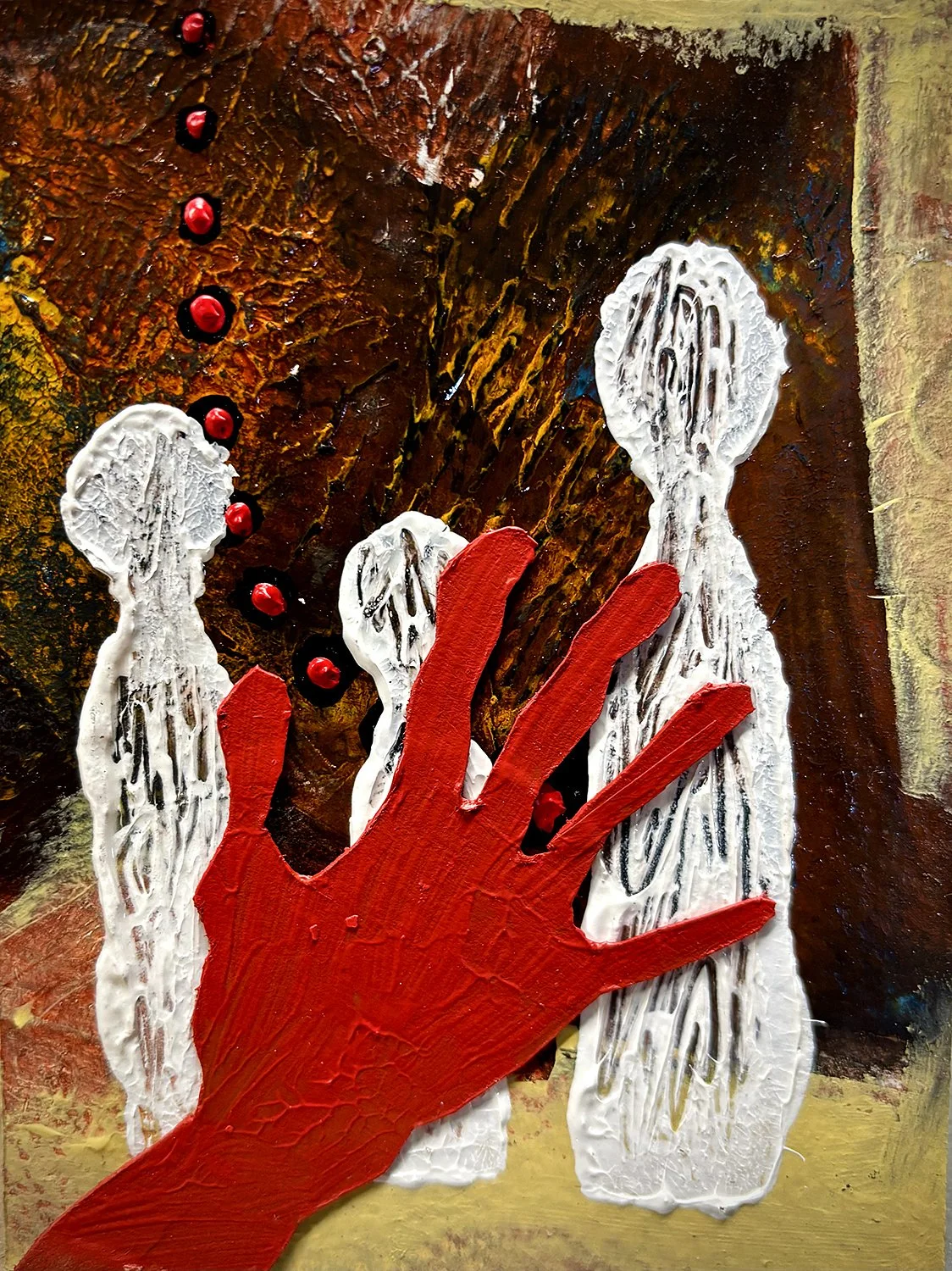
Untitled (Red Hand)
Acrylic mixed media on paper, 4.25" × 5.5"
A red hand interrupts three attenuated figures, marking the moment where existential anxiety is no longer diffuse but made contact—contained, metabolized, and rendered visible through form.
The Red Hand Problem
How artists metabolize existential anxiety, and why the work still matters.
I keep returning to the same question, no matter how many theories I read or objects I make: What exactly happens to existential anxiety when it moves through the hands of an artist?
Not rhetorically. Mechanically. Psychologically.
The image above is one attempt to make that process visible. Three pale figures stand upright, stripped of detail, reduced almost to afterimages. They are not portraits so much as placeholders. Awareness has rendered their bodies thin. Over them reaches a red hand, oversized and intrusive, neither comforting nor gentle. It interrupts and intrudes. It stains. It marks.
That hand is not expression. It is intervention.
Most people manage death anxiety by keeping it diffuse, by never letting it fully localize. The artist does the opposite. The anxiety is brought forward, concentrated, and given a task. Creation becomes a site of containment. The fear does not disappear, but it changes state. It becomes workable.
This is what I mean by metabolizing existential anxiety. Not purging it. Not transcending it. Converting it into form.
Psychologically, this matters more than we often admit. The act of making gives the anxious mind boundaries. Time slows. Attention narrows. The self becomes less abstract and more procedural. The question shifts from What does it all mean? to What happens if I put this here? That shift is not trivial. It is regulatory. It allows consciousness to stay in contact with mortality without flooding.
The white figures in the image are not victims. They are witnesses. They stand because the hand is doing something on their behalf.
This is where arts-based research comes into focus for me. ABR is often framed as alternative knowledge production, which is true but incomplete. Its deeper value lies in its psychological function. Making becomes a way of thinking that does not rely exclusively on symbolic abstraction. Image, material, gesture, and repetition—these are not illustrations of insight; they are the insight.
When anxiety stays purely cognitive, it spirals. When it enters the body through making, it circulates. It acquires rhythm. It becomes legible.
This brings me to the harder question: is there any value in writing books like Glass Bones and Rupture?
If the goal were resolution, probably not. No book resolves the fact of death. No theory seals the crack. But that has never been the real task. The value lies in creating sustained containers where anxiety can be held long enough to be examined without collapsing into distraction or denial.
These books are not answers. They are pressure vessels.
Writing them will force me to stay with the material—psychologically and ethically—longer than images alone sometimes allow. It slows the metabolism. It traces the process. It makes visible what is usually hidden: how fear becomes form, how rupture becomes method, and how meaning is provisional but still worth making.
The red hand, then, is also authorship. It is the decision to intervene rather than look away. To touch the thing that makes us uncomfortable and accept the consequences of contact.
Artists do not escape existential anxiety (not at all). They work it. They give it edges. They give it weight. They give it somewhere to go.
That’s not a cure.
But it is a practice.
And in a culture built on denial, practice may be the most honest form of value we have left.
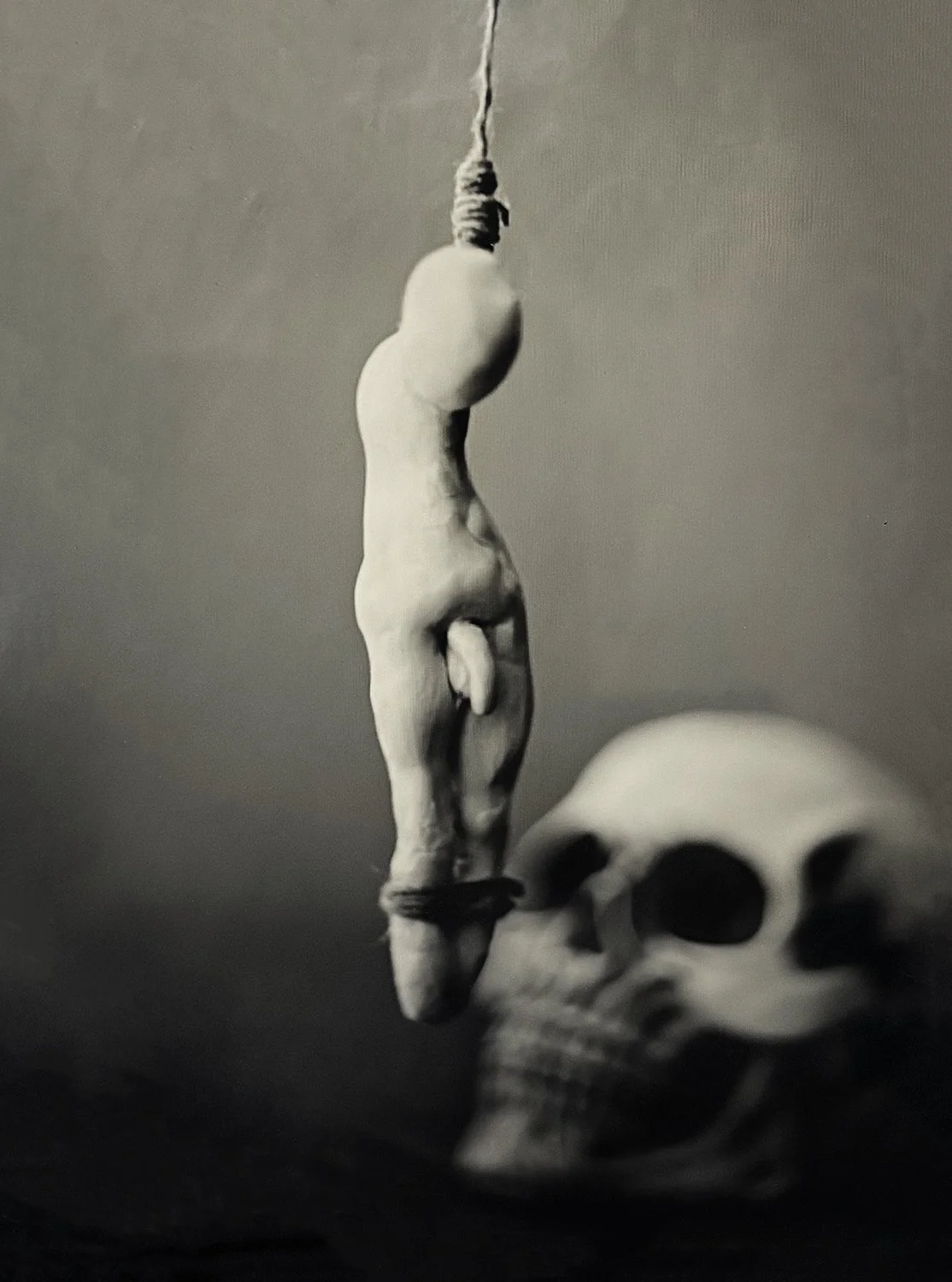
Punished for Embodiment. Half-plate tintype (4.25 × 5.5 in.). December 2025.
Western art has long tried to discipline the body—shrinking it, idealizing it, and denying its animality. This work pushes back. The figure is restrained not for what he has done, but for what he is: a vulnerable organism aware of its own end. The skull waits behind him, already finished with the struggle.
Living With The Dimmer Switch
One of the biggest challenges I face when I talk about Becker, Rank, Zapffe, or Terror Management Theory isn’t that the ideas are too complex. It’s that they’re describing the very psychological machinery that makes them difficult to understand in the first place. (Becker, 1973; Greenberg et al., 1986; Rank, 1932; Zapffe, 1933/2010).
That’s the paradox.
From an evolutionary perspective, human consciousness didn’t just give us language, imagination, and culture. It gave us a problem no other animal has to solve: we know we’re going to die, and we know it with enough clarity to make life unbearable if that awareness stayed fully online all the time (Becker, 1973; Solomon et al., 2015). So evolution didn’t eliminate the problem. It built a workaround.
These thinkers essentially suggest that the human mind evolved a dimmer switch mechanism. This is not an on-off switch, but rather a regulator (Jacobson, 2025). With too much awareness of death, the organism freezes, panics, or collapses. Too little, and life loses urgency, meaning, and care (Becker, 1973; Yalom, 2008).
So the psyche learned to keep mortality awareness just low enough to function and just high enough to motivate (Greenberg et al., 1986; Solomon et al., 2015).
That’s why so many people genuinely believe they don’t think about death or aren’t afraid of dying. They’re not lying. The system is working exactly as it’s supposed to (Greenberg et al., 1986; Pyszczynski et al., 2015). These defenses operate beneath conscious awareness, the same way breathing or balance does. You don’t feel yourself regulating your blood pressure either, but that doesn’t mean it isn’t happening.
In fact, one of the clearest signs that death anxiety is present is the firm belief that it isn’t (Solomon et al., 2015).
Becker’s insight was never that people walk around consciously terrified. It was that culture exists to make sure they don’t have to (Becker, 1973). Worldviews, identities, careers, religions, politics, moral certainty, and even the idea of being a “good person” quietly serve the same psychological function: they tell us we matter in a universe that otherwise wouldn’t notice our disappearance (Becker, 1973; Greenberg et al., 1986). Once those structures are in place, the fear drops out of awareness. The dimmer switch does its job (Jacobson, 2025).
This is also why these ideas often provoke irritation or dismissal instead of curiosity. When someone encounters them for the first time, they aren’t just learning new information. They’re brushing up against the scaffolding that holds their sense of reality together. The mind doesn’t experience that as insight. It experiences it as a threat (Greenberg et al., 1986; Pyszczynski et al., 2015). The response isn’t “Is this true?” so much as “Why does this feel wrong?”
Zapffe pushed this even further and suggested that consciousness itself may be over-equipped for the world it inhabits. We see too much, anticipate too far ahead, and know too well how the story ends (Zapffe, 1933/2010). The defenses he described—isolation, distraction, anchoring, and sublimation—aren’t moral failures. They’re survival strategies (Zapffe, 1933/2010). Without them, the weight of existence would be crushing. So when people recoil from these ideas, they’re doing exactly what the human animal evolved to do.
This is where my work sits.
Artists tend to live closer to that fault line. It's not because we're braver or more enlightened, but rather because creative practice weakens the dimmer switch (Jacobson, 2025; Rank, 1932). Making art requires attention, dwelling, repetition, and exposure. Over time, some of the automatic defenses erode. You keep looking where others glance away. That doesn’t make life easier. It makes it more honest.
This is why arts-based research matters so much to me (Barone & Eisner, 2012). I’m not trying to convince anyone with arguments alone. I’m showing what happens when someone lives with the dimmer turned slightly higher than average and then tries to metabolize what comes into view. The artifacts aren’t illustrations of theory. They are the evidence of a nervous system and a psyche working under different conditions.
So when someone says, “I don’t have death anxiety,” I hear, “My defenses are intact.” And when they say, “This feels abstract,” I hear, “This is getting too close to something I’ve spent my life not naming.”
That isn’t a failure of communication. It’s the terrain.
My work isn’t about forcing understanding. It’s about creating conditions where understanding can happen without overwhelming the person encountering it (Barone & Eisner, 2012; Jacobson, 2025). That’s why I move through story, image, material, land, and memory. I’m not avoiding theory. I’m respecting the psychology that makes theory hard to hear in the first place (Becker, 1973; Solomon et al., 2015).
And in that sense, the difficulty isn’t a flaw in these ideas.
It’s the sound the dimmer switch makes when you try to turn it up.
The resistance.
The discomfort.
The urge to look away.
Those aren’t misunderstandings.
They’re the evidence.
References
Barone, T., & Eisner, E. W. (2012). Arts-based research. SAGE.
Becker, E. (1973). The denial of death. Free Press.
Greenberg, J., Pyszczynski, T., & Solomon, S. (1986). The causes and consequences of a need for self-esteem: A terror management theory. In R. F. Baumeister (Ed.), Public self and private self (pp. 189–212). Springer.
Jacobson, Q. (2025). Living with the dimmer switch [Blog post manuscript]. Unpublished.
Pyszczynski, T., Solomon, S., & Greenberg, J. (2015). Thirty years of terror management theory: From genesis to revelation. In J. M. Olson & M. P. Zanna (Eds.), Advances in experimental social psychology (Vol. 52, pp. 1–70). Academic Press.
Rank, O. (1932). Art and artist: Creative urge and personality development. W. W. Norton.
Solomon, S., Greenberg, J., & Pyszczynski, T. (2015). The worm at the core: On the role of death in life. Random House.
Yalom, I. D. (2008). Staring at the sun: Overcoming the terror of death. Jossey-Bass.
Zapffe, P. W. (2010). The last messiah. (Original work published 1933)
Racism isn’t innate – Here are Five Psychological Stages that may Lead to It
I encourage you to take a look at this article from The Conversation. It references Terror Management Theory, which to me is one of the most overlooked—and ignored—frameworks for understanding the problems we face today.
From racism to war, from bigotry and xenophobia to jingoism and religious dogma, we seem almost determined to find “the other.” As the old saying goes, I’ll hate you for the color of your shirt or the shape of your nose. Anything will do, so long as it puts someone in the “out group.” America has been marinating in this for a long time, and at this moment, I don’t see the future looking particularly bright. If anything, I’d caution people to prepare themselves for more, and larger, terrible events ahead.
You can already see it unfolding: Russia’s war in Ukraine, the genocide in Gaza, and climate disasters that grow more relentless each year—wildfires, hurricanes, and flooding. These events are not only catastrophic in themselves, but they remind us, again and again, of our own fragility and mortality. And when we are forced to face that, death anxiety tends to boil over into hostility, scapegoating, and division.
“We spend endless energy on the ‘what’ of our problems but rarely ask the ‘why.’ It’s like treating a cough while ignoring the virus that causes it.”
Add to this the terrible political divide in America: the Kirk assassination, Trump sending troops into American cities, and the daily drumbeat of culture war rhetoric. Political party loyalties—red and blue alike—are tearing at the fabric of our society. Even in our everyday lives, people seem more standoffish, impatient, and cold (I’ve felt this for a few years). It’s as if the collective weight of death anxiety is bubbling up everywhere, pushing us further into our corners.
This is what my studies and interests revolve around: what the fear of non-existence means for people and how it runs outside of conscious awareness. Terror Management Theory and Ernest Becker’s work hold so much explanatory power, I can’t understand why more people don’t embrace them—don’t bring them into their lives. Our world would be a much better place if we did.
Sheldon Solomon, building on Becker, put it bluntly: We will always need a designated group of inferiors.
What do you think? Do you see this drive to divide and “other” playing out in your own circles, communities, or even in the way strangers treat each other on the street? I’d love to hear your perspective.
And yet, I can’t help but believe there’s another path. If we had the courage to face death honestly, maybe we wouldn’t need enemies at all.
“Lunch in the French Countryside,” 5” x 4” Black Glass Ambrotype, France 2009
Clarity on Direction for Doctoral Studies
As I move through this program, I’ll be posting here as part diary/journal and part research/reminders. I’m going to start at the beginning (first things first, in that order).
Despite existing research on death anxiety and Terror Management Theory, there remains a lack of understanding about how artists uniquely engage with mortality through their creative practice. Here lies my sweet spot: artists metabolize absurdity into elegiac beauty, creating work that doesn’t deny death but dwells in its presence.
While previous studies have examined the psychological strategies humans use to manage death anxiety, few have focused on the role of art-making as a direct and conscious confrontation with death (the main driver for me). The literature has largely prioritized quantitative measures of death anxiety and its behavioral outcomes, but less attention has been paid to qualitative, practice-based explorations of how mortality awareness shapes the creative process.
“I use mortality as a creative source, creating art that turns fear into connection and purpose.”
I want my work to address this gap by investigating how artists’ engagement with death anxiety can lead to existentially authentic art. Using a mixed-methods approach that combines autoethnography, interviews with artists, and analysis of creative works, this study will explore how artistic practice functions as a site for mortality confrontation and how such engagement reorients artistic purpose and output. It sounds daunting, I know, but it’s really just asking questions about how mortality affects creative people versus those who don’t identify as creative.
The research will contribute to existential psychology, art theory, and creative practice by offering an integrated theoretical and practice-based model for understanding how artists process death anxiety. The findings are expected to inform theories of death anxiety, models of creative practice, and arts-based approaches to existential therapy, ultimately supporting artists, educators, and mental health practitioners in fostering deeper, more meaningful engagement with the realities of death.
“The life-giving question guiding me now is: How might confronting mortality through creativity lead us into deeper, more authentic ways of being human?”
Vision Seed (short form)
Helping people directly confront mortality—not as a means to an end, but as a source of ingenuity, fortitude, and a closer bond—is my vision seed. I use historical wounds, grief, and death anxiety in my writing and art to demonstrate how facing our greatest fears can lead to purpose and service. My mission is to advance these discussions so that we can live more compassionately, reciprocally, and with greater presence.
Picacho Hills early August morning. Las Cruces, New Mexico 2025
The Explanatory Power of Becker's Ideas and TMT
On the first page of Ernest Becker’s book, The Birth and Death of Meaning (1962), he wrote, “This is an ambitious book. In these times there is hardly any point in writing just for the sake of writing: one has to want to do something really important. What I have tried to do here is to present in a brief, challenging, and readable way the most important things that the various disciplines have discovered about man, about what makes people act the way they do.”
Terror Management Theory (TMT), developed as an extension of Ernest Becker’s work, posits that the uniquely human awareness of mortality gives rise to profound existential anxiety. As Becker argued in The Denial of Death (1973), this awareness creates the potential for paralyzing terror that must be managed if life is to remain bearable. To buffer against this anxiety, individuals construct and maintain cultural worldviews that provide meaning, order, and the promise of personal significance. These worldviews not only orient individuals within a shared reality but also serve as symbolic defenses against death anxiety. Consequently, human motivation is fundamentally tied to sustaining the belief that life has purpose and that one’s existence has value. When these worldviews are challenged—or when mortality becomes salient—individuals typically respond with defensive strategies aimed at reestablishing confidence in their cultural frameworks and reaffirming their sense of worth.
This is where my work enters the conversation. If culture at large defends us against mortality, art can turn toward it. My work is centered on art that metabolizes death anxiety into meaning—not by escaping it, but by dwelling in its presence. Over the next three years, I will be creating both a dissertation and a body of work that explore how creativity can transform existential dread into something we can live with, and maybe even live more fully because of it.
“Hanging Fisherman,” Whole Plate Black Glass Ambrotype—Hangzhou, China, 2014 (part of a diptych).
Mortality as the Artist’s Compass
I have come to believe that authenticity in art is not only about emotional honesty. That is part of it, of course. But for me, it is about something deeper: truth to your own existential position.
Most of us spend a lifetime borrowing meaning from somewhere else, from culture, religion, politics, or trends. We take on beliefs about life and death that make things easier to bear, whether or not they feel real to us. And then, if we are lucky or unlucky enough, something cracks those beliefs open. A death. A diagnosis. A moment when the denial stops working.
When that happens, you are left staring at your own finite reflection. The illusions peel away. The question becomes: What do I actually believe about my time here?
For an artist, that is the turning point. Once you have wrestled with your own mortality, the work changes. It stops being about what will sell or what will get likes. It stops being about fitting into someone else’s “hero system.” The work starts coming from a place that is aligned with how you actually see the world, its fragility, its cruelty, its beauty, its brevity.
That is when the art gets dangerous. Vulnerable. Alive. People can feel it, even if they cannot explain why.
Confronting death does not just strip away the noise. It reorients the compass. The art you make from that place carries the weight of your own reckoning. It is not about making peace with death. It is about making something true in its shadow.
What This Looks Like in Practice
I have seen this shift in my own work. When I started photographing massacre sites for Ghost Dance, it was not a project I chose because it was marketable. In fact, I knew it would make some people uncomfortable. I chose it because those places carried the weight of lives ended, stories erased, and the uncomfortable truth that we are standing on the bones of history. Making that work forced me to sit with my own mortality and the fact that history is a mirror, not just a record.
You see the same thing in other artists who have wrestled with death. Käthe Kollwitz lost her son in the First World War, and her work after that loss is stripped of any pretension, just raw, unfiltered grief and solidarity with those crushed by violence. There is Egon Schiele, painting feverishly as the Spanish flu closed in on him, his portraits vibrating with the urgency of someone who knows the clock is almost out of time. Or someone like David Wojnarowicz, turning his rage at the AIDS epidemic into work that was both deeply personal and politically explosive.
In each case, the confrontation with mortality burned away the excess. What was left was not pretty or safe. It was a direct transmission of how they saw the world in that moment.
That is the authenticity I am talking about. Not the buzzword. Not the marketing gimmick. The kind that comes when you have looked death in the eye and decided to make something anyway.
Why This Matters Beyond Art
This is the heartbeat of my current research. In my doctoral work, I am exploring how artists confront death anxiety differently than non-artists and what that difference reveals about the human search for meaning. Drawing on thinkers like Ernest Becker and Otto Rank, I am looking at how creative engagement with mortality does not just change the work. It changes the maker.
When an artist faces death head-on, it interrupts the psychological strategies we all use to soften the fact of our finitude. Those strategies, denial, distraction, and absorption in borrowed belief systems, are comfortable, but they keep us from living in alignment with our own worldview. Art that emerges from this confrontation is not only more personal. It is existentially authentic.
I believe this authenticity matters because it models a way of living. It shows that even in the shadow of death, and maybe especially there, it is possible to create something that is alive with meaning, stripped of illusion, and true to the person who made it.
Dissertation Adaptation
This research investigates how artists confront death anxiety differently than non-artists and the implications of this difference for understanding the human search for meaning. Building on the work of Ernest Becker, Otto Rank, and Terror Management Theory, I propose that creative engagement with mortality disrupts the culturally mediated denial systems that typically buffer individuals from the anxiety of finitude. Such engagement compels the artist to interrogate and often discard “borrowed” systems of meaning in favor of a self-authored existential position. When the resulting creative work emerges from this clarified stance, it attains what I define as existential authenticity: a coherence between the artist’s worldview and their creative expression. This authenticity is not merely aesthetic or emotional; it is the product of alignment between the maker’s lived confrontation with mortality and the work they bring into the world. In this way, the artistic process becomes both a site of meaning-making and a lived model for confronting, rather than evading, the inevitability of death.
ICYMI - Are We Equipped to Have This Conversation?
This post is from October 2024, but the question still lingers: what are we really doing when we make art?
Something feels off in the way we talk about art-making today. Are we even on the same page? What is art for? What’s its function in our lives—especially now? Why do we make it? And can we sit with the hard questions when they come—about meaning, originality, and purpose? Can we actually hear the feedback without flinching?
I keep noticing this trend: artists trying to patch holes in their creative lives by borrowing someone else’s voice, someone else’s vision. Emulating a style or riding the momentum of a movement that already has weight, hoping some of that gravity will rub off.
But that’s not it. That’s not the work.
Curious where you stand with all this. Drop a comment—let’s talk.
We Will Be Forgotten
We Die. Then We’re Forgotten.
We all know life ends. That’s not the surprise. The harder part is this: not only do we die, but we’re eventually forgotten. Completely. That fact sits at the edge of consciousness—rarely invited in, but always looming.
A year ago, I saw this video about Danish photographer Balder Olrik. It just resurfaced in my YouTube feed. An artist, going through a health crisis, came face-to-face with his mortality. It shook him. He realized, maybe for the first time, that he’s going to die. And not just die, but vanish from memory. No legacy. No monument. Just absence.
It hit me because I see this all the time: artists wrestling with death anxiety without having the language to name it. They circle around it, feeling it, expressing it, but never quite framing it. This is exactly the moment where Ernest Becker’s work becomes powerful. If I could talk to this guy, I’d walk him through Becker’s ideas—the tension between our symbolic hunger and our fragile biology. I think it would land. I think it would help.
What’s most interesting is this: in the midst of his anxiety, he’s creating. That’s the paradox. He’s using the very thing that can help him confront death—artmaking—without realizing it. Creativity isn’t a cure, but it is a confrontation. It’s a way to say: I know I’m going to die… but here’s what I made while I was here.
Spend 16 minutes and watch it. You won’t regret it.
“Ice Fish,” 9” x 12” acrylic on paper.
The title, "Ice Fish," evokes a creature navigating a hostile, frozen environment, which can be read as a metaphor for the human condition: a delicate being striving to survive and find purpose in a world fraught with existential threats. The ice itself, often associated with stasis or preservation, could symbolize the human desire to "freeze" or immortalize moments of life—an act that speaks to our efforts to transcend impermanence through art, culture, and memory.
"Ice Fish" captures the psychological landscape of death anxiety, presenting viewers with a visual meditation on how we confront and manage the tension between life's fragility and our yearning for meaning and permanence. It becomes not just a painting but an existential narrative—a reminder of both our vulnerability and our resilience in the shadow of mortality.
Denial: Self-Deception, False Beliefs, and the Origins of the Human Mind
Denial: Self-Deception, False Beliefs, and the Origins of the Human Mind by Ajit Varki and Danny Brower
Happy 2025! I hope this year is a good year for you.
A couple of years ago, I read a book called Denial: Self-Deception, False Beliefs, and the Origins of the Human Mind, by Ajit Varki and Danny Brower. I’ve written about it before here. It played an important role in my studies. It deals with our evolutionary psychology. Evolutionary psychology is something rarely considered when thinking about why we are the way we are. This book gives some very interesting and plausible explanations for our behavior.
They propose a provocative hypothesis that marries the Theory of Mind (TOM) with Mortality Awareness through the Mind Over Reality Transition (MORT) to explain one of humanity’s most perplexing characteristics: the denial of death. Their central argument is rooted in the paradox that human beings, uniquely aware of their own mortality, have also evolved mechanisms to suppress the existential terror this awareness entails. This duality, they argue, is a key to understanding not just human psychology but also the evolutionary processes that shaped our species.
The Evolutionary Conundrum of Awareness and Denial
Human beings possess an extraordinary ability to recognize that others have minds—a skill encompassed in the Theory of Mind. This capacity enables us to infer the intentions, beliefs, and emotions of others, facilitating complex social interactions and cooperation. However, TOM is not merely an interpersonal tool; it also turns inward, allowing us to imagine our future selves. This introspective ability inevitably leads to the realization of our own mortality. An organism's realization that it will eventually die marks both an evolutionary milestone and a potential psychological roadblock.
Varki and Brower posit that this acute awareness of mortality could have been paralyzing. A creature consumed by the fear of its own inevitable demise might struggle to survive, let alone reproduce. Natural selection, however, provided a solution: the cognitive ability to deny uncomfortable truths. This capacity for self-deception—what Varki and Brower term the "Mind Over Reality Transition" (MORT)—allowed early humans to sidestep the crippling anxiety of mortality while retaining the evolutionary advantages of self-awareness and social cognition.
Denial as a Survival Mechanism
The denial of death operates as an adaptive mechanism that balances the benefits of self-awareness against its existential costs. This balance is crucial. Without an understanding of mortality, humans would lack the foresight and caution necessary to avoid life-threatening dangers. But without denial, the dread of death could lead to apathy, despair, or an inability to take risks—all of which would hinder survival and reproductive success.
This interplay between TOM and MORT reveals an elegant evolutionary solution: our minds are hardwired to accept a paradoxical truth. We know, intellectually, that we are mortal, but we also possess the psychological mechanisms to compartmentalize, suppress, or distort this knowledge. This is not a flaw, but a feature that allows us to concentrate on the tasks of life—building relationships, raising children, creating art, and seeking meaning—without succumbing to the overwhelming presence of death.
The Role of Culture and Terror Management
While evolution provided the foundation for denying death, culture built the scaffolding. Varki and Brower’s ideas resonate strongly with Terror Management Theory (TMT), which suggests that cultural worldviews and symbolic systems are human constructs designed to mitigate death anxiety. Religion, art, philosophy, and even societal norms function as buffers against the existential terror of mortality. They provide frameworks that promise continuity—whether through an afterlife, a legacy, or the enduring influence of one’s creations.
“Existential Dread #9,” 9” x 12” acrylic and charcoal on paper.
This painting serves as a visual exploration of the TOM-MORT hypothesis. The abstraction invites viewers to project their fears and hopes, echoing the way denial itself operates. By obscuring the harsh edges of reality, the mind creates space for connection, creativity, and meaning. Yet, the tension in the painting suggests that denial is not absolute; the void beneath remains visible, demanding contemplation.
It’s both a personal and universal expression of the struggle with mortality. It asks us to confront the void while acknowledging the evolutionary and cultural scaffolding that has allowed us to thrive in its shadow. This piece does not offer resolution but instead invites the viewer into the complex interplay of awareness, denial, and the human condition—a visual testament to the insights into the mind’s delicate dance with reality.
These cultural constructs do more than soothe individual fears; they reinforce social cohesion. Shared beliefs about life and death foster unity, enabling groups to work together toward common goals. In this sense, denial of death is not merely a personal defense mechanism but a social glue that holds communities together.
Implications for Understanding Human Behavior
The TOM-MORT hypothesis invites us to reconsider many aspects of human behavior through the lens of denial. It explains why humans are uniquely capable of both profound creativity and devastating self-destruction. Our ability to deny death enables us to take risks, innovate, and envision futures that might never come to pass. But it also blinds us to long-term consequences, fueling behaviors that threaten our survival, such as environmental degradation and warfare.
Understanding the evolutionary roots of death denial also sheds light on the psychological struggles of modern life. In a world where traditional cultural buffers are eroding, individuals are increasingly confronted with unmediated mortality awareness. The resulting anxiety manifests in various ways, from existential despair to compulsive consumption. Yet, the same cognitive flexibility that enables denial also holds the potential for growth. By confronting the void and integrating our awareness of mortality into our lives, we can find new ways to navigate the human condition.
Varki and Brower’s TOM-MORT hypothesis offers a profound insight into the evolutionary origins of death denial. It reminds us that our ability to deny uncomfortable truths is not a weakness but a survival strategy—one that has allowed us to thrive in the face of existential uncertainty. At the same time, it challenges us to recognize the limitations of this denial. In a world where our actions increasingly have global and long-term consequences, the time may have come to reconcile our evolutionary heritage with the demands of modern existence. Only by understanding the roots of our denial can we hope to transcend it, transforming the fear of death into a catalyst for living fully and responsibly.