• blog
  • in the shadow of sun mountain
  • buy my books
  • photographs
  • paintings
  • bio
  • cv
  • contact
  • search
Menu

Studio Q Photography

Exploring Human Behavior and Death Anxiety Through Art
  • blog
  • in the shadow of sun mountain
  • buy my books
  • photographs
  • paintings
  • bio
  • cv
  • contact
  • search
×

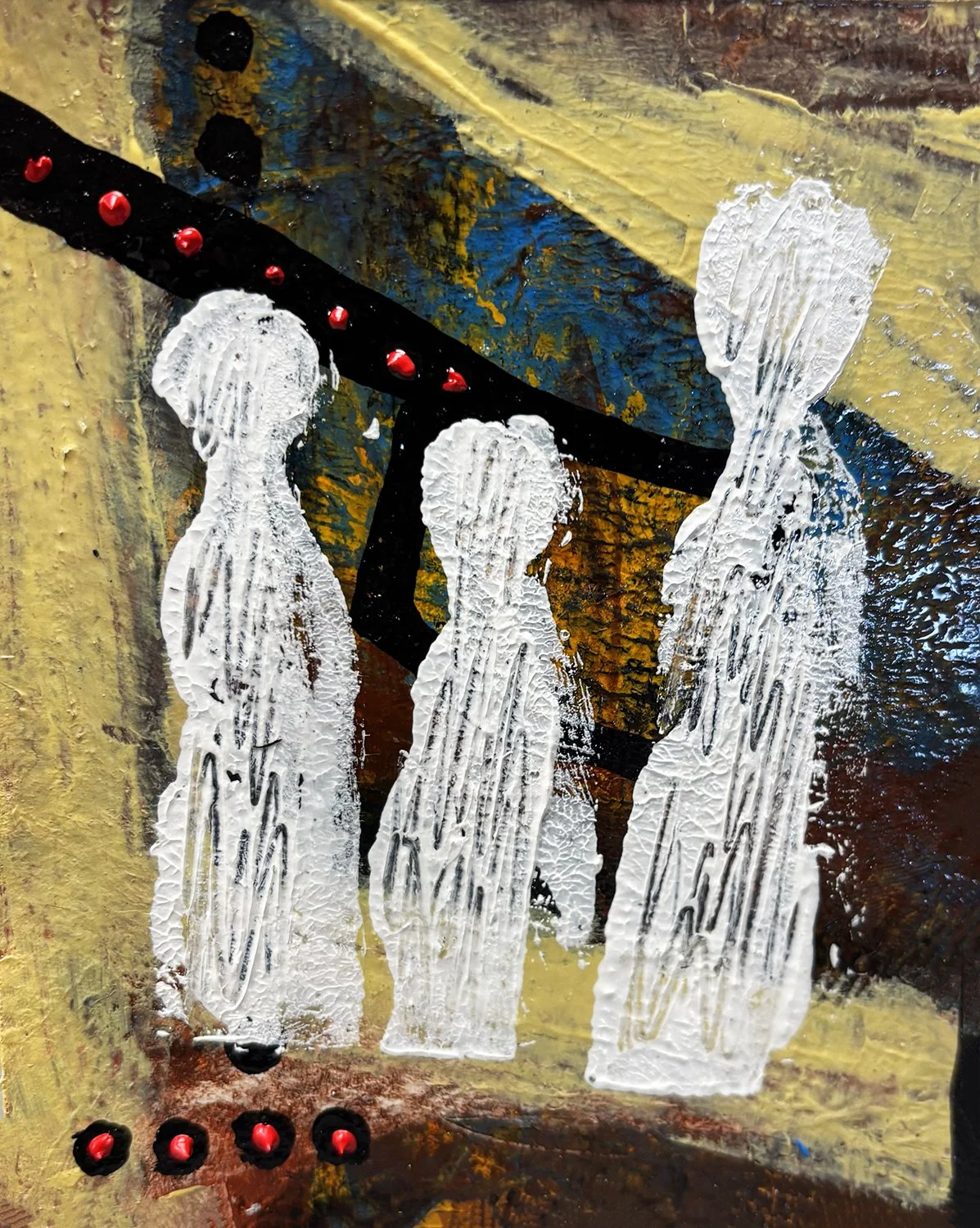
Three Figures, One Refusal
4.25” x 5.25” Acrylic mixed media on paper, journal study.
Three figures stand beneath a shared structure, rendered as residue rather than portrait. The surface holds tension between alignment and separation—together, but not merged. This piece was made during a class reflection on authority, expectation, and the quiet insistence of staying intact while moving through institutional space.

Working With Academia Without Being Rewritten

Quinn Jacobson January 17, 2026

Yes, I’m working on a PhD. But that fact is routinely mistaken for the point.

The degree is not the axis around which my thinking turns. It’s a container. A temporary structure. Useful, sometimes generative, occasionally constraining. What it is not is an origin story, nor a corrective arc meant to sand down who I already am.

One of the tensions I keep encountering in academic spaces is the tendency to read clarity as rigidity. When a student speaks with confidence about what they are doing, why they are doing it, and where they are not willing to go, that clarity is often interpreted as resistance. As if seriousness of intent must signal a closed mind. As if conviction is incompatible with learning.

I don’t experience it that way.

I’m in my sixties. I’ve lived abroad for years at a time. I’ve made art for over three decades, long enough to watch entire theoretical fashions rise, harden, and quietly disappear. I’ve failed publicly. I’ve revised privately. I’ve changed in ways that mattered and refused change when it felt performative or hollow. That history doesn’t make me inflexible; it makes me selective.

There’s a recurring assumption in academia that improvement requires visible transformation. That a “good” student emerges looking markedly different than when they arrived. New language. New posture. New allegiances. Sometimes even a kind of aesthetic conversion. Growth becomes legible only when it announces itself as rupture.

But not all development works that way.

Some learning deepens rather than redirects. Some refinement sharpens what is already there instead of replacing it. For practitioners who come in with a long arc behind them, progress often looks less like reinvention and more like compression. Fewer detours. Cleaner lines. A stronger refusal of what doesn’t belong.

That kind of maturation can read as stubbornness if one expects the student to be plastic.

I actually like my program. I respect the faculty. I value the conversations. I’m not at war with academia. But I am uninterested in being improved in ways that dilute the very work I came to do. I’m here to articulate, not to audition. To clarify, not to contort myself into novelty for novelty’s sake.

If there is change happening, and there is, it’s happening subterraneously. It’s happening in how precisely I can name what matters, how quickly I can discard what doesn’t, and how calmly I can hold my ground when someone suggests that seriousness requires surrender.

I’m pursuing this path in my way. Not despite academia, but not because of its appetite for visible transformation either. I’m not here to become someone else. I’m here to say, with more precision than before, who I already am and why that stance matters.

That distinction feels worth defending.

In Academic, Education, PhD, Perspective Tags academia, PhD, clarity versus rigidity
Comment

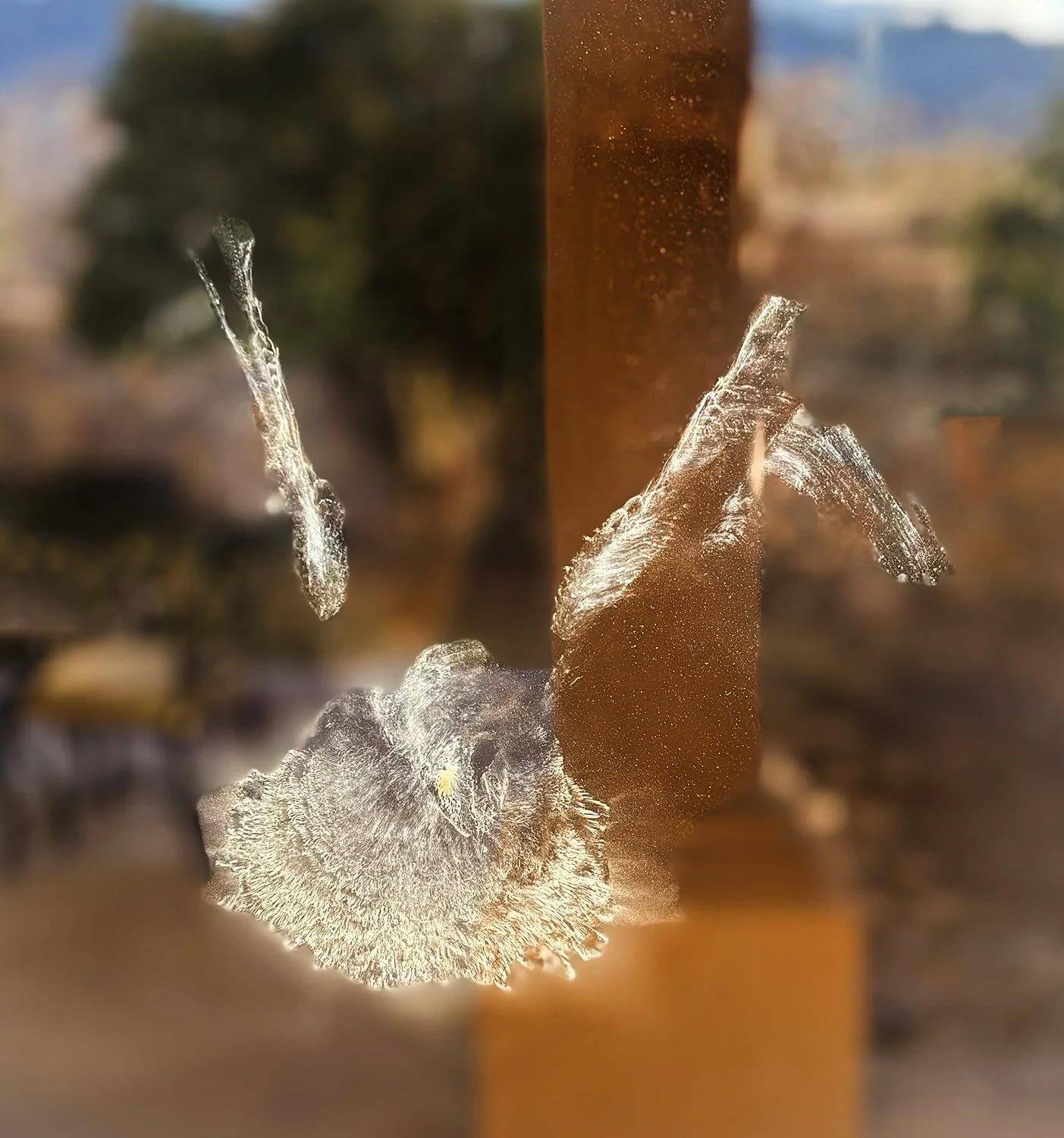
Leaving a trace—the mark of a white-winged dove on my kitchen window. December 28, 2025

A white-winged dove hits the glass, and what’s left behind isn’t the bird but the residue of contact: a powdery bloom, two wing smears, and a ghosted body shape suspended in light. That’s the interview in miniature. Dr. Fisher and I are circling the same problem from different angles: how the most real forces in a human life rarely show up directly. They show up as traces. As misreadings. As displaced language. As the “dimmer switch” doing its job.

I’m interested in what the awareness of an ending does to the living, minute by minute. The dove doesn’t leave a story; it leaves evidence. A mark that asks to be interpreted. It’s rupture without a sermon: meaning fails for a second, the world stutters, and then you’re standing there in your own kitchen looking at a fragile imprint and feeling the entire question come back online.

Interview With Dr. R. Michael Fisher: Careers of Folly and Wisdom

Quinn Jacobson December 29, 2025

In this conversation, I sit down with Dr. R. Michael Fisher for Careers of Folly and Wisdom (Episode 3) at the close of 2025, and we trace the strange overlap between two lives shaped by study, teaching, and the long arc of existential pressure. What begins as a simple introduction quickly becomes a deeper exchange about why some ideas take decades to name and why the hardest work is often learning how to speak those ideas in public without having them reduced to something smaller.

We talk about how we connected through Southwestern College’s Visionary Practice & Regenerative Leadership doctoral program and why I went searching for faculty whose work could actually hold what I’m building: an arts-based inquiry into creativity, mortality, and the psychological machinery of denial. I share my early “folly” at residency, where I became “the death guy” despite my real focus being the opposite: what happens inside the dash between birth and death, and how the knowledge of impermanence reshapes a human life. That misreading became a kind of field experiment in real time, revealing how quickly people reroute mortality talk into safer channels like grief, loss, or therapeutic language. It also forced me to sharpen my communication, not by diluting the thesis, but by learning how to meet the audience where the “dimmer switch” is already working.

From there, the conversation widens. Dr. Fisher pushes on the themes of education, fallibility, and maturity: how a person with deep content and lived experience learns to teach without preaching, and how humility becomes an actual method. I bring in two foundational touchstones that anchor my work: Becker’s insistence that death terror is a mainspring of human activity and Rank’s claim (via Becker) that the artist takes in the world and reworks it rather than being crushed by it. That tension is the engine of my research question: if most of culture is organized to keep death out of view, what do artists do differently with that same pressure, consciously or unconsciously?

A major thread running through the interview is that denial is not just a personal quirk. It’s cultural, political, and historical. I talk about early experiences that formed my worldview, including family stories that complicate simple narratives of “normal” American life, and how those early exposures shaped my sensitivity to power, erasure, and the stories nations tell themselves. We also move into my military background, where I describe the kind of learning you don’t go looking for: the collision between youthful exceptionalism and the realities of violence, trauma, and institutional harm, including witnessing suicide deaths while working as a photographer. The folly, as I name it, is the arrogance of certainty; the wisdom is the painful clarity that comes after the myth breaks.

In the final stretch, we pivot to Dr. Fisher’s work in fearology and his reframing of Terror Management Theory as, in many ways, a kind of “fear management education.” That exchange matters because it shows the real stakes of language: fear, terror, anxiety, and denial. These aren’t interchangeable terms, and both of us have been forced to grapple with how quickly audiences collapse complex ideas into familiar clichés. We end with a concise statement of my own working thesis, offered almost like a poem: artists tend to give anxiety form rather than discharge it through denial; material practice slows experience enough for mortality to move into objects; rupture is where meaning fails, and art often happens there; the ethic is not to “fix” the break, but to stay present with it.

The conversation closes on an honest note about the cost of passion. We talk about parenting, devotion to work, and the ways even meaningful lives leave blind spots in their wake. If this episode has a through-line, it’s that wisdom is rarely clean. It comes out of misfires, misreadings, and the slow work of learning how to hold the real without turning it into a brand, a sermon, or a therapy session.

I really enjoyed the conversation, and I look forward to working with Dr. Fisher. Check out his YouTube channel and his other interviews and commentary.

In ABR, Academic, Art & Theory, Art History, Autobiography, Core Values, Death Anxiety, Denial of Death, Denial: Self Deception Tags R. Michael Fisher, Interview
Comment

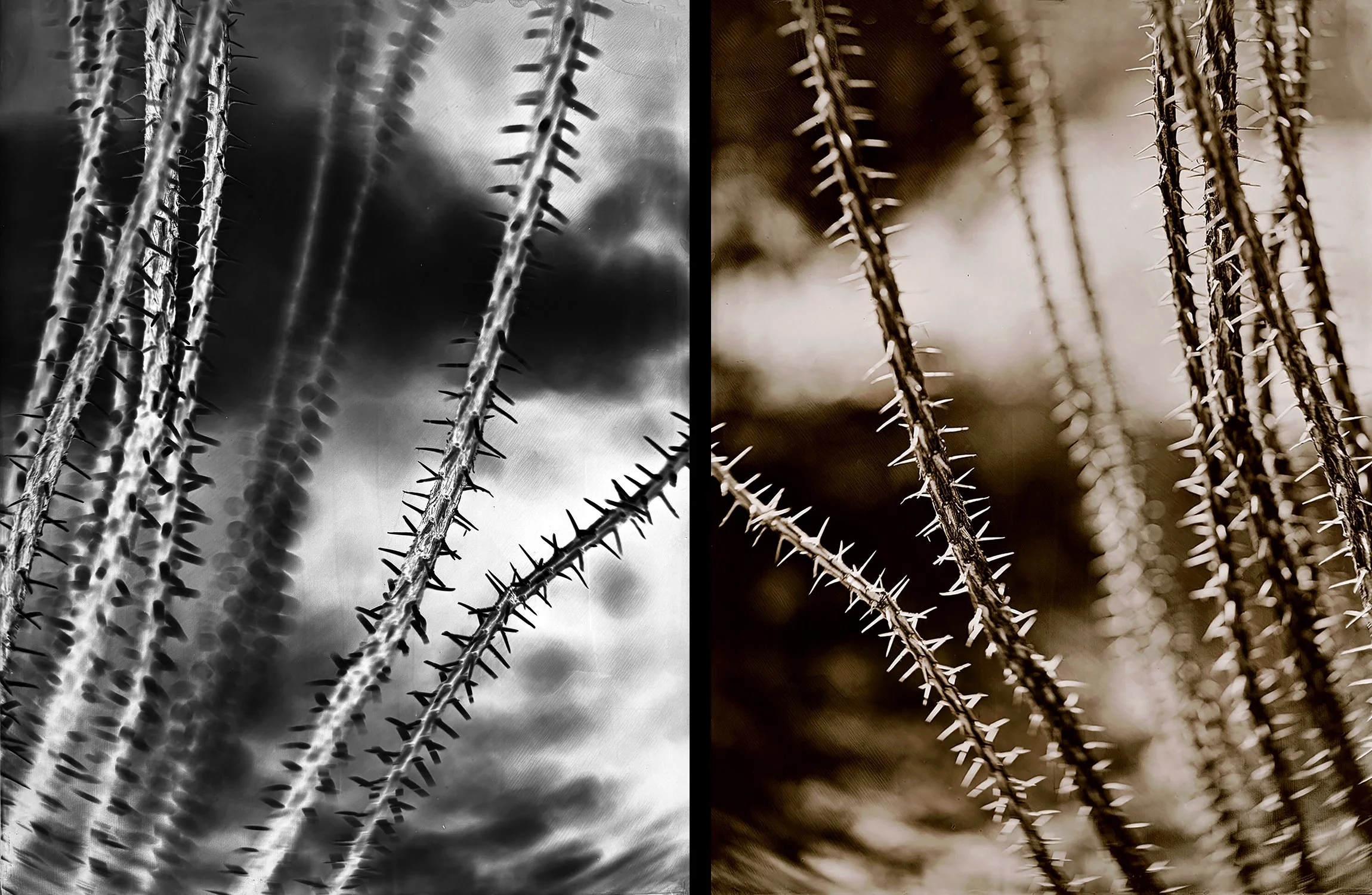
“Lunch in the French Countryside,” 5” x 4” Black Glass Ambrotype, France 2009

Clarity on Direction for Doctoral Studies

Quinn Jacobson September 6, 2025

As I move through this program, I’ll be posting here as part diary/journal and part research/reminders. I’m going to start at the beginning (first things first, in that order).

Despite existing research on death anxiety and Terror Management Theory, there remains a lack of understanding about how artists uniquely engage with mortality through their creative practice. Here lies my sweet spot: artists metabolize absurdity into elegiac beauty, creating work that doesn’t deny death but dwells in its presence.

While previous studies have examined the psychological strategies humans use to manage death anxiety, few have focused on the role of art-making as a direct and conscious confrontation with death (the main driver for me). The literature has largely prioritized quantitative measures of death anxiety and its behavioral outcomes, but less attention has been paid to qualitative, practice-based explorations of how mortality awareness shapes the creative process.

“I use mortality as a creative source, creating art that turns fear into connection and purpose.”
— Quinn Jacobson

I want my work to address this gap by investigating how artists’ engagement with death anxiety can lead to existentially authentic art. Using a mixed-methods approach that combines autoethnography, interviews with artists, and analysis of creative works, this study will explore how artistic practice functions as a site for mortality confrontation and how such engagement reorients artistic purpose and output. It sounds daunting, I know, but it’s really just asking questions about how mortality affects creative people versus those who don’t identify as creative.

The research will contribute to existential psychology, art theory, and creative practice by offering an integrated theoretical and practice-based model for understanding how artists process death anxiety. The findings are expected to inform theories of death anxiety, models of creative practice, and arts-based approaches to existential therapy, ultimately supporting artists, educators, and mental health practitioners in fostering deeper, more meaningful engagement with the realities of death.

“The life-giving question guiding me now is: How might confronting mortality through creativity lead us into deeper, more authentic ways of being human?”
— Quinn Jacobson

Vision Seed (short form)

Helping people directly confront mortality—not as a means to an end, but as a source of ingenuity, fortitude, and a closer bond—is my vision seed. I use historical wounds, grief, and death anxiety in my writing and art to demonstrate how facing our greatest fears can lead to purpose and service. My mission is to advance these discussions so that we can live more compassionately, reciprocally, and with greater presence.

In Academic, Psychology and Art, Psychology Philiosophy, PhD, Philosophy, Art & Theory, Anxiety Tags doctoral studies direction, PhD, creative type
2 Comments

Search Posts

Archive Block
This is example content. Double-click here and select a page to create an index of your own content. Learn more
Post Archive
  • Photography
 

Featured Posts

Featured
Jan 27, 2026
My New Books for 2026
Jan 27, 2026
Jan 27, 2026
Jan 26, 2026
The Dimmer Switch Explained
Jan 26, 2026
Jan 26, 2026
Jan 24, 2026
Holding Pattern
Jan 24, 2026
Jan 24, 2026
Jan 19, 2026
The Sacred Didn’t Vanish - It Migrated
Jan 19, 2026
Jan 19, 2026
Jan 19, 2026
Animality: The Part of Us We Keep Trying to Forget
Jan 19, 2026
Jan 19, 2026
Jan 17, 2026
Working With Academia Without Being Rewritten
Jan 17, 2026
Jan 17, 2026
Jan 12, 2026
The Red Hand Problem
Jan 12, 2026
Jan 12, 2026
Jan 4, 2026
Immortality Projects and Creative Works
Jan 4, 2026
Jan 4, 2026
Dec 29, 2025
Interview With Dr. R. Michael Fisher: Careers of Folly and Wisdom
Dec 29, 2025
Dec 29, 2025
Dec 27, 2025
Denial: Self-Deception, False Beliefs, and the Origins of the Human Mind
Dec 27, 2025
Dec 27, 2025