• blog
  • in the shadow of sun mountain
  • buy my books
  • photographs
  • paintings
  • bio
  • cv
  • contact
  • search
Menu

Studio Q Photography

Exploring Human Behavior and Death Anxiety Through Art
  • blog
  • in the shadow of sun mountain
  • buy my books
  • photographs
  • paintings
  • bio
  • cv
  • contact
  • search
×

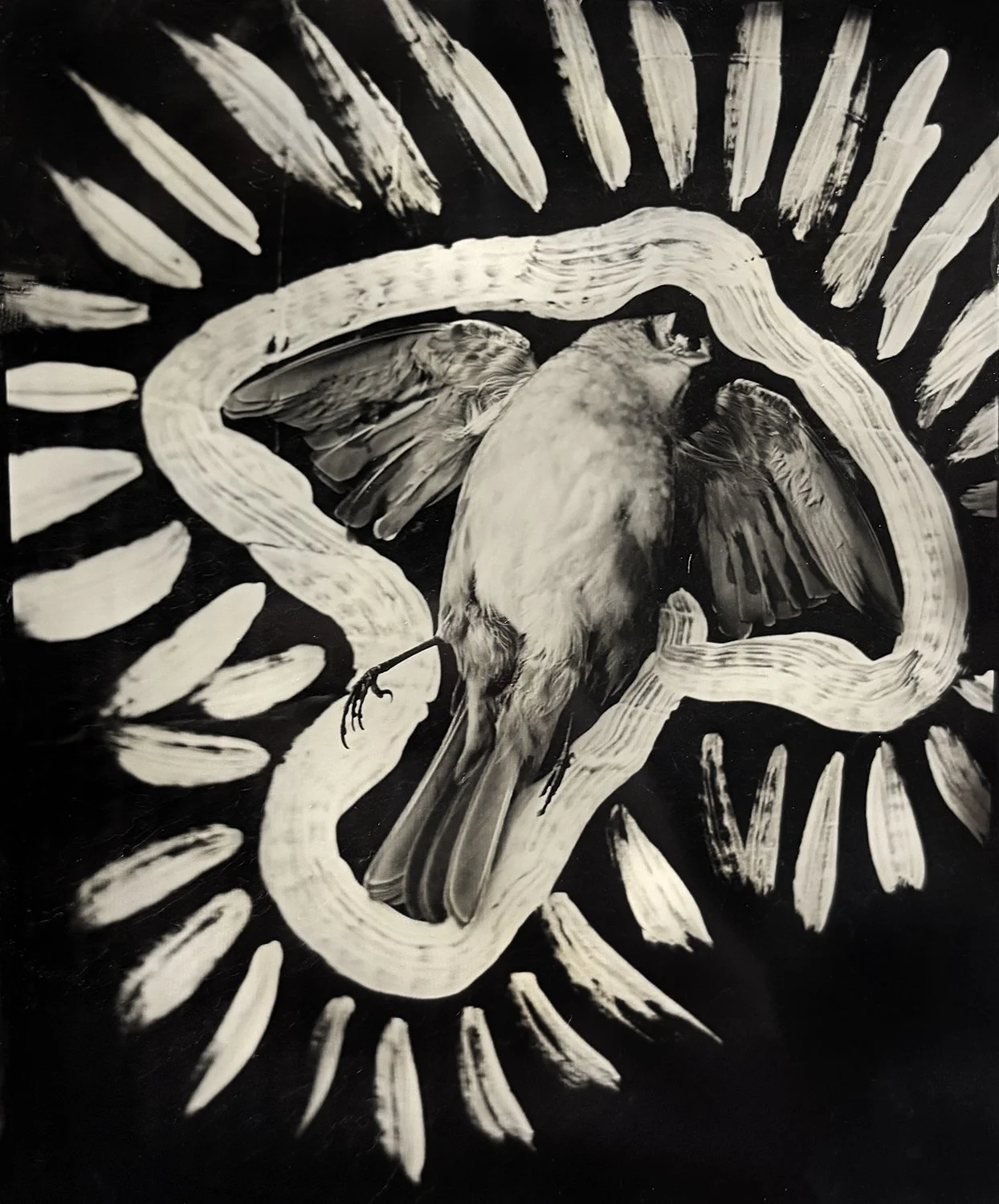
“The Outline and the Drift,” half-plate tintype.
February 5, 2026 Las Cruces, New Mexico

The Outline and the Drift

Quinn Jacobson February 5, 2026

I made this image today using a dead bird mounted on black-painted cardboard, then worked around the body rather than on it. The decision felt important. I didn’t want to manipulate the bird into meaning or turn it into a symbol that behaved too neatly. I wanted to acknowledge the body as it was and let my response happen in the space around it. The marks I painted loosely reference feathers, but only in the most unstable sense. They’re not meant to describe anatomy. They’re an attempt to register something leaving the body at death, not as transcendence or ascent, but as dispersal. Whatever animates a living being doesn’t depart cleanly. It destabilizes. It lingers as a trace.

I was also intentionally playing with the visual language of a chalk outline, the kind left at a crime scene. That gesture carries a particular cultural weight. A chalk outline is an attempt to fix an event in place, to impose order after something irreversible has already occurred. It marks where a body was, not where it went. In this image, that outline sits in tension with the radiating marks around it. One gesture tries to contain the loss, to hold it still. The other admits that containment has already failed. Together, they stage a familiar human dilemma: the impulse to document death versus the fact that death resists explanation.

The contrast between the bird’s spanning wings and the surrounding painted “feathers” matters to me. The body is heavy, finished, and unequivocally still. The marks around it are directional but unresolved, interrupted, and uneven. They don’t form a halo. They don’t promise meaning. They reflect the lag that often follows death, the moment when the body has stopped but our perception hasn’t caught up yet. Meaning keeps moving even when life has ended. The image lives in that gap.

I’m not making a claim here about what death is or what leaves the body when it happens. I’m more interested in the human need to respond once stillness becomes unbearable. The marks don’t prove that energy exists. They mark the moment when we can no longer tolerate absence without gesture. For me, that’s where the work begins: not in explanation or consolation, but in staying with what remains unresolved and allowing the image to hold that tension without trying to seal it shut.

In Art & Theory, Arts-Based Research, Death, Experimental Collodion, Existentialism, Tintype, Wet Plate Collodion, PhD Tags PhD, Arts-Based Research, Tintype
Comment

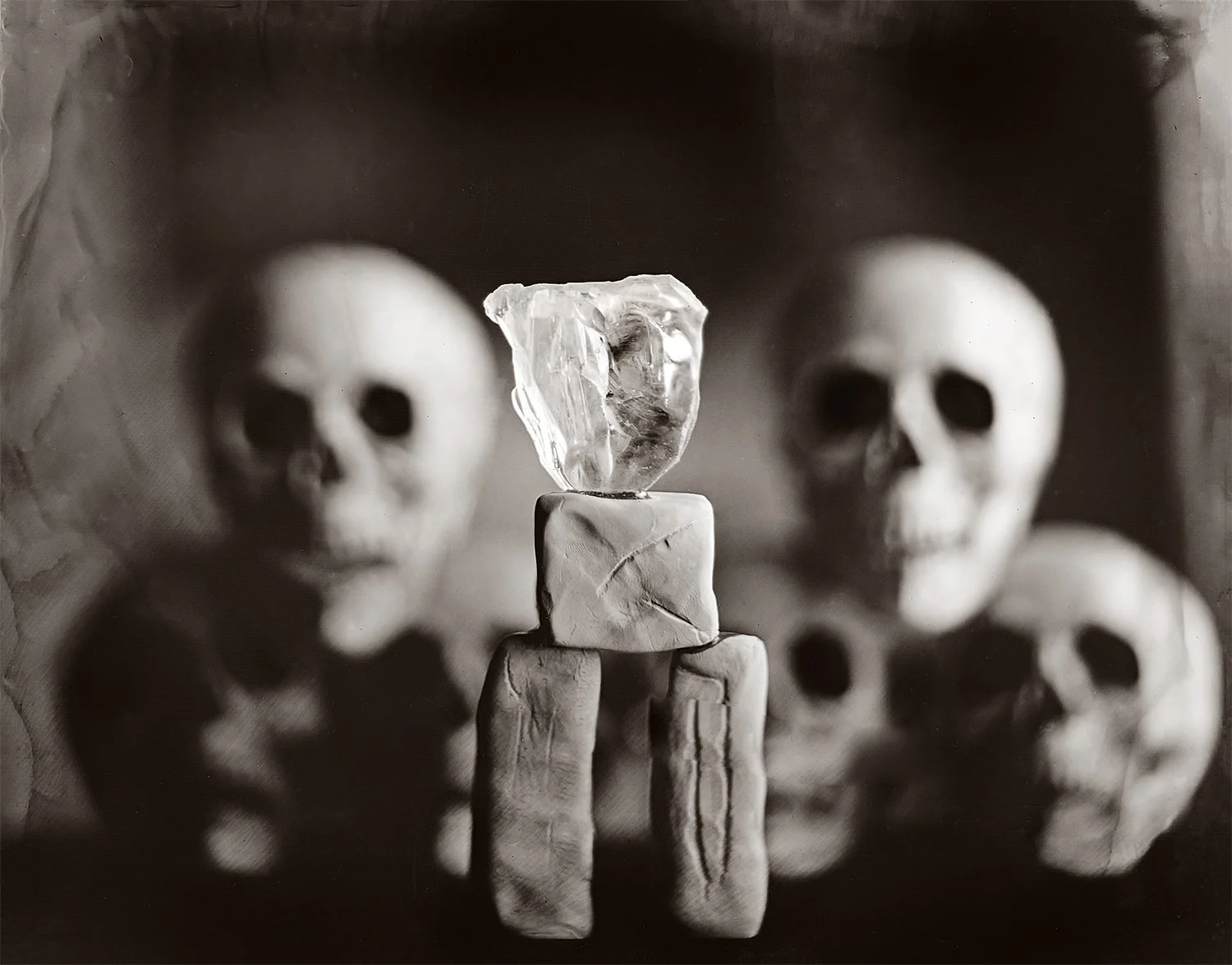
Glasshead–Stoneman (Animality Study)—half-plate wet collodion negative. January 18, 2026
A stone-assembled figure crowned with a fractured glass head stands before blurred skulls, holding the tension between human symbolic striving and our inescapable animal condition.

Animality: The Part of Us We Keep Trying to Forget

Quinn Jacobson January 19, 2026

One of the simplest but hardest ideas for people to accept is that we are animals who know we will die.

That sentence alone has more psychological weight than most of us want to deal with. We are more than just living things that move through time. We are aware of ourselves, and our bodies get older, break down, and disappear. And we know this. That information alters everything.

This is where Ernest Becker begins. In The Denial of Death, Becker posited that human psychology is influenced by a fundamental contradiction. We are biological entities motivated by instinct, hunger, fear, and reproduction; concurrently, we are symbolic entities endowed with imagination, language, and self-reflection. We have bodies that will die, and our minds can picture that death before it happens. The conflict between those two facts never goes away. It just gets taken care of.

That tension is right in the middle of animality.

Being an animal means being weak. People bleed. Bodies decay. Bodies break down. That doesn't change, no matter how smart or culturally accomplished you are. But most of modern life is set up to keep that truth far away. We keep the dying out of sight. We make decay into a medical issue. We raise the mind, the self, the brand, and the legacy as if they could somehow float away from the body.

Terror Management Theory says that this is not a coincidence. When reminders of our animal nature break through, like illness, aging, death, or even some kinds of art, they make us anxious on a deep, often unconscious level. The answer is almost never calm, though. It's protection. We hold on to our identities, beliefs, status, and moral frameworks more tightly when they promise that we are more than just meat that is going to die out.

The skull has always been one of the best ways to show this problem. It takes away everything that makes us who we are, reminding us that we are just physical matter with a time limit. Skulls don't fight. They don't talk about it. They just give testimony.

Rachel and Ross Menzies talk about how much of human behavior is based on avoiding this confrontation in their book Mortals. Not just being afraid of dying, but being afraid of being an animal that has to die. We deal with that fear by keeping busy, doing health rituals, telling success stories, and always trying to be better. In most cases, the goal is not to live forever. It is a mental distance from what will happen to the body.

That's what this picture is trying to show.

The Glasshead–Stoneman is standing up, put together, and almost ceremonial. The stone blocks make up a body that looks solid, scarred, planned, and calm. The glass head on top is clear, glowing, broken, and fragile. Skulls float behind it, not quite there and not quite gone. They didn't read as reminders of death, but as witnesses. The truth about animals is there, but it won't stay out of the way.

Glass is important here. Heat and violence make glass. It looks like it will last forever, but it breaks easily. It shows its own cracks while carrying light. It is an uncomfortable material that is between solid and broken. A lot like the human self.

Stone suggests strength. Glass makes things look fragile. The skulls show that something is going to happen.

They make a quiet argument that no amount of structure or symbolic architecture can change our animal nature. We can make identities. We can add meaning. We can give ourselves names. But the body is still there. The animal is still there. Death stays.

Even though it makes people uncomfortable, this is not a negative statement. Becker himself thought that this tension is what makes creativity, art, and meaning come to life. The issue does not stem from our animalistic nature. The issue is that we put so much effort into pretending we aren't.

Art does something important for the mind when it lets animality back into the room without being showy or moralizing. It lowers the defenses just enough for the person to be recognized. Don't panic. Acknowledgment. The kind that says, "This is what we have to work with."

The Glasshead–Stoneman does not fix the problem. It doesn't make you feel better. It just keeps the animal and the symbol in the same frame, not letting either one go away.

That might be enough.

Because confronting our animality does not diminish the significance of life. It makes it sharper. It reminds us that everything we build, love, and make is done inside a body that will eventually fail. And oddly enough, that's what makes those actions important.

In Glasshead, Stoneman, Wet Collodion Negatives, Death Anxiety, Animality, ABR, Art & Theory, Arts-Based Research, Ernest Becker, Mortals Tags Glasshead-Stoneman, half animal and half symbolic, TMT
Comment

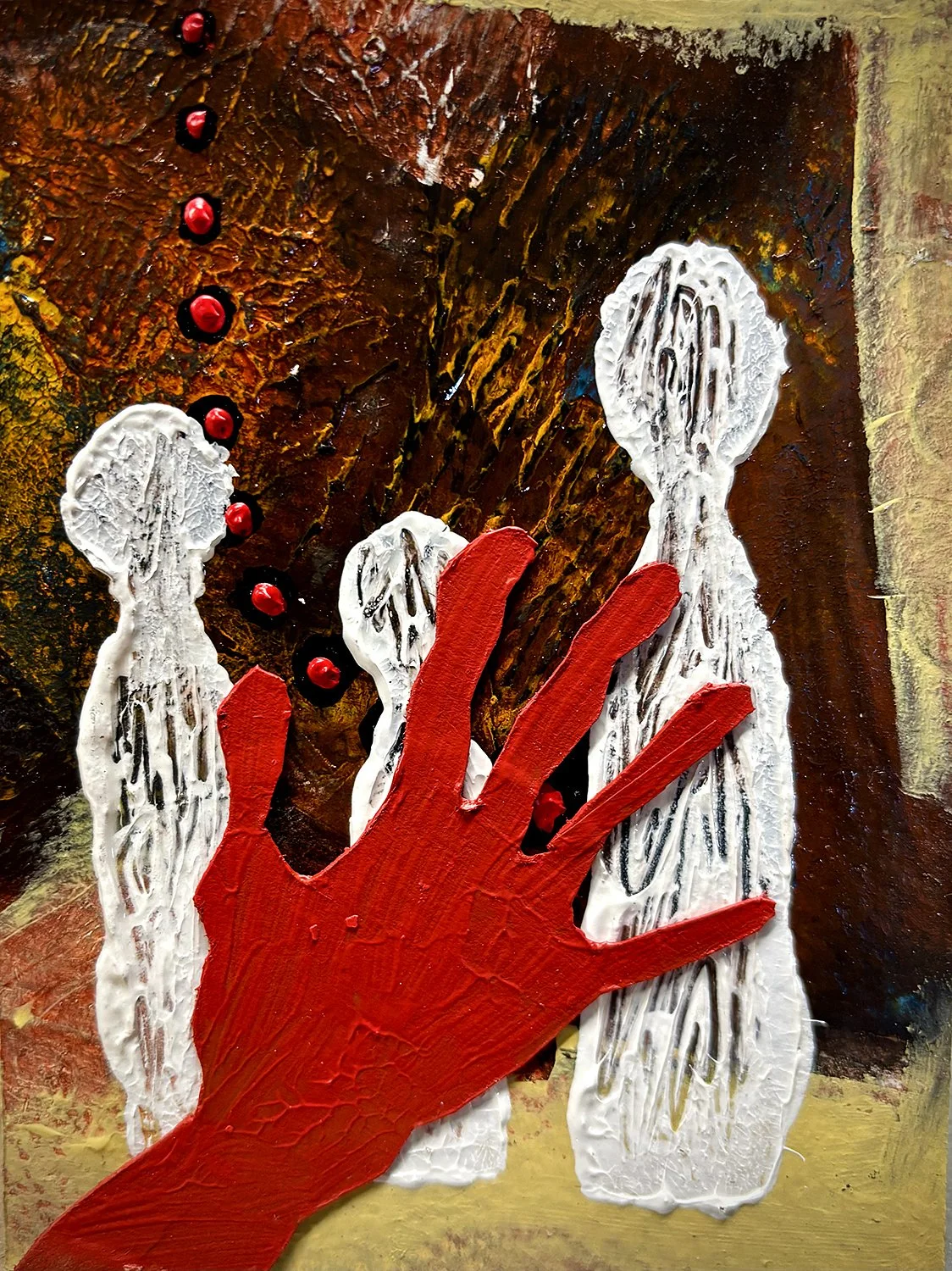
Untitled (Red Hand)
Acrylic mixed media on paper, 4.25" × 5.5"

A red hand interrupts three attenuated figures, marking the moment where existential anxiety is no longer diffuse but made contact—contained, metabolized, and rendered visible through form.

The Red Hand Problem

Quinn Jacobson January 12, 2026

How artists metabolize existential anxiety, and why the work still matters.

I keep returning to the same question, no matter how many theories I read or objects I make: What exactly happens to existential anxiety when it moves through the hands of an artist?

Not rhetorically. Mechanically. Psychologically.

The image above is one attempt to make that process visible. Three pale figures stand upright, stripped of detail, reduced almost to afterimages. They are not portraits so much as placeholders. Awareness has rendered their bodies thin. Over them reaches a red hand, oversized and intrusive, neither comforting nor gentle. It interrupts and intrudes. It stains. It marks.

That hand is not expression. It is intervention.

Most people manage death anxiety by keeping it diffuse, by never letting it fully localize. The artist does the opposite. The anxiety is brought forward, concentrated, and given a task. Creation becomes a site of containment. The fear does not disappear, but it changes state. It becomes workable.

This is what I mean by metabolizing existential anxiety. Not purging it. Not transcending it. Converting it into form.

Psychologically, this matters more than we often admit. The act of making gives the anxious mind boundaries. Time slows. Attention narrows. The self becomes less abstract and more procedural. The question shifts from What does it all mean? to What happens if I put this here? That shift is not trivial. It is regulatory. It allows consciousness to stay in contact with mortality without flooding.

The white figures in the image are not victims. They are witnesses. They stand because the hand is doing something on their behalf.

This is where arts-based research comes into focus for me. ABR is often framed as alternative knowledge production, which is true but incomplete. Its deeper value lies in its psychological function. Making becomes a way of thinking that does not rely exclusively on symbolic abstraction. Image, material, gesture, and repetition—these are not illustrations of insight; they are the insight.

When anxiety stays purely cognitive, it spirals. When it enters the body through making, it circulates. It acquires rhythm. It becomes legible.

This brings me to the harder question: is there any value in writing books like Glass Bones and Rupture?

If the goal were resolution, probably not. No book resolves the fact of death. No theory seals the crack. But that has never been the real task. The value lies in creating sustained containers where anxiety can be held long enough to be examined without collapsing into distraction or denial.

These books are not answers. They are pressure vessels.

Writing them will force me to stay with the material—psychologically and ethically—longer than images alone sometimes allow. It slows the metabolism. It traces the process. It makes visible what is usually hidden: how fear becomes form, how rupture becomes method, and how meaning is provisional but still worth making.

The red hand, then, is also authorship. It is the decision to intervene rather than look away. To touch the thing that makes us uncomfortable and accept the consequences of contact.

Artists do not escape existential anxiety (not at all). They work it. They give it edges. They give it weight. They give it somewhere to go.

That’s not a cure.
But it is a practice.
And in a culture built on denial, practice may be the most honest form of value we have left.

In Abstract Painting, Acrylic Painting, Angst, Anxiety, Art & Theory, Arts-Based Research, Death Anxiety, Existential Art, Fragile, Handmade Print, Neurotic, Painting, PhD, Psychology and Art Tags Existentialism, existential psychology, Existential Art, acrylic painting, Mixed Media
Comment

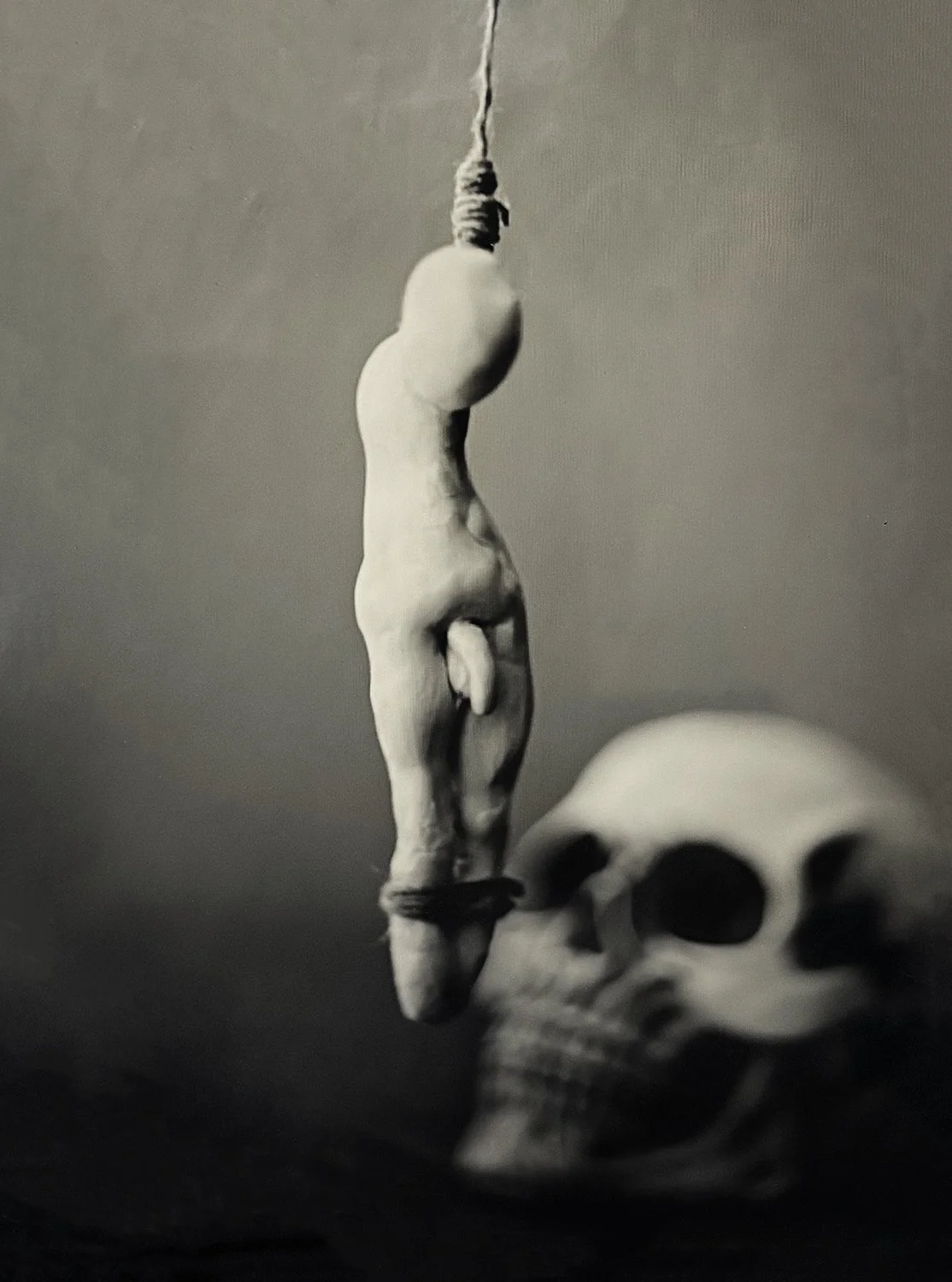
Punished for Embodiment. Half-plate tintype (4.25 × 5.5 in.). December 2025.
Western art has long tried to discipline the body—shrinking it, idealizing it, and denying its animality. This work pushes back. The figure is restrained not for what he has done, but for what he is: a vulnerable organism aware of its own end. The skull waits behind him, already finished with the struggle.

Living With The Dimmer Switch

Quinn Jacobson December 21, 2025

One of the biggest challenges I face when I talk about Becker, Rank, Zapffe, or Terror Management Theory isn’t that the ideas are too complex. It’s that they’re describing the very psychological machinery that makes them difficult to understand in the first place. (Becker, 1973; Greenberg et al., 1986; Rank, 1932; Zapffe, 1933/2010).

That’s the paradox.

From an evolutionary perspective, human consciousness didn’t just give us language, imagination, and culture. It gave us a problem no other animal has to solve: we know we’re going to die, and we know it with enough clarity to make life unbearable if that awareness stayed fully online all the time (Becker, 1973; Solomon et al., 2015). So evolution didn’t eliminate the problem. It built a workaround.

These thinkers essentially suggest that the human mind evolved a dimmer switch mechanism. This is not an on-off switch, but rather a regulator (Jacobson, 2025). With too much awareness of death, the organism freezes, panics, or collapses. Too little, and life loses urgency, meaning, and care (Becker, 1973; Yalom, 2008).

So the psyche learned to keep mortality awareness just low enough to function and just high enough to motivate (Greenberg et al., 1986; Solomon et al., 2015).

That’s why so many people genuinely believe they don’t think about death or aren’t afraid of dying. They’re not lying. The system is working exactly as it’s supposed to (Greenberg et al., 1986; Pyszczynski et al., 2015). These defenses operate beneath conscious awareness, the same way breathing or balance does. You don’t feel yourself regulating your blood pressure either, but that doesn’t mean it isn’t happening.

In fact, one of the clearest signs that death anxiety is present is the firm belief that it isn’t (Solomon et al., 2015).

Becker’s insight was never that people walk around consciously terrified. It was that culture exists to make sure they don’t have to (Becker, 1973). Worldviews, identities, careers, religions, politics, moral certainty, and even the idea of being a “good person” quietly serve the same psychological function: they tell us we matter in a universe that otherwise wouldn’t notice our disappearance (Becker, 1973; Greenberg et al., 1986). Once those structures are in place, the fear drops out of awareness. The dimmer switch does its job (Jacobson, 2025).

This is also why these ideas often provoke irritation or dismissal instead of curiosity. When someone encounters them for the first time, they aren’t just learning new information. They’re brushing up against the scaffolding that holds their sense of reality together. The mind doesn’t experience that as insight. It experiences it as a threat (Greenberg et al., 1986; Pyszczynski et al., 2015). The response isn’t “Is this true?” so much as “Why does this feel wrong?”

Zapffe pushed this even further and suggested that consciousness itself may be over-equipped for the world it inhabits. We see too much, anticipate too far ahead, and know too well how the story ends (Zapffe, 1933/2010). The defenses he described—isolation, distraction, anchoring, and sublimation—aren’t moral failures. They’re survival strategies (Zapffe, 1933/2010). Without them, the weight of existence would be crushing. So when people recoil from these ideas, they’re doing exactly what the human animal evolved to do.

This is where my work sits.

Artists tend to live closer to that fault line. It's not because we're braver or more enlightened, but rather because creative practice weakens the dimmer switch (Jacobson, 2025; Rank, 1932). Making art requires attention, dwelling, repetition, and exposure. Over time, some of the automatic defenses erode. You keep looking where others glance away. That doesn’t make life easier. It makes it more honest.

This is why arts-based research matters so much to me (Barone & Eisner, 2012). I’m not trying to convince anyone with arguments alone. I’m showing what happens when someone lives with the dimmer turned slightly higher than average and then tries to metabolize what comes into view. The artifacts aren’t illustrations of theory. They are the evidence of a nervous system and a psyche working under different conditions.

So when someone says, “I don’t have death anxiety,” I hear, “My defenses are intact.” And when they say, “This feels abstract,” I hear, “This is getting too close to something I’ve spent my life not naming.”

That isn’t a failure of communication. It’s the terrain.

My work isn’t about forcing understanding. It’s about creating conditions where understanding can happen without overwhelming the person encountering it (Barone & Eisner, 2012; Jacobson, 2025). That’s why I move through story, image, material, land, and memory. I’m not avoiding theory. I’m respecting the psychology that makes theory hard to hear in the first place (Becker, 1973; Solomon et al., 2015).

And in that sense, the difficulty isn’t a flaw in these ideas.

It’s the sound the dimmer switch makes when you try to turn it up.

The resistance.
The discomfort.
The urge to look away.

Those aren’t misunderstandings.

They’re the evidence.


References

Barone, T., & Eisner, E. W. (2012). Arts-based research. SAGE.

Becker, E. (1973). The denial of death. Free Press.

Greenberg, J., Pyszczynski, T., & Solomon, S. (1986). The causes and consequences of a need for self-esteem: A terror management theory. In R. F. Baumeister (Ed.), Public self and private self (pp. 189–212). Springer.

Jacobson, Q. (2025). Living with the dimmer switch [Blog post manuscript]. Unpublished.

Pyszczynski, T., Solomon, S., & Greenberg, J. (2015). Thirty years of terror management theory: From genesis to revelation. In J. M. Olson & M. P. Zanna (Eds.), Advances in experimental social psychology (Vol. 52, pp. 1–70). Academic Press.

Rank, O. (1932). Art and artist: Creative urge and personality development. W. W. Norton.

Solomon, S., Greenberg, J., & Pyszczynski, T. (2015). The worm at the core: On the role of death in life. Random House.

Yalom, I. D. (2008). Staring at the sun: Overcoming the terror of death. Jossey-Bass.

Zapffe, P. W. (2010). The last messiah. (Original work published 1933)


In ABR, Anxiety, Art & Theory, Art History, Arts-Based Research, Death Anxiety, Doctoral Studies, Ernest Becker, Existential Art, Metabolizing anxiety, New Mexico, PhD, Psychology and Art, Ruptureology, Wet Collodion, Glass Bones Tags Dimmer Switch, Punished for Embodiment, Tintype
Comment

“Choking on Rocks,” Whole Plate (6.5” x 8.5”) wet collodion negative. October 2025.

Where My Work Is Heading

Quinn Jacobson December 10, 2025

On Rewriting, Rebuilding, and Turning Toward Mortality

For years now, I’ve been circling the same set of questions, questions that live somewhere between psychology, philosophy, the studio, and the darkroom. Why do humans deny death? What holds our meaning structures together? And why do artists seem to approach these tensions differently than everyone else, often with a kind of clarity that only comes from standing close to fear?

I’ve been asked why In the Shadow of Sun Mountain still isn’t published. The simple truth is that the book outgrew its original frame. I wrote it during a period when I was wrestling with ideas that didn’t yet have the right container. What I couldn’t see then, but can see now, is that the book was waiting for the structure of my doctoral work. It needed a broader foundation, and I needed more time to understand what I was actually trying to say.

So instead of releasing it in its earlier form, I’ve decided to rework it as part of my PhD. It will become the third manuscript in a three-part sequence I’m developing during the program.

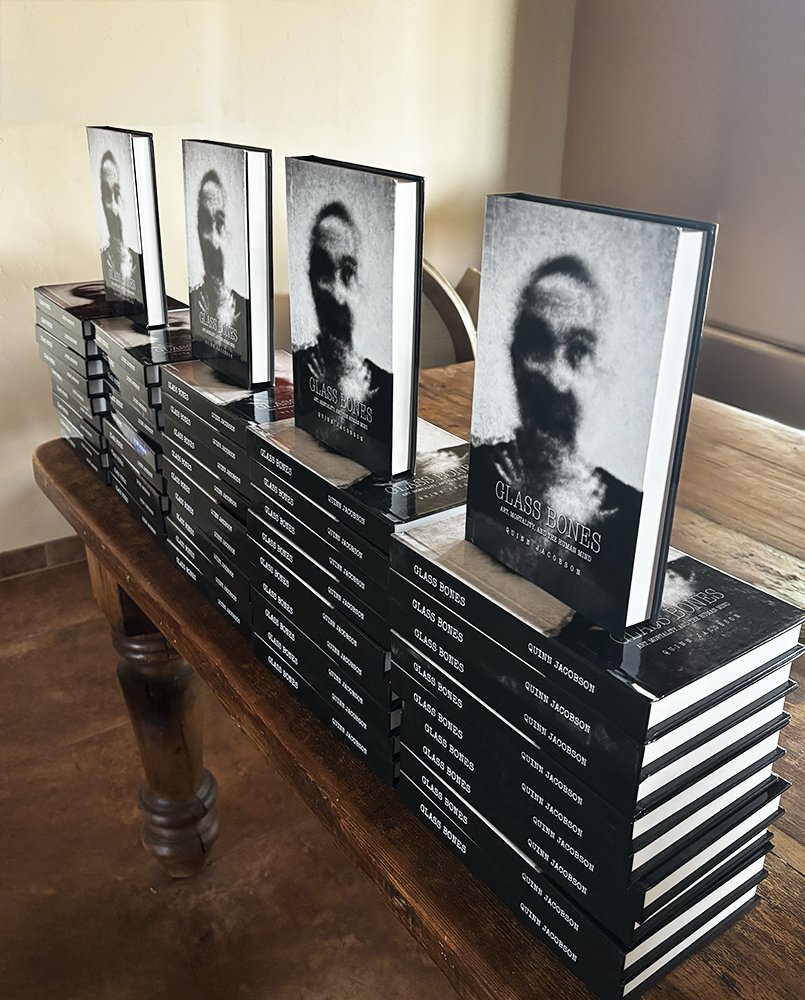
The first manuscript will be an explanation of these theories—death anxiety, denial, worldview defense, and the evolutionary roots of awareness—in a way anyone can read and understand. Simple, accessible, and grounded. The working title is Glass Bones.

The second manuscript will be directed toward artists and toward creatives and will explore how they metabolize existential concerns in ways that differ from non-artists. It will look closely at creative practice as a pathway for meaning-making. The working title is Rupture.

And the third will be a rewritten In the Shadow of Sun Mountain, offered as a real-life example of an artist metabolizing these ideas through creative work, reflection, and lived experience.

All of this leads to the question that my dissertation will take up directly:

What actually happens inside an artist when they confront mortality in their creative practice?

To answer that, I’m turning toward arts-based research methodology. ABR is a natural fit for the work I’ve been doing for decades, because in ABR, the studio becomes the site of inquiry. The process becomes a way of knowing. Material becomes a kind of data. Instead of illustrating findings after the fact, the creative act generates them. It’s not about making art that explains theory; it’s about letting the art reveal what theory can’t access on its own.

So the dissertation will center on creating a completely new body of artwork, work made specifically for this research. Clay figures and/or objects suspended or collapsing under their own weight. Wet collodion images that feel like memory rising through fog and confusion. Paintings and photographs that follow the direction of the inquiry. I want the research to grow out of the process itself, out of the contact with clay, with silver, with pigment, with symbol, and with the ambiguous space where meaning forms.

Journal entry - October 2025.

At the same time, I’ll be studying how others respond to this work and what happens psychologically, symbolically, and emotionally when someone encounters artwork that doesn’t look away from mortality. Death denial shows up in recognizable ways: humor, defensiveness, projection, avoidance, and philosophical distancing. But sometimes something deeper appears: recognition, quiet, even a brief moment of meaning.

ABR gives me a structure to study all of this.

My own creative process.

The images that emerge.

The responses they evoke.

The symbolic patterns that repeat.

The ways meaning cracks open or closes down.

It lets me bring the studio, the psyche, and the research questions into one integrated space.

My hope is to create a body of work that matters both inside academia and beyond it. Art isn’t an accessory to life; it’s a method of survival. Artists metabolize things the culture doesn’t know how to hold directly. We take fear, grief, rupture, and turn them into form, into symbols that others can bear to look at. It isn’t therapy and it isn’t escape. It’s a form of existential transformation.

If I can articulate that process, what it feels like, what it reveals, and how it shapes both the maker and the viewer, then the work will have done something meaningful. It will help explain why creative practice is one of the most honest responses we have to our own mortality.

So that’s the direction I’m heading: a reworked Sun Mountain, a sequence of manuscripts that build the conceptual ground, a new exhibition, and a dissertation that uses arts-based research to study the artist’s encounter with mortality from the inside out. I’m building an integrated body of work, creative, philosophical, and experiential, that examines what it means to be mortal and how artists turn that reality into meaning.

More will unfold as the work begins to take shape.

In ABR, Arts-Based Research, Create iand Face of Death, Death, Death Anxiety, Doctoral Studies, Dissertation, Wet Plate Collodion, Shadow of Sun Mountain Tags Arts-Based Research, Dissertation, PhD
5 Comments

A Salt Print From Another Life

Quinn Jacobson November 20, 2025

I printed this 4x5 salt print today from a negative I made back in 2009, when I was living in Germany. Pulling an old plate like this into the present is always a strange experience. It’s like opening a time capsule you didn’t realize you buried. The negative was unvarnished—intentionally, because I wanted to see how far the elements had carried it over sixteen years. The result is this distressed, fractured surface that feels less like damage and more like memory asserting itself.

The subject is a simple setup: a cigar-box guitar propped on an old chair, a yarmulke (I got in Budapest) hanging beside it. At the time, I was thinking about the way ordinary objects can hold the weight of identity and belonging. Today, the print reads differently. The salt process softened everything, pulled it into an older register. The marks, flaws, and chemical bruises add a gravity the original plate didn’t have. It’s as if the print has aged along with me, and it’s finally showing its own scars.

Salt prints have a way of whispering rather than shouting. They blur the line (no pun) between what’s depicted and what’s remembered. This one carries the ghosts of two moments: who I was in 2009, exploring Europe with a camera and too many questions, and who I am now, printing in the desert, working at the intersection of creativity and mortality. These processes keep teaching me that nothing stays untouched—not glass plates, not bodies, not beliefs. Everything changes.

What I love most about this print is that it feels like a conversation between past and present versions of myself. A reminder that every piece of work we make continues living long after we think we’ve finished with it.

Impermanence and Insignificance: A Brief Note from the Void

I’ve been sitting with Escape from Evil again, and every time I revisit Becker’s later work, I feel the same jolt. He names the thing we spend our lives circling. Not death, exactly, but the quieter dread underneath it, the fear of slipping through this world without leaving so much as a fingerprint. Impermanence on one side. Insignificance on the other. It’s a tight little vise. And it’s psychologically terrifying.

Becker saw our terror clearly: we are symbolic creatures who can imagine infinity, yet we’re trapped in these fragile, temporary bodies that can vanish in a moment. The universe isn’t just big. It’s indifferent. And in that indifference, we feel an echo of our own smallness.

“The real fear isn’t the moment of dying. It’s the reckoning that follows: what does our ending reveal about how we lived?”
— Quinn Jacobson

Most of us respond by building what Becker called “immortality projects”—the long list of things we hope will grant us some kind of permanence (like what I’m doing right now). Careers. Families. Beliefs. A reputation. A legacy. Art. Even the small rituals of daily life can start to feel like talismans against oblivion. Becker never mocked these efforts. He understood their necessity. Without them, we’d drown in the sheer scale of our vulnerability.

For me, that tension shows up every time I work. Photography, especially the old processes I use, makes this dance impossible to ignore. A wet collodion plate holds everything and nothing at once. Light settles on silver and forms an image that can last centuries, yet the plate itself is so delicate you can wipe it clean with a rag or crack it between two fingers. It’s the same paradox Becker lived in: durability wrapped in impermanence.

And honestly, that’s why I keep returning to these ancient materials. They tell the truth gently. They remind me that nothing I make will rescue me from the limits of being human. But the making still matters. Maybe that’s the part Becker understood so well: our projects don’t need to defeat insignificance; they only need to give us a way to live with it.

Impermanence isn’t the enemy. Insignificance isn’t a verdict. They’re conditions. The water we swim in, if you will.

What we create—our art, our relationships, our gestures of care—won’t make us immortal. But they mark our brief time here with intention rather than avoidance. They let us stand, for a moment, in the truth of our smallness and still say: I was here. I noticed. I tried.

That might be enough.

In Art & Theory, Arts-Based Research, Existential Art, German, Metabolizing anxiety, PhD, Ruptureology, Salt Prints, Wet Collodion Negatives Tags salt, Wet Plate Collodion Negatve, germany
2 Comments

Untitled—Whole Plate Salt Print from a wet collodion negative.

When I pull a print like this from the wash, I think about presence, the way it clings for a moment before fading (not fixed). The chemistry stains, the brush strokes at the edges, and the paper that curls in my hands—none of it is meant to last. That’s what I love about it. It’s a print that remembers its making. The figure still feels fragile, but now it’s suspended in a kind of quiet acceptance.

Living Truthfully Inside Impermanence

Quinn Jacobson November 13, 2025

Rupture is not simply a wound; it’s the generative moment when denial collapses and creation begins. It’s the place where death anxiety, cultural myth, and personal memory are transmuted into presence. Within rupture, the artist becomes a witness rather than a defender, turning from the fantasy of permanence toward the truth of impermanence. In that shift, art no longer seeks to outlive death; it becomes a form of living with it.

Otto Rank’s distinction between the artist and the neurotic illuminates this process. Both encounter rupture, the psychic shattering that comes when one’s symbolic world no longer holds, but only the artist metabolizes it. Where the neurotic internalizes and chokes on anxiety, the artist transforms it into form. The creative act becomes a means of surviving truth, of remaking coherence in the face of its undoing. Ernest Becker described culture as a shield against mortality; I see art as the moment that shield cracks. The fracture is not failure but revelation, an aperture where something honest can enter.

My work with wet collodion lives inside that aperture. The process itself enacts rupture: collodion, glass, silver, and time. Each plate holds the risk of loss. The collodion might peel, the image might fog, and the light might fail. Yet those failures become evidence of life. The surface bears the marks of both fragility and endurance, transparency and strength. Each plate is a negotiation between control and surrender, between the impulse to preserve and the inevitability of decay. To work in this way is to accept that every act of making is also an act of unmaking. I’m connecting deeply to these ideas and am excited to see where it takes me.

In Art & Theory, Arts-Based Research, Collodion Negatives, Death Anxiety, Ernest Becker, Existential Art, Metabolizing anxiety, New Mexico, Otto Rank, PhD, Salt Prints Tags Ruptureology, rupture, Rupturegenesis, Wet Plate Collodion Negatve, Salt Print
Comment

“Choking on Rocks.” Whole-plate wet collodion negative, made in the New Mexico desert, 2025. The plate holds the brief intersection of flesh, glass, and stone, an encounter with what endures and what disappears.

Between Presence and Absence

Quinn Jacobson November 5, 2025

This new whole-plate wet collodion negative feels less like a photograph and more like a question: what does it mean to hold presence and impermanence in the same breath? The man, the bottle, and the rocks: are they material, or are they ghosts caught in the alchemy of silver and collodion? The glass doesn’t just capture an image; it captures the residue of time passing. What remains when the moment is gone? What does the plate remember that we forget?

Collodion always reminds me that everything we try to fix eventually fades. The process is slow and ritualistic; it forces me into a state of attention. Light becomes a witness, not just a means. This plate, like so many I make, isn’t about nostalgia; it’s about the impossibility of permanence. It’s about standing inside the paradox that Becker, Rank, and Yalom each described in their own way: to create in the face of death is both defiance and surrender.

In that sense, this image is elegiac. The man’s presence feels temporary, the bottle reflective, and the rocks ancient and indifferent. Together they form a kind of visual equation, human transience measured against geological time. The silver surface, with its imperfections and streaks, becomes a metaphor for the self: luminous, decaying, still reaching toward meaning.

In Art & Theory, Arts-Based Research, Death Anxiety, Ernest Becker Tags Wet Plate Collodion Negatve, what endures and what disappears
Comment

Coyote carcass on desert dirt, Las Cruces, New Mexico, November 2025. Photograph by Quinn Jacobson.

The Coyote That Died on My Land

Quinn Jacobson November 3, 2025

A couple of days ago, I caught a strong smell outside while working on a photograph. It was sharp, pungent, and unmistakable. Death has a particular odor that bypasses thought and goes straight to the gut. It made me queasy for a moment. Human death is worse; its scent lingers in your psyche as much as your senses, but this was still hard to shake.

I live on two acres, so it could’ve been anywhere. But the breeze was steady from the south, and the smell was heavy enough to trace. I didn’t walk a hundred feet before I saw it: a coyote, fully grown, laid out in the dirt as if sleep had taken it mid-motion. I hear them often at 4 a.m. Their calls ricocheting through the desert, a chorus of wild life that reminds me I’m not alone out here. They’re ghosts most of the time, heard but rarely seen.

My first instinct was to call animal control. But after thinking about it, I decided to leave the body where it was. Nature doesn’t need me to manage it. I’ll let it return to itself. When the flesh is gone and the bones are bare, I’ll bring them into my studio and make photographs.

For me, that act isn’t about morbidity; it’s about continuity. As Ernest Becker wrote, “All organisms are torn between the desire to live and the knowledge that they must die.” This coyote’s death is part of the same existential equation that drives art. Otto Rank saw art as the individual’s answer to mortality, a symbolic act of defiance, and an assertion that something of us can endure. Terror Management Theory later confirmed it empirically: the awareness of death propels us to create meaning, to build culture, and to leave traces that say we were here.

The coyote reminds me that no creature escapes this truth. Yet, there’s a strange grace in its stillness. The desert will do what it’s always done; it will metabolize the body, slowly, beautifully, until there’s only bone and dust. In that process, I see a mirror of the creative act: transformation through decay.

In time, I’ll photograph what remains—not as documentation of death, but as witness to the cycle that keeps everything alive.

Theory Note: Death, Art, and the Creative Instinct

Becker believed that culture, and by extension, art, is humanity’s way of managing the terror of mortality. We build symbolic worlds to convince ourselves that our lives matter, that something of us endures beyond the grave. Otto Rank expanded this idea, seeing the artist as a kind of “hero of creation,” transforming existential anxiety into symbolic immortality through the act of making. Terror Management Theory offers the scientific echo: when reminded of death, people turn to creativity, meaning, and worldview defense to restore equilibrium.

This coyote, in its silent return to the earth, embodies what Becker, Rank, and the TMT researchers all touch upon: the dance between decay and creation. In death’s presence, we’re reminded why we make anything at all.

In Art & Theory, Arts-Based Research, Death, Death and Dying, Doctoral Studies, Ernest Becker, Existential Art, Coyote Tags coyote, death, carcass, bones
Comment

Old Glass Insulators, Whole Plate Negative, 2025
Found half-buried in desert dust, some shattered, one miraculously whole. Once they carried power across distance; now they sit in silence, transmitting something else entirely. A meditation on endurance, fracture, and the quiet persistence of connection.

Old Glass Insulators — Whole Plate, November 1, 2025

Quinn Jacobson November 1, 2025

It’s so good to be back! It’s like riding a bicycle!

This is my first time making wet collodion images in New Mexican light. The air here feels different, drier, sharper, almost sentient in the way it bends light and shadow. The light is amazing. It’s “soft.” Much softer than the high UV light of the Colorado mountains.

The process felt both foreign and familiar. I missed the smell of ether, the sticky residue of collodion on my hands, and the small miracle of seeing the image appear in the developer. It’s not nostalgia; it’s recognition. The darkroom remains a place where time collapses.

The image I made today is of old glass insulators, remnants of a different kind of transmission. I found them half-buried in the desert dirt, relics of a vanished network that once carried voices and voltage across the American landscape. Some were shot through and fractured; one, improbably, remained whole. Its blue glass caught the morning light like a memory refusing to die.

The scene in digits.

I was drawn to these objects for their contradictions. They were built to endure, yet they shatter easily. They once conducted invisible currents, and now they are silent. They hold the history of connection and the inevitability of disconnection. Photographing them felt like standing between those two poles—between what holds and what breaks.

The glass, like the psyche, records every impact. The fractures become part of its character. In that way, the act of photographing them became a meditation on survival—how the self transmits meaning even after being cracked by experience. The blue insulator, intact among the ruins, felt like a metaphor for what remains transmissible in me: the impulse to create, to reach across distance, and to make contact through image and light.

Working with glass has always been more than a process; it’s a kind of ceremony. Each plate is a conversation with chemistry, a slow revelation of what wants to appear. Collodion teaches humility; silver sees everything. It reacts to the smallest impurity, just as the psyche reacts to what it resists. There’s a kind of grace in that sensitivity.

Holding the plate, watching the image emerge, I felt the familiar sense of presence that only this process offers. It’s not just about recording an object—it’s about witnessing transformation. The photograph becomes a transmission, a signal from matter to mind, from the visible to the invisible.

In the end, the plate is both image and mirror. It reflects what I brought into the room: a desire to reconnect with process, with light, and with myself. The broken insulators remind me that communication is never perfect, that art itself is a fragile conduit. But sometimes, even after the line is cut, the current finds its way through.

Whole Plate placeholder.

Some of my chemistry and supply shelves are up and full. I’m still making small changes and arrangements to my darkroom, but I really like it—very comfortable to work in and very spacious!

In Art & Theory, Arts-Based Research, Collodion Negatives, Wet Plate Collodion, Wet Collodion Negatives, New Mexico Tags wet collodion photography, Wet Plate Collodion Negatve, new mexico, glass insulators
2 Comments
Older →

Search Posts

Archive Block
This is example content. Double-click here and select a page to create an index of your own content. Learn more
Post Archive
  • Photography
 

Featured Posts

Featured
Feb 17, 2026
The 12 Steps of Rupturelogy
Feb 17, 2026
Feb 17, 2026
Feb 7, 2026
What Remains: On Meaning, Mortality, and Making in the Age of Artificial Intelligence
Feb 7, 2026
Feb 7, 2026
Feb 5, 2026
The Outline and the Drift
Feb 5, 2026
Feb 5, 2026
Feb 4, 2026
Ruptureology
Feb 4, 2026
Feb 4, 2026
Jan 31, 2026
Glass and Gold - Glass Prints
Jan 31, 2026
Jan 31, 2026
Jan 28, 2026
A Film You Should Watch
Jan 28, 2026
Jan 28, 2026
Jan 27, 2026
My New Books for 2026
Jan 27, 2026
Jan 27, 2026
Jan 26, 2026
The Dimmer Switch Explained
Jan 26, 2026
Jan 26, 2026
Jan 24, 2026
Holding Pattern
Jan 24, 2026
Jan 24, 2026
Jan 19, 2026
The Sacred Didn’t Vanish - It Migrated
Jan 19, 2026
Jan 19, 2026