This piece grew out of a technical curiosity, but it didn’t stay there for long.
I’ve been experimenting with collodio-chloride on glass, using a wet collodion half-plate negative as the source image. What interested me initially was the reversal: taking a process already defined by fragility and asking it to exist as an object rather than an image alone. Printing onto glass changes the relationship immediately. The photograph no longer sits on a surface; it hovers within one. It becomes something you look into rather than at. I’ve printed on glass before—carbon, oil, and collodio-chloride. This gold addition was new.
That shift matters to me. My work is often in the unstable space between presence and absence, between what can be held and what can't. Collodio-chloride amplifies that tension. The image is there, but it never fully settles. It feels provisional, as if it could just as easily slip away.
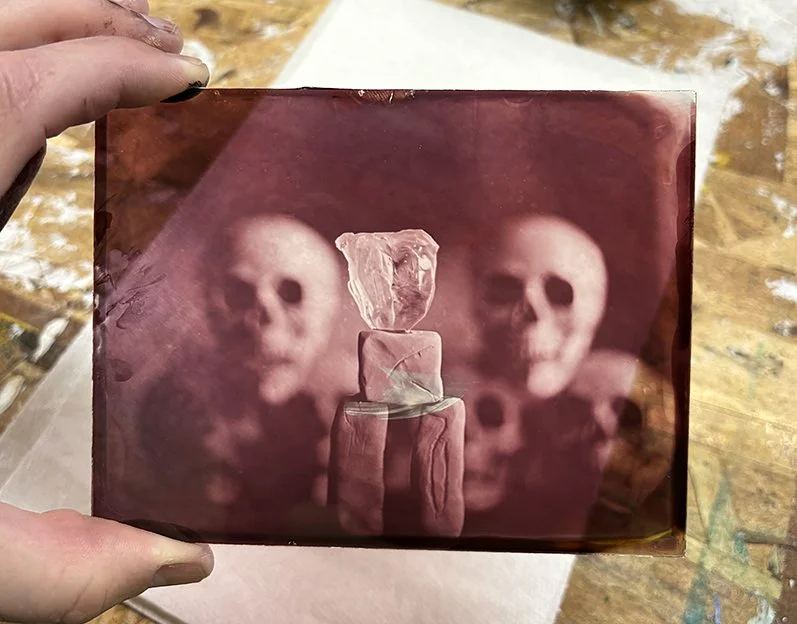
Exposed, pre-fix.
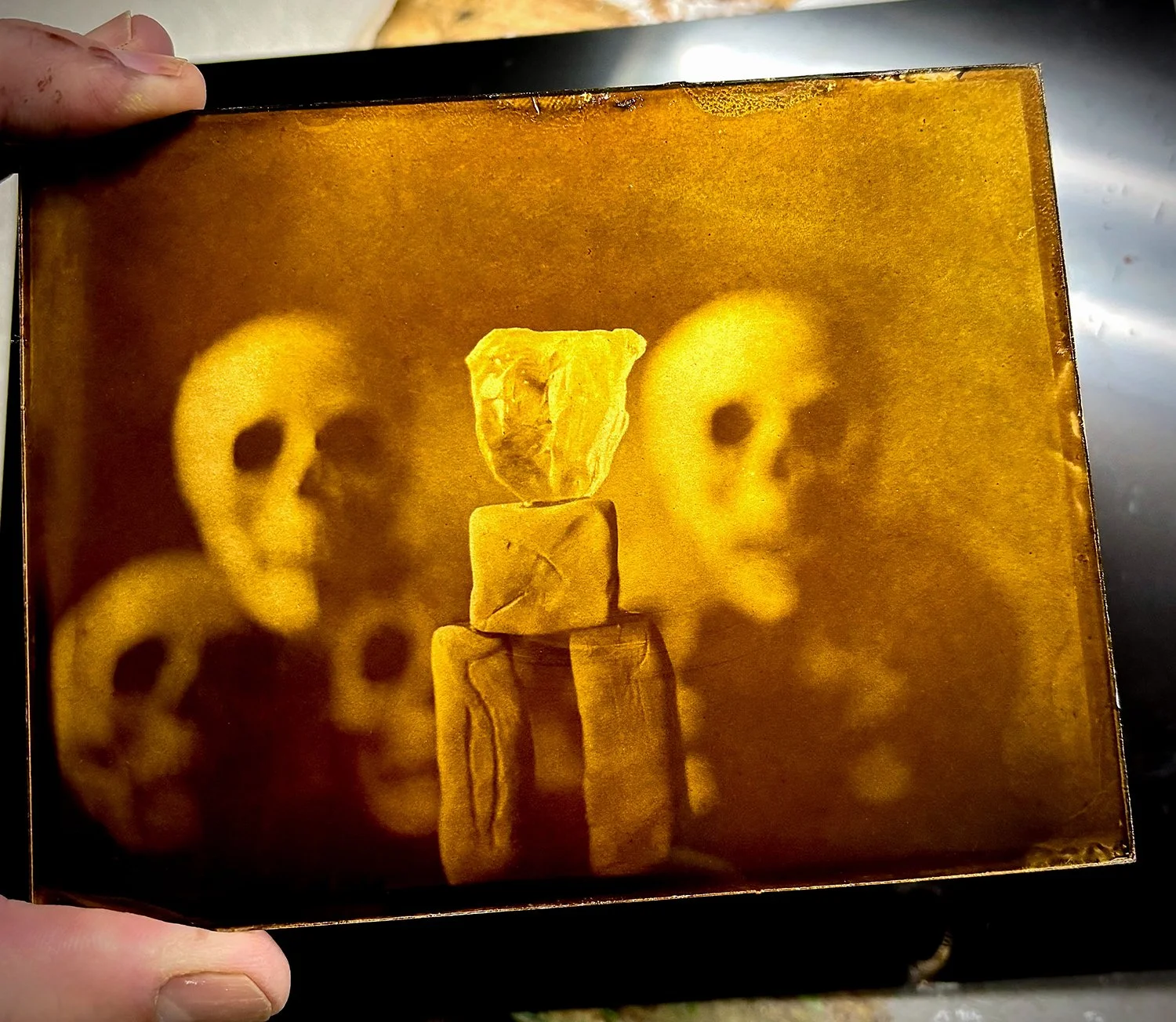
After the print was finished, I backed the glass with gold. That decision wasn’t decorative. Gold carries a long cultural history of sanctification, permanence, value, and transcendence. Gold is what we use to signify that something matters and endures. In this context, it felt closer to a defense mechanism. A thin layer of assurance applied to something fundamentally unstable. The gold doesn’t resolve the fragility of the glass or the image; it frames it and maybe even tries to protect it. That tension is the point.
I’m aware that backing photographic images with gold carries the history of the orotone, a process designed to heighten luminosity and permanence. I’m interested in that lineage, but not in reviving it. Here, the gold isn’t about brilliance or finish. It functions more like a psychological gesture, an attempt to stabilize what can’t be stabilized, to sanctify something that is already slipping.
The skull forms in the background weren’t meant to announce themselves. They emerge slowly, almost reluctantly. That’s how mortality functions most of the time. It isn’t usually dramatic or explicit. It sits behind us, watching, shaping our behavior without demanding our attention. I wanted that presence to feel ambient rather than symbolic, something you notice only after spending time with the image.
The central figure feels assembled rather than organic. Stacked. Held together. I think of it less as a subject and more as a structure, a self-constructed one under pressure. The translucence of the collodio-chloride allows it to exist somewhere between solidity and dissolution, which mirrors the psychological space I’m often working in. Identity here isn’t fixed. It’s maintained.
From an arts-based research perspective, this piece feels important because the process itself is doing the thinking. I’m not illustrating theory after the fact. The materials are pushing back. Glass breaks. Chemistry misbehaves. The image resists control. Those risks aren’t incidental; they’re where the knowledge lives. The work knows something because it could fail.
What consistently resonates with me is the delicate boundary between reverence and denial. The gold can read as a halo or a shield. I’m interested in that ambiguity. It reflects the way we often try to stabilize what we know is unstable—through meaning, through ritual, through objects that promise endurance.
This piece doesn’t try to solve anything. It holds a condition. It sits with fragility rather than sealing it over. That feels honest to me.
Much more exploring ahead! I might break these and see what that produces. And I’m in the process of getting some front-surface mirror material to experiment with; I mention the technique in my book to make “faux” daguerreotypes. I’m going to use collodio-chloride to see what happens.