• blog
  • in the shadow of sun mountain
  • buy my books
  • photographs
  • paintings
  • bio
  • cv
  • contact
  • search
Menu

Studio Q Photography

Exploring Human Behavior and Death Anxiety Through Art
  • blog
  • in the shadow of sun mountain
  • buy my books
  • photographs
  • paintings
  • bio
  • cv
  • contact
  • search
×

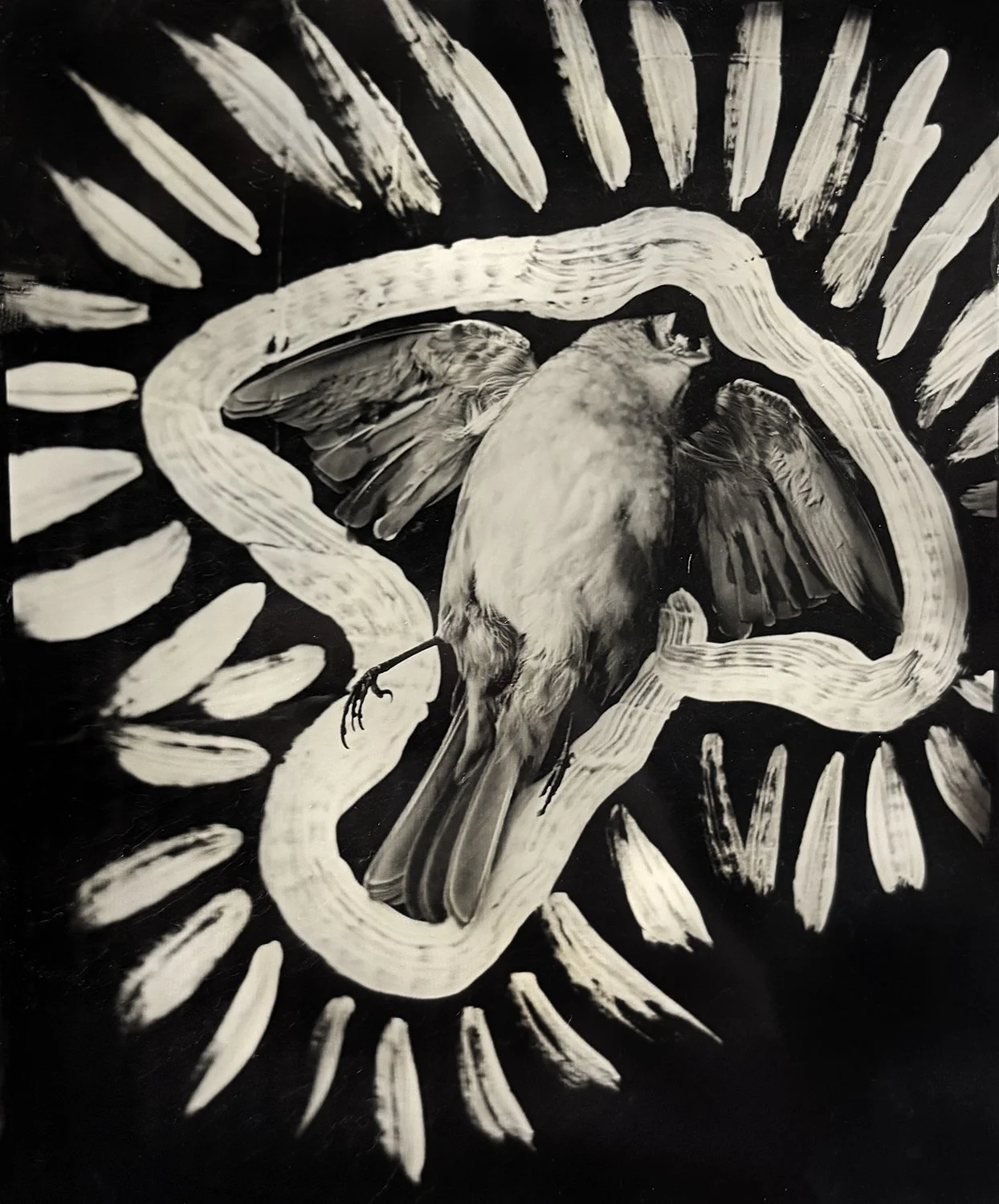
“The Outline and the Drift,” half-plate tintype.
February 5, 2026 Las Cruces, New Mexico

The Outline and the Drift

Quinn Jacobson February 5, 2026

I made this image today using a dead bird mounted on black-painted cardboard, then worked around the body rather than on it. The decision felt important. I didn’t want to manipulate the bird into meaning or turn it into a symbol that behaved too neatly. I wanted to acknowledge the body as it was and let my response happen in the space around it. The marks I painted loosely reference feathers, but only in the most unstable sense. They’re not meant to describe anatomy. They’re an attempt to register something leaving the body at death, not as transcendence or ascent, but as dispersal. Whatever animates a living being doesn’t depart cleanly. It destabilizes. It lingers as a trace.

I was also intentionally playing with the visual language of a chalk outline, the kind left at a crime scene. That gesture carries a particular cultural weight. A chalk outline is an attempt to fix an event in place, to impose order after something irreversible has already occurred. It marks where a body was, not where it went. In this image, that outline sits in tension with the radiating marks around it. One gesture tries to contain the loss, to hold it still. The other admits that containment has already failed. Together, they stage a familiar human dilemma: the impulse to document death versus the fact that death resists explanation.

The contrast between the bird’s spanning wings and the surrounding painted “feathers” matters to me. The body is heavy, finished, and unequivocally still. The marks around it are directional but unresolved, interrupted, and uneven. They don’t form a halo. They don’t promise meaning. They reflect the lag that often follows death, the moment when the body has stopped but our perception hasn’t caught up yet. Meaning keeps moving even when life has ended. The image lives in that gap.

I’m not making a claim here about what death is or what leaves the body when it happens. I’m more interested in the human need to respond once stillness becomes unbearable. The marks don’t prove that energy exists. They mark the moment when we can no longer tolerate absence without gesture. For me, that’s where the work begins: not in explanation or consolation, but in staying with what remains unresolved and allowing the image to hold that tension without trying to seal it shut.

In Art & Theory, Arts-Based Research, Death, Experimental Collodion, Existentialism, Tintype, Wet Plate Collodion, PhD Tags PhD, Arts-Based Research, Tintype
Comment

“Staring at the Sun,” Whole Plate Tintype—November 30, 2025 - Las Cruces, New Mexico

Notes From the Studio: Staring at the Sun

Quinn Jacobson November 30, 2025

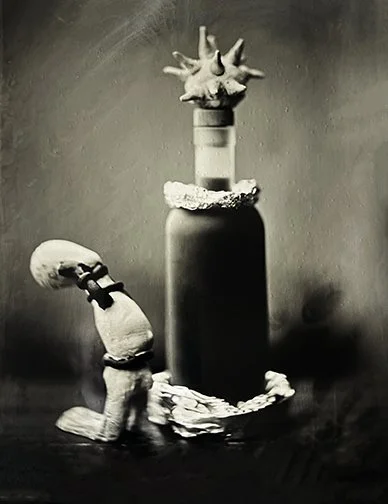
I made a new tintype today (I made several, actually)—something small, simple, and unexpectedly revealing. It began as a response to reading Yalom’s Staring at the Sun. I sculpted a tiny figure and a rough, spiked “sun” and set them up in the studio to explore that familiar tension between awe, fear, and the search for meaning.

But once the plate dried, the image took on a different life. The “sun” started to resemble a virus, and the little figure looked like he was trying to negotiate with a force he couldn’t quite name. It shifted the whole feeling of the piece. It’s strange when a photograph teaches you something you didn’t intend, but that’s usually a sign you’re on the right track.


“Staring at the Sun—V.2,” Whole Plate Tintype—November 30, 2025 - Las Cruces, New Mexico

The chemistry added its own voice, too. I shot it wide open with an 1872 Dallmeyer 3B lens, using natural New Mexico light. Because the developer had no alcohol in it, the plate is full of sweeping, ghostlike marks, patterns that feel like turbulence or weather. Those imperfections have become one of the things I trust most about collodion. They reveal the atmosphere of the moment in a way nothing else can.

This little setup feels like the start of a new thread, a kind of still-life cosmology. Small figures, simple objects, big questions. I won’t say more yet, but I’m excited about where this can go.

I’ll keep at it and see what develops ;-)

In Glass Bones, Wet Collodion, Tintype, Yalom Tags Yalom, Staring at the Sun, virus, Tintype, Glass Bones
Comment

Search Posts

Archive Block
This is example content. Double-click here and select a page to create an index of your own content. Learn more
Post Archive
  • Photography
 

Featured Posts

Featured
Feb 17, 2026
The 12 Steps of Rupturelogy
Feb 17, 2026
Feb 17, 2026
Feb 7, 2026
What Remains: On Meaning, Mortality, and Making in the Age of Artificial Intelligence
Feb 7, 2026
Feb 7, 2026
Feb 5, 2026
The Outline and the Drift
Feb 5, 2026
Feb 5, 2026
Feb 4, 2026
Ruptureology
Feb 4, 2026
Feb 4, 2026
Jan 31, 2026
Glass and Gold - Glass Prints
Jan 31, 2026
Jan 31, 2026
Jan 28, 2026
A Film You Should Watch
Jan 28, 2026
Jan 28, 2026
Jan 27, 2026
My New Books for 2026
Jan 27, 2026
Jan 27, 2026
Jan 26, 2026
The Dimmer Switch Explained
Jan 26, 2026
Jan 26, 2026
Jan 24, 2026
Holding Pattern
Jan 24, 2026
Jan 24, 2026
Jan 19, 2026
The Sacred Didn’t Vanish - It Migrated
Jan 19, 2026
Jan 19, 2026