• blog
  • in the shadow of sun mountain
  • buy my books
  • photographs
  • paintings
  • bio
  • cv
  • contact
  • search
Menu

Studio Q Photography

Exploring Human Behavior and Death Anxiety Through Art
  • blog
  • in the shadow of sun mountain
  • buy my books
  • photographs
  • paintings
  • bio
  • cv
  • contact
  • search
×

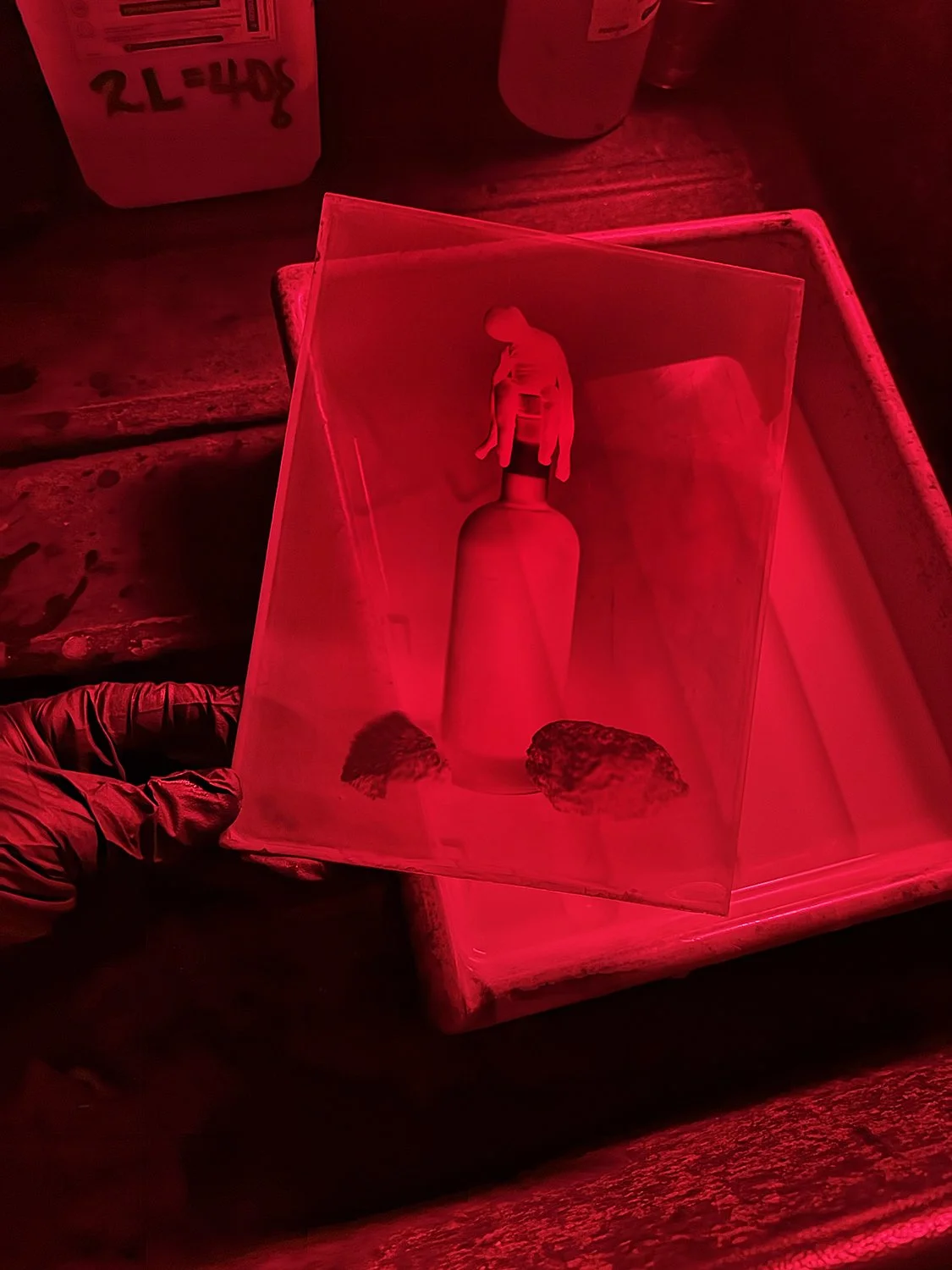
“Choking on Rocks,” Whole Plate (6.5” x 8.5”) wet collodion negative. October 2025.

Where My Work Is Heading

Quinn Jacobson December 10, 2025

On Rewriting, Rebuilding, and Turning Toward Mortality

For years now, I’ve been circling the same set of questions, questions that live somewhere between psychology, philosophy, the studio, and the darkroom. Why do humans deny death? What holds our meaning structures together? And why do artists seem to approach these tensions differently than everyone else, often with a kind of clarity that only comes from standing close to fear?

I’ve been asked why In the Shadow of Sun Mountain still isn’t published. The simple truth is that the book outgrew its original frame. I wrote it during a period when I was wrestling with ideas that didn’t yet have the right container. What I couldn’t see then, but can see now, is that the book was waiting for the structure of my doctoral work. It needed a broader foundation, and I needed more time to understand what I was actually trying to say.

So instead of releasing it in its earlier form, I’ve decided to rework it as part of my PhD. It will become the third manuscript in a three-part sequence I’m developing during the program.

The first manuscript will be an explanation of these theories—death anxiety, denial, worldview defense, and the evolutionary roots of awareness—in a way anyone can read and understand. Simple, accessible, and grounded. The working title is Glass Bones.

The second manuscript will be directed toward artists and toward creatives and will explore how they metabolize existential concerns in ways that differ from non-artists. It will look closely at creative practice as a pathway for meaning-making. The working title is Rupture.

And the third will be a rewritten In the Shadow of Sun Mountain, offered as a real-life example of an artist metabolizing these ideas through creative work, reflection, and lived experience.

All of this leads to the question that my dissertation will take up directly:

What actually happens inside an artist when they confront mortality in their creative practice?

To answer that, I’m turning toward arts-based research methodology. ABR is a natural fit for the work I’ve been doing for decades, because in ABR, the studio becomes the site of inquiry. The process becomes a way of knowing. Material becomes a kind of data. Instead of illustrating findings after the fact, the creative act generates them. It’s not about making art that explains theory; it’s about letting the art reveal what theory can’t access on its own.

So the dissertation will center on creating a completely new body of artwork, work made specifically for this research. Clay figures and/or objects suspended or collapsing under their own weight. Wet collodion images that feel like memory rising through fog and confusion. Paintings and photographs that follow the direction of the inquiry. I want the research to grow out of the process itself, out of the contact with clay, with silver, with pigment, with symbol, and with the ambiguous space where meaning forms.

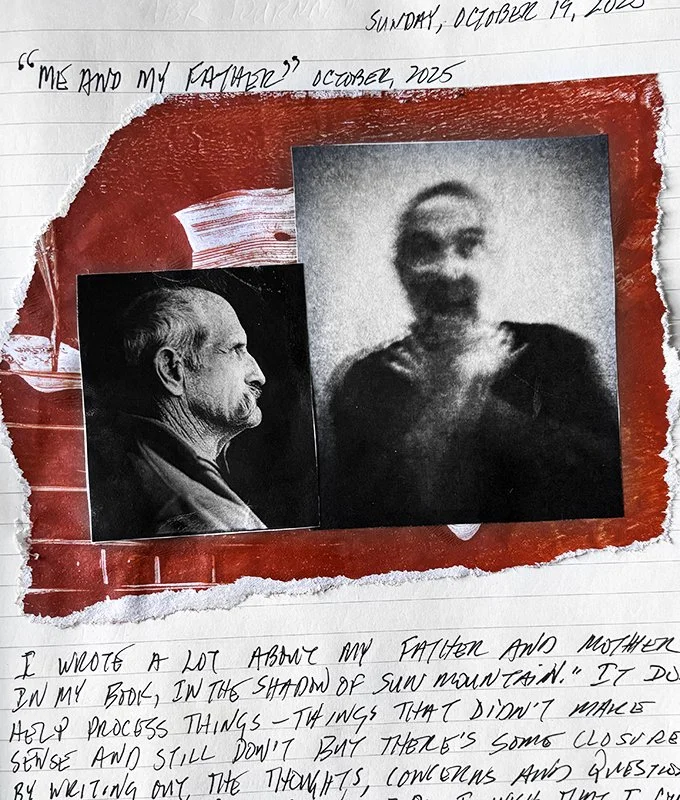
Journal entry - October 2025.

At the same time, I’ll be studying how others respond to this work and what happens psychologically, symbolically, and emotionally when someone encounters artwork that doesn’t look away from mortality. Death denial shows up in recognizable ways: humor, defensiveness, projection, avoidance, and philosophical distancing. But sometimes something deeper appears: recognition, quiet, even a brief moment of meaning.

ABR gives me a structure to study all of this.

My own creative process.

The images that emerge.

The responses they evoke.

The symbolic patterns that repeat.

The ways meaning cracks open or closes down.

It lets me bring the studio, the psyche, and the research questions into one integrated space.

My hope is to create a body of work that matters both inside academia and beyond it. Art isn’t an accessory to life; it’s a method of survival. Artists metabolize things the culture doesn’t know how to hold directly. We take fear, grief, rupture, and turn them into form, into symbols that others can bear to look at. It isn’t therapy and it isn’t escape. It’s a form of existential transformation.

If I can articulate that process, what it feels like, what it reveals, and how it shapes both the maker and the viewer, then the work will have done something meaningful. It will help explain why creative practice is one of the most honest responses we have to our own mortality.

So that’s the direction I’m heading: a reworked Sun Mountain, a sequence of manuscripts that build the conceptual ground, a new exhibition, and a dissertation that uses arts-based research to study the artist’s encounter with mortality from the inside out. I’m building an integrated body of work, creative, philosophical, and experiential, that examines what it means to be mortal and how artists turn that reality into meaning.

More will unfold as the work begins to take shape.

In ABR, Arts-Based Research, Create iand Face of Death, Death, Death Anxiety, Doctoral Studies, Dissertation, Wet Plate Collodion, Shadow of Sun Mountain Tags Arts-Based Research, Dissertation, PhD
2 Comments

Old Glass Insulators, Whole Plate Negative, 2025
Found half-buried in desert dust, some shattered, one miraculously whole. Once they carried power across distance; now they sit in silence, transmitting something else entirely. A meditation on endurance, fracture, and the quiet persistence of connection.

Old Glass Insulators — Whole Plate, November 1, 2025

Quinn Jacobson November 1, 2025

It’s so good to be back! It’s like riding a bicycle!

This is my first time making wet collodion images in New Mexican light. The air here feels different, drier, sharper, almost sentient in the way it bends light and shadow. The light is amazing. It’s “soft.” Much softer than the high UV light of the Colorado mountains.

The process felt both foreign and familiar. I missed the smell of ether, the sticky residue of collodion on my hands, and the small miracle of seeing the image appear in the developer. It’s not nostalgia; it’s recognition. The darkroom remains a place where time collapses.

The image I made today is of old glass insulators, remnants of a different kind of transmission. I found them half-buried in the desert dirt, relics of a vanished network that once carried voices and voltage across the American landscape. Some were shot through and fractured; one, improbably, remained whole. Its blue glass caught the morning light like a memory refusing to die.

The scene in digits.

I was drawn to these objects for their contradictions. They were built to endure, yet they shatter easily. They once conducted invisible currents, and now they are silent. They hold the history of connection and the inevitability of disconnection. Photographing them felt like standing between those two poles—between what holds and what breaks.

The glass, like the psyche, records every impact. The fractures become part of its character. In that way, the act of photographing them became a meditation on survival—how the self transmits meaning even after being cracked by experience. The blue insulator, intact among the ruins, felt like a metaphor for what remains transmissible in me: the impulse to create, to reach across distance, and to make contact through image and light.

Working with glass has always been more than a process; it’s a kind of ceremony. Each plate is a conversation with chemistry, a slow revelation of what wants to appear. Collodion teaches humility; silver sees everything. It reacts to the smallest impurity, just as the psyche reacts to what it resists. There’s a kind of grace in that sensitivity.

Holding the plate, watching the image emerge, I felt the familiar sense of presence that only this process offers. It’s not just about recording an object—it’s about witnessing transformation. The photograph becomes a transmission, a signal from matter to mind, from the visible to the invisible.

In the end, the plate is both image and mirror. It reflects what I brought into the room: a desire to reconnect with process, with light, and with myself. The broken insulators remind me that communication is never perfect, that art itself is a fragile conduit. But sometimes, even after the line is cut, the current finds its way through.

Whole Plate placeholder.

Some of my chemistry and supply shelves are up and full. I’m still making small changes and arrangements to my darkroom, but I really like it—very comfortable to work in and very spacious!

In Art & Theory, Arts-Based Research, Collodion Negatives, Wet Plate Collodion, Wet Collodion Negatives, New Mexico Tags wet collodion photography, Wet Plate Collodion Negatve, new mexico, glass insulators
2 Comments

Filtering Silver – October 31, 2025
Preparing the bath for tomorrow’s plates. The chemistry always feels like a mirror, revealing more than it records.

The Alchemy of Attention

Quinn Jacobson October 31, 2025

This is the silver bath I filtered today. One liter of clean AgNO₃, ready for plates tomorrow. It’s the first time I’ve filtered and maintained silver (or any chemical in the process) since 2023. The move from the mountains of Colorado to the desert of southern New Mexico took time: more than just chronologically. It took time to root again, to find rhythm, and to remember why I started this work in the first place.

The PhD program has become my way back. It’s a return to the process that has always been the heart of my practice. Wet collodion will be central again, not just as a technique, but as a way of being present with the materials, the world, and myself.

Working with glass plates is an act of attention. The glass is both fragile and eternal; it records every trace of what passes over it. The collodion binds light to the surface for only a few minutes before it dries, so everything depends on presence. It asks you to show up completely. 100%

Filtering the silver feels ceremonial. It’s a quiet ritual of purification, of chemistry, but also of intent. Silver sees everything. It reacts to the smallest impurity, just as the psyche reacts to what we avoid. It’s easy to anthropomorphize AgNO₃. It has moods. It remembers. It rewards patience and punishes haste. Working with it becomes a kind of dialogue between matter and mind, between what’s visible and what’s hidden (until the sun shines on your hands).

In the end, every plate is a mirror of both chemistry and consciousness. Each pour, each exposure, and each development is a small transformation—matter becoming memory and light becoming meaning.

Tomorrow, I’ll pour my first plates in this new desert light. It feels like coming home to something ancient, something still alive, something that believes in the alchemy of attention.

* smily face *

In AgNO3, Transcendence, Wet Collodion, Wet Plate Collodion Tags AgNO3, filtering silver nirate, Silver, silver nitrate
2 Comments

Search Posts

Archive Block
This is example content. Double-click here and select a page to create an index of your own content. Learn more
Post Archive
  • Photography
 

Featured Posts

Featured
Dec 10, 2025
Where My Work Is Heading
Dec 10, 2025
Dec 10, 2025
Nov 30, 2025
Notes From the Studio: Staring at the Sun
Nov 30, 2025
Nov 30, 2025
Nov 20, 2025
A Salt Print From Another Life
Nov 20, 2025
Nov 20, 2025
Nov 20, 2025
A Coyote in the Desert, and What It Taught Me Today
Nov 20, 2025
Nov 20, 2025
Nov 13, 2025
Living Truthfully Inside Impermanence
Nov 13, 2025
Nov 13, 2025
Nov 5, 2025
Between Presence and Absence
Nov 5, 2025
Nov 5, 2025
Nov 3, 2025
The Coyote That Died on My Land
Nov 3, 2025
Nov 3, 2025
Nov 1, 2025
Old Glass Insulators — Whole Plate, November 1, 2025
Nov 1, 2025
Nov 1, 2025
Oct 31, 2025
The Alchemy of Attention
Oct 31, 2025
Oct 31, 2025
Oct 28, 2025
The Body Shows Up When Theory Isn’t Enough
Oct 28, 2025
Oct 28, 2025