
• blog
  • in the shadow of sun mountain
  • buy my books
  • photographs
  • paintings
  • bio
  • cv
  • contact
  • search
Menu

Studio Q Photography

Exploring Human Behavior and Death Anxiety Through Art
  • blog
  • in the shadow of sun mountain
  • buy my books
  • photographs
  • paintings
  • bio
  • cv
  • contact
  • search
×

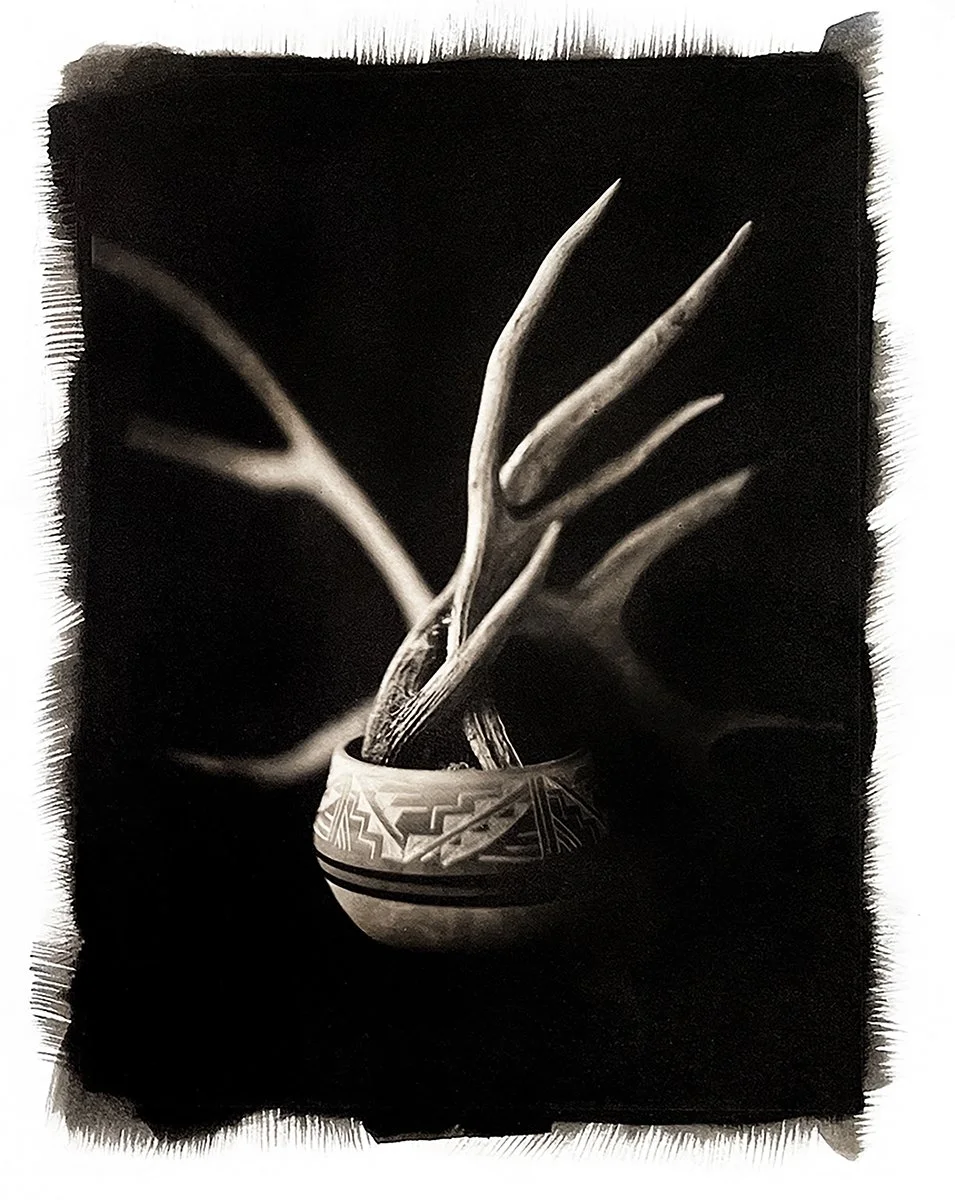
Figure 23

Antlers in a Ute Pot: Over-Evolution and the Burden of Consciousness. The photograph draws on Peter Wessel Zapffe’s account of overdeveloped consciousness and its associated coping structures, situating human awareness as a form of evolutionary excess. This image also serves as the cover of In the Shadow of Sun Mountain: The Psychology of Othering and the Origins of Evil.

Whole plate palladium print from a wet collodion negative, 2022.
Photograph by Quinn B. Jacobson.

Glass Bones - Chapter 14: The Edge of Meaning

Quinn Jacobson November 5, 2026

Ernest Becker, Otto Rank, and the Burden of Consciousness

The Creative Mind & Mortality Podcast

In this week's reading of Glass Bones: Art, Mortality, and the Human Mind, I bring Ernest Becker more fully into the conversation about the artist and the psychological consequences of mortality awareness.

In Chapter 13, I explored Otto Rank's understanding of the artist as someone caught between two powerful human needs: the desire to belong to a collective culture and the equally strong need to remain an individual. Rank believed this tension was central to the creative personality. Artists depend on culture for meaning, language, and symbolic expression, yet their work often requires them to question the very structures that provide psychological stability.

Becker takes us further into the existential implications of that tension.

He understood that human beings live with a profound contradiction. We possess symbolic minds capable of imagining permanence, significance, and transcendence, yet we inhabit biological bodies destined to deteriorate and die.

We want our lives to matter. We want continuity. We want to believe that something about us will endure.

And we know, at some level, that our physical existence is temporary.

Becker believed this contradiction shapes much of human psychology. To manage the anxiety it produces, we construct cultural systems of meaning that tell us who we are, what matters, and how our lives might contribute to something larger than ourselves. He called these cultural hero systems.

Religion, nationalism, professional achievement, social identity, and even artistic accomplishment can become ways of establishing significance in a world where permanence is impossible.

These systems provide essential psychological protection. They also create difficulties when we begin to recognize how much of our meaning depends on beliefs we've inherited or constructed.

This is where Becker's understanding of the artist becomes particularly interesting.

The Artist's Tragic Position

Becker saw the artist as someone who may experience the instability of cultural meaning more directly. The artist recognizes that the symbolic structures we depend on are human creations, yet still needs those structures to make sense of existence.

There's a difficult tension here.

We can recognize that meaning is constructed and still experience a profound need for it. We can understand that our work will eventually disappear and still feel compelled to make it.

Becker described this condition through the idea of tragic heroism.

For me, this is one of his most compelling insights.

Tragic heroism involves acknowledging our limitations, recognizing the absence of ultimate guarantees, and continuing to participate in life anyway.

In creative practice, this might mean returning to the studio knowing that the work will deteriorate, that our accomplishments may eventually be forgotten, and that nothing we make can permanently protect us from death.

And yet we continue.

Creativity and the Burden of Knowing

I've spent decades working with nineteenth-century photographic processes, particularly wet collodion, along with painting and mixed media.

These processes continually remind me of impermanence. The chemistry is unstable. Glass can break. Images can deteriorate. A photograph preserves a moment that has already passed.

I'm interested in what happens psychologically when we work with that awareness rather than immediately trying to escape it.

Rank helps explain the tension between the individual and the collective. Becker reveals the existential pressure beneath that tension: our need for symbolic significance within a finite biological life.

Together, they offer a useful framework for understanding why creative work can be psychologically demanding.

But I think there's another question worth asking.

What actually happens when an artist remains with existential uncertainty long enough for it to influence the work?

Does the creative process change our relationship with death anxiety? Can it help us metabolize experiences that might otherwise become overwhelming? And what happens when the beliefs and narratives that once sustained us begin to collapse?

These questions move beyond the artist's psychological position and into the experience of making.

Where the Inquiry Goes Next

Rank and Becker provide much of the theoretical foundation for my inquiry, but their accounts leave important questions about the actual process of creative engagement.

They help us understand why artists might experience tension with collective meaning and why mortality awareness creates such profound psychological pressure.

What remains to be examined is how that pressure unfolds.

In the chapters ahead, I'll turn toward Terror Management Theory, the instability of cultural worldviews, and the moments when familiar systems of meaning begin to fail.

I'm particularly interested in the threshold where awareness becomes difficult to contain, where the stories we've depended on no longer provide the protection they once did.

This is the territory of rupture.

For me, the central question remains whether creative practice offers a different way of encountering that instability, one that allows us to remain present without immediately constructing another protective narrative.

Becker's tragic heroism suggests that there may be dignity in acknowledging our condition and continuing to create without guarantees.

Perhaps that's one of the most important things art can offer.

A way to work with the knowledge of our impermanence, even when we cannot resolve what that knowledge means.

Glass Bones: Art, Mortality, and the Human Mind
Quinn B. Jacobson
In Chapter 14, Edge of Meaning, The Creative Mind and Mor, Ruptureology, Rupture Field Theory, Rupture, Otto Rank, New Books 2026, Glass Bones Book, Glass Bones Reading Tags chapter 14, Book Reading, Edge of Meaning, Glass Bones
Comment

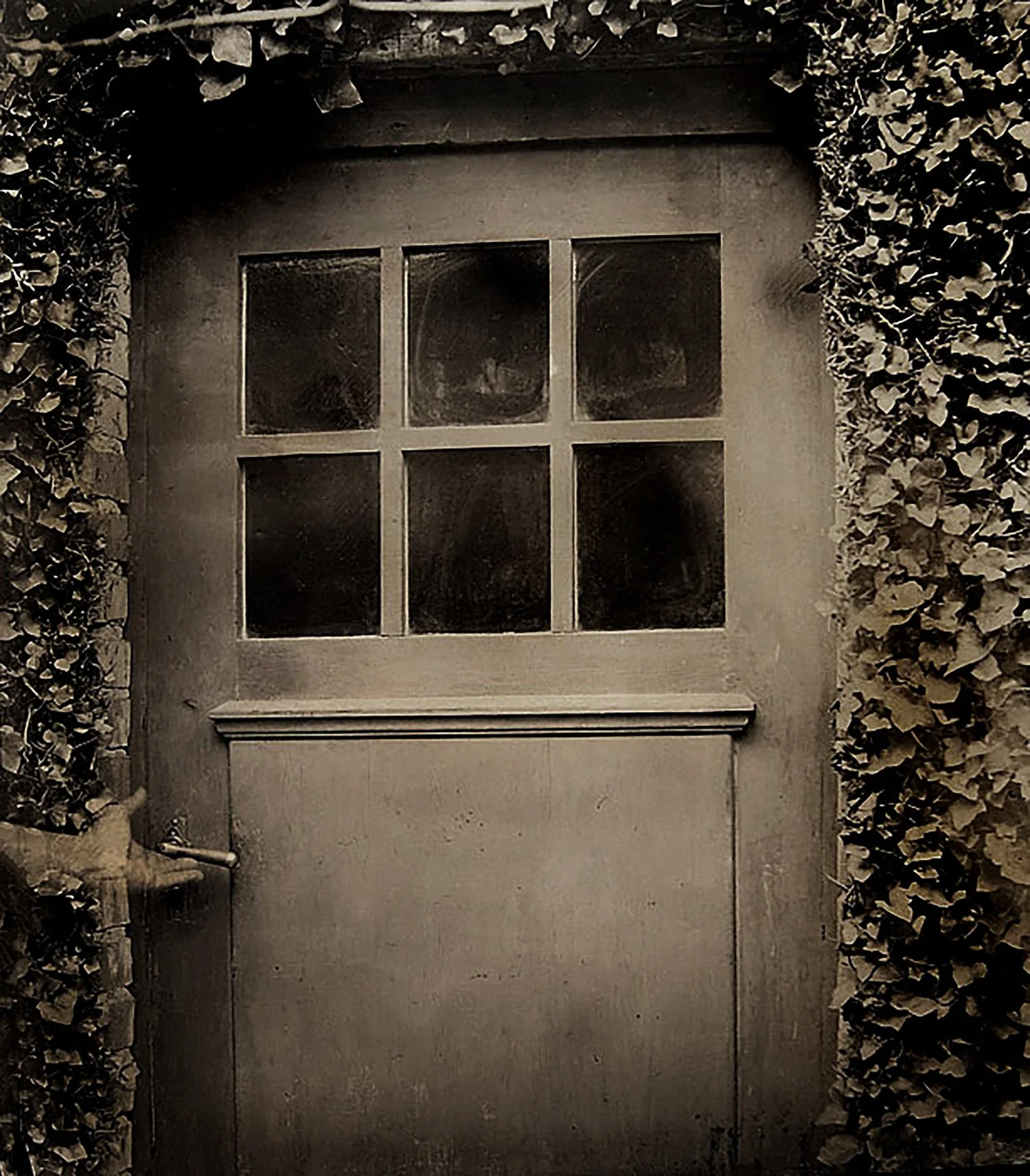
Figure 22

The Old German Man’s Door.
A closed door holds the tension between concealment and access. A faint, unresolved hand approaches the handle, registering as trace rather than contact. The image situates perception at a threshold, where approach does not guarantee entry and absence organizes attention as much as presence.

Note. Albumen print from a wet collodion negative, whole plate (6.5 × 8.5 in.), 2008. Photograph by Quinn B. Jacobson. Viernheim, Germany.

Glass Bones - Chapter 13: The Pressure of Knowing

Quinn Jacobson October 30, 2026

The Pressure of Knowing: Otto Rank and the Psychology of the Artist

Why do artists often seem to live at the edges of cultural meaning? What compels someone to question the beliefs and assumptions that provide other people with stability? And why does creative work so often emerge from anxiety, uncertainty, and psychological conflict?

In this week's reading of Glass Bones: Art, Mortality, and the Human Mind, I explore these questions through the work of Austrian psychoanalyst Otto Rank and his understanding of the creative personality.

Rank was one of the earliest psychological thinkers to take the artist seriously as a distinct expression of the human condition. He recognized a fundamental tension in the creative life: the desire to belong to the collective world of culture and the equally powerful need to maintain one's individuality.

We all depend on culture to provide meaning, identity, and continuity. Our religious beliefs, social institutions, traditions, and shared narratives help us navigate a world in which our existence is temporary. These systems provide psychological stability, particularly when we're confronted with uncertainty and death.

For Rank, the artist occupies a difficult position within this arrangement.

Artists need culture. We depend on its symbols, language, history, and traditions to communicate. At the same time, creative work often requires enough distance from those structures to question them, challenge their assumptions, and recognize their limitations.

Too much belonging can diminish the independence necessary for creative inquiry. Too much separation can make communication nearly impossible.

The artist lives somewhere between those conditions.

The Artist and the Neurotic

One of Rank's more provocative ideas concerns the relationship between the artist and the neurotic.

He believed both experience heightened psychological tension. Both struggle with the conflict between individuality and collective expectations. The distinction, in Rank's framework, lies in what happens to that tension.

The artist gives it form.

Anxiety, conflict, and uncertainty become material for creative work. Experiences that might otherwise remain psychologically overwhelming can be externalized through painting, photography, writing, music, or other forms of expression.

This is an important insight, particularly when considered alongside Ernest Becker's theories about mortality awareness and our dependence on symbolic meaning.

But I think Rank's interpretation requires some qualification.

My Perspective: The Practice Changes the Relationship

Rank sometimes described artists as possessing a heightened or superior perception of reality.

I'm not convinced that's the most useful way to understand the creative mind.

I don't necessarily believe artists see more than other people, possess greater sensitivity, or have some privileged access to existential truth.

What interests me is the possibility that creative practice requires a different relationship with the things our psychological defenses ordinarily keep at a distance.

Artists often work directly with ambiguity, instability, vulnerability, and impermanence. We return to these conditions repeatedly because they become the material of our work.

That distinction matters.

It shifts the conversation away from the idea of an exceptional artistic personality and toward the psychological consequences of sustained creative engagement.

After decades of working with nineteenth-century photographic processes, painting, and mixed media, I've become increasingly interested in how the act of making something changes our relationship with uncertainty.

The work doesn't necessarily resolve the anxiety. Sometimes it makes the anxiety more visible.

A photograph can preserve a trace of something already disappearing. A painting can emerge from an experience we haven't fully understood. Creative work can hold contradictions that ordinary explanations struggle to accommodate.

Maybe this is one way artists metabolize existential pressure. We give form to experiences that resist easy resolution.

The Cost of Awareness

Rank understood that the artist's position comes at a psychological cost.

Remaining close to uncertainty can make life more difficult. Questioning collective assumptions can produce isolation. The need for individuality may conflict with our equally human need for acceptance and belonging.

There's a certain loneliness in recognizing that the stories we depend on are constructions, even when those stories remain meaningful and necessary.

This is particularly relevant to my larger inquiry into mortality awareness.

If culture provides psychological protection against the knowledge of death, what happens when creative practice continually exposes the limitations of that protection?

Can art become a way of living with the anxiety rather than immediately defending against it?

I think Rank offers an important starting point.

His understanding of the artist as someone caught between individuality and collective belonging helps explain why creativity can be both psychologically demanding and deeply meaningful.

My interest is in what happens within that tension.

The artist may become a witness to the instability of meaning, working with the very uncertainties that cultural systems are designed to contain.

And perhaps the work makes that exposure bearable.

In this chapter, I'm exploring the possibility that creativity offers a way to remain engaged with existential uncertainty long enough for something meaningful to emerge.

The pressure of knowing remains.

We continue making things anyway.

In Chapter 13, Psychology and Art, Reading Glass Bones, Otto Rank Tags chaptter 13, reading, glass bones reading
Comment

Untitled—Whole Plate Salt Print from a wet collodion negative.

When I pull a print like this from the wash, I think about presence, the way it clings for a moment before fading (not fixed). The chemistry stains, the brush strokes at the edges, and the paper that curls in my hands—none of it is meant to last. That’s what I love about it. It’s a print that remembers its making. The figure still feels fragile, but now it’s suspended in a kind of quiet acceptance.

Living Truthfully Inside Impermanence

Quinn Jacobson November 13, 2025

Rupture is not simply a wound; it’s the generative moment when denial collapses and creation begins. It’s the place where death anxiety, cultural myth, and personal memory are transmuted into presence. Within rupture, the artist becomes a witness rather than a defender, turning from the fantasy of permanence toward the truth of impermanence. In that shift, art no longer seeks to outlive death; it becomes a form of living with it.

Otto Rank’s distinction between the artist and the neurotic illuminates this process. Both encounter rupture, the psychic shattering that comes when one’s symbolic world no longer holds, but only the artist metabolizes it. Where the neurotic internalizes and chokes on anxiety, the artist transforms it into form. The creative act becomes a means of surviving truth, of remaking coherence in the face of its undoing. Ernest Becker described culture as a shield against mortality; I see art as the moment that shield cracks. The fracture is not failure but revelation, an aperture where something honest can enter.

My work with wet collodion lives inside that aperture. The process itself enacts rupture: collodion, glass, silver, and time. Each plate holds the risk of loss. The collodion might peel, the image might fog, and the light might fail. Yet those failures become evidence of life. The surface bears the marks of both fragility and endurance, transparency and strength. Each plate is a negotiation between control and surrender, between the impulse to preserve and the inevitability of decay. To work in this way is to accept that every act of making is also an act of unmaking. I’m connecting deeply to these ideas and am excited to see where it takes me.

In Art & Theory, Arts-Based Research, Collodion Negatives, Death Anxiety, Ernest Becker, Existential Art, Metabolizing anxiety, New Mexico, Otto Rank, PhD, Salt Prints Tags Ruptureology, rupture, Rupturegenesis, Wet Plate Collodion Negatve, Salt Print
Comment

“Bird Bones or Spewing Out My Introversions,” 2013 - Half Plate Gelatin Chloride Print from a wet collodion negative.

Bird Bones

Quinn Jacobson October 9, 2025

“Rank asked why the artist so often avoids clinical neurosis when he is so much a candidate for it because of his vivid imagination, his openness to the finest and broadest aspects of experience, his isolation from the cultural world-view that satisfies everyone else. The answer is that he takes in the world, but instead of being oppressed by it he reworks it in his own personality and recreates it in the work of art. The neurotic is precisely the one who cannot create—the “artiste-manque,” as Rank so aptly called him. We might say that both the artist and the neurotic bite off more than they can chew, but the artist spews it back out again and chews it over in an objectified way, as an ex­ternal, active, work project. The neurotic can’t marshal this creative response embodied in a specific work, and so he chokes on his in­troversions. The artist has similar large-scale introversions, but he uses them as material.”

―Ernest Becker
The Denial of Death

In Ernest Becker, Otto Rank Tags bird bones, bines, death, becker, otto rank
Comment

Search Posts

No results found
Archive Block
The page connected to this block was deleted. Double-click here to select a different page, or check the recycle bin for the deleted page. Learn more
Post Archive
  • Adventures
  • Spotlight
 

Featured Posts

Featured
Figure-20-Antlers copy.jpg
November 5, 2026
Glass Bones - Chapter 14: The Edge of Meaning
November 5, 2026
Read more →
November 5, 2026
knopp_door_052707-Ross.jpg
October 30, 2026
Glass Bones - Chapter 13: The Pressure of Knowing
October 30, 2026
Read more →
October 30, 2026
Suicide-Lux-Web copy 2.jpg
October 24, 2026
Glass Bones - Part One: Conclusion and Part Two: Introduction
October 24, 2026
Read more →
October 24, 2026
Quinn-Existential Artist.jpg
October 15, 2026
Glass Bones - Chapter 12: When Awareness Deepens
October 15, 2026
Read more →
October 15, 2026
Red-Yucca-book.jpg
October 9, 2026
Glass Bones — Chapter 11: Living with the Tension
October 9, 2026
Read more →
October 9, 2026
swallowing.jpeg
October 2, 2026
Glass Bones, Chapter 10: The Anxiety Beneath It All
October 2, 2026
Read more →
October 2, 2026
September 25, 2026
Glass Bones, Chapter 9: The Need to Matter
September 25, 2026
Read more →
September 25, 2026
Oragns-Clouds-Sept-16.jpg
September 17, 2026
Glass Bones, Chapter 8: When Meaning Breaks
September 17, 2026
Read more →
September 17, 2026
September 4, 2026
Glass Bones, Chapter 7: The Fragile Architecture of Meaning
September 4, 2026
Read more →
September 4, 2026
August 29, 2026
Glass Bones - Chapter 6: The Mechanics of Defense
August 29, 2026
Read more →
August 29, 2026