
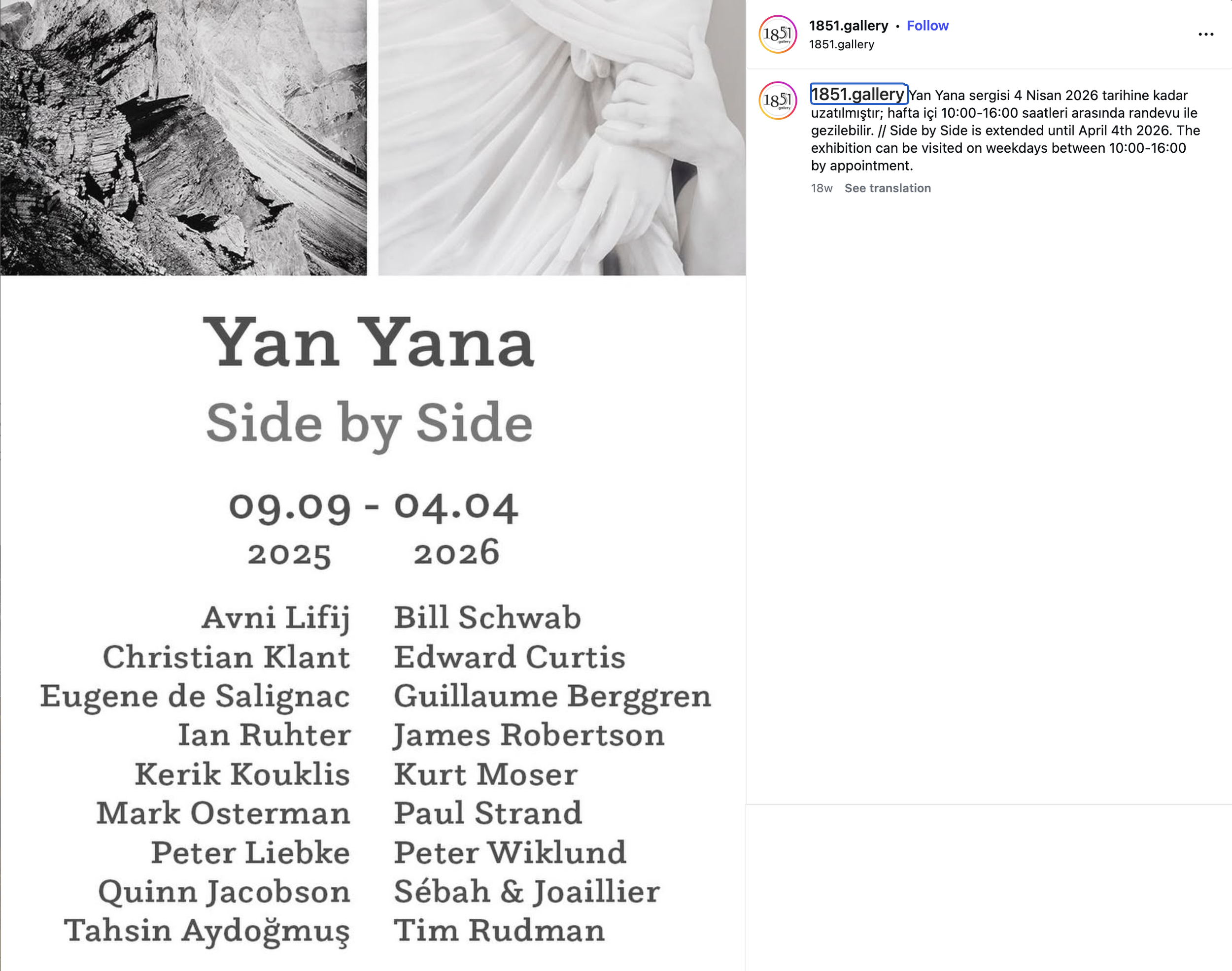
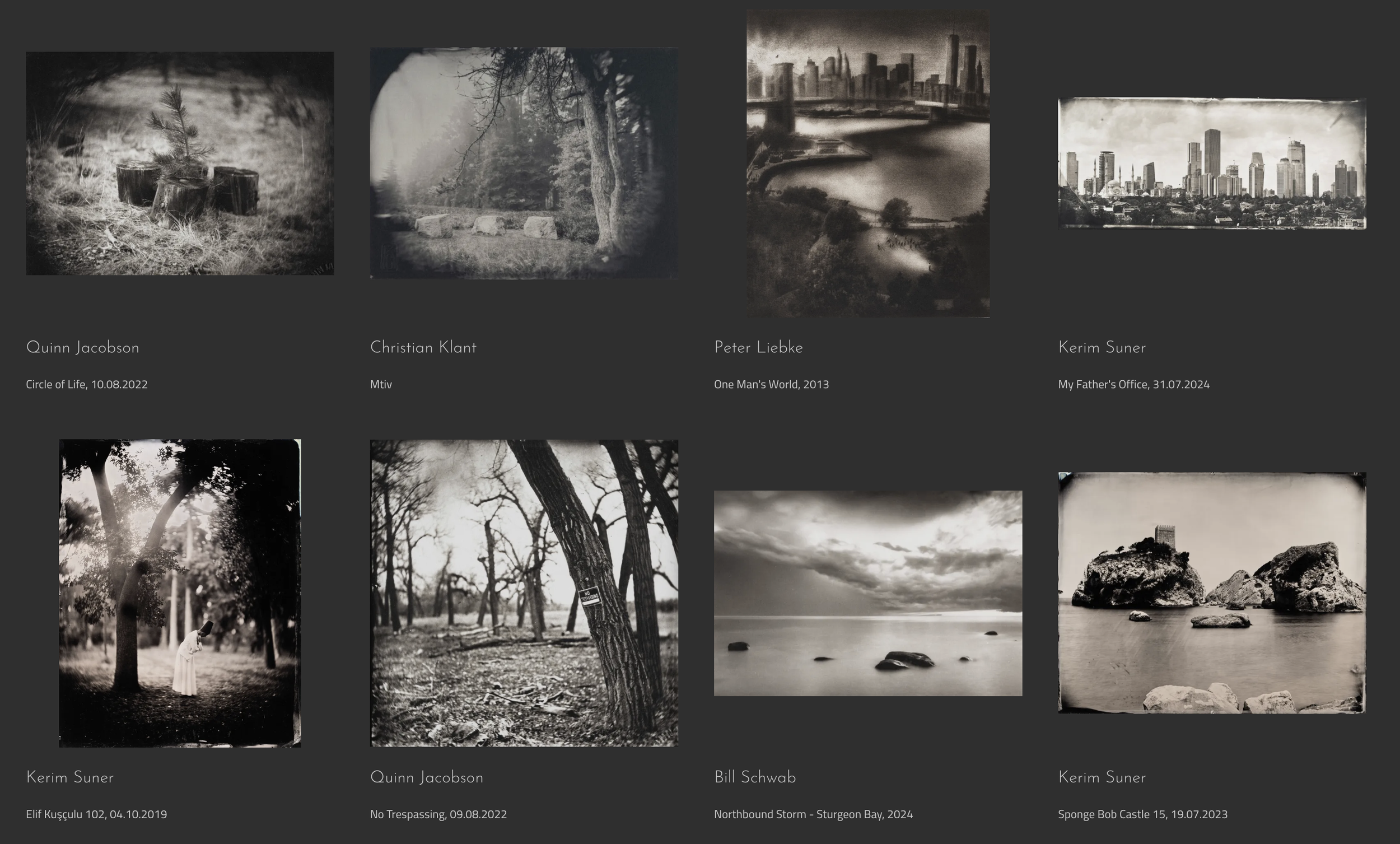
I was surprised to find two prints of mine in this show in Istanbul, Turkey. I know Kerim, the owner of the gallery, he owns both of the prints, but he never informed me about the exhibition.
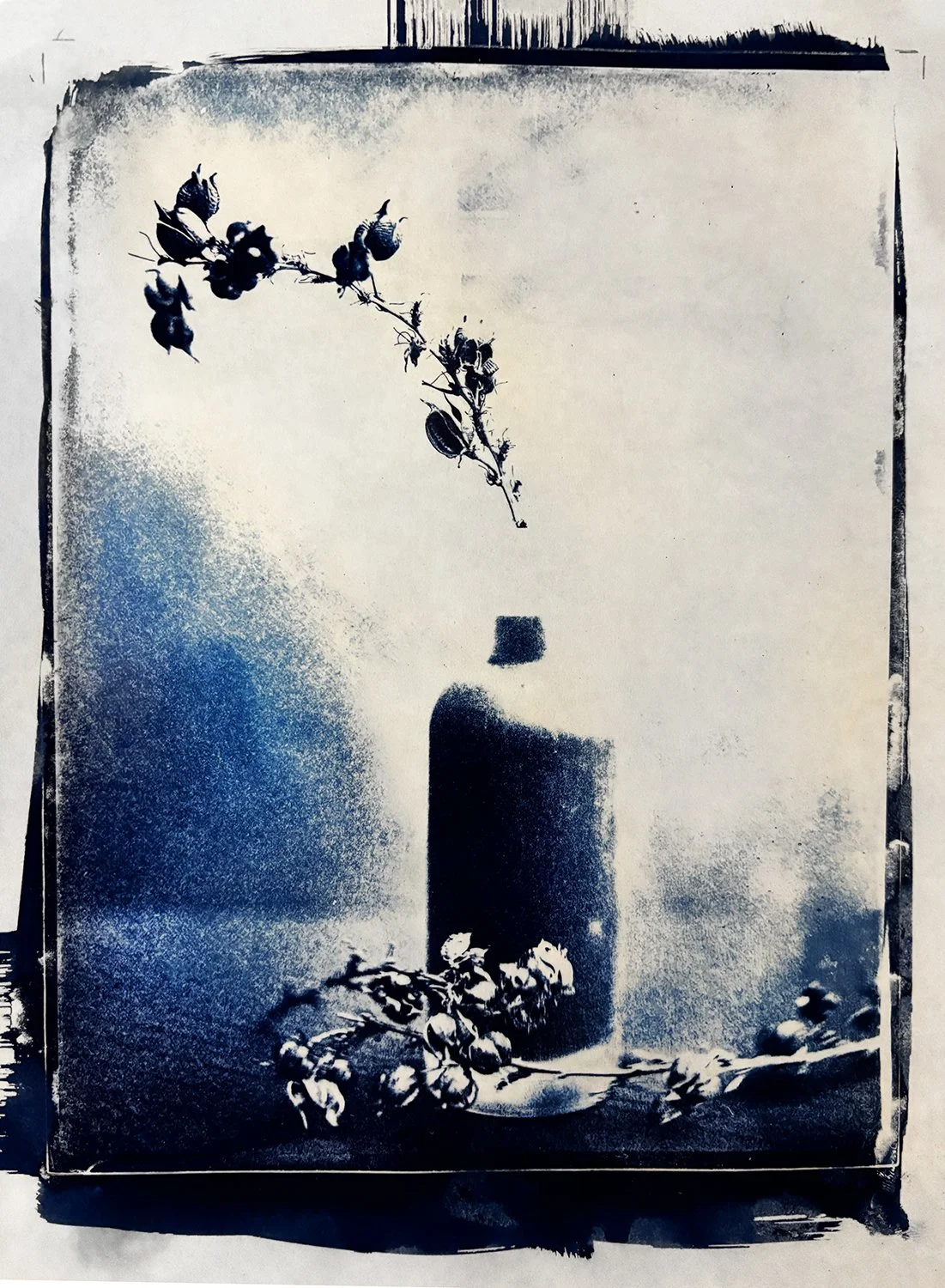
“Residue, Red Yucca” - experimental cyanotype from a whole plate wet collodion negative.
Experimental Work
There’s a moment in the darkroom when an image stops behaving like a document and starts behaving like a memory. Not a record of something that happened, but something closer to the feeling of having been there without being able to say exactly when or how or even if it was real. That’s where this print seems to live.
This Red Yucca began as a whole-plate wet collodion negative, already a material that carries its own temporal weight. Collodion doesn’t just record light; it slows it down. It asks for patience, for proximity, for a kind of attentiveness that feels increasingly out of step with the speed of contemporary image-making. But what happened here wasn’t about preservation. It was about disturbance.
In the cyanotype, I let the image come in, and then I partially took it away.
Washing sections of the print back out introduced a kind of instability into the surface. Areas that should have held firm dissolved into something closer to residue. The hydrogen peroxide, used to deepen the blues, didn’t simply “enhance” the shadows in a technical sense. It pushed the image toward a more pronounced polarity, presence and absence sitting closer together, almost uncomfortably so. What remains feels less like a fixed object and more like something that has survived a process of erosion.
And that’s where the feeling of déjà vu enters.
Not as nostalgia. Not as sentimentality. But as a kind of cognitive dislocation. The image feels familiar, but not locatable. It suggests that it belongs to a past but refuses to specify which one. The plant itself—red yucca, rooted in the desert, resilient, persistent—becomes secondary to the condition of its appearance. It’s no longer just botanical. It’s been pulled into a different register, where form begins to carry the weight of time.
There’s something important here about memory.
Memory, at least as we tend to experience it, isn’t archival. It doesn’t preserve things cleanly. It degrades, edits, overlays, and distorts. It holds onto fragments and lets other parts go without explanation. In that sense, this print feels more accurate to the structure of memory than a sharply rendered, fully intact image ever could. The losses aren’t flaws. They’re constitutive.
I find myself thinking about how much of our visual culture is oriented toward clarity, toward resolution, toward the elimination of ambiguity. High definition, perfect tonal range, immaculate surfaces. But lived experience doesn’t operate that way. The things that stay with us most persistently are often the least resolved. They hover. They repeat. They resist closure.
This print leans into that resistance.
It doesn’t present the yucca as an object to be known. It offers it as something half-recalled, half-erased, suspended between emergence and disappearance. The edges bleed. The ground feels unstable. The image seems to be both arriving and leaving at the same time.
In a way, it’s less about the plant than about the conditions under which anything comes to be seen, remembered, or lost.
And that feels close to the larger thread I keep returning to in the work: what happens when an image is allowed to carry not just form but also the pressure of time, decay, or partial disappearance? What kind of meaning becomes possible when we stop trying to stabilize the image and instead let it remain in that fragile, shifting state?
I don’t think this is about making something “beautiful” in any conventional sense. It’s about making something that feels true to the way experience actually moves through us—uneven, incomplete, and, at times, quietly haunting.
This one lingers. What do you think?
The Creative Mind & Mortality Podcast S1: Glass Bones E11: The Rupture Field Theory
Rupture Field Theory: Before I Had the Language - Introducing Episode 11
There are moments in life that don’t make sense when they happen.
They don’t arrive as ideas. They don’t announce themselves as important. They pass quietly, almost unnoticed, but something in them stays. Not exactly as memory, but as pressure. An imprint that doesn’t resolve.
Episode 11 of The Creative Mind & Mortality Podcast begins in that space.
I go back to two experiences that stayed with me long before I had the language to understand them. One from childhood, walking through a low-income apartment complex on Madison Avenue in Ogden, Utah. Years later, standing at the Sand Creek Massacre site in Colorado.
At the time, they felt unrelated. But over time, a pattern started to emerge.
That pattern is what I now call Rupture Field Theory (RFT).
Rupture, as I’m using it, isn’t always dramatic. More often, it’s subtle. Something doesn’t fit. Something exceeds your ability to make sense of it. And instead of resolving, it remains active beneath the surface.
This episode is an attempt to articulate that structure—not as abstract theory, but as something lived and worked through in the studio. A movement from rupture into form, from contact into expression, without rushing too quickly toward closure.
Most of the time, we stabilize as fast as we can. We translate experience into meaning and move on. But creative practice offers another possibility: to hold the instability long enough for something new to emerge.
That’s the ground this episode is built on.
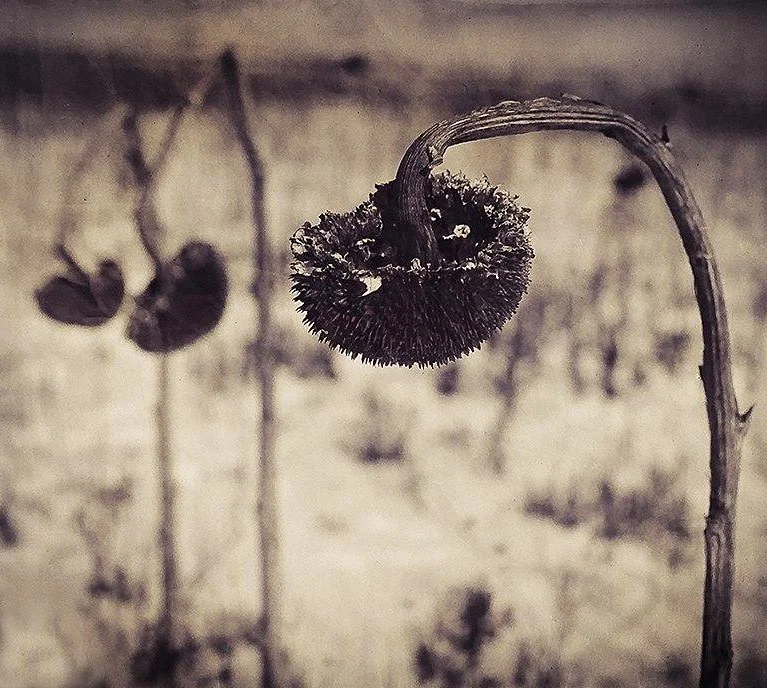
Three dead sunflowers at Sand Creek, Colorado.
The Creative Mind & Mortality Podcast – S1 E10: The Fragile Architecture of Meaning
There’s a moment, usually quiet, sometimes abrupt, when the systems we rely on to make sense of our lives begin to show strain. Not collapse exactly. Instead, it manifests as a subtle instability. A recognition that what once felt solid might be more provisional than we assumed.
This episode opens with Work Song by Hozier, a track that, on first listen, reads as devotion. But listen more closely, and something else comes through. The song doesn’t locate meaning in permanence. It locates it in relation—in presence, in connection, in being-with. That shift matters. It suggests that meaning might not be something we secure once and for all but something we participate in, moment by moment.
From there, the episode moves into Chapter 7 of Glass Bones, where the focus turns toward a more difficult realization: the structures that hold our sense of meaning together are not fixed. They are constructed, maintained, and—under pressure—fragile.
Drawing on Ernest Becker, this fragility begins to make sense. Becker argued that culture functions as a buffer against the anxiety of mortality. We build systems—religion, identity, achievement, and legacy—not simply to organize life, but to protect ourselves from the destabilizing awareness that it ends. Culture, in this sense, is not neutral. It is defensive. It allows us to move through the world without being overwhelmed by what Becker calls the “terror” of death.
But once that function becomes visible, the stability of those systems starts to look different. What we often take as enduring truths begin to reveal themselves as negotiated constructions—what Becker at times calls “necessary illusions,” not in a dismissive sense, but as conditions for psychological survival.
This is where Terror Management Theory extends Becker’s insight. Research consistently shows that when mortality becomes salient, people tend to defend their worldviews more aggressively. Beliefs harden. Boundaries sharpen. What might otherwise be approached with curiosity becomes something to protect. Work by Ross Menzies and Rachel Menzies traces this into everyday life, where even subtle reminders of death can amplify anxiety and trigger defensive responses—prejudice, polarization, or withdrawal.
Seen this way, conflict begins to look less like a failure of reasoning and more like a function of existential pressure. When meaning structures are threatened, the response is often not to revise them but to reinforce them.
At the same time, modern culture has developed increasingly sophisticated ways of avoiding death altogether. Distraction becomes ambient. Consumerism offers endless substitution. Even the pursuit of longevity begins to take on a symbolic dimension, as if extending life could also resolve the deeper problem of finitude. What emerges is not just denial, but an architecture—one designed to keep mortality at a manageable distance.
Yet fragility does not only produce defensiveness. It also produces pressure.
And under pressure, something else can begin to form.
If the systems we rely on are not as stable as they appear, the question shifts. It is no longer simply how we defend meaning but how we relate to it when it destabilizes. This is where the episode turns toward a different possibility. Not abandoning meaning, but loosening our grip on the idea that it must be fixed, guaranteed, or permanent.
There is a line of thought—present in existential philosophy and implicit in Becker—that suggests meaning may not be something we secure against death but something that emerges in proximity to it. Not despite fragility, but through it.
This is not a comfortable position. It asks for a different kind of orientation. One that does not rely entirely on stable systems but is willing to remain in relation—to others, to the work, to the moment—even when the larger structure feels uncertain.
The architecture may be fragile. But that fragility is not only a liability. It may also be the condition that makes meaning possible at all.
Keywords
creative mind and mortality
Glass Bones podcast
Chapter 7 fragile architecture of meaning
death anxiety
Ernest Becker
terror management theory
Ross Menzies Rachel Menzies
mortality awareness
worldview defense
existential psychology
culture and death denial
meaning making and mortality
conflict and belief systems
existential philosophy podcast
artists and mortality
symbolic immortality
modern death denial
consumerism and death anxiety
psychology of belief
Hozier Work Song meaning
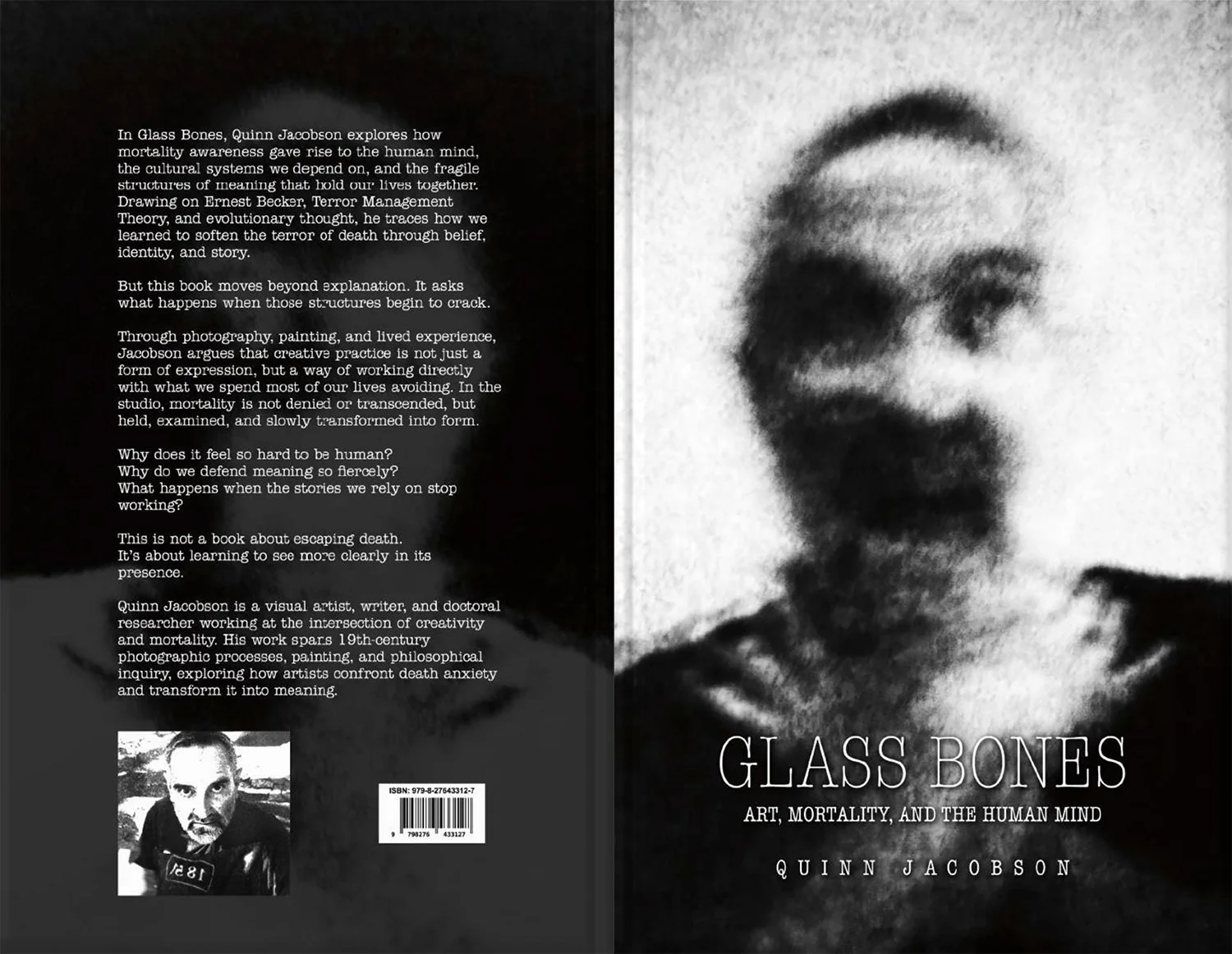
Front and back cover.
My Book: The Final Stages of Glass Bones
I wanted to share a few pages from Glass Bones—a glimpse into how the book is beginning to take shape as a physical object.
I’m still working. Still in the darkroom, still at the canvas, still refining the manuscript. Every day. But it’s close now. Close enough that I can begin to think less about what it is becoming and more about where it might live once it leaves my hands.
Right now, I’m planning a small hardback run (5.5” x 8.5”)—somewhere in the range of 250 to 300 copies. Not because I expect a large audience, but because I’m more interested in placement than scale. This isn’t a commercial project. It moves in the opposite direction.
What I keep returning to is the idea of libraries, especially at art schools. It’s a niche path, but that’s always been where this work lives.
There’s something compelling about the possibility that this book could sit quietly on a shelf, embedded within a larger system of knowledge, waiting for the right kind of encounter. Not driven by visibility or promotion, but by proximity. Someone searches for a keyword—mortality, art, psychology, violence, or meaning—and this object appears. They take it down. Spend time with it. Or don’t. But the encounter remains possible.
In that sense, distribution becomes part of the work.
If Becker is even partially right that culture functions as a buffer against the anxiety of death, then placing a book like this into public collections may operate as a small countercurrent. Not as a corrective, exactly, but as an opening. A space where the usual defenses are not reinforced but perhaps loosened.
Because this project doesn’t offer resolution.
Much of the work moves through sites of rupture—historical, psychological, and cultural. The violence enacted against the Tabeguache Ute, for example, is not framed as an aberration of cruelty but as something emerging from a deeper structure. A culture unable to face its own mortality displaces that terror outward, producing an “other” to carry what it cannot hold itself.
The images that follow don’t attempt to resolve that. They witness it.
They sit in the places where meaning breaks down and remain there long enough for something else to surface—something less stable, but perhaps more honest.
There will be a digital version. An audiobook as well. Both extend access, which matters. But they inevitably flatten part of the experience. The scale of the images, the pacing, the way text and image occupy the same field—those things don’t translate cleanly.
This has always been a hybrid project. Part book, part object. Something meant to be read but also handled. Something that lives not just in circulation but in place.
More soon.
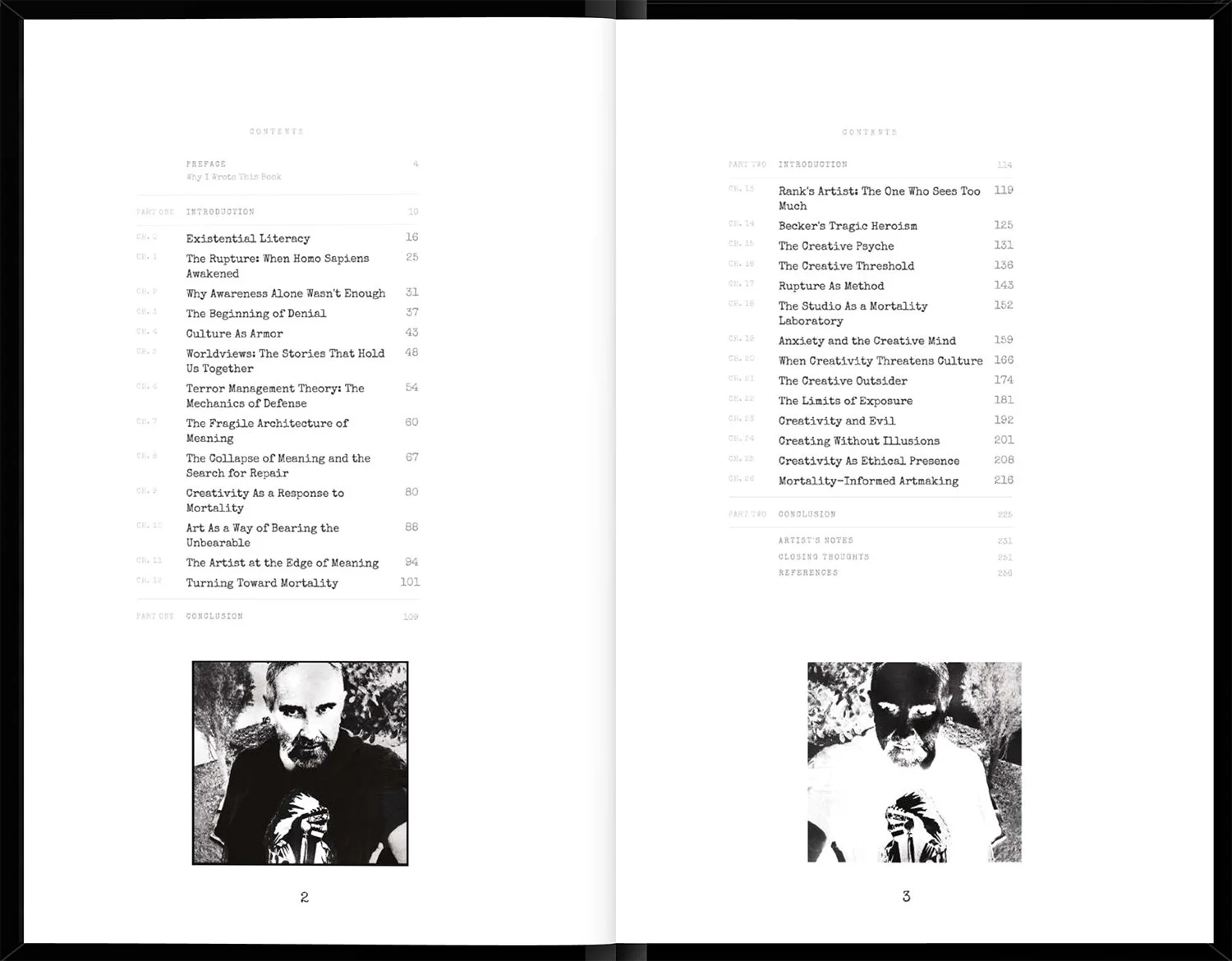
Table of contents.
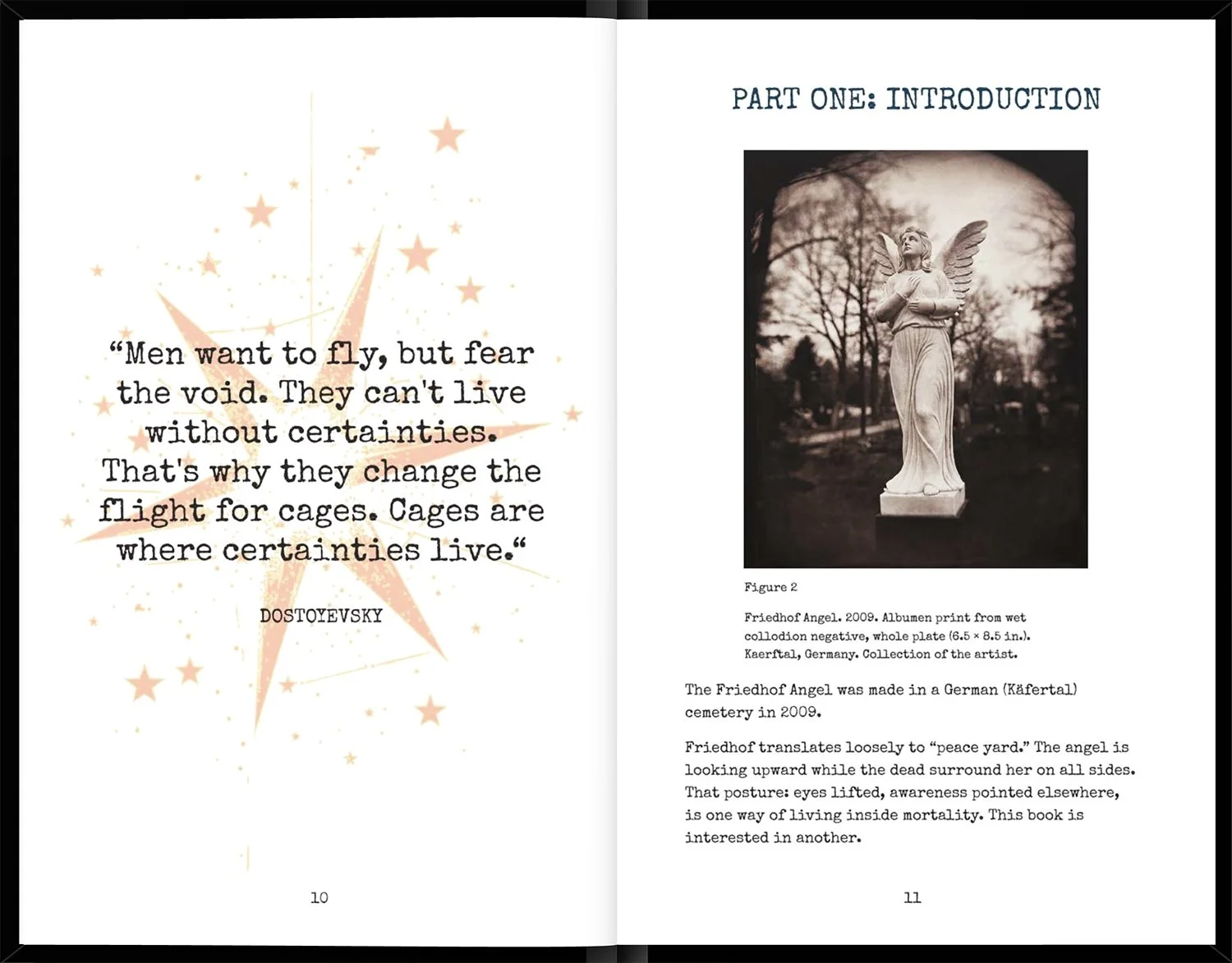
How each chapter begins: a quote and an image somewhere within the chapter or at the end.
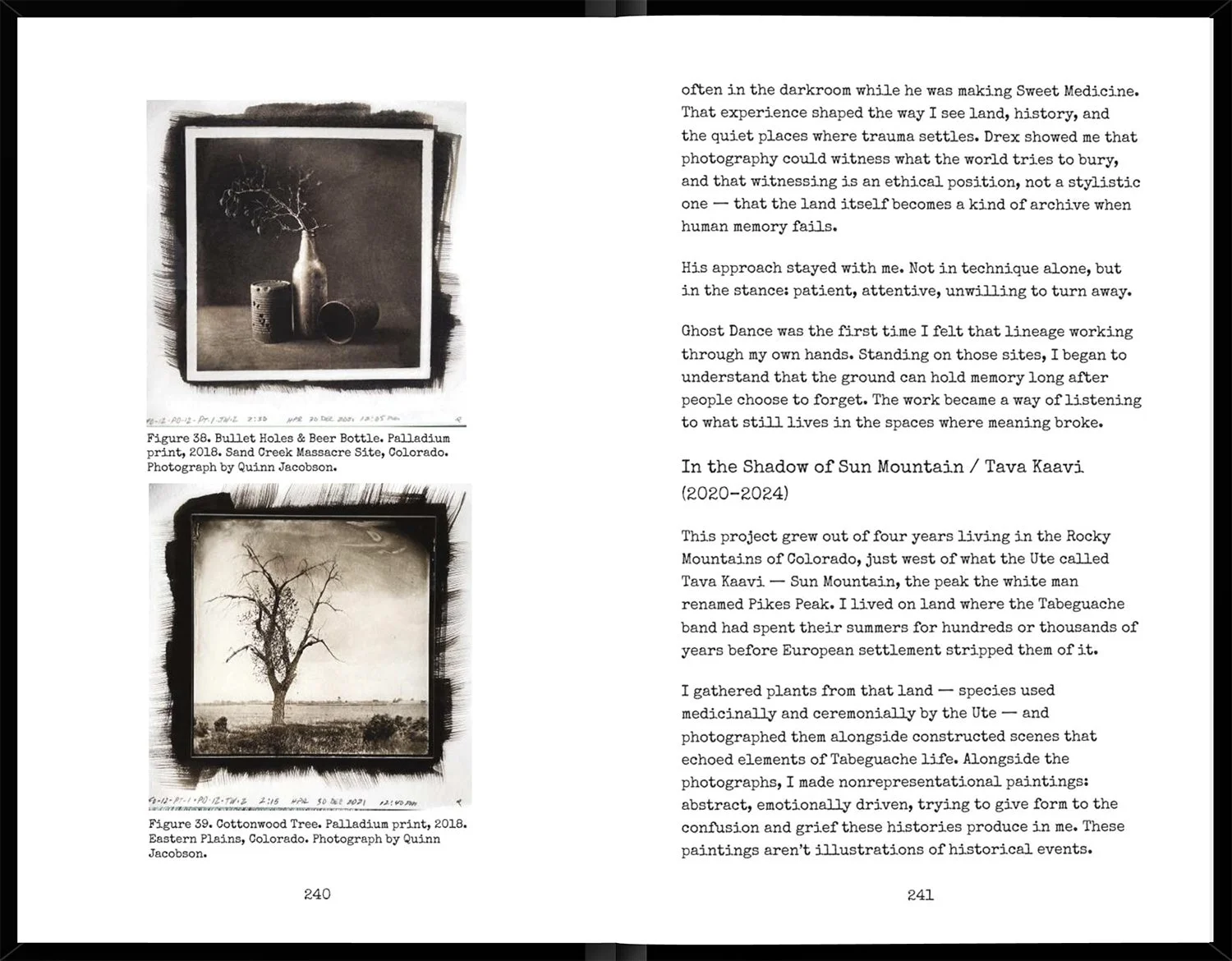
At the end of the book, I cover my work over the past 30+ years.
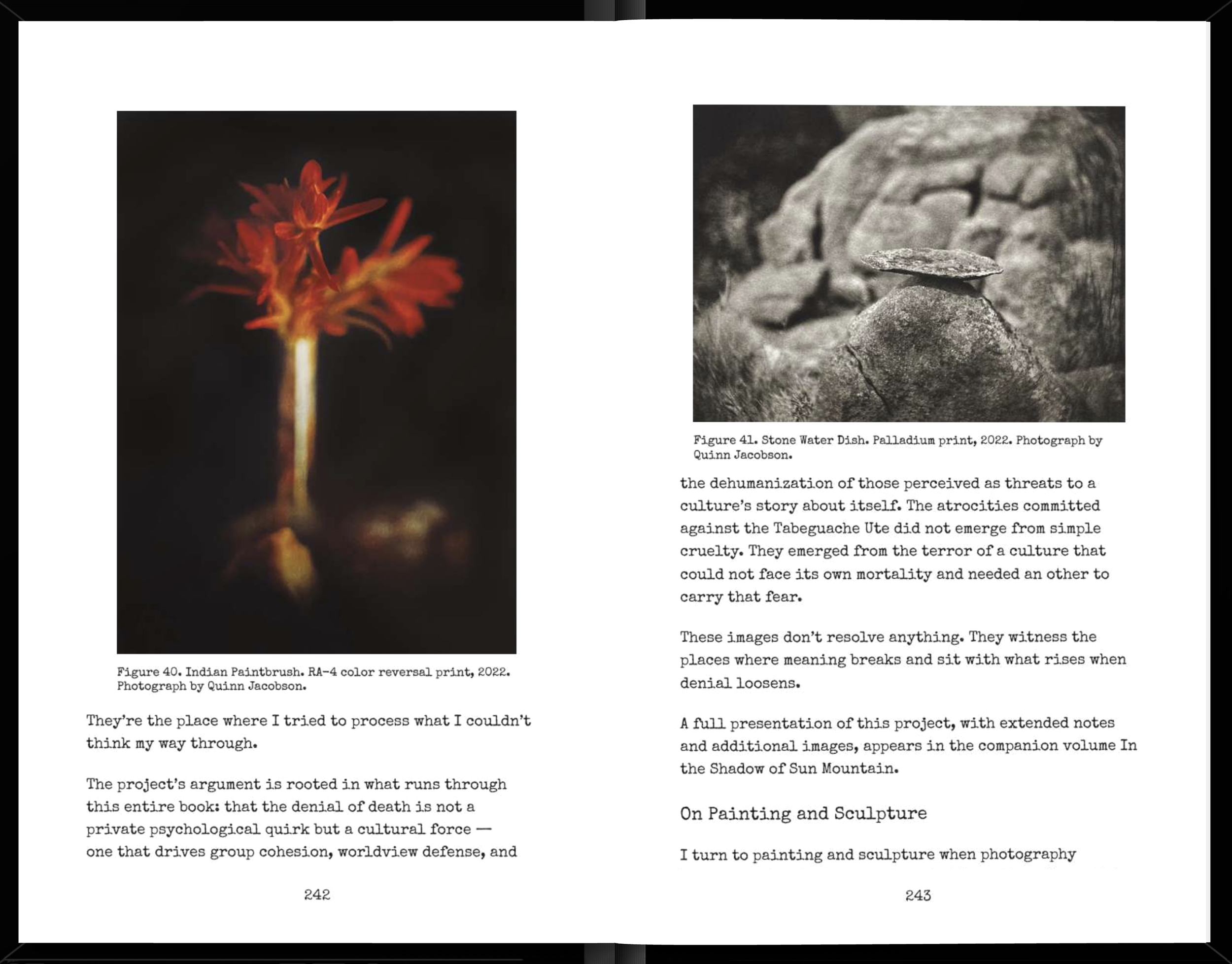
Terror Management Theory: The Mechanics Beneath Belief
Episode 9 — The Creative Mind & Mortality Series
There’s a moment in God Shuffled His Feet by Crash Test Dummies that lingers longer than it should.
It’s not dramatic. Nothing collapses. No revelation arrives. People sit in the shade with God, drinking wine, asking questions about death. What happens to the body? What carries forward? What remains? The questions are direct, almost childlike in their clarity.
And then something subtle shifts.
God answers with a story that doesn’t resolve. A boy with blue hair. It has the structure of a parable, but none of the closure. The meaning doesn’t land. It doesn’t return the listener to coherence. The people hesitate. They try to interpret. Someone finally asks what everyone is thinking: was that a parable or a joke?
God doesn’t answer.
He shuffles his feet.
What the song captures, almost inadvertently, is a moment of instability. Not the collapse of meaning, but a failure of resolution. The structure that is supposed to organize reality is still present, but it doesn’t quite hold. It hesitates.
That hesitation becomes a useful entry point into Terror Management Theory.
If Ernest Becker identified the central problem—the human awareness of death and the need to buffer it through culture—TMT attempts to observe what happens when that buffer is disturbed. It moves from philosophical diagnosis to experimental inquiry, asking whether mortality awareness can be measured in behavior.
The answer, across decades of research, appears to be yes.
TMT introduced the concept of mortality salience: the moment when death enters awareness, whether consciously or not. What is striking is how little it takes. A brief prompt asking someone to reflect on their own death. A passing image. A symbolic cue. The trigger can be minimal, almost incidental.
And yet, the effects are consistent.
When mortality is made salient, people do not typically report fear. There is no overt sense of panic. Instead, what emerges is a tightening. Worldviews become more rigid. Beliefs feel more certain. Cultural symbols take on increased emotional weight. Individuals show stronger preference for those who share their values and more hostility toward those who do not.
These are not random reactions. They follow a pattern.
Worldview defense intensifies. In-group loyalty strengthens. Out-group rejection increases. Self-esteem becomes more urgently pursued. What appears on the surface as conviction or moral clarity may, at least in part, be functioning as a buffer against existential threat (Solomon et al., 2015).
In this sense, culture operates less as a passive inheritance and more as an active defense system. It provides symbolic continuity, a way to feel that one’s life participates in something enduring. Becker described this as a “symbolic hero system,” a structure that allows individuals to experience significance in the face of finitude.
TMT shows how reactive that system can become when it is pressured.
What the laboratory captures, however, is primarily what happens after the disturbance. The worldview tightens. The armor is reinforced. The system re-stabilizes.
What the song offers is something slightly different.
It lingers in the moment before that re-stabilization fully takes hold.
The people in the song do not immediately defend. They hesitate. They attempt to interpret. They search for footing. The question—parable or joke—functions as an effort to restore structure, to reclassify ambiguity into something manageable. But for a brief moment, that effort does not succeed.
They remain in the gap.
This is a psychologically narrow space. One that is typically short-lived. The TMT literature would suggest that the system does not remain open for long. The need for coherence is too strong. The pressure of mortality too persistent.
And yet, that moment of hesitation may be worth examining more closely.
If worldview defense is a reflexive response to mortality awareness, then the question becomes whether it is possible to encounter that awareness without immediately reinforcing the structures that contain it. Not to eliminate defense, which is likely neither possible nor desirable, but to notice its activation. To recognize the moment when belief tightens, when identity hardens, when meaning is being secured rather than explored.
This is where the conversation begins to move beyond TMT.
The theory is precise in its observations, but it is limited in scope. It can demonstrate that mortality awareness shapes behavior. It can map the patterns of defense. But it does not fully address what it means to live with that awareness in a sustained way. It does not ask whether there are modes of engagement that are not primarily defensive.
That question opens into creative practice.
Art, at least in its more honest forms, does not always resolve tension. It does not necessarily restore coherence. It can hold ambiguity longer than most psychological systems are comfortable with. It can remain in that space where meaning has not yet stabilized, where the answer does not arrive cleanly.
In that sense, the hesitation in the song is not merely a failure of explanation. It is a condition.
A threshold.
The place where the worldview does not fully protect but has not yet been reinforced. The place where mortality is present, but not entirely covered over.
TMT helps us understand why that space is difficult to inhabit.
The question that follows is whether it is also where something generative begins.
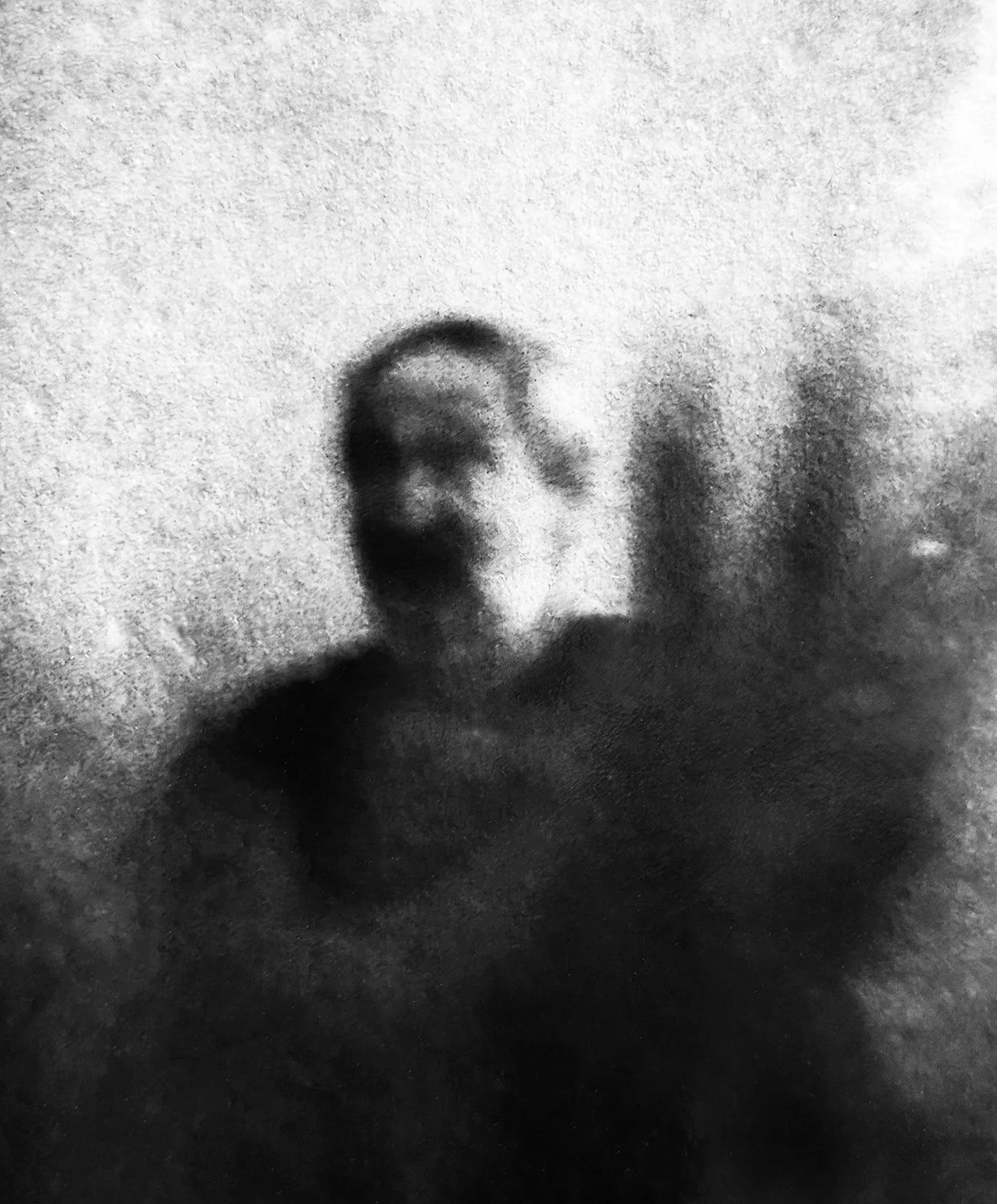
To Buffer or Not to Buffer?
Why Not Just Buffer?
Buffering is the psychological and cultural process that regulates our awareness of death, embedding it within beliefs, identities, and meanings that make it tolerable enough to live and function. Most of us do this constantly, automatically, and without knowing it. The question worth sitting with is not whether buffering happens, but what it costs, and whether there is anything worth preserving on the other side of it.
Why not simply buffer and numb out to the reality of mortality? If it keeps us functional, stable, even relatively content, why not leave it in place?
One answer is pragmatic: in many cases, we probably do need some degree of numbing. Becker, Zapffe, and the Terror Management theorists who followed them are fairly clear on this. Zapffe, the Norwegian philosopher whose work predates and in some ways anticipates Becker's, argued that human consciousness is biologically overbuilt for survival. In "The Last Messiah" (1933), he wrote that we are the only creatures who can foresee our own deaths, and that this foresight is not a gift but a burden we spend most of our lives managing through what he called anchoring: attaching ourselves to fixed values, identities, and purposes that hold the abyss at a manageable distance. A fully unfiltered awareness of mortality is not something most people can sustain without consequence. The real question, then, is not whether buffering exists, but how much of it we rely on, and at what cost.
The argument for remaining conscious, at least intermittently, has less to do with moral superiority and more to do with what becomes available when the buffer loosens. When mortality is not fully suppressed, certain patterns become visible: the contingency of one's worldview, the constructed nature of identity, the fragility of meaning. That recognition can be destabilizing, but it can also open a different kind of responsiveness.
From one angle, this is about accuracy. You see more of what is actually structuring your experience rather than mistaking the structure for reality itself. That doesn't dissolve the structure, but it introduces a degree of reflexivity. You are not only inside it; you are also aware of being inside it.
From another angle, it shifts the register of creative work. If anxiety is only buffered, it tends to get displaced into symbolic systems that reinforce the existing worldview. If it is metabolized, even partially, it can move through the work differently, less as defense and more as material. That is where the distinction between buffering and processing becomes meaningful. It is not that one eliminates anxiety while the other doesn't. It is that one reorganizes how anxiety circulates. Rank made a related observation in Art and Artist (1932), arguing that the creative act is never simply a resolution of anxiety but a repeated negotiation with it, one that can either fortify the existing character structure or, in rarer cases, begin to transform it.
There is also an ethical dimension, and it is sharper than it might first appear. In Escape from Evil (1975), Becker argues that the same defensive structures which protect the individual from death anxiety can, under pressure, harden into aggression toward those who embody a different answer to the problem of mortality. We don't buffer privately alone; we buffer collectively, and we tend to protect those buffers by marginalizing or harming whoever threatens them. Greater consciousness doesn't automatically dissolve this dynamic, but it does make it harder to participate in unconsciously. You begin to see the mechanism, and seeing it introduces at least the possibility of refusal.
At the same time, there is no guarantee of relief or clarity. In some cases, increased awareness simply intensifies the tension. That is why many traditions, philosophical and religious alike, have treated this not as something to be exposed but contained. The Stoics practiced memento mori as a disciplined, bounded form of mortality awareness, not an invitation to sustained exposure (Marcus Aurelius, Meditations, c. 161–180 CE). The point was regulation, not immersion.
What Does a Fully Unbuffered Life Actually Suffer?
If you take the idea seriously, "fully unbuffered" is not just more awareness. It is a qualitative shift in how experience is organized.
At the psychological level, the first consequence is overwhelm, not in a vague sense but something closer to what Becker describes in The Denial of Death (1973) as the terror that symbolic systems exist to manage. Without the usual filters, mortality is no longer abstract or deferred. It becomes immediate, pervasive, and difficult to bracket. The ordinary scaffolding that keeps experience coherent begins to loosen, and what follows can register as acute anxiety or panic.
Cognitively, meaning itself begins to destabilize. If cultural narratives, identities, and purposes are seen through completely, they may lose their binding force, not because they are simply false but because their constructed nature is no longer hidden. The risk is not just doubt. It is a kind of flattening, where distinctions between what matters and what doesn't become harder to sustain. That can slide toward nihilism or toward a collapse of motivational structure. Yalom describes something like this in Existential Psychotherapy (1980), noting that confrontations with mortality, when uncontained, can produce not liberation but a disorienting loss of the ordinary purposes that structure daily life.
Functionally, this matters. Action depends on a certain degree of selective blindness. You go to work, make plans, take risks, invest in relationships, all under conditions where death is backgrounded. If it moves fully into the foreground, it can interrupt those processes. Why build, strive, or commit if the endpoint is not just known but constantly present? Some people might still act, but the basis for action shifts, and often weakens.
There is also a social cost. Shared worldviews are not only individual defenses; they are collective agreements, what TMT researchers Greenberg, Pyszczynski, and Solomon (1986) describe as culturally constructed realities that function precisely because their members treat them as given rather than chosen. When one person steps too far outside them, communication strains. You begin to see the rules of the game while others are still playing it as if it were simply the world. That produces a particular kind of isolation, not dramatic, not always chosen, but persistent.
At the extreme, what full unbuffering describes starts to resemble states that clinical psychology would classify as pathological: severe anxiety disorders, depersonalization, certain forms of existential depression. That does not mean the perception is wrong. But it does suggest that the human system is not built to sustain that level of exposure continuously.
Which is why the metaphor of a dimmer switch is more useful than an on/off toggle. It implies regulation rather than elimination, a system that allows glimpses, moments where the structure thins and something more fundamental shows through, before reconstituting itself so that life can continue. The question is not how to remove the buffer entirely. It is how to move along that spectrum without collapsing; how to see more, at intervals, and still remain capable of living, acting, and making. That is the territory this work tries to stay inside, not because it is comfortable, but because it is honest, and because something that might be called clarity, or at least a less mediated relationship to being alive, waits on the other side of looking.
References
Aurelius, M. (2002). Meditations (G. Hays, Trans.). Modern Library. (Original work written c. 161–180 CE)
Becker, E. (1973). The denial of death. Free Press.
Becker, E. (1975). Escape from evil. Free Press.
Greenberg, J., Pyszczynski, T., & Solomon, S. (1986). The causes and consequences of a need for self-esteem: A terror management theory. In R. F. Baumeister (Ed.), Public self and private self (pp. 189–212). Springer.
Rank, O. (1932). Art and artist: Creative urge and personality development (C. F. Atkinson, Trans.). Alfred A. Knopf.
Yalom, I. D. (1980). Existential psychotherapy. Basic Books.
Zapffe, P. W. (1933). The last messiah (G. R. Tangenes, Trans.). Philosophy Now, 45, 21–24. (Original work published 1933)
Worldviews: The Stories That Hold Us Together
The Creative Mind & Mortality Podcast – Season 1, Episode 8
There’s a question sitting underneath everything we do that most of us never ask directly:
Why do we care that our lives mean something?
Not casually. Not in the self-help sense. I mean structurally. Why does that pressure exist at all? Why does it feel like our lives need to count for something?
Other animals don’t seem burdened by this. They exist, they act, and that’s enough. Human beings, though, seem incapable of leaving the question alone. Something in us insists on meaning. Something in us refuses a purely biological life (Becker, 1973).
This is where Ernest Becker becomes difficult to avoid.
The Problem Beneath the Story
Becker’s starting point is deceptively simple. Human beings exist in a tension that doesn’t resolve.
On one side, we are biological organisms. Fragile, finite, and exposed to contingency.
On the other, we are symbolic creatures. We imagine, create, and construct systems of meaning that extend far beyond our physical limits.
The problem is not just that we die. It’s that we know we’re going to die while simultaneously experiencing ourselves as capable of significance. That contradiction produces what Becker describes as a fundamental condition of terror, or at least the potential for it (Becker, 1973).
Left unmediated, that awareness would be destabilizing. It would make ordinary life difficult, if not impossible.
So we don’t live there.
We build something instead.
Worldviews as Psychological Structure
A worldview is often treated as an intellectual position, but that misses its function. It is less about belief and more about orientation.
It answers questions most of us never consciously formulate:
Where did I come from?
What matters?
Who am I in relation to others?
What remains when I’m gone?
These are not abstract problems. They are stabilizing mechanisms.
Becker’s claim, which aligns in interesting ways with Berger’s sociology of knowledge, is that these systems are not optional. They are required for functioning. Without them, the individual confronts what Berger later calls the “precariousness” of socially constructed reality (Berger, 1967/1990; Shilling, 2012).
If culture is the armor, then worldviews are the structure that holds it together.
The Defiant Creation of Meaning
Faced with mortality, human beings don’t simply retreat. They respond.
They create.
What Becker calls a “defiant creation of meaning” is the attempt to construct a life that feels significant despite its finitude (Becker, 1973).
This is visible everywhere:
In artistic production
In family life
In career ambition
In political identity
In religious commitment
Different forms, same underlying structure.
You align yourself with a system of value and participate in projects that extend beyond your individual lifespan. Becker names these immortality projects.
The aim is not literal immortality, but symbolic continuity. A way of mattering that outlasts the body.
The Role of “Necessary Illusions”
Becker’s use of the term illusion can be misleading if taken too literally.
He is not arguing that meaning is trivial or disposable. He is arguing that it is constructed. And more importantly, that it is necessary.
These “necessary lies,” as he sometimes calls them, are not moral failures. They are psychological conditions of stability. Without them, individuals would struggle to function within the awareness of their own impermanence (Becker, 1973).
This aligns with broader sociological claims that meaning systems must appear stable in order to be lived as real, even if they are, at base, contingent (Turner, 1992; Shilling, 2012).
The issue, then, is not illusion itself.
It’s mistaking a particular construction for an ultimate truth and defending it accordingly.
Culture as a Shared Project
At the collective level, these dynamics scale.
Culture can be understood as a coordinated system of meaning that allows individuals to participate in shared immortality projects. It distributes identity, value, and purpose across a population.
We don’t invent meaning in isolation. We inherit it.
We step into roles that already exist:
Artist
Parent
Worker
Believer
Citizen
These roles do more than describe behavior. They situate us within a broader symbolic structure that promises continuity.
In this sense, culture itself can be read as a response to mortality. A collective effort to stabilize meaning in the face of impermanence (Becker, 1973).
The Problem of Seeing Through It
There’s a moment, especially in modernity, where the structure becomes visible.
You begin to see that meaning is constructed. That identities are inherited. That systems of value are contingent.
At first, this can feel like clarity.
But Becker anticipates the consequence. If you become too good at seeing through the structure, you risk undermining the very conditions that allow meaning to function.
This tension is not just philosophical. It is psychological.
We require meaning, even if we recognize its constructed nature.
The task is not to eliminate illusion, but to relate to it consciously. To use it without being fully absorbed by it.
That balance is unstable.
Where This Leaves Us
Becker’s work doesn’t remove meaning. It relocates it.
Meaning is not guaranteed by the structure of the universe. It is generated in response to the problem of mortality.
And that reframing matters.
It suggests that what we create in the face of death is not trivial. It is, in some sense, the most human thing we do.
So the question shifts.
Not whether meaning is “real.”
But what kind of meaning we are willing to participate in.
That question remains open.
And it likely always will.
References
Becker, E. (1973). The denial of death. Free Press.
Berger, P. L. (1990). The sacred canopy: Elements of a sociological theory of religion (Original work published 1967). Anchor Books.
Shilling, C. (2012). The body and social theory (3rd ed.). Sage.
Turner, B. S. (1992). Regulating bodies: Essays in medical sociology. Routledge.
Quirke, J. P. (2014). Death and the persistence of meaning (Master’s thesis, University of Limerick).
The Creative Mind & Mortality Podcast - S1 E7: Culture As Armor
Culture as Armor: The Stories That Hold Us Together
I start this with a song.
An Old Norse piece about Skaði, a goddess who belongs to the mountains, to cold, and to distance. There’s no softness in that world. No attempt to hide what life is. Death is not pushed to the edges. It sits in the open, part of the terrain itself.
What hits me isn’t just the imagery. It’s the orientation.
In that world, there is no illusion that life is safe or permanent. And yet, it is still livable. Not because the conditions are resolved, but because they are accepted as given. Skaði doesn’t transcend that reality. She inhabits it.
That’s what interests me.
Because what we’re looking at there isn’t just mythology. It’s a worldview. A structure that allows a human being to stand inside existence without collapsing under it.
Every culture does this in its own way.
Some create warmth. They promise continuity, legacy, an afterlife, a sense that something of us endures. Others, like the world Skaði moves through, don’t offer that same kind of comfort. They hold beauty and severity in the same frame. They don’t deny death. They integrate it.
This is where Ernest Becker becomes difficult to ignore.
Becker argued that human beings are unique in one unsettling way. We know we are going to die. Not abstractly, not as a distant possibility, but as a certainty. And that awareness creates a psychological problem that the mind was never designed to solve.
We cannot live every day with the full weight of that knowledge. If we did, it would overwhelm us. The mind, at a basic level, has to regulate it. It has to soften the impact, turn the volume down just enough so that we can function.
But even that isn’t enough.
Because once the question is there—once we know that our lives are temporary—it doesn’t just disappear. It transforms into something else.
If we are going to die, then why live at all?
Why build anything? Why care? Why create meaning in a world where everything is passing?
Becker’s answer is as simple as it is unsettling. Culture exists because we need it to.
We tend to think of culture as something added onto life. Art, music, religion, tradition. Things that make life richer, more interesting, more expressive.
Becker flips that entirely.
Culture is not decoration. It is structure. It is a psychological shelter that allows human beings to live in the presence of death without being paralyzed by it (Becker, 1973).
It does this in a few essential ways.
First, it gives us meaning. It organizes experience so that life doesn’t feel random or chaotic. It tells us what matters and what doesn’t.
Second, it gives us a sense of heroism. Not necessarily in the dramatic sense, but in the quieter belief that our lives count for something, that we are participating in something larger than ourselves.
And third, it gives us continuity. A way of extending ourselves beyond our biological limits. Through family, religion, nation, art, legacy, history. Through the idea that something of us will persist.
Becker called this symbolic immortality.
And once you begin to see culture this way, a lot of human behavior starts to come into focus.
You start to understand why people defend their beliefs so intensely. Why challenges to religion, politics, identity, or tradition can feel deeply personal. Why disagreement escalates so quickly into conflict.
Because what is being threatened isn’t just an idea.
It’s the structure that holds the fear of death at bay.
When a worldview destabilizes, it doesn’t register as a simple intellectual disagreement. It feels like something much closer to survival. If the story that gives your life meaning begins to fall apart, the anxiety underneath it doesn’t stay contained.
It returns.
This is one of the tensions running through Becker’s work. Culture is what allows us to create beauty, art, love, and community. But it is also what divides us. The same structures that hold us together can set us against one another.
The armor protects. It also hardens.
And that raises a question Becker leaves open but doesn’t fully resolve.
What happens when the armor starts to crack?
What happens when mortality awareness breaks through, despite the structures we’ve built to contain it?
This is where Becker’s work moves toward what later became Terror Management Theory, where researchers began to study how people respond when they are reminded of their own mortality. The findings are consistent. When death becomes salient, people tend to cling more tightly to their existing worldviews, defend them more aggressively, and react more strongly to anything that threatens them (Greenberg, Pyszczynski, & Solomon, 1986).
In other words, the armor tightens under pressure.
But that isn’t the only possible response.
And this is where my own work begins to diverge slightly from Becker.
If culture is armor, then the question isn’t just how it protects us. It’s whether we can relate to that protection differently. Whether there are ways of engaging mortality that don’t rely entirely on defense.
Artists, at least at times, seem to move in that direction. Not by rejecting culture, but by exposing its limits. By stepping into spaces where meaning is less stable, where the usual structures don’t fully hold, and creating something from within that uncertainty.
Not resolution. Not escape.
But form.
Something that can carry the tension without immediately closing it down.
When I think back to the world of Skaði, that’s what I see.
Not a solution to death, but a way of standing inside it.
And maybe that’s the deeper question underneath all of this.
Not how we avoid the awareness of death, or how we defend against it, but how we live with it in a way that remains open, creative, and, at least at times, honest.
References
Becker, E. (1973). The denial of death. Free Press.
Greenberg, J., Pyszczynski, T., & Solomon, S. (1986). The causes and consequences of a need for self-esteem: A terror management theory. In R. F. Baumeister (Ed.), Public self and private self (pp. 189–212). Springer.
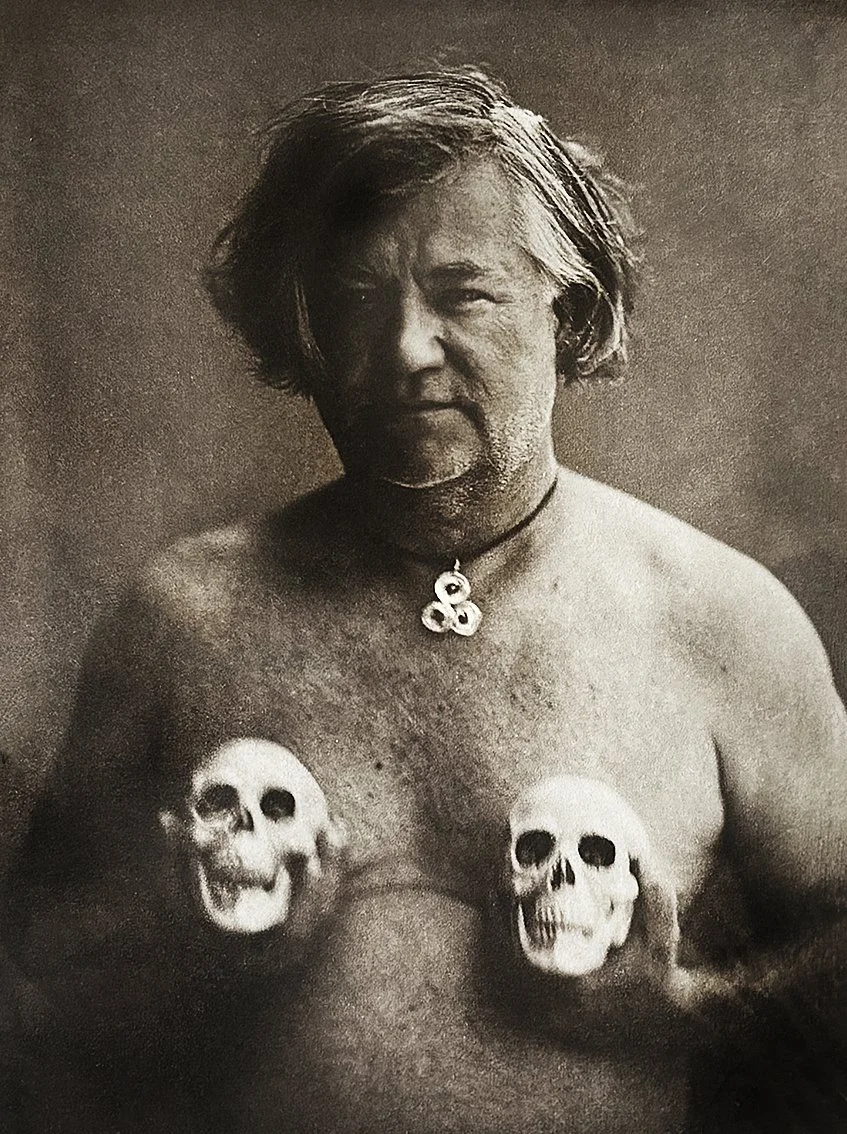
Holding the Unresolvable, 2026. Whole-plate kallitype, gold-toned, printed from wet collodion negative on Revere Platinum paper.
March 28, 2026, Las Cruces, New Mexico — ©Quinn Jacobson
Holding the Unresolvable: Mortality and Form in a Kallitype Portrait
I made this image over the weekend. A friend, a fellow doctoral student, sitting in front of the camera. Bare-chested. Two skulls held against the torso, or resting there, or emerging from it. The preposition doesn’t quite hold, which is part of the point.
What you see is simple. What the image is doing is not.
I've been thinking for years about where images actually come from, not technically but psychologically. What pressures give rise to them. What gets carried into the frame, intended or not. This portrait didn't begin as a concept about mortality. It began as a feeling I've been circling a long time: that death isn't something we encounter occasionally, from a safe distance, but something we are already inside of. Always. The awareness held at arm's length. Functional, buffered, but never fully absent.
Ernest Becker called this the negotiated space of human existence—knowing, but not fully feeling (Becker, 1973). Culture itself, he argued, is largely a structure built to manage what we can't afford to fully face. We live between awareness and denial, close enough to the fact of mortality to be shaped by it and far enough to keep moving. This image tries to make that band visible. Not as argument. As form.
The Body as Pressure
The first decision was compositional: a frontal, centered figure. The kind of formal stability that early photographic portraiture used to convey dignity, legibility, and presence. That stability matters here because it sets up what follows.
Then the disruption.
The skulls aren't beside the body or held out for display. They're not props arranged for symbolic effect. They hover in the uncertain space between inside and outside the torso—not quite organs, not quite objects. The ambiguity is the point. If they were clearly internal, the image would collapse into anatomy. If they were clearly external, it would resolve too quickly into symbol. What I wanted was something less settled, something closer to what Becker describes as the ongoing, never-quite-finished negotiation between awareness and denial. Death not repressed, but not integrated either. Present, but unstable.
What I didn't anticipate until I saw the finished print was the gaze.
He isn't looking at the camera. He's looking past it, slightly—not evasively, but as if what he's attending to exists just outside the frame. That deflection changes the image's register entirely. It doesn't become a confrontation between viewer and subject. It becomes something more like shared witness: two figures—the one in the frame and the one looking at it—both oriented toward something that isn't fully visible. Something that hasn't arrived yet, or hasn't been named.
Trace, Not Symbol
There's always a risk with the skull. It's one of the most overdetermined objects in the history of art. From vanitas painting forward, it carries a ready-made meaning: mortality, transience, and memento mori.
That's not what I'm after. Or at least, not that way.
What I'm trying to do is shift the skull away from symbol and toward trace. The distinction matters. A symbol points toward meaning. A trace is the residue of a process already underway. Not a sign placed onto the surface to indicate death, but something more like the visible remains of a metabolic struggle that hasn't resolved.
In the framework I've been developing around rupture—what I'm calling the Rupture Field—this image sits somewhere between exposure and trace. The rupture has already occurred. Mortality awareness has exceeded the capacity of ordinary denial to contain it. What remains aren't conclusions. They're fragments. Partial forms. Something that couldn't be fully metabolized and so became visible instead.
That's what these skulls feel like to me. Not imposed onto the body from outside but surfaced from within it. The pressure finding form.
The Material Is Part of the Argument
The process here isn't incidental.
Kallitype, especially gold-toned, has a tonal range that is long, compressed, and quiet. Nothing leaps forward. The image doesn't announce itself—it accrues. There's something about the way the shadows pool and the highlights hold that makes the image feel like it already belongs to another time, even as it depicts someone sitting in front of a camera in the present.
And the paper—Revere Platinum—has a weight and tooth that digital processes can't replicate. You're aware that you're holding something. That the image exists on a surface that will age, fade, and eventually fail.
Otto Rank argued that the creative act is bound up with the desire to stabilize experience against loss—to produce something that persists beyond the individual life (Rank, 1932/1989). But I want to be careful here, because I don't think that's exactly what's happening in this print. The kallitype isn't trying to outlast anyone. It's not an immortality project in Rank's sense.
It's something closer to metabolization: making the pressure of mortality awareness visible while it is still being lived. Not preservation. Not transcendence. Processing. The print as a site where the rupture is held, turned over, and examined—without being resolved.
The difference matters. Preservation seals the wound. Metabolization keeps it open long enough to learn something from it.
The Necklace
I didn't plan for the necklace to do what it does. I noticed it after the print was finished, when I was looking at the full image for the first time.
Barthes would call this the punctum—the detail that arrives uninvited and redirects the image's meaning. But what interests me methodologically is something slightly different: not that the necklace pierced me as a viewer, but that it revealed itself to me as a researcher. The practice had generated something the conceptual framework hadn't predicted. The studio was thinking.
What it introduced was a different register entirely: relation, identity, and continuity. Something cultural and personal and chosen, against all the elements in the frame that belong to no one—the anonymous skulls, the bare torso, the ambiguous dark ground. The necklace says: this is a particular person. He has a history. He is located in a world of meaning.
And then everything around it reasserts: he is also mortal.
Rank makes a distinction that I keep returning to here. Religion, he suggests, emerges from collective belief in immortality—the promise that death will be overcome. Art arises from the individual's confrontation with impermanence—the refusal of that promise, or at least the refusal to look away from it (Rank, 1932/1989). This image seems to live between those poles. The necklace carries something like religious weight—continuity, relation, belonging—while everything surrounding it insists on the mortal body.
The body is no longer singular. It's carrying multiple realities at once: biological, relational, symbolic, and mortal. Not in sequence. Simultaneously.
What the Image Knows
I want to say something about methodology, because it matters here and I don't want to leave it implicit.
This image is not an illustration of a theoretical argument. It's not Becker made visual, or Rank translated into form. If it were, the essay would be sufficient and the image redundant. What I'm claiming—and what arts-based research methodology asks us to take seriously—is that the image produces a different kind of knowledge than the writing does. Not the same knowledge in a different register. Something the writing cannot replicate without remainder.
Propositional language can describe the negotiated space between awareness and denial. It can name it, analyze it, and situate it theoretically. What it cannot do is construct one. The kallitype doesn't point toward that space. It builds an instance of it. The viewer who stays with this image long enough, who lets the tonal range accrue rather than scanning for meaning, is briefly inside the condition the writing can only describe from outside.
That's not a claim about aesthetic experience. It's an epistemological one.
Practice-led research proceeds from the assumption that making is a form of inquiry, that the studio generates knowledge the conceptual framework hasn't yet predicted, and that this excess is methodologically significant rather than incidental. The necklace is my clearest evidence. I didn't plan for it to do what it does. I didn't theorize it in advance. It arrived in the finished print as something the process had produced independently of my intentions, and it changed what the image knew. That's the practice thinking. The researcher's job, afterward, is to follow where it went.
What the image knows that this essay doesn't: what it feels like to not be met by the subject's gaze. To stand in front of a figure who is looking past you, toward something outside the frame, and to realize that you are not the recipient of a statement but a fellow witness. The essay can describe that experience. It cannot produce it. The image produces it every time, for anyone willing to look long enough.
That gap, between what the writing can say and what the image can do, is not a limitation of the research. It's the point of it.
Condition, Not Conclusion
What I notice more and more in my own work is that I'm less interested in making statements than in staging conditions. This image doesn't explain anything. It doesn't arrive at a conclusion. It doesn't argue.
It presents a situation: a person, standing there, holding themselves together. With something else present. Not named. Not integrated. Not fully metabolized.
That feels honest to me.
If Becker is right, and I believe he is, then most of life unfolds precisely in that space. Not in full awareness, and not in complete denial. In the narrow band between them, where we can continue to function without being overwhelmed by what we know. The task isn't to resolve that tension. The task is to stay inside it long enough to make something true.
That's what I was trying to do here.
Not to illustrate mortality. Not to comfort anyone, including myself.
But to make the pressure visible. To let it take form. And to see what that form had to say.
References
Barthes, R. (1980). Camera Lucida: Reflections on Photography (R. Howard, Trans.). Hill and Wang.
Becker, E. (1973). The Denial of Death. Free Press.
Rank, O. (1989). Art and Artist: Creative Urge and Personality Development (C. F. Atkinson, Trans.). Agathon Press. (Original work published 1932)