
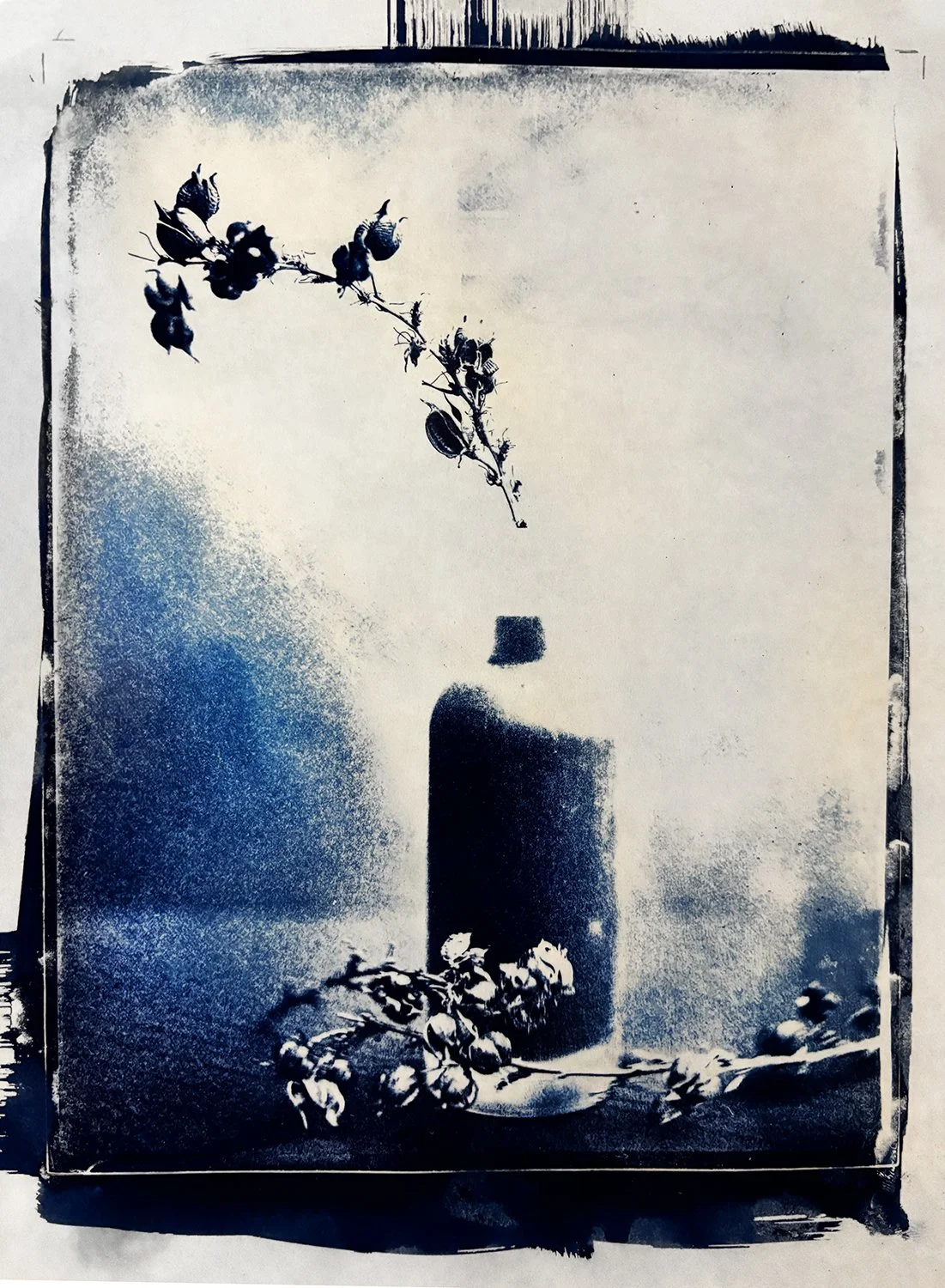
There’s a moment in the darkroom when an image stops behaving like a document and starts behaving like a memory. Not a record of something that happened, but something closer to the feeling of having been there without being able to say exactly when or how or even if it was real. That’s where this print seems to live.
This Red Yucca began as a whole-plate wet collodion negative, already a material that carries its own temporal weight. Collodion doesn’t just record light; it slows it down. It asks for patience, for proximity, for a kind of attentiveness that feels increasingly out of step with the speed of contemporary image-making. But what happened here wasn’t about preservation. It was about disturbance.
In the cyanotype, I let the image come in, and then I partially took it away.
Washing sections of the print back out introduced a kind of instability into the surface. Areas that should have held firm dissolved into something closer to residue. The hydrogen peroxide, used to deepen the blues, didn’t simply “enhance” the shadows in a technical sense. It pushed the image toward a more pronounced polarity, presence and absence sitting closer together, almost uncomfortably so. What remains feels less like a fixed object and more like something that has survived a process of erosion.
And that’s where the feeling of déjà vu enters.
Not as nostalgia. Not as sentimentality. But as a kind of cognitive dislocation. The image feels familiar, but not locatable. It suggests that it belongs to a past but refuses to specify which one. The plant itself—red yucca, rooted in the desert, resilient, persistent—becomes secondary to the condition of its appearance. It’s no longer just botanical. It’s been pulled into a different register, where form begins to carry the weight of time.
There’s something important here about memory.
Memory, at least as we tend to experience it, isn’t archival. It doesn’t preserve things cleanly. It degrades, edits, overlays, and distorts. It holds onto fragments and lets other parts go without explanation. In that sense, this print feels more accurate to the structure of memory than a sharply rendered, fully intact image ever could. The losses aren’t flaws. They’re constitutive.
I find myself thinking about how much of our visual culture is oriented toward clarity, toward resolution, toward the elimination of ambiguity. High definition, perfect tonal range, immaculate surfaces. But lived experience doesn’t operate that way. The things that stay with us most persistently are often the least resolved. They hover. They repeat. They resist closure.
This print leans into that resistance.
It doesn’t present the yucca as an object to be known. It offers it as something half-recalled, half-erased, suspended between emergence and disappearance. The edges bleed. The ground feels unstable. The image seems to be both arriving and leaving at the same time.
In a way, it’s less about the plant than about the conditions under which anything comes to be seen, remembered, or lost.
And that feels close to the larger thread I keep returning to in the work: what happens when an image is allowed to carry not just form but also the pressure of time, decay, or partial disappearance? What kind of meaning becomes possible when we stop trying to stabilize the image and instead let it remain in that fragile, shifting state?
I don’t think this is about making something “beautiful” in any conventional sense. It’s about making something that feels true to the way experience actually moves through us—uneven, incomplete, and, at times, quietly haunting.
This one lingers. What do you think?