
Rupture Field Theory: Before I Had the Language - Introducing Episode 11
There are moments in life that don’t make sense when they happen.
They don’t arrive as ideas. They don’t announce themselves as important. They pass quietly, almost unnoticed, but something in them stays. Not exactly as memory, but as pressure. An imprint that doesn’t resolve.
Episode 11 of The Creative Mind & Mortality Podcast begins in that space.
I go back to two experiences that stayed with me long before I had the language to understand them. One from childhood, walking through a low-income apartment complex on Madison Avenue in Ogden, Utah. Years later, standing at the Sand Creek Massacre site in Colorado.
At the time, they felt unrelated. But over time, a pattern started to emerge.
That pattern is what I now call Rupture Field Theory (RFT).
Rupture, as I’m using it, isn’t always dramatic. More often, it’s subtle. Something doesn’t fit. Something exceeds your ability to make sense of it. And instead of resolving, it remains active beneath the surface.
This episode is an attempt to articulate that structure—not as abstract theory, but as something lived and worked through in the studio. A movement from rupture into form, from contact into expression, without rushing too quickly toward closure.
Most of the time, we stabilize as fast as we can. We translate experience into meaning and move on. But creative practice offers another possibility: to hold the instability long enough for something new to emerge.
That’s the ground this episode is built on.
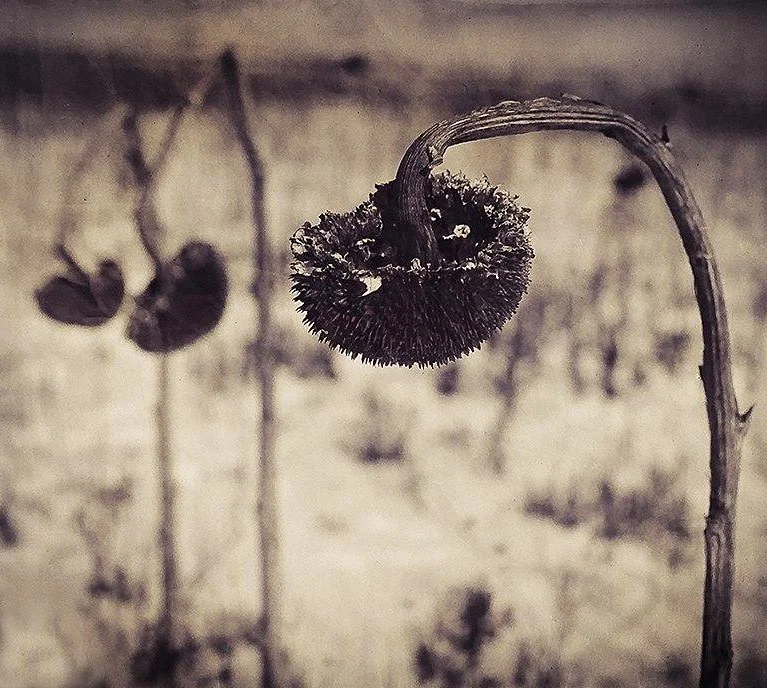
Three dead sunflowers at Sand Creek, Colorado.