
• blog
  • in the shadow of sun mountain
  • buy my books
  • photographs
  • paintings
  • bio
  • cv
  • contact
  • search
Menu

Studio Q Photography

Exploring Human Behavior and Death Anxiety Through Art
  • blog
  • in the shadow of sun mountain
  • buy my books
  • photographs
  • paintings
  • bio
  • cv
  • contact
  • search
×

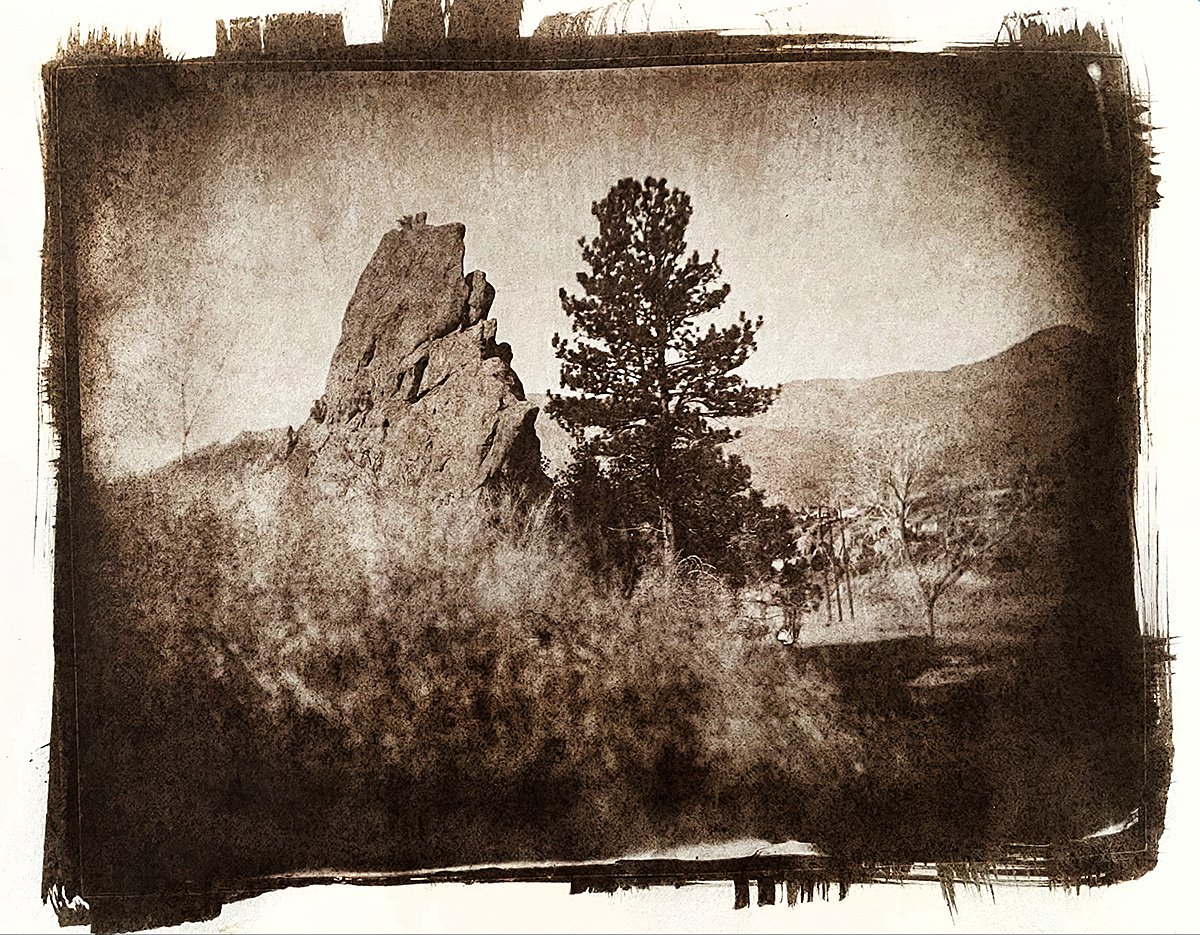
Garden of the Gods, Colorado Springs, Colorado, U.S.A. Whole Plate Argyrotype from a collodion dry plate negative printed on 16 lb drafting vellum paper— In the Shadow of Sun Mountain. 2022

A Reading: Introduction In the Shadow of Sun Mountain

Quinn Jacobson December 15, 2025

Introduction

In the Shadow of Sun Mountain (2020–2024)

I lived for years on twelve acres in the mountains of central Colorado, on land where the (Tabeguache) Ute had lived, traveled, gathered medicine, and buried their dead for thousands of years. That fact was not abstract to me. It was present every day. In the plants that grew around the house. In the way the light moved across the ground. In the silence that settled at dusk. The land didn’t feel empty. It felt inhabited by memory.

Sun Mountain rose nearby, not dramatically, not as a monument, but as a constant presence. Its shadow crossed the land in long, slow arcs. I began to understand that shadow less as an absence than as a reminder. Something persisted there, something unresolved. The land wasn’t haunted in the theatrical sense. It was honest. It held the residue of belief, fear, violence, endurance, and the stories that try to make those things bearable.

The plants themselves became teachers. This work is grounded in ethnobotany and spiritual ecology, not as metaphor, but as epistemology. The (Tabeguache) Ute understood land through use, relationship, and attention: which plants heal, which harm, which alter perception, which open ritual space, which return the body to the ground. Medicine was not separate from cosmology. Knowledge was embedded in practice, repetition, and care. Working among these plants, photographing them, painting them, and incorporating them into mixed media was a way of entering that lineage of attention, however imperfectly. The work does not claim that knowledge as mine, but it does acknowledge that plants carry memory and instruction, and that ways of knowing grounded in land and body predate and quietly challenge the abstractions that made conquest and erasure possible.

This work began with a question I couldn’t shake: why do human beings need an enemy to feel secure?
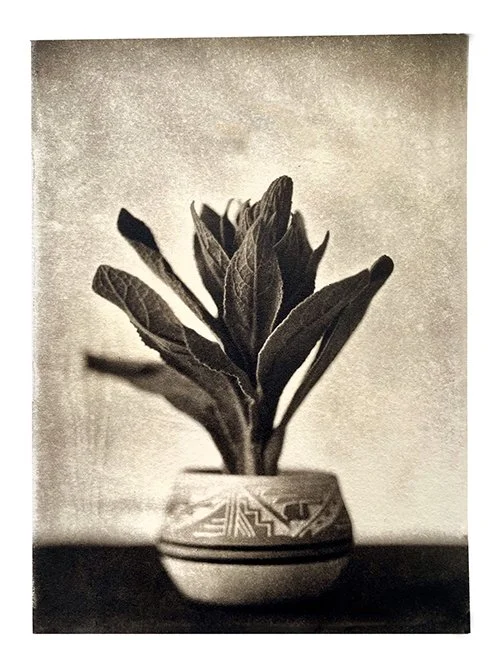
The Great Mullein Plant—Palladiotype from a wet collodion negative. 2022

I’d spent years photographing sites where violence had taken place, standing in spaces where something irreparable had occurred and sensing that the story told about those events was never the whole story. Living on that land intensified the question. The history of the (Tabeguache) Ute was not distant. It was botanical. Ecological. Embedded in place. Their knowledge of medicinal plants, spiritual botany, seasonal movement, and relationship to land was not a footnote to history. It was a worldview that had been violently interrupted.

The longer I lived there, the clearer it became that the question wasn’t only historical. It was psychological. What allows people to draw a line between “us” and “them” with such confidence? Why does that line harden so quickly? And what does our buried awareness of being temporary have to do with it?

My studio practice kept circling the same terrain. I worked with wet-collodion photography, color reversal prints, painting, and mixed media not out of nostalgia, but because these materials resist control. Collodion is unstable. A glass plate can appear solid and fail without warning. Silver remembers everything. Chemistry responds to temperature, breath, humidity, and time. You don’t dominate the process; you negotiate with it.

That instability mattered. It mirrored something I recognized in the human mind when it tries to manage fear, especially fear it refuses to name. What began as an old photographic process became a form of inquiry. The fractures in the plates, the fogging, the lifting emulsion, the breakage, they echoed the fractures I was seeing in our collective imagination.

Ernest Becker helped sharpen that connection. He argued that culture itself is a defense system built around the fact that we will die (Becker, 1973). We build worldviews to seem steady. We cling to identity because it promises continuity. And when those stories feel threatened, we look outward for someone to blame.

Othering is not an accident. It’s a psychological survival strategy. A way to redirect fear so we don’t have to feel it directly.

In the Shadow of Sun Mountain grew from that realization. What began as an artistic investigation rooted in land, plants, and material practice expanded into a broader inquiry into how death anxiety shapes behavior, morality, and the human capacity for cruelty. Starting a PhD in my sixties didn’t create this path. It helped me name it. Becker, Rank, and the existentialists gave language to what I had been sensing intuitively for decades: that creativity is not separate from mortality, and that artists often work at the fault line where denial begins to crack.

The chapters that follow trace how fear becomes ideology. How ideology becomes violence. How violence becomes history. And how history becomes a story we repeat so we don’t have to confront what made the violence possible in the first place.

This isn’t a moral lesson. It isn’t a condemnation delivered from a safe distance. It’s an examination of the ordinary human mind and what it does with the knowledge that life is short, unpredictable, and finite. It’s about the psychological architecture we inherit, the beliefs we defend, and the places where those beliefs fail.

Sun Mountain is both literal ground and conceptual ground. The plants, the landscapes, the objects, the materials, and the photographic processes are not illustrations of theory. They are part of the thinking itself. The shadow it casts represents what we push away: the parts of ourselves we disown, project, or punish in others.

If there is any hope here, it’s a quiet one. That facing impermanence might soften the need to harden ourselves against difference. Artists understand that tension intimately. We work every day between creation and loss. We accept what breaks. We learn from what cannot be repaired.

This book is an invitation into that space. It begins with a question and refuses to resolve it too quickly. It follows it through land, material, history, psychology, and lived experience, toward a clearer understanding of what we do in the presence of death, and what might change if we learned to see ourselves more honestly.

References
Becker, E. (1973). The denial of death. Free Press.
In Art & Theory, Art History, Ernest Becker, Othering, Palladiotype, PhD, Psychology and Art, Shadow of Sun Mountain Tags Audio Reading, In the Shadow of Sun Mountain, Wet Collodion, collodion dry plate
6 Comments

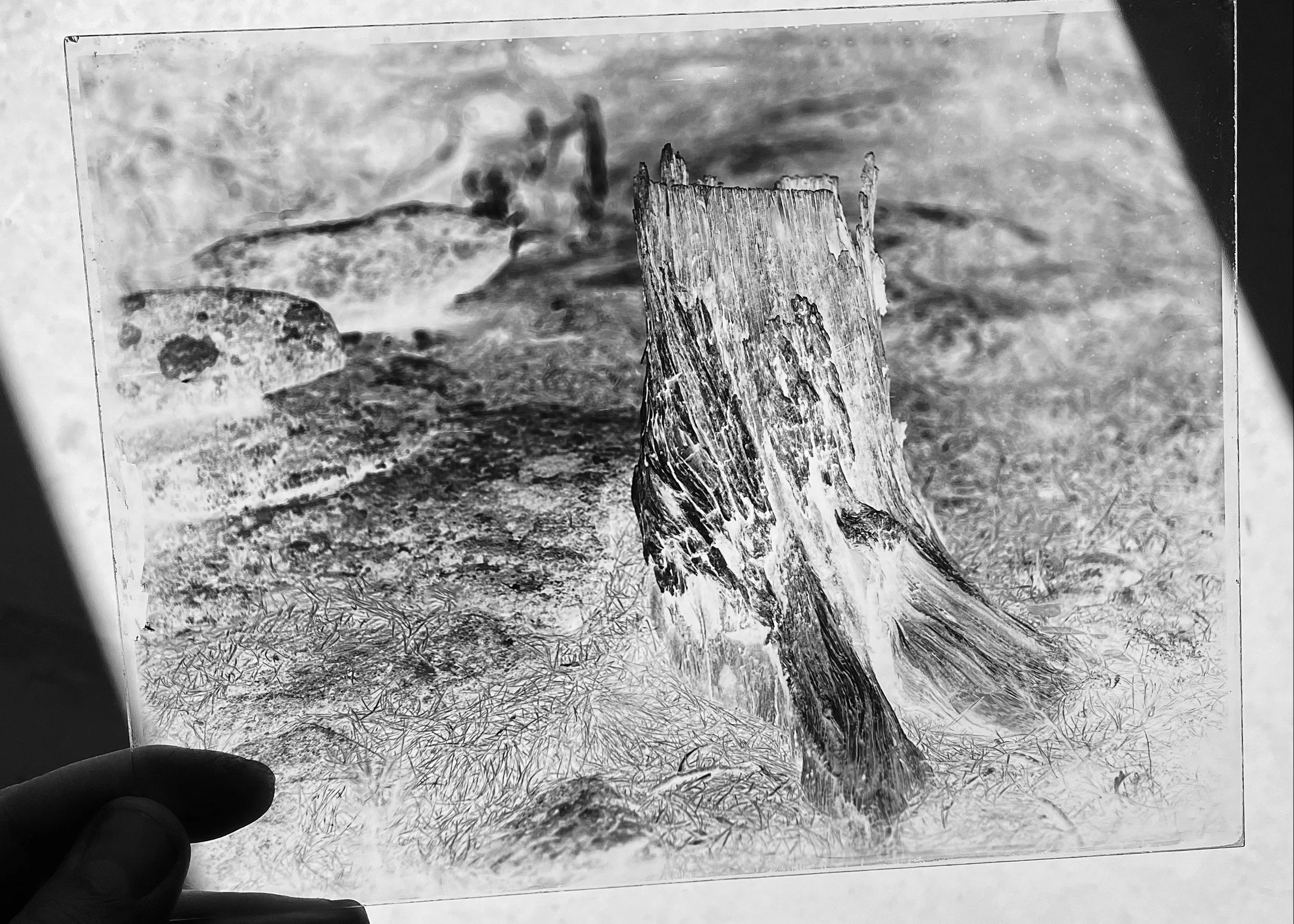
A whole plate wet collodion negative held against a light table to inspect for density.

Photography Was Born from Death Anxiety

Quinn Jacobson July 17, 2025

In Flashes of Brilliance, Anika Burgess maps the birth of photography across the 19th century—a strange, luminous era where light first learned how to remember. But underneath the surface of these technical milestones is something deeper: the same existential terror Ernest Becker exposed in The Denial of Death. Photography, from the beginning, was a defense against our disappearance.

The daguerreotype, introduced by Louis Daguerre in 1839, wasn’t just a new technology—it was a cultural event. Suddenly, faces could outlive their flesh. Sitting for a portrait was serious business. You had to be still for minutes, sometimes longer, and the result was a haunted likeness, sealed in silver and glass. It was more than documentation—it was a bid for immortality. Becker might say it was a way to manage death anxiety by creating a symbolic self that could outlast the body.

Before Daguerre, Nicéphore Niépce spent years coaxing ghostly images from bitumen and sunlight. His exposures took days. His results were vague, barely-there impressions—like memory itself. Still, he was trying to do what we all do: leave a trace.

The real turning point came with Frederick Scott Archer’s wet collodion process in 1851. It was faster, sharper, and allowed for duplication. Suddenly, your image could exist in multiple places at once. You didn’t just resist death—you replicated yourself. The carte de visite, popularized shortly after, took this further. You could hand out tiny portraits like tokens of your existence, proof that you’d been here, that you mattered.

And it wasn’t just about faces. Flash powder brought violent light into dark rooms, revealing what the eye couldn’t see. Solar enlargers, early color processes, even underwater photography—all pushed the boundaries of time and space. Burgess notes that many photographers were driven by obsession, risk, even self-destruction. They were intoxicated by the possibility of preservation. Isn’t that what Becker called the “immortality project”? Whether through fame, art, religion, or science—we’re always trying to escape the void.

Photography, in its early years, was dangerous (read Bill Jay’s “Dangers in the Dark”). Mercury, ether, explosive chemicals. But what else would we expect from a practice rooted in anxiety? It was an alchemy fueled by fear and longing. It gave people the illusion of permanence, even as everything around them was vanishing.

Burgess’s book isn’t just a history—it’s a reminder that every photograph is a symptom of our condition. It’s a way to say: I was here. I saw. I mattered.

As someone who works with 19th-century processes today, I feel that tension every time I pour collodion or pull a plate from the fixer. The medium has always been about death. About holding onto something just long enough to believe we’re not already disappearing.

And maybe that’s the brilliance Burgess is talking about. Not just in the chemical spark of silver meeting light—but in the way humans, terrified of their own impermanence, invented a machine to freeze time.

In Art & Theory, Collodion Negatives, Death Anxiety, Denial of Death, Ernest Becker Tags photography, Wet Collodion, Collodion Negative, death anxiety
Comment

“The Birth of Man (La Naissance de l' Homme),” 8” x 10” acrylic, charcoal, and pastels.

The Birth of Man (La Naissance de l' Homme)

Quinn Jacobson January 11, 2024

Several years ago, a friend invited me to Brussels, Belgium. He wanted me to meet some of the local photography group and make a couple of wet collodion images for them. I obliged. Brussel’s is a wonderful city. We enjoyed our time there. In fact, we went back a couple of times after that, too.

“The Birth of Man,” Whole Plate Ambrotype (Wet Collodion), May Claerhout (1939–2016), Brussels, Belgium 2009

I ended up doing a group portrait (or maybe a few), and I also made a plate of this wonderful piece of work by May Claerhout (1939–2016). She was a Belgian artist and made these amazing sculptures. This one sits in the courtyard of the Belgium National Archives; it’s called “The Birth of Man (La Naissance de l'Homme).

When I see this image and think about its narrative, I can’t help but think about Becker’s writing on “immortality projects.” In his 1974 Pulitzer Prize-winning book, The Denial of Death, he argues that “the basic motivation for human behavior is our biological need to control our basic anxiety, to deny the terror of death.” (Keen 1973). Becker suggested that a significant function of culture is to provide successful ways to engage in death denial.

Becker describes the human pursuit of “immortality projects” (or causa sui), in which we create or become part of something that we feel will outlast our time on earth. In doing so, we feel that we become heroic and part of something eternal that will never die, compared to the physical body that will eventually die. This gives human beings the belief that our lives have meaning, purpose, and significance in the grand scheme of things.

This is true for any piece of artwork, including books, buildings (especially those with names on them), building great wealth, or even having children. This is the human desire for immortality, literally or symbolically. It’s a very strong urge, and whether we admit it or not, we all participate. What purpose does it serve? As Becker said, it gives us meaning and purpose. When we feel that we have purpose and meaning in our lives, we feel psychologically secure; this quells death anxiety or existential dread. We need this to function every day.

Claerhout’s piece speaks to death anxiety in so many ways for me. The title alone is revealing. What does “The Birth of Man” imply? For me, it implies that the death of man is also waiting, silent, and hidden. Buried deep in the psychological bushes of our minds. There are five figures represented here—maybe symbolizing earth, air, fire, water, and spirit? I find it interesting that the top figure is stretching and reaching toward the heavens. This also symbolizes a type of immortality. It says that we’re not really going to die; we live on after this physical existence—literal immortality.

That belief has always been a great anxiety buffer—religion—but it comes with a lot of baggage and a heavy price (look at history and the role religion has played in death and suffering). In the 19th century, Nietzsche said, “God is dead.” And he goes on to say, “God remains dead. And we have killed him.“ This is often misquoted or misunderstood. What he meant was that humans had relied on religious beliefs for thousands or tens of thousands of years to quell death anxiety, and now technology and science have replaced them. Some say those are our new gods, and we rely on them as our ancestors relied on the religious gods. We’re always looking for cultural constructs to lean on to buffer our existential dread.

Tags acrylic painting, the birth of man, may claerhout, belgium, brussels, The Birth of Man, May Claerhout, Brussels, Belgium, Wet Collodion, Tintype
Comment

Search Posts

Archive Block
This is example content. Double-click here and select a page to create an index of your own content. Learn more
Post Archive
  • Photography
 

Featured Posts

Featured
Dec 15, 2025
A Reading: Introduction In the Shadow of Sun Mountain
Dec 15, 2025
Dec 15, 2025
Dec 10, 2025
Where My Work Is Heading
Dec 10, 2025
Dec 10, 2025
Nov 30, 2025
Notes From the Studio: Staring at the Sun
Nov 30, 2025
Nov 30, 2025
Nov 20, 2025
A Salt Print From Another Life
Nov 20, 2025
Nov 20, 2025
Nov 20, 2025
A Coyote in the Desert, and What It Taught Me Today
Nov 20, 2025
Nov 20, 2025
Nov 13, 2025
Living Truthfully Inside Impermanence
Nov 13, 2025
Nov 13, 2025
Nov 5, 2025
Between Presence and Absence
Nov 5, 2025
Nov 5, 2025
Nov 3, 2025
The Coyote That Died on My Land
Nov 3, 2025
Nov 3, 2025
Nov 1, 2025
Old Glass Insulators — Whole Plate, November 1, 2025
Nov 1, 2025
Nov 1, 2025
Oct 31, 2025
The Alchemy of Attention
Oct 31, 2025
Oct 31, 2025