• blog
  • in the shadow of sun mountain
  • buy my books
  • photographs
  • paintings
  • bio
  • cv
  • contact
  • search
Menu

Studio Q Photography

Exploring Human Behavior and Death Anxiety Through Art
  • blog
  • in the shadow of sun mountain
  • buy my books
  • photographs
  • paintings
  • bio
  • cv
  • contact
  • search
×

“Cactus People” May 14, 2023, 10” x 10” (25,4 x 25.4 cm) (Made in camera, no negative) RA-4 Reversal Color Direct Print I used my Derogy (1864) Petzval lens for this image. I’ve made hundreds of portraits with this lens. A friend gave it to me on a visit to Glasgow, Scotland, in 2009. It's been one of my favorite lenses for working with historic photographic processes—very painterly and full of memories and experiences, it’s the perfect optic for this work. I called this image “Cactus People” because I see two “heads” fighting against the backdrop of a fire. It appears one has the advantage; maybe a blow or a strike took the other one down.

The Influence of Color

Quinn Jacobson May 15, 2023
“in·flu·ence (noun) the capacity to have an effect on the character, development, or behavior of someone or something, or the effect itself.”
— Oxford Dictionary

I love paintings. I always have. I’ve said many times that I’m a "frustrated painter." I’ve always said that one day I'd learn to paint. That may still happen. For now, I’m exploring the emotional influence that color prints bring to my photographic work (In the Shadow of Sun Mountain). The "vibration" of color, to use Marc Chagall's term, influences and moves me more as I produce more prints. I see it and, moreover, I feel it.

As I work through my ideas, I find what I’m attracted to is the "life vibrations," or the depth of life, that the colors bring to the subject matter. In other words, there is a poetry or feeling that they give where the monochrome fails. As an artist, you’re always searching for the right tool to use to make your work successful. The color prints are the correct tool for this work. I’m convinced.

“Cactus People With Water Vessel” May 14, 2023, 10” x 10” (25,4 x 25.4 cm) (Made in camera, no negative) RA-4 Reversal Color Direct Print I used my Derogy (1864) Petzval lens for this image. The beautiful fall-off, or depth of field, is like a half-remembered dream.

Working in the RA-4 reversal process has given me a lot of new ways to approach making photographs, too. The paper is quite “fast” (ISO)—I rate it at ISO 6 or 8 with the filter pack I’m using. That means I can work at times of the day and early evening that I was never able to with wet or dry collodion, let alone paper negatives. Also, I can “stop down” my lenses to gain depth of field and still manage to make exposures in seconds, not minutes. This opens an entirely new world for me. That’s very exciting, and I’m looking forward to the summer here and making this work come alive!

I see how this project has evolved over the two years I’ve been working on it. And I hope it will continue to evolve. I stay open and aware of that. For me, it has two layers: the personal exploration of our denial of death and terror management theory. This is the foundation for telling the story of the Tabeguache Ute, what happened to them here, and, more importantly, why it happened.

The second layer is more abstract, concerning poetry, beauty, and the life-affirming examination of mortality. For me, this is the perfect narrative. I have “skin in the game," given my preoccupation with marginal communities and the psychology that drives human behavior. And I have a love of the mystery of life and how beautiful it can be. My objectives have nothing to do with “self-help” or offering to analyze people’s lives through these psychological theories. It’s more about sharing my self-awareness and what that means for me. Also, there is a big part of it that is based on how these theories have driven human behavior and historical events. In the end, it’s both historical and personal, terrifying and beautiful. I feel like the color component helps me translate these kinds of concepts better than monochrome work. It elevates both the work and the concepts.

“Awe, humility and gratitude effectively mitigate death anxiety.”
— Sheldon Solomon

Color is now a primary tool for me to communicate the nuances and beauty of the place where I live. Through the color, I can talk about the history and events that took place here with a subtlety that I didn’t possess before. I know now that I’ll start (and have already started) incorporating visual ideas that represent the concepts of consciousness, death anxiety, awe, humility, and gratitude. I want to show how facing the existential anxieties that we all have can be resolved (or at least managed) through deeply reflecting on yourself, having true self-awareness, and being authentic.

Life is both beautiful and terrifying—that’s the paradox we face. Choosing to be death-forward (in the words of Heidegger) and working toward that horizon of opportunity to have a “turning” in your life is the goal. We will never be free from death anxiety. It will always be there. We can, however, learn to be in awe, be humble (not self-deprecating but understanding your position in the universe), and most of all, be grateful and have gratitude for life. It will end, no doubt, but we can strive toward being thoughtful, self-aware, open, and honest every day. Like Socrates said, examine yourself, be honest, and move toward the good.

“The bottom line is this: Terror Management Theory may seem like a dark and depressing topic, but it can actually shed a lot of light on the ways that we as humans strive to find meaning and purpose in a world that can sometimes seem bleak and meaningless. By understanding the ways that we cope with our mortality, we can begin to develop more positive and life-affirming strategies for dealing with the existential terror that is an inevitable part of the human experience.”
— Mark Manson

“Cactus People With Water Vessel” May 14, 2023, 10” x 10” (25,4 x 25.4 cm) (Made in camera, no negative) RA-4 Reversal Color Direct Print I used my Derogy (1864) Petzval lens for this image. I’ve made hundreds of portraits with this lens. I can control color with exposure—the length of exposure will warm or cool the image color. Absolutely amazing!

In Art & Theory, Books, Color Prints, Death Anxiety, Denial of Death, Ernest Becker, Glasgow, Martin Heidegger, New Book 2023, Nietzsche, Philosophy, Psychology, RA-4 Reversal Positive, Scotland, Shadow of Sun Mountain, Sheldon Solomon, Tabeguache Ute, Terror Management Theory Tags color, direct-color positive prints, Martin Heidegger, awe, humility, gratitude, RA-4
2 Comments

“Dead Daisies: A Firework of Consciousness,” May 8, 2023, RA-4 Reversal Color Direct Print, 10” x 10” (25,4 x 25,4 cm). This image is a metaphor for consciousness for me—a visual of how we “expand” our awareness, a “firework” of consciousness. Death is such a mystery. That’s why we fear it so much—we don’t know what happens, if anything, after we die.

We do know that we have what the philosophers call “existential guilt” for making decisions in our lives, good or bad, or not making them. Existential guilt is a feeling of guilt or remorse that arises from a sense of responsibility for one's own existence and the choices one has made in life. It is a form of guilt that is related to the realization that one's actions, or inaction, have contributed to the course of one's life and the lives of those around them.

Existential guilt is often associated with the philosophical concept of existentialism, which emphasizes individual freedom and choice, and the responsibility that comes with it. The feeling of existential guilt can arise when an individual realizes that their choices have led them down a path that is not aligned with their values or when they feel that they have failed to live up to their own expectations.

Existential guilt can also arise from a sense of guilt about one's own mortality or the inevitability of death. This can be a difficult emotion to deal with, as it can lead to feelings of anxiety, depression, and a sense of futility. However, by acknowledging and accepting these feelings, individuals can work towards finding meaning and purpose in their lives.

Culturally Constructed Meat Puppets and Martin Heidegger

Quinn Jacobson May 11, 2023

Reading through The Worm at the Core brings awareness to so many other ideas and extensions of these theories. I’ve been getting into Martin Heidegger and his ideas lately. His book (a set of lectures), “Being and Time” is available on archive.org. Forewarning: It’s a difficult book to read. It’s dense, and I don’t understand a lot of it. It was originally written in German, and the translator claimed that it was very difficult to translate into English (some say it’s impossible to translate). He was an extraordinary thinker—way beyond my capabilities to understand. There are some “nuggets” in the book. One of them, pointed out by Sheldon Solomon, is the quote in this essay. That’s what I’m most intrigued by.

Having lived in Germany and having a basic understanding of the language, the word “angst” is used a lot in his writing. I’ve always understood the word to mean “fear.” Most translate it to “anxiety.” What it really means is a feeling of uneasiness, or "dis-ease," or a feeling of not “being at home” (not in the literal sense of home, but psychologically). Heidegger gives a clear and compelling solution to overcoming, or at least coming to terms with, death and death anxiety. Kierkegaard offered a solution of taking a “leap into faith,” and Heidegger offers the same idea, but instead of faith, he says, “take a leap into life.” You can read the deconstruction of his philosophy below.

Another thing that I’ve been giving thought to is a “flowchart” of terror management theory. Breaking it down into a simple, line-by-line evolution of what happens to human beings in life as it applies to coping with the knowledge of death:

  • You were born.

  • You cry, scream, and shake; miraculously, a “deity figure(s)" (parents or caregivers) appears and your diaper is changed, you’re fed, or you're cuddled. Life is good.

  • You grow older and lean on your parents or caregivers for psychological security as well as all of your Maslow needs (shelter, food, warmth, etc.).

  • You grow through childhood and the teenage years, learning how to bolster your self-esteem. Your parents or caregivers provide the framework and reward for this. For example, when you learn to use the toilet, “Good boy or girl!” You earn top grades on your schoolwork. “Great job!” You go to the school prom, and everyone says, “You look so pretty or handsome!” This bolsters your self-esteem; you feel significant and have meaning in your life. Death anxiety is held at bay.

  • You learn how to respect and honor your country or tribe (Americans put their hands over their hearts and say “the pledge of allegiance”) and the important symbols from your culture: a flag, a cross, a star, a uniform, etc.

  • You attend religious services with your parents and learn how to be a “good person” and how to achieve immortality through a religion; this provides psychological security and buffers death anxiety. You know that you will never really die! Life is meaningful, and I have a purpose; my religion says so!

  • You separate from your parents or caregivers as a young adult. Now, you look to your culture for the same psychological security that your parents or caregivers provided.

  • You quickly learn what your culture rewards and what it doesn’t. This is how your cultural worldview is established and maintained. For example, you might belong to a particular religion you strongly believe in or a political group you adamantly embrace. You might get a promotion at your job, be recognized as “employee of the month,” get a degree from higher education, earn a lot of money, drive a fancy car, live in a big house, get a lot of “likes” on social media, etc. These all provide self-esteem for you. Self-esteem buffers death anxiety. It’s kept repressed and buried deep in your unconscious. In fact, some of you reading this will proclaim, “What are you talking about? This doesn’t apply to me; I don’t think about death!” Exactly. See how well it works? When you’re ensconced in your cultural worldview, it will keep thoughts of death repressed, at least for the most part.

  • You go through life wrapped in the illusions that your culture provides—religion, community, politics, relationships, etc. They give you a feeling of significance in a meaningful world (psychological security). This keeps existential anxiety at bay, for the most part.

  • You are, at this point, a culturally constructed meat puppet.

  • If you are one of the unlucky ones or live in a culture that either doesn’t provide ways for you to bolster your self-esteem or that offers ways that are unattainable for the average person, i.e., not everyone can be a movie star, a rock star, a professional athlete, or the president of the United States, this can, and often does, extend to physical appearance as well. If you’re not thin (especially women) and stay young forever, the culture can be harsh and not only prevent you from getting self-esteem, it will point out your faults and shortcomings: you’re fat, you’re old, you're the wrong color, you have wrinkly skin and gray hair, etc.

  • When a person cannot find ways to bolster their self-esteem, they will often turn to drugs, alcohol, eating, shopping, narcissistic behavior, social media, and different kinds of risky behaviors. The 19th-century philosopher Soren Kierkegaard called this “tranquilizing with the trivial.” One of the reasons the United States has such a high rate of drug abuse, depression, anxiety, and deaths of despair, including those that die by suicide, is because the culture sets standards for attaining self-esteem that are not attainable for the average American.

  • According to Martin Heidegger, if one ceases to numb oneself to the knowledge of one's own mortality, known as "flight from death," and instead undergoes what he termed a "turning," they may discover a newfound sense of ease with death anxiety and the inherent truths of the human condition. This turning leads to a greater appreciation for life's simple yet profound pleasures, such as recognizing the beauty in virtuous individuals, the finite nature of humanity, the majesty of nature, or even something as seemingly mundane as a refreshing breeze on a sweltering day.

  • Both Frederick Nietzsche and Ernest Becker discussed the concept of the "authentic man" in their respective philosophical works.

    Nietzsche believed that the authentic man was one who lived according to his own values and ideals, rather than those imposed upon him by society or tradition. For Nietzsche, the authentic man was a "free spirit," unencumbered by conventional morality or religious dogma. He argued that the authentic man was capable of creating his own values and living a fulfilling life, rather than being constrained by the values of others.

    Becker, on the other hand, believed that the authentic man was one who had come to terms with his own mortality and the inevitability of death. He argued that in order to live a meaningful life, one must confront the reality of death and the limitations of human existence. For Becker, the authentic man was one who had overcome the fear of death and embraced life fully, without illusions or delusions.

    In both cases, the authentic man is someone who is true to himself and lives a life that is genuinely his own. Nietzsche emphasizes the importance of individuality and creativity in this process, while Becker emphasizes the importance of confronting one's mortality and accepting the limitations of human existence. This is the antithesis of a culturally constructed meat puppet.

Culturally Constructed Meat Puppet

The Terror Management Theory (TMT), which is based on Becker's ideas, suggests that individuals cope with the inevitability of death by developing their self-esteem and identifying with their cultural group. This allows them to feel significant and have a sense of purpose and meaning in their lives.

However, there is a risk associated with this approach, as individuals may become "culturally constructed meat puppets" who are entirely dependent on their roles and conform to cultural standards for their sense of self-worth.

Becker's theory also explains why people tend to fear and dislike those who hold different beliefs or belong to different groups. When reminded of their mortality, people often become more strongly identified with their own groups and view outsiders as the embodiment of evil. This can result in animosity and even violence toward those who are different.

The idea of a “culturally constructed meat puppet” is meant to highlight the tension between our biological nature and our cultural aspirations. On the one hand, we are flesh-and-blood creatures that are subject to the laws of nature. On the other hand, we are aware that we need to create meaning and purpose through our engagement with our culture.

Are you a culturally constructed meat puppet? Humans are like hamsters on a wheel, spinning around and around and going nowhere—or like Sisyphus pushing the rock up the mountain only to have it roll back down over and over again. We do these things every day to distract ourselves from the knowledge of death. Beware of insatiable desires—money and stuff.

Martin Heidegger

Martin Heidegger (1889–1976) was a German philosopher who is widely regarded as one of the most important and influential philosophers of the 20th century. He is known for his highly original and complex philosophy, which deals with a wide range of topics including ontology (the study of being), phenomenology, hermeneutics (the study of interpretation), and existentialism.

Heidegger's most famous work is Being and Time, published in 1927, which is widely regarded as one of the most important philosophical works of the 20th century. In this book, Heidegger explores the nature of human existence and the relationship between being and time. He argues that human beings are fundamentally "thrown" into the world, meaning that we find ourselves in a particular time and place, and we must make sense of this situation through our own existence.

Heidegger's philosophy is highly influenced by his interest in ancient Greek philosophy as well as his experiences living in Germany during the 20th century. His political views, which included membership in the Nazi party in the early 1930s, have been the subject of controversy and criticism, but his philosophical ideas continue to be studied and debated by scholars and philosophers around the world.

“Turning away from a flight from death, you see a horizon of opportunity that puts you in a state of anticipatory resoluteness with solicitous regard for others that makes your life seem like an adventure perfused with unshakeable joy.”
— Martin Heidegger, Being and Time (1927)

This quote is a reflection of Martin Heidegger's philosophy, which places great emphasis on the concept of "being toward death." For Heidegger, death is not simply an event that happens to us at some point in the future but rather an essential aspect of our being. In other words, our mortality is not something we can escape or ignore; it is a fundamental part of who we are.

The quote suggests that if one confronts their mortality and does not try to flee from it, they may see a horizon of opportunities that can give their life a sense of purpose and direction. By embracing the inevitability of death, one can live with a sense of "anticipatory resoluteness," meaning that they are ready and willing to face whatever challenges come their way.

Additionally, Heidegger suggests that this attitude should be accompanied by "solicitous regard for others," meaning that we should also be concerned with the well-being of those around us. By living with this kind of awareness and consideration for others, one's life can become an "adventure perfused with unshakeable joy," filled with meaning and purpose.

Heidegger's quote highlights the importance of confronting our mortality and living with a sense of purpose and concern for others. It's a beautiful idea that everyone should work toward. The first step is to understand the true nature of your condition, without doing that, nothing changes.


In Art & Theory, Books, Color Prints, Consciousness, Death Anxiety, Denial of Death, Ernest Becker, Maslow, Memento Mori, Philosophy, Psychology, RA-4 Reversal Positive, Sun Mountain, Tabeguache Ute, Terror Management Theory, Worm at the Core, Martin Heidegger Tags Culturally Constructed Puppet, Martin Heidegger, The Worm at the Core, Philosophy, RA-4, ra-4 reversal prints
Comment

“Dead Yarrow,” May 8, 2023, 10” x 10” (23,4 x 23,4 cm) RA-4 Reversal Direct Color Print

This dead yarrow reminds me of the dreaded “mushroom cloud” from a nuclear explosion. I see these prints come up in the tray and that’s the first thing that comes to mind. Can anyone say, “death thought accessibility”? ;-)

Death Near and Far

Quinn Jacobson May 9, 2023

"The Worm at the Core: On the Role of Death in Life"

Chapter 9: Death Near and Far

  • Death: Out of Sight, Out of Mind?

  • The Power of the Unconscious

  • Death Can Be Hazardous to Your Health

This is a reading of the book "The Worm at the Core: On the Role of Death in Life" by Sheldon Solomon, Jeff Greenberg, and Tom Pyszczynski. Quinn reads a chapter every week and then has a discussion about it. This book, along with "The Denial of Death" by Ernest Becker, is the basis for Quinn's (photographic) book, "In the Shadow of Sun Mountain: The Psychology of Othering and the Genesis of Evil."

When: Saturday, May 13, 2023, at 1000 MST

Where: My YouTube channel and Stream Yard

YouTube: https://youtube.com/live/OIiP8PxUqQ8

Stream Yard: https://streamyard.com/sj22vz87ji

#intheshadowofsunmountain #ernestbecker #deathanxiety #denialofdeath #sheldonsolomon #jeffgreenberg #tompyszcynski #terrormanagementtheory #thewormatthecore #quinnjacobson #studioQ #chemicalpictures #proximalanddistaldefenses #ra4reversal

In Acrylotype, Art & Theory, Creating A Body Of Work, Death Anxiety, Denial of Death, Ernest Becker, New Book 2023, Philosophy, Psychology, Public Reading, Quinn Jacobson, RA-4 Reversal Positive, Self Esteem, Shadow of Sun Mountain, Sheldon Solomon, Terror Management Theory, The Worm at the Core Tags The Worm at the Core
Comment

“Between a Rock and a Hard Place”: found alone between a rock and a hard place, emerging from the darkness, reaching for the light, a small Aspen tree stands bare, waking up from a long, cold winter. RA-4 Reversal Print (direct positive)

The Last Messiah - Peter Zapffe

Quinn Jacobson April 24, 2023
“One night in long bygone times, man awoke and saw himself.

He saw that he was naked under cosmos, homeless in his own body. All things dissolved before his testing thought, wonder above wonder, horror above horror unfolded in his mind.

Then woman too awoke and said it was time to go and slay. And he fetched his bow and arrow, a fruit of the marriage of spirit and hand, and went outside beneath the stars. But as the beasts arrived at their waterholes where he expected them of habit, he felt no more the tiger’s bound in his blood, but a great psalm about the brotherhood of suffering between everything alive.

That day he did not return with prey, and when they found him by the next new moon, he was sitting dead by the waterhole.”
— The Last Messiah - Peter Zapffe

Peter Zapffe was a Norwegian philosopher and writer. In this passage, he describes the existential crisis of humanity and the realization of our place in the cosmos. It reflects on the moment when early humans, represented by "man," became self-aware and conscious of their own existence.

Initially, man is depicted as naked and homeless, symbolizing a sense of vulnerability and a lack of purpose in the vastness of the universe. However, man's "testing thought," or his capacity for reasoning and contemplation, allows him to marvel at the wonders and horrors of existence. This suggests that self-awareness and consciousness bring both enlightenment and anguish as man grapples with the mysteries of existence.

The mention of a woman awakening and urging the man to go and slay represents the emergence of survival instincts and the beginning of human civilization. Man equips himself with tools, represented by the bow and arrow, which symbolize the development of human intellect and technology through the marriage of spirit and hand.

However, when the man goes out to hunt, he realizes a sense of interconnectedness and empathy with all living beings, as reflected in the "psalm about the brotherhood of suffering between everything alive." This suggests a shift in man's perspective, where he starts to see himself as part of a larger web of existence rather than a superior predator. This realization may have led to a change in man's behavior, as he no longer returns with prey but instead sits by the waterhole and eventually dies.

“Man is a tragic animal. Not because of his smallness, but because he is too well endowed. Man has longings and spiritual demands that reality cannot fulfill. We have expectations of a just and moral world. Man requires meaning in a meaningless world.”
— Peter Wesel Zapffe

Zapffe's passage reflects on the human condition, the complexities of self-awareness, and the existential struggles that arise from our consciousness and perception of the world around us. It presents a philosophical exploration of the nature of existence, the search for meaning, and the consequences of self-awareness.

I read Thomas Ligotti’s book, “The Conspiracy Against the Human Race,” a while back. I don’t recall how I ran into his writing; it must have been a book review or something when I was doing research and reading on existential philosophy. Regardless, it is mind-blowing. I wouldn’t say it’s for everyone. It’s dark, scary, and sticks with you. He’s known as a horror writer. This is horror, but in a more realistic way. I’m not sure I’d call him a nihilist, but he’s something akin to that—definitely an anti-natialist. Antinatalism, or anti-natalism, is the philosophical position that views birth and procreation of sentient beings (including non-human animals) as morally wrong. Antinatalists therefore argue that humans should abstain from procreating.

He wrote a lot about Peter Wessel Zapffe in the book. I can get on board with Zapffe, for the most part, anyway. I really like Zapffe’s essay, “The Last Messiah.” It’s littered with metaphor and meaning regarding the human condition. I’ve quoted the beginning of the essay above and wanted to share a tiny bit of insight about it. In this essay, he addresses the giant deer (Irish elk) of long ago that evolution got wrong. The animal grew antlers that were almost 12 feet wide (almost 4 meters)! The antlers were so heavy, they pinned the animal’s head to the ground. Needless to say, the animal went extinct. Zapffe compares human consciousness to this animal’s overgrown antlers.

Zapffe suggests that, like the antlers of the Irish elk, human consciousness is a maladaptation that brings about its own downfall. While other animals are able to live instinctively, without the burden of self-consciousness, humans are burdened with an awareness of their own mortality and the inherent meaninglessness of existence. This awareness creates a tragic contradiction in human life, as humans strive to find meaning, purpose, and significance in a world that appears devoid of inherent meaning.

His analogy of the Irish elk's antlers serves as a metaphor for the heavy burden of human consciousness and the existential anguish that it can bring. It reflects his view that human existence is characterized by a profound sense of tragedy, as humans grapple with the absurdity and meaninglessness of their own existence.


THE WORM AT THE CORE READING

Join me Saturday, April 29, 2023, at 1000 MST on YouTube or Stream Yard for the reading of Chapter 7, The Worm at the Core. This is a big chapter for me. It informs my project and is at the center of the idea behind my current work. The next few chapters really lay out the human response to death anxiety and the denial of death.

The Worm at the Core: On the Role of Death in Life

Chapter 7: The Anatomy of Human Destructiveness

  • Derogation and Dehumanization

  • Cultural Assimilation and Accommodation

  • Demonization and Destruction

  • September 11, 2001: The Lash and the Backlash

  • Dr. Strangelove in the Lab

  • Nothing New Under the Sun

  • Out on a Limb?

This is a reading of the book, "The Worm at the Core: On the Role of Death in Life" by Sheldon Solomon, Jeff Greenberg, and Tom Pyszczynski. Quinn will read a chapter every week and then have a discussion about it. This book, along with "The Denial of Death" by Ernest Becker, is the basis for Quinn's (photographic) book, "In the Shadow of Sun Mountain: The Psychology of Othering and the Genesis of Evil."

When: Saturday, April 29, 2023, at 1000 MST.

Where: My YouTube channel and Stream Yard

YouTube: https://www.youtube.com/watch?v=RNTibFMdWLU

Stream Yard: https://streamyard.com/f95s2myq8r

In Thomas Ligotti, Peter Wessel Zapffe, Writing, The Last Messiah, Shadow of Sun Mountain, Reading and Research, RA-4 Reversal Positive, Quinn Jacobson, Psychology, Philosophy, Pessimistic Philosophy, Consciousness, Irish Elk Tags peter wessel zapffe, Irish elk, huge antlers, human consciousness, mortality burden, in the shadow of sun mountain, ra-4 reversal prints, quinn jacobson, thomas ligotti, the conspiracy against the human race, the last messiah
2 Comments

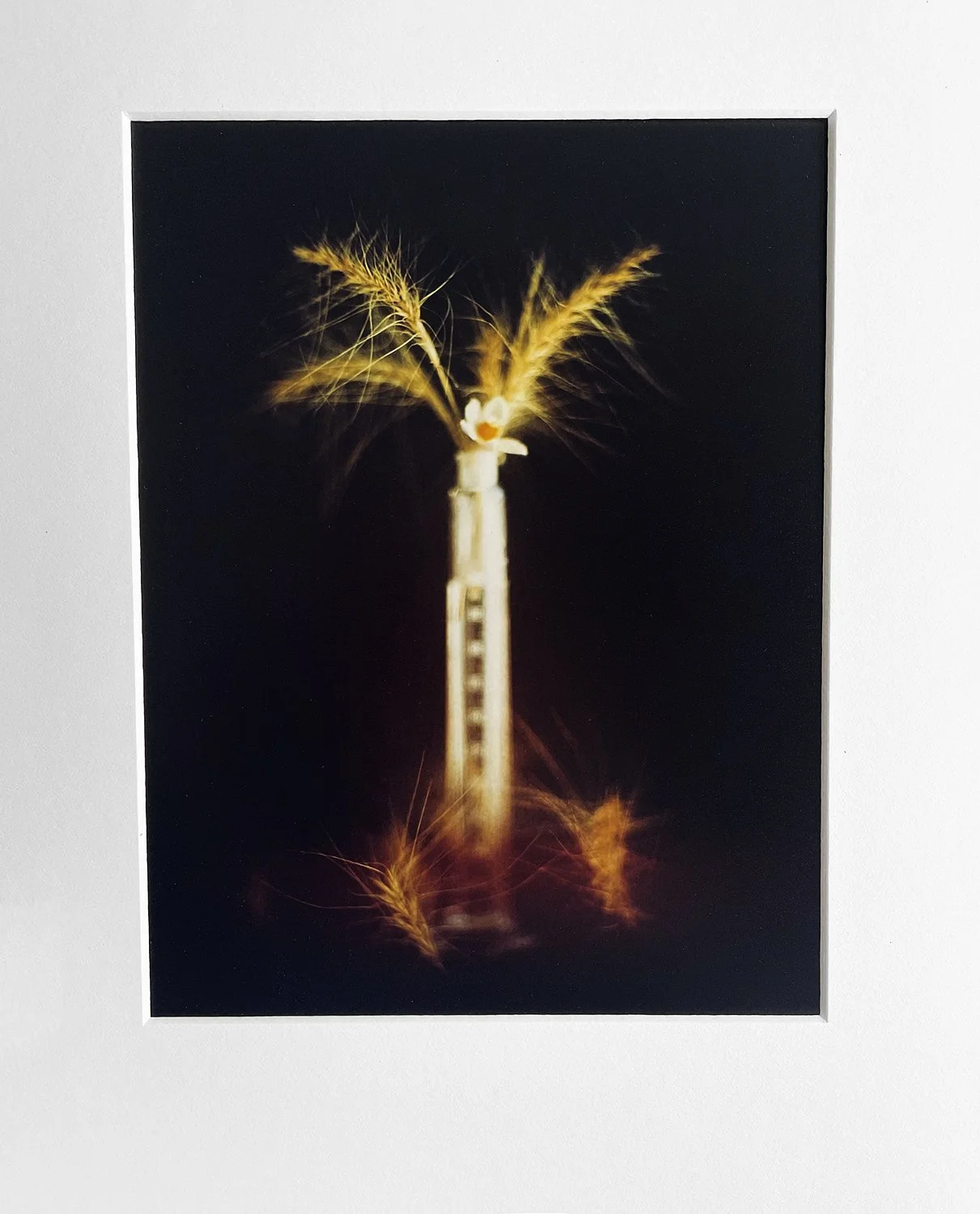
“Life”: This is dead Rocky Mountain barley and a small cactus flower that is blooming. It’s the first sign of anything blooming here—life returning to the mountain. We’re still below freezing at night and sometimes in the teens, with snow still. So this was a nice sight today. I only took one small flower from one of the cacti. This is a 10” x 10” (25,4 x 25,4 cm) RA-4 color reversal direct print (made in the camera).

Finding Meaning in the Meaninglessness

Quinn Jacobson April 18, 2023

“Light” This is dead Rocky Mountain barley and a small cactus flower that is blooming. This is a 10” x 10” (25,4 x 25,4 cm) RA-4 color reversal direct print (made in the camera). This is about 1 second overexposed - I really like the diptych of these.

““Man’s main concern is not to gain pleasure or to avoid pain but rather to see a meaning in his life. That is why man is even ready to suffer, on the condition, to be sure, that his suffering has a meaning.””
— Viktor Frankl, Man's Search for Meaning

This coming Saturday, April 22, 2023, I’m going to read the sixth chapter of “The Worm at the Core: On the Role of Death in Life” on my YouTube show. This chapter is about symbolic immortality. What is symbolic immortality? It’s the flip side of the coin of human desiring or striving for immorality. One side of the coin is literal immortality (last week’s read), and the other is symbolic immortality. It’s a big driving force in our lives. And it’s very interesting in terms of terror management theory. If you can, join me for the reading, I’m sure you’ll find something vaguely interesting if you’re reading this.

The book really starts to take off with this chapter. To this point, the authors have laid the groundwork for the reasons we lean on repression, denial, and the transcendence of death. They’ve addressed how we use our parents when we’re children for our self-esteem, and then we separate, or individuate, and lean on culture for the all-important tools to repress or deny the knowledge of our impending death and to build self-esteem (which acts as a buffer to death anxiety). They’ve given both historical references and modern empirical evidence about how we respond to death awareness. For me, this is where these theories really take off and we begin to connect the dots.

“Humans are incredibly intelligent. On consciousness: It takes a ridiculously sophisticated cognitive apparatus to render yourself the object of your own subjective inquiry. ”
— Soren Kierkegaard

Since human beings acquired consciousness or became aware that they existed, nonexistence has become a frightening reality. Mortality is on our minds and in our thoughts; it consumes us, and we need a way to buffer, repress, or transcend it. This is true, whether we know it or not, and most don’t (it’s an unconscious activity, like most psychological events). We are so embedded or ensconced in our cultural worldview that we’re blind to what motivates our activities, shapes our desires, and drives us on a daily basis. For me, this is the most revealing feature of these ideas. We’re so far down the rabbit hole (repressing the anxiety) that we can’t make sense of these theories; we don’t understand them. That’s what they’re designed to do: keep us from thinking about becoming worm food. And over tens of thousands of years, they have become so deeply embedded in our psychological landscape that we are shielded from the knowledge of death—at least for the most part.

One way we deal with the terror of death is to transcend it; we mainly use culture to do that. Technology, religion, art, ritual, myth, family, politics, relationships, money, etc.—these all provide some form of immortality for us or ways to repress or buffer existential dread. Why are we so afraid of dying? It’s not the actual event of death that gives us anxiety (some do have anxiety about how they will die), but the knowledge of it. We are living and existing in a meaningless world. We won’t be remembered. It’s the impermanence and insignificance that give us anxiety and dread. We want to be remembered; better yet, we don’t want to die!

“Ernest Becker called this desperation ‘the ache of cosmic specialness.’ Becker states what is patently obvious to most: as humans, we constantly put ourselves at the center of the universe.”
— The Denial of Death

“Life & Light” is a 20” x 20” (51 x 51 cm) these are RA-4 color reversal direct prints (made in the camera).

As Ernest Becker, the author of “The Denial of Death” (1973), pointed out, Freud was wrong. It’s not our sexual drive that motivates our behavior and psychological gymnastics; it’s our fear of death. Peter Zapffe, a Norwegian philosopher, also addressed these theories in his 1933 essay, “The Last Messiah.” Zapffe cites four coping mechanisms we use to repress death anxiety. For Zapffe, our becoming mentally over-equipped has resulted in us becoming “fearful of life itself" and of our “very being." The degree to which we are conscious of reality, which is unlike any other species, also means that we have become acutely aware of the suffering of billions of people and sentient life on the planet, as well as the planet itself.

“The Last Messiah” starts like this (bold for emphasis):

“One night in long bygone times, man awoke and saw himself.

He saw that he was naked under cosmos, homeless in his own body. All things dissolved before his testing thought, wonder above wonder, horror above horror unfolded in his mind.

Then woman too awoke and said it was time to go and slay. And he fetched his bow and arrow, a fruit of the marriage of spirit and hand, and went outside beneath the stars. But as the beasts arrived at their waterholes where he expected them of habit, he felt no more the tiger’s bound in his blood, but a great psalm about the brotherhood of suffering between everything alive.

That day he did not return with prey, and when they found him by the next new moon, he was sitting dead by the waterhole.”

Sublimation, which Zapffe calls “a matter of transformation rather than repression,” It involves turning “the very pain of living” into “valuable experiences.” He continues: “Positive impulses engage the evil and put it to their own ends, fastening onto its pictorial, dramatic, heroic, lyric, or even comic aspects.” He also notes that the essay "The Last Messiah" itself is an attempt at such sublimation. For Zapffe, sublimation is “the rarest of protective mechanisms." Most people can limit the contents of their consciousness using the previous three mechanisms (isolation, anchoring, and distraction), staving off existential angst and world-weariness. But when these forms of repression fail and the tragic cannot be ignored, sublimation offers a remedy, a way of turning the unignorable “pain of living” into creative, positive, aesthetically valuable works. (Partially Examined Life) This is where I find myself—deep into sublimation.

Meaning and Meaninglessness
Everyone has the responsibility to create meaning in their lives. There is nothing inherently meaningful in life. Life is primarily a biological process; it goes on whether we believe in something or not; it simply doesn’t matter; the world goes on. When people ask, “What is the meaning of life?” They are missing the point; there is no meaning; you have to create it, find it, search it out, apply it, and live it. The question should be, “What is the meaning in life?” Your life. Whatever that might be, I believe whatever you do to create meaning is a good thing as long as it doesn’t hurt or infringe on other people's ways of creating meaning.

If you’re religious or have a certain faith or belief in an afterlife and believe in a deity, no problem. If you belong to a sports club or a political group and find meaning and significance there, no problem. If you have a hobby—gardening, cooking, sewing, writing, painting, or photography—that’s great! If it bolsters your self-esteem, makes you feel significant, and gives you meaning, you’re on the right track.

The problem is that, a lot of times, unconscious beliefs infringe on other people's cultural worldviews; it creates hurt, discrimination, oppression, and even death (this usually happens to members of marginalized groups). Everyone needs to find something that provides them with meaning and significance. This isn’t about being right or wrong; it’s about being human and feeding self-esteem to buffer death anxiety. We all suffer from this condition (the human condition). No one gets to say, "That doesn’t apply to me." It applies to everyone.

I’m not a nihilist, but there is some truth in the “nothingness” that nihilists ascribe to, especially existential nihilism. Nietzsche said, "To live is to suffer. To survive is to find some meaning in the suffering." I do ascribe to that idea.

William Shakespeare wrote:
"Life’s but a walking shadow, a poor player that struts and frets his hour upon the stage
And then is heard no more. It is a tale told by an idiot, full of sound and fury, signifying nothing.
"

I titled this essay “Finding Meaning in the Meaninglessness.” It’s a difficult thing to admit, but everything is meaningless. Everything. For context, when I say meaningless, I mean it in the cosmic sense, not the personal sense. For me, all of my pictures, all of my writings and books, all of my thoughts, my degrees, my life experiences, all of my accomplishments, even my existence, are all meaningless. It’s true, and I’m fine with that truth. What I’ve found is that, while I understand this fact in the cosmic sense, it doesn’t preclude me from finding meaning and significance for myself. All of the aforementioned things are very meaningful, significant, and important to me, including my wife and daughter, who are at the top of my meaningful list, and my friendships and relationships outside of my family.

I’ve created, experienced, and lived all of it for my mental health and well-being, not for some bigger purpose or to change the world. It’s wonderful to be alive most of the time. I’m in awe of the beauty where I live. I’m amazed at the progress human beings have made over the millennia. It’s truly amazing. I’m grateful to wake up every morning.

On the surface, it may seem that I’m trying to change the world through my work, but I’m not. If no one ever read a word I’ve written, looked at a picture I’ve made, or listened to my philosophies about life, it wouldn’t matter—because it doesn’t. They’re not meaningful or important to the bigger scheme of things (cosmic); I get that, and I’m okay with that. I’ve come to terms with it. It doesn’t depress or demotivate me either. In fact, in a lot of ways, it’s freeing and maybe even emancipating in ways. It encourages me even more to express and create.

The only thing I’ve tried to do (intentionally) in my life is encourage people to consider people who are different from them as fully human and try not to do harm to “the other.” And now, with my new work, I’m trying to help people understand what these important ideas have to offer. It would be a much better world, at least for the time we’re here, if we could come to terms with our mortality. As Albert Camus said, “There is only one liberty, to come to terms with death, thereafter anything is possible.”

In Art & Theory, Books, Death Anxiety, Denial of Death, Direct Color Prints, Ernest Becker, Memento Mori, New Book 2023, Peter Zapffe, Psychology, Public Reading, Quinn Jacobson, RA-4 Reversal Positive, Self Esteem, Shadow of Sun Mountain, The Worm at the Core, The Last Messiah Tags peter zapffe, the last messiah, meaninglessness, meaning, coming to terms with life and death, The Worm at the Core, Quinn Jacobson, victor frankl, man's search for meaning, Ernest Becker, cosmic ache for specialness, the ache of cosmic specialness
Comment

“Medicine Wheel on a Large Granite Stone” whole plate palladiotype from a wet collodion negative—this is a symbol that was used by the Tabeguache-Ute. They would set up one of these at the center of each place they lived. They would travel widely over the year and hunt, fish, and gather plants at different locations. They spent the summer months where I live now.

Summary of My Project: In the Shadow of Sun Mountain: The Psychology of Othering

Quinn Jacobson March 5, 2023

DEATH ANXIETY & THE DENIAL OF DEATH
This project has a level of complexity in communicating what it is, what it’s about, and the objective of the work. It is very complex in one sense and, in another, very simple and straightforward. It’s simply expounding on theories of human behavior (Becker et al.) that affect all of us and the implications of them. I would sum up the objective of the work using Carl Jung’s idea of making the unconscious conscious. That’s what I would like to have happen: The average person would be able to accommodate and assimilate these ideas and understand their universal implications.

From the book, “The Worm at the Core: The Role of Death in Life,” by Sheldon Solomon, Jeff Greenberg, and Tom Pyszczynski. This is a great book. I encourage you to read it.

This is what I've written as a short description of the project. I would like to hear your feedback if you're willing to share. Does it make sense? Do you think you understand the work or the goals of the project? Do you feel that you have a basic understanding of the theories I'm working with?

SUMMARY STATEMENT OF THE WORK
Drawing inspiration from the seminal work of cultural anthropologist Ernest Becker, my book, "In the Shadow of Sun Mountain: The Psychology of Othering" (2024), aims to challenge the dominant cultural narratives that deny the reality of death and the ways in which this denial contributes to the oppression and eradication of marginalized cultures, specifically the Tabeguache-Ute of the Rocky Mountains in Colorado. By embracing Becker's insights into terror management theory and the role of death anxiety in shaping human behavior, this project seeks to provoke reflection and dialogue about the urgent need to come to terms with our mortality and its implications for our relationships with one another and the planet.

In Artist Statement, Art & Theory, Collodion Negatives, Creating A Body Of Work, Death Anxiety, Denial of Death, Ernest Becker, Handmade Print, Palladiotype, Palladium, Philosophy, Project Wor\k, Psychology, Shadow of Sun Mountain, Tabeguache Ute, Writing Tags medicine wheel, tabeguache, palladiotype, wet collodion negatives, Ernest Becker, summary statement, In the Shadow of Sun Mountain
2 Comments

“Deer Antlers & Wooden Buffalo Head,” whole-plate toned cyanotype from a wet collodion negative. From the project, :”In the Shadow of Sun Mountain: The Psychology of Othering”

Our Struggle To Be Unique

Quinn Jacobson March 1, 2023

Ernest Becker said, when talking about being unique, “it expresses the heart of the creature: the desire to stand out, to be the one in creation. When you combine natural narcissism with the basic need for self-esteem, you create a creature who has to feel himself an object of primary value: first in the universe, representing in himself all of life.” Simply put, we want attention and adoration. We will go to great lengths to get it, and sometimes it manifests as narcissism. It's everywhere in society, especially with social media. It’s given us a clear example of this behavior (and need). Posting an endless stream of "selfies" and showing the "ideal lifestyle"—travel, wealth, high-end material goods, famous friends, popularity, etc.

I know that most people never think about their struggle for self-esteem (to find meaning and significance); not consciously anyway. It’s a daily battle for most human beings. This drives most human behavior after the basic needs are met, and most people don’t even know it.

If you look at Maslow’s hierarchy of needs, you’ll find what human beings spend their time doing every day. The basic requirements include physiological and safety needs. We need to breathe, eat, sleep, have shelter, safety, etc. These show the first survival drives, which include reproduction. Becker would call these "animal needs." Like all other animals, we are not exempt when it comes to the basic survival and reproduction drives. This is, in fact, what collides with our knowledge of death and creates the anxiety that we repress through self-esteem and culture.

“It is quite true that man lives by bread alone — when there is no bread. But what happens to man’s desires when there is plenty of bread and when his belly is chronically filled? At once other (and “higher”) needs emerge and these, rather than physiological hungers, dominate the organism. And when these in turn are satisfied, again new (and still “higher”) needs emerge and so on. This is what we mean by saying that the basic human needs are organized into a hierarchy of relative prepotency.”
— (Maslow, 1943, p. 375)

As you climb up the Maslow ladder, you see where this changes. I like Maslow’s theory. And for the most part, I agree with it. Where I would differ is how these are separated. Love and belonging, self-esteem, and self-actualization can all be put into one category: self-esteem. We can never really attain self-actualization. This is a goal set in this theory to strive toward (the carrot on the stick). Self-actualization gives you a way to look for and get a steady supply of self-esteem. Becker calls this "culture" or "cultural worldview."

Culture provides a way we can bolster and maintain our self-esteem, and self-esteem keeps our existential terror (death anxiety) at bay. Self-esteem buffers anxiety. “Psychological equanimity also requires that individuals perceive themselves as persons of value in a world of meaning. This is accomplished through social roles with associated standards. Self-esteem is the sense of personal significance that results from meeting or exceeding such standards.” (The Ernest Becker Foundation)

“I was no longer needing to be special, because I was no longer so caught in my puny separateness that had to keep proving I was something. I was part of the universe, like a tree is, or like grass is, or like water is. Like storms, like roses. I was just part of it all.”
— Ram Dass, Changing Lenses

From here, we can understand the need for self-esteem. We have to have it; if we don’t, psychological pathologies, namely depression, will emerge. The question becomes one of balance. How do we balance our need for self-esteem and yet keep narcissism at bay? Bolstering self-esteem and narcissism are sometimes very difficult to tell apart.

Once we have self-esteem (meaning and significance), we can operate day-to-day with what most would call "normalcy." Our self-esteem comes from our culture, which is a shared reality that tells us what to believe and how to act to boost our self-esteem. When this cultural worldview is threatened or questioned, we get angry and go to great lengths to defend it. And the deeper we believe or cling to our worldview, the more extreme our response to a threat will be. Herein lies the problem. This is the crux of my project.

“Half of the harm that is done in this world is due to people who want to feel important...they do not mean to do harm...they are absorbed in their endless struggle to think well of themselves.”
— T. S. Eliot
In Self Esteem, Wet Collodion Negatives, Terror Management, Shadow of Sun Mountain, Psychology, Project Work, Philosophy, New Book 2023, Cyanotype, Collodion Negatives, Maslow, Death Anxiety, Ernest Becker Tags Ernest Becker, self-esteem, toned cyanotype, Wet Plate Collodion Negatve, In the Shadow of Sun Mountain, the psychology of othering
Comment

“Rocky Mountain Barley Grass.” Whole-plate palladiotype from a wet collodion negative. This was printed out on HPR paper with a hot potassium oxalate developer (for warm color). The photogenic drawing print from a recent essay (Meaning in a Meaningless World) was of one of these individual barley strands (see image below). The pot was made by L. Posey, a Ute potter.

Why Photographic Prints (and Books) Are Important

Quinn Jacobson February 26, 2023
“We have in fact only two certainties in this world - that we are not everything and that we will die.”
— Georges Bataille

You hear advice for digital photographers to “print their images.” It’s good advice. Storage cards and drives crash all the time. I suspect very few actually follow that advice. However, this essay is not about that type of printing, and the ideas that I’m going to address live in a completely different space. This is about the photographic fine art print as an object of value: something tangible and handmade. As well as the importance of books and the meaning of value,

In this essay, I want to address the idea of value as it relates to prints and books in the photographic fine art world. What is value, and how do you define it?

Have you ever thought about the importance of the photographic print? What I mean is that when we talk about photography today, it’s usually about posting digital snaps on social media. I read a scary statistic the other day about “Generation Z” (Zoomer students): very few have ever been to an art gallery (to see work in person), even fewer own any photography books, or books in general, and almost none of them have ever been in a photographic darkroom. Their photographic and art world lives online in zeros and ones. That really shocked me. The last few wet collodion demonstrations I did (pre-COVID) at the local university, I felt that something was “off.” I couldn’t put my finger on it; it just felt like the students were distant and not really interested in my presentation. I’d been doing these for years and never had a response, or lack thereof, like this before. It made me start to wonder about the changing perception of art, literature, and education in general. I taught higher education for a few years; in fact, the initial reason for getting an M.F.A. was to continue to teach in higher education. I had a change of heart when I finished graduate school. I feel that I can contribute more to the world doing what I’m doing now. I’m very grateful that I didn’t continue teaching. I think I would have been disappointed and discouraged by it.

WORK, SKILL, & MATERIALS

The Value of Work
When we talk about value, we have to address some key elements that separate the different approaches to making art using photography. One of the big ones for me is work. The 19th-century French novelist George Sand said, "Work is not man's punishment. It is his reward, his strength, and his pleasure." I agree. I define work as a system of mostly failing and continuing to pursue your goal until you’ve achieved it—be willing to not only accept failure but embrace it. I work the hardest on the ideas behind my work. The other component of my photography is the work in the darkroom and printing. I can spend an hour developing and processing one negative. And I can spend an entire day trying to make a print from the negative that I like. While today’s technology allows a person to fire off thousands of images onto a digital card, my work is in the single digits (maybe three on a good day). I have to physically work for those, and some days are complete failures. Whatever the reason(s), nothing works.

The Value of Skill
This is a topic that can be controversial in the sense of how you determine or define skill. For me, skill includes all of the technical knowledge of any given process plus the wisdom of how to apply the process to achieve a certain aesthetic—not an easy thing to do. Knowledge, gained through the study of new information, consists of a rich storage of information. Wisdom, on the other hand, has to do more with insight, understanding, and accepting the fundamental “nature” of things. Let me back up a little and say that the wisdom of applying an aesthetic to an image comes from the knowledge of what you’re trying to say with the image. In other words, there needs to be a story or narrative in place in order to even do this. Without this, you can’t really do anything.

The Value of Material
One of the most important ideas to me is materials. One of the many reasons I enjoy working with historic processes is the variety of materials available for use in any given process. Everything from the papers to the silver can be used as a metaphor in the work. I used to talk about the glass used in collodion when making photographs of synagogues destroyed in Germany on Kristallnacht (the Night of Broken Glass). Or the cyanide I use to remove the unexposed silver from the plate; the same substance was used in Europe's gas chambers during WWII. With my current project, I’m using a variety of materials that address, directly or indirectly, the thesis of the work. The tangible quality of the materials lies beyond the metaphors. It's an experience to hold a handmade photograph physically in your hands. I believe we've lost touch with the material (physical) aspect of photography. That has changed the medium a lot in my mind. This is where books can be vital. In this digital age, we rely on internet connections, computers (phones), and power to be able to see or read anything. If any one of those isn’t available, the work is no longer available to you. With a book, you only need light.

Photogenic Drawing of Rocky Mountain Barley.

THE HANDMADE PRINT
In the context of a handmade print, value can be defined in several ways, including:

  1. Unique craftsmanship: One of the primary sources of value in a handmade print is the uniqueness and individuality of each print produced. Handmade processes often involve a high level of skill, attention to detail, and creativity, which can result in prints that are distinct from one another-each one an original. Viewers may place a premium on handmade items because of their uniqueness and the sense of artistry and personality that they convey.

  2. High-quality materials: Handmade processes often involve the use of high-quality materials that are carefully selected and sourced. This can add to the value of the final product, as the materials used may be of a higher quality than those used in mass-produced items.

  3. Personal connection: Handmade processes often involve a personal connection between the creator and the product. The maker may have a strong emotional connection to the item they are creating, and this can be conveyed to the viewer in the finished print. Viewers may value this personal connection and feel more attached to handmade items than they would to mass-produced items.

Overall, the value of something made by hand can come from a number of things, such as its uniqueness, quality, and personal connection.

In Art & Theory, Book Publishing, Books, Collodion Negatives, Creating A Body Of Work, Death Anxiety, Denial of Death, Ernest Becker, Palladiotype, Philosophy, Photogenic Drawing, Psychology, Shadow of Sun Mountain Tags palladiotype, meaning, handmade print, rocky mountain barley
Comment

"Paradise Cove, Colorado": whole-plate palladiotype print on Revere Platinum paper from a dry collodion negative. The negative was exposed for 4 minutes at f/5.6. This scene is 9,000 feet above sea level in the Rocky Mountains of Colorado, May 2022, for my book "In the Shadow of Sun Mountain: The Psychology of "Othering."

The first word that comes to mind when I look at this print is "alien." The dictionary definition is: "a foreigner, especially one who is not a naturalized citizen of the country where they are living." I think about this a lot. I ponder how people end up living in a place that was stolen from the original people of the land. I think I know how it happens, and moreover, why!

The small Ponderosa Pine tree growing out of the granite—granite formed by ancient volcanoes in the area—stands out to me as well. Again, it makes me think about the people who lived here before the colonizers arrived. And I can feel the passing of time in this photograph. It feels old. In fact, it feels ancient and mysterious to me—a place that’s seen so much happen over time. It puts my finitude and smallness in perspective.

My Plans: Spring, Summer & Autumn 2023

Quinn Jacobson February 20, 2023
“The bitter medicine he prescribes — contemplation of the horror of our inevitable death — is , paradoxically , the tincture that adds sweetness to mortality .”
— Ernest Becker, The Denial of Death (foreword)

Winter in the Rocky Mountains of Colorado is not over yet, but my mind is already thinking ahead to spring, summer, and autumn. I’m starting to make plans to work on my project again. It’s not too far off, and I’m excited to start making photographs again.

In the winter, I go into "photographic hibernation." I shut down the studio and darkroom, and I only go into the building (maybe) once a month to check on things. I thought it would drive me insane not to be able to create images all winter. I’ve found quite the opposite. In fact, I would recommend taking a break from the craft and working on the concept with no distractions—it’s been a great way for me to see, with more clarity and purpose, what I’m trying to do. I think I’m making my best work by writing for a few months and making images for a few months. I've found that time is the greatest asset when creating work like this. I've never had such distraction-free time before, and I'm beyond grateful for it. Rollo May said, “Absorption, being caught up in, wholly involved, and so on, are used commonly to describe the state of the artist or scientist when creating or even a child at play. By whatever name one calls it, genuine creativity is characterized by and intensity of awareness, a heightened consciousness.“

In the Shadow of Sun Mountain: The Psychology of “Othering” (example book cover)

My book, In the Shadow of Sun Mountain: The Psychology of “Othering”, is going to be my "magnum opus." I’m not saying that it will be my final body of work, but it will completely close this chapter of inquiry for me. It’s literally a body of work, both written and photographed, that examines questions that I’ve wrestled with for over 30 years of my life. It’s a big deal to me, and I hope it resonates with a few other people. I know it’s a difficult topic to get people interested in; it’s not something that’s addressed much, but it should be. That’s the very point of this work. Through the historical events of the 19th century, I’m telling the story of “othering” (xenophobia) and what happened to the Tabeguache Utes that lived on the land where I now live.

This is not a body of work that documents the Tabeguache Utes, but explores the land, plants, objects, and symbols they used here. My objective is to explore the denial of death and the negative consequences it bears when it’s not directed in a positive, non-destructive way. This book will address why things like this happen and will continue to happen. I feel like it’s a unique blend of art, history, and psychology that applies to every human being and all human behavior.

Making art, especially a large body of work on a specific topic, is an interesting process to go through. I’ve done it several times in my life, but this is different. As I just mentioned, this is the culmination of all of my previous work. It reveals answers to the questions I’ve been asking for so long. It feels like I’ve worked on smaller projects to warm up for this. I’m beyond excited about all of it.

I'm not sure what the next chapter of my life will bring. I’m not even sure it will be photography. I find my interest in traditional photography waning. Don’t misunderstand me; I love photography, but my interest is waning in how it’s being used today and how it’s changed over the years. Even the purpose of working with historic processes (something that should be very special) has turned into something that I don’t recognize and have no interest in. Everything feels exploited and commodified to me.

“Absorption, being caught up in, wholly involved, and so on, are used commonly to describe the state of the artist or scientist when creating or even a child at play. By whatever name one calls it, genuine creativity is characterized by and intensity of awareness, a heightened consciousness.”
— Rollo May

It seems that most people working in these processes are firmly rooted in commercial work or are immersed in constant technical talk about processes and equipment (I’ve written several essays on this topic). There seems to be so little real output of expression or ideas using these processes. To be honest, it bores me to death; I have nothing left to say about it. So whatever I do next, I'll be prepared for it. If it involves photography, it won’t be commercially based or solely technical—it will be personal and expressive. It'll come to me naturally and organically, just like this work and my previous work have.

PLANS FOR THIS YEAR
For 2023, I’m going to continue to work on the “flora” portion of my project. I have several more plants I want to photograph as well as try some new approaches to making these images. There are quite a few landscape images I’m after, and I'll attempt some “fauna” work as well. I’ll continue to work it out and discover new ways to communicate these ideas semiotically.

I’m still very much in "creation mode" for the project—work, work, work—meaning that I’ll spend a few months editing a lot of photographs (about 200 images) and deciding what best represents my ideas for the concepts. I’m sitting on about 130 negatives from the work I did last year (2022). These are wet and dry collodion negatives, as well as paper negatives (calotypes). I have about 30 to 40 photogenic drawing prints and cyanotypes, too. I’ll have several print-out-processes to select from as well. Different negatives print differently in various P.O.P. processes. Even the paper selection can make a big difference. It's a lot of work, but it's also a lot of fun.

This year, I plan to do another 100–125 negatives plus several photogenic drawings and cyanotypes. I want a large variety to work with. The book will have between 75 and 100 images. To get that, I’ll need about 200 images to edit from. They will vary in process, too. There will be palladiotypes, kallitypes, salt prints, gelatin and collodion aristotypes, cyanotypes, Rawlins oil prints, and photogenic drawing prints. The substrate and execution will vary too. I’m going to try to make some very interesting images involving both content and process. They will be unique and, hopefully, engaging and interesting. That’s the goal. I want the visuals to connect with and represent the writing (concept) of the work more than anything else.

I’m thinking that this year’s work won’t be shared online. As much as I like sharing the work, I think I may keep this second year to myself. When I publish the book, I want most of the images to be "new" to the viewers. I think that seeing the photographs in the book with all of the text available adds more power to the concept. I hope those interested will stay tuned for the book. It will be worth the wait, I promise.

MY THOUGHTS ON SHARING, & SOCIAL MEDIA
I enjoy sharing work with people online. Most of the time, it’s a very positive experience. It builds community and is generally a positive thing. I try to stay away from the contentious stuff and just share with those that are interested. That will change somewhat over the coming year and the rest of this work. I’ll explain why.

I’ll continue to publish essays here (on my blog) over the coming year. This is like a public journal for me. I “exercise” stuff from my mind here; it’s cathartic for me. Sometimes, I’ll even come back to it to find something I’ve written about or a reference. It’s a good thing for me. And to those that read it, thank you, and thanks for the positive and kind words about it. So what about social media?

Social media has a tight grip on all of us—too much control over our personal, artistic, and creative lives. Too much influence is placed on what people will "like" or not, and the number of “likes.” Why do we put so much weight on social media? We want those dopamine hits! I get it.

Beyond that, there's surveillance capitalism and the data these large corporations are gathering on us via these platforms—it's intrusive and scary! We give it to them freely and ignorantly. Every Facebag survey you take on "What Kind of Potato Are You?" (or some other ridiculous thing) is simply getting more information about you to sell you stuff that you don’t need. These platforms are constantly encouraging people to compare themselves to each other (especially dangerous for young people). And the algorithms determine what will keep you scrolling for hours on end—so-called doom scrolling—and then feed it to you on an endless loop.

There’s so much negativity on these platforms. That alone should keep us away, but it doesn’t. The arguing and fighting over who is the best and smartest, as well as the "experts" shouting down, belittling, and degrading others, and the cultural and political squabbles, are heartbreaking. It's exactly what I read about and write about every day—existential uncertainty—and this is how people deal with the anxiety.

I see a lot of (malignant) narcissism on these platforms as well: “filtered selfies” and great lifestyles that are all fake. I get that people use it to bolster their self-esteem—life is difficult and frightening, and the knowledge of our impending death (death anxiety) drives us to deny it and act out this way—and social media assists in doing exactly that. In his book The Denial of Death, Ernest Becker said, "But it is too all-absorbing and relentless to be an aberration; it expresses the heart of the creature: the desire to stand out, to be the one in creation. When you combine natural narcissism with the basic need for self-esteem, you create a creature who has to feel himself an object of primary value: first in the universe, representing in himself all of life."

Every day, people post something that says, in essence, "Please like me and validate my existence; I seek meaning and significance." This is what Becker talks about constantly in his books. I wish there was a viable alternative. When I first started the Collodion Forum Board in 2003, there was a great community there. It lasted for a few years. People were courteous, kind, and generous with their knowledge and information. It didn’t have all of the negative aspects that we see on social media today (photo groups and egos). A lot of people working in wet collodion today got their start there - in fact most of them. Times change, and we move on. I wax nostalgic.

I think I can convince people that there are better and healthier ways to bolster their self-esteem. My book has nothing to do with "self-help,” but it will talk about ways to deal with death anxiety without being so self-centered and destructive.

There are some positive things about social media (very few things), but as a whole, the liabilities outweigh any of the good or positive things. I want to break the rules and try something different, like not sharing everything I make. How novel is that?

MOUNTAIN LIVING & SOLITUDE
I’ve had a few months of writing and time to lay out the book for its first iteration. So far, I feel great about what I’ve written. The writing has really allowed me to think about the photographs I want to make. This time has been priceless in that way. I write every day, seven days a week, some days more than others, but I still write. And I read every day, too. I’m always looking for books, films, music, and art in general that may have some connection to these ideas. I take in a wide variety of information; it seems to help me make the connections I need to write about these theories. I’ve written a lot about being fully aware of how I’m using art and creativity to buffer my own anxiety. I would go even farther and say that I’m not only buffering the anxiety, I’m feeding off of it. In other words, I’m using existential terror creatively in my favor. I feel like I'm getting one over on my own death awareness.

“I am losing precious days. I am degenerating into a machine for making money. I am learning nothing in this trivial world of men. I must break away and get out into the mountains to learn the news. ”
— John Muir

This June (2023), we will begin our third year of living on the mountain. Living up here has definitely changed me. Maybe it’s the mountain air, the isolation, the peace and quiet, being close to nature and the wildlife, or a combination of all of it. Whatever it is, it’s had a big impact on how I view the world. It’s allowed me to see what’s important and what’s not. What I actually need and don't need, as well as the ability to say "no," sounds trite and cliche to say, but it’s true.

Time away from a toxic culture that influences your life without your knowledge resets your mind; it changes you. Living in cities and suburbs directs your life to the point where you become something you don't want to be: a conspicuous consumer—not just a consumer, but someone who is always looking for the next thing to buy, have, or be, endlessly seeking satisfaction but never receiving it. The big ontological question is: If we have everything, why aren’t we happy?

My changes are positive, fulfilling, and meaningful to me. I'm forever grateful to be here; we love this mountain. And I’m filled with gratitude to spend my days thinking about the human (paradoxical) condition, art, photography, and how to live each day of my life in the best way possible.

BY THE END OF 2023…
My hope is that by the end of this year, I’ll be going through prints and making selections for the book. I feel like I can have the writing mostly completed by the spring. There will be refinement and editing, but the bulk of it will be completed by June. I’ll work on it periodically throughout the year and have a final edit done by an outside resource.

Included in the book is an extensive autobiography. In fact, the second chapter, The Introduction, is where I write extensively about how my life (artistic and creative) unfolded and put me where I am now. It was an “eye-opener” to me. I think any artist or photographer will appreciate reading about my journey.

I’ve incorporated art, psychology, history, anthropology, theology, philosophy, sociology, and other disciplines to accomplish what I’ve set out to do with this book. I've had to combine all of the disciplines and theories in order to explain them so that people like me, a layperson, can understand them. I wanted the writing to be simple and understandable, not academic. It’s been a big chore, but it’s working.

The interdisciplinary approach to this work is critical. It truly supports the ideas in ways that one or two areas couldn’t. My goal is to make the art and my expression of these ideas the central theme. I want the photographs to act as a catalyst for understanding the psychology of "othering."

I feel like we don’t acknowledge the psychological underpinnings of photography enough. It’s easy to get academic about it, and again, I don’t want that. I want an authentic connection between the images and the psychology that they represent. So far, I feel very good about what I’ve accomplished. Let’s see what this year brings.

“We are all in search of a feeling more connected to reality... We indulge in drugs and alcohol, or engage in dangerous sports or risky behavior, just to wake ourselves up from the sleep of our daily existence and feel a heightened sense of connection to reality. In the end, the most satisfying and powerful way to feel this connection is through creativity. Engaged in the creative process we feel more alive than ever, because we are making something and not merely consuming, Masters of the small reality we create.”
— Robert Greene, Mastery
In Art & Theory, Colorado, Creating A Body Of Work, Death Anxiety, Denial of Death, Ute, Terror Management, Shadow of Sun Mountain, Psychology, Palladiotype Tags Plans 2023, social media, death denial, death anxiety, palladiotype, native american
2 Comments

“Rocky Mountain Meadow Barley"—a whole-plate photogenic drawing. The plant was laid directly on the photographic paper (silver nitrate on salted paper) and exposed to direct sunlight for a couple of minutes. Then it was washed and fixed. This process was first used by Henry Fox Talbot in England in the 1830s.

The concept of the plant making direct contact with the paper appeals to me. The most important concept is contact. This image's elegance gives rise to an intriguing story in my mind. The sunlight that gave life to the plant also created this image. The "hair" emerges when the seed is released. I think the simplicity is beautiful.

Meaning in a Meaningless World

Quinn Jacobson February 17, 2023

Peter Zapffe said, "Man is a tragic animal. Not because of his smallness, but because he is too well endowed. Man has longings and spiritual demands that reality cannot fulfill. We have expectations of a just and moral world. Man requires meaning in a meaningless world."

Like others, Zapffe was convinced that our consciousness was an evolutionary misstep. A mistake. To have a "surplus" of consciousness is too much for us to bear. We shrink from living and are afraid to die because of it. We don't necessarily fear death or dying, but rather the prospect of being forgotten—the consequences of dying. We fear impermanence and insignificance. That’s what’s unbearable to us; that’s what drives us to distractions, illusions, and denial.

Moreover, we find ourselves in a world that has no meaning. The only meaning is what we create for ourselves, and in the cosmic picture, it’s all meaningless. This idea is central to my work. This conflict creates anxiety that we need to buffer, and if we can’t buffer it, a lot of times it will manifest as anger or violence, and we will take it out on the person or people who are challenging our buffering mechanism (othering). In other words, if you challenge my worldview (my coping mechanism for death anxiety), I may lash out and want to convert you to my worldview or destroy you.

I’ve come to understand why I gravitate toward making art and having a creative life. Reading the works of the great thinkers and philosophers, it's clear to me what my attraction is to pursuing creativity versus other ways I could buffer my existential anxiety. Nietzsche said, "The truly serious task of art is to save the eye from gazing into the horrors of night and to deliver the subject by the healing balm of illusion from the spasms of the agitations of the will." That resonates deeply with me. My life has consisted of trying to unravel the problem of "othering" through art. Over the years, I’ve pulled on the threads of artists, thinkers, and philosophers before me (and those who are contemporary to me) and have used art to explore human behavior as well as buffer my own existential terror. I’m very aware of how I’ve intellectualized my impending death. Socrates claimed that the practice of philosophy in life is really a dress rehearsal for what comes in death: “… those who practice philosophy in the right way are in training for dying, and they fear death least of all men.”

When Nietzsche talks about the "truly serious task of art" being to save the eye from gazing into the horrors of night and deliver the subject from the spasms of the agitations of the will, he is speaking about the power of art to provide a form of psychological relief from existential terror.

Nietzsche believed that human existence was marked by suffering and that our awareness of this suffering could be overwhelming. In his view, the role of art was to provide a kind of escape from existential terror by creating a "healing balm of illusion" that would allow us to momentarily forget about our problems and experience a sense of peace and tranquility. I would add to that; I would argue that it allows the artist to transfer the anxiety to the work—to exercise it out of the mind, if you will. Peter Zapffe called this “sublimation”; he said it was rare but the best way to buffer anxiety. It’s rare because the majority of people choose not to have a creative life.

At the same time, Nietzsche recognized that the experience of art was not just about escaping from reality. He believed that great art had the power to transform our understanding of the world and to challenge our assumptions about what is real and what is possible.

In short, Nietzsche's comment about art's "serious task" shows how art has the power to both temporarily calm our existential terror and give our lives meaning—or at least an illusion of meaning and value.

In Art & Theory, Books, Death Anxiety, Denial of Death, Ernest Becker, Peter Zapffe, Pessimistic Philosophy, Philosophy, Photogenic Drawing, Psychology, Shadow of Sun Mountain Tags Peter Wessel Zapffe, Nietzsche, meaning, meaninglessness, meaningless, philosophy, pessimistic philosophy, art, art theory
Comment
← NewerOlder →

Search Posts

Archive Block
This is example content. Double-click here and select a page to create an index of your own content. Learn more
Post Archive
  • Photography
 

Featured Posts

Featured
Feb 7, 2026
What Remains: On Meaning, Mortality, and Making in the Age of Artificial Intelligence
Feb 7, 2026
Feb 7, 2026
Feb 5, 2026
The Outline and the Drift
Feb 5, 2026
Feb 5, 2026
Feb 4, 2026
Ruptureology
Feb 4, 2026
Feb 4, 2026
Jan 31, 2026
Glass and Gold - Glass Prints
Jan 31, 2026
Jan 31, 2026
Jan 28, 2026
A Film You Should Watch
Jan 28, 2026
Jan 28, 2026
Jan 27, 2026
My New Books for 2026
Jan 27, 2026
Jan 27, 2026
Jan 26, 2026
The Dimmer Switch Explained
Jan 26, 2026
Jan 26, 2026
Jan 24, 2026
Holding Pattern
Jan 24, 2026
Jan 24, 2026
Jan 19, 2026
The Sacred Didn’t Vanish - It Migrated
Jan 19, 2026
Jan 19, 2026
Jan 19, 2026
Animality: The Part of Us We Keep Trying to Forget
Jan 19, 2026
Jan 19, 2026