
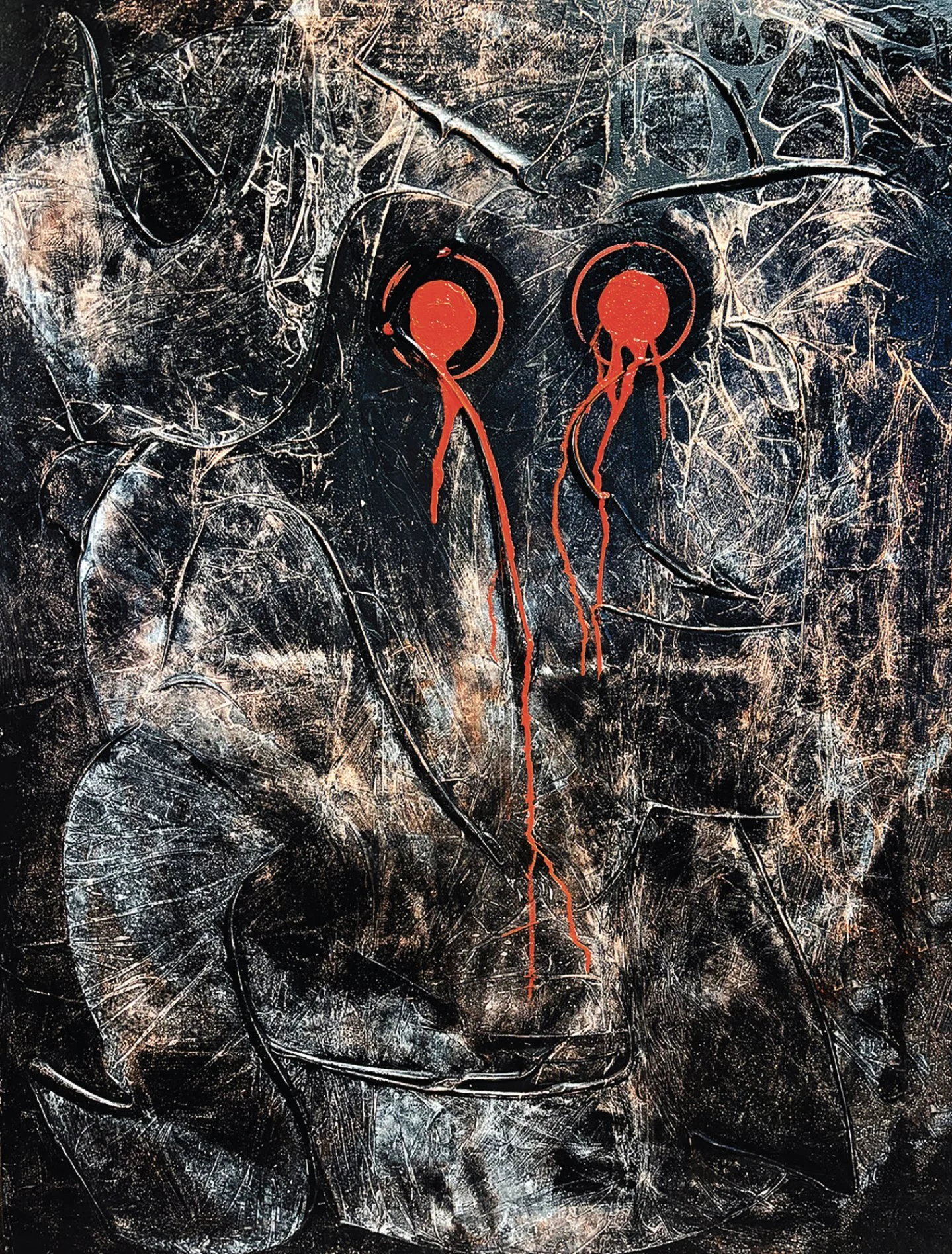
The Weight of Exposure: When Meaning Breaks and Creative Work Begins
The Creative Mind & Mortality Podcast | Glass Bones, Chapter 16
What happens when the beliefs and stories we've depended on to make sense of our lives stop working?
We all construct meaning around our existence. Our identities, beliefs, relationships, and cultural traditions provide a sense of stability in a world that is constantly changing. These structures help us navigate uncertainty and, perhaps most importantly, manage the anxiety that comes from knowing our lives are temporary.
But sometimes those structures begin to fail.
A death, a personal loss, a historical revelation, or an unexpected moment of awareness can expose something our familiar explanations can no longer contain.
In Chapter 16 of Glass Bones: Art, Mortality, and the Human Mind, titled “The Weight of Exposure,” I explore what happens at that moment, particularly for artists who work directly with uncertainty, mortality, and the instability of meaning.
When the Worldview Begins to Crack
Ernest Becker argued that human beings depend on cultural systems of meaning to protect themselves from the psychological consequences of mortality awareness. These systems provide a sense of continuity and significance, allowing us to participate in life without constantly confronting the reality of our eventual disappearance.
Otto Rank approached this problem through the psychology of the artist. He believed artists often resist complete absorption into collective beliefs because creative individuality requires some distance from the culture that sustains them.
Terror Management Theory adds another dimension. Research suggests that reminders of mortality can strengthen our attachment to existing worldviews, sometimes producing greater rigidity and defensiveness.
These perspectives help explain why we protect our beliefs so fiercely.
But creative practice can sometimes require us to remain with the uncertainty that those beliefs ordinarily help us avoid.
When an inherited explanation stops working, an artist may find that the instability itself becomes material for inquiry.
Rupture and the Threshold
In the previous chapter, I introduced the concept of rupture.
Rupture occurs when awareness exceeds the psychological structures we've relied on to contain it. Something breaks in our understanding of ourselves or the world, and the meaning that once provided stability can no longer hold.
In Chapter 16, I make an important distinction between rupture and threshold.
Rupture is the moment of breaking. The threshold is the psychological space that opens when the old meaning has failed and something new has not yet formed.
That interval interests me enormously.
It's a place of uncertainty, vulnerability, and sometimes considerable anxiety. We may recognize that something we believed is no longer adequate, but we haven't developed another way of understanding the experience.
The temptation is to resolve the discomfort as quickly as possible.
Creative practice may offer another possibility: remaining with the uncertainty long enough to examine what it reveals.
This doesn't make artists immune to fear, confusion, or psychological distress. The exposure can be difficult, and there's no guarantee that it will produce meaningful work.
But I've come to recognize a recurring pattern in my own creative process.
From Rupture to Creative Form
After decades of working with nineteenth-century photographic processes, painting, and mixed media, I've identified a sequence of experiences that seems to emerge when creative work begins with existential uncertainty.
I describe this through twelve interconnected stages:
Rupture → Exposure → Anxiety → Threshold → Holding → Metabolization → Residue → Trace → Form → Witness → Provisional Meaning → Return
The process begins when something breaks through our familiar understanding of the world.
That rupture creates exposure, followed by the anxiety of confronting something without the protection of our usual explanations.
Eventually, we arrive at the threshold, where the old meaning has failed but a new understanding has not yet emerged.
Holding becomes essential here. It's the practice of remaining present with the uncertainty without immediately forcing a conclusion.
Over time, the experience may begin to change. I call this metabolization: the gradual transformation of raw psychological pressure into something we can work with.
What remains is residue, the emotional and psychological material left behind by the encounter.
That residue may eventually produce a trace, the first gesture toward creative expression.
A photograph, a mark on a canvas, or the beginning of a written passage can become the first indication that something is taking form.
As the work develops, it becomes possible to witness it as something separate from ourselves. Meaning may emerge, although I consider that meaning provisional. It offers temporary coherence without requiring permanence or absolute certainty.
And eventually, the process begins again.
Creativity as a Form of Reconstruction
I'm interested in this process because it suggests that creative work may offer a way of reconstructing meaning after familiar psychological protections have failed.
The artist doesn't necessarily return to the same beliefs that existed before the rupture.
Something has changed.
The experience may alter how we understand ourselves, our relationships, our history, or the temporary nature of existence.
Making something can become a way of participating in that change.
For me, this is especially apparent in the darkroom or when I'm painting. The work often begins before I fully understand what I'm trying to express. Something has unsettled me, and I return to the material repeatedly, allowing the process to reveal possibilities I couldn't have anticipated.
I don't see this as a guaranteed path toward psychological resolution.
Sometimes the work remains unresolved. Sometimes the questions become more complicated.
That uncertainty is part of the inquiry.
Where the Work Begins
Chapter 16 is an important transition in Glass Bones.
Rank, Becker, and Terror Management Theory help explain the psychological structures surrounding mortality awareness. My twelve-stage framework attempts to describe what happens within the creative process when those structures begin to falter.
It's an effort to make the experience more visible, particularly the interval between losing an established meaning and beginning to construct another.
In Chapter 17, “Where the Work Begins,” I'll examine these stages more closely, drawing from my own studio practice and the lived experience of making art at the edge of meaning.
I'm increasingly convinced that one of the most important questions we can ask about creativity concerns our willingness to remain present when familiar explanations no longer work.
What happens when we stay with the uncertainty?
What becomes possible when we allow the experience to take form?
And can we make something meaningful while recognizing that whatever meaning emerges will also be temporary?
These questions continue to shape my work.
Watch or listen to Chapter 16, “The Weight of Exposure”: