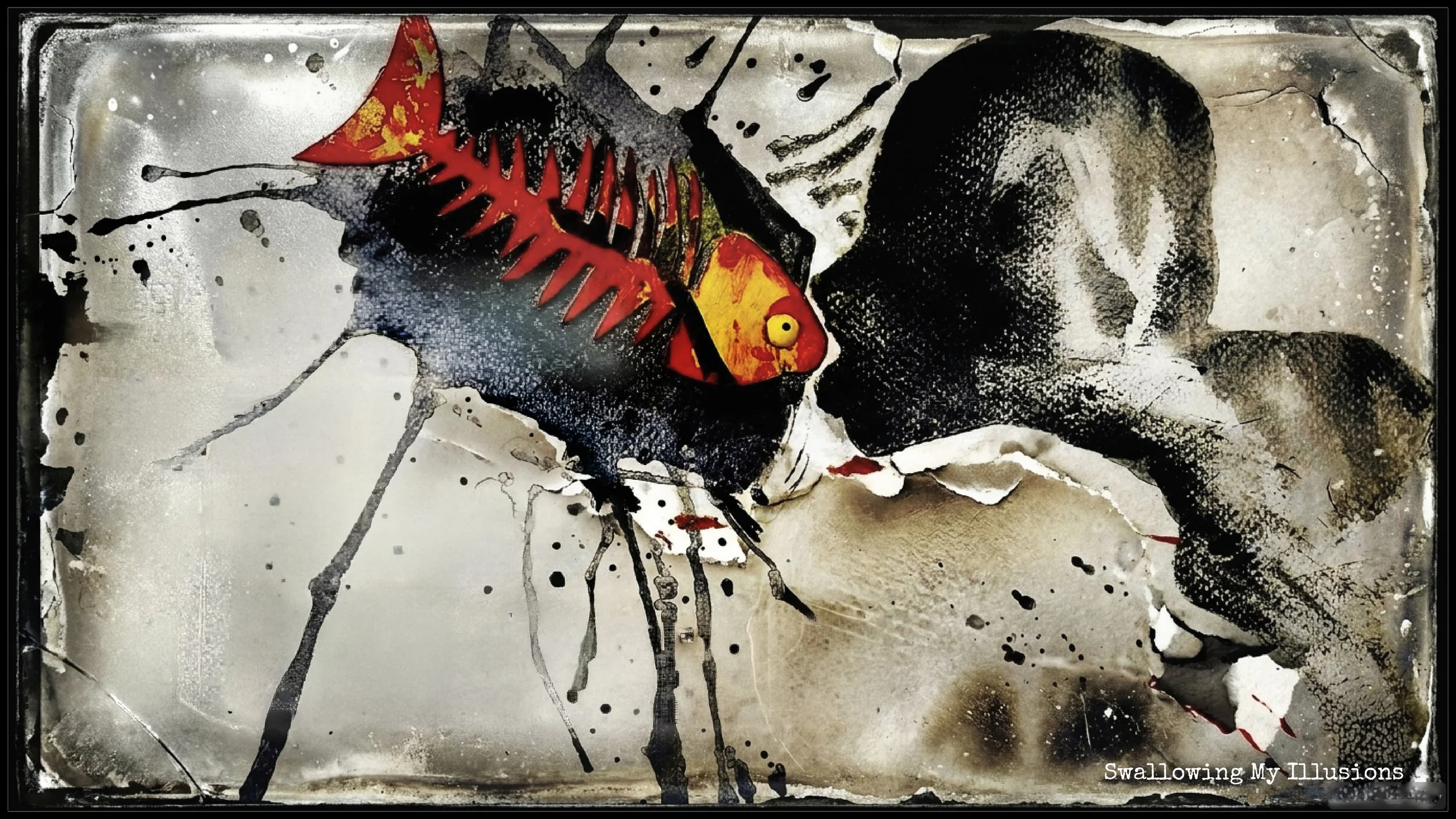

Glass Bones, Chapter 7: The Fragile Architecture of Meaning

This week's reading from Glass Bones is Chapter 7, The Fragile Architecture of Meaning.

I've been building toward this chapter through Becker, mortality awareness, denial, culture, worldviews, and Terror Management Theory. Chapter 7 brings those ideas together around something I've become increasingly interested in: how stable meaning feels from inside it and how fragile it actually is.

Culture looks solid. We have institutions, religions, political systems, traditions, identities, rituals, laws, flags, and all the stories we inherit about who we are and what matters.

But psychologically, these structures may be far less permanent than they appear.

Ernest Becker understood culture as a symbolic system constructed partly in response to mortality awareness. It gives us significance, continuity, and a place inside a world that will eventually continue without us. Terror Management Theory extended Becker's argument experimentally, showing how strongly people can defend these worldviews when mortality becomes psychologically salient.

That helps explain something about human conflict that has always fascinated and disturbed me.

When someone challenges a deeply held worldview, we may experience more than disagreement. Something underneath the argument is being disturbed. The structure that organizes reality itself begins to tremble.

This is why political disagreements can become questions of identity. Religious differences can become existential threats. National symbols acquire enormous emotional power. People may become more certain precisely when the ground beneath that certainty has become less secure.

We defend the very structures that protect us.

The problem is that no symbolic structure can completely solve mortality. Every worldview eventually encounters something it cannot explain, absorb, or protect us from. Death remains. Loss remains, chance remains, and the body fails. History interrupts us, and the world refuses to behave according to the stories we've constructed around it. The architecture cracks.

For me, this moment is also where art becomes interesting.

Artists spend a remarkable amount of time working with things that refuse complete control. Materials fail, images disappear, and paintings go somewhere you didn't intend. A glass plate that seemed perfect suddenly lifts in the wash or is damaged. Sometimes the failure becomes more compelling than the thing you were trying to make.

Glass Bones - Chapter 6: The Mechanics of Defense

I’ve posted my reading of Chapter 6 of Glass Bones, “The Mechanics of Defense.”

The previous chapters have gradually moved toward a central problem: human beings possess enough consciousness to understand that we exist, but that same consciousness allows us to anticipate our own disappearance.

We know that we will die.

And yet we still have to get out of bed in the morning.

We make coffee. We work. We fall in love. We make photographs and paintings. We worry about money. We argue about politics. We plan for next year. Somehow, the knowledge of death remains present without occupying the center of consciousness every waking moment.

How do we do that?

Chapter 6 examines some of the psychological machinery that makes ordinary life possible.

Defense mechanisms are usually discussed as ways of protecting the ego from uncomfortable thoughts, impulses, emotions, or experiences. From an existential perspective, however, they may also participate in something much larger. They help regulate our awareness of vulnerability, contingency, meaninglessness, and ultimately mortality.

Denial, repression, projection, displacement, rationalization, and other defensive processes create psychological distance between ourselves and what threatens us.

Ernest Becker understood this problem in unusually stark terms. For Becker, the denial of death was not simply one defense among many. It was woven deeply into human culture and personality. Much of what we construct around ourselves, including identity, status, morality, achievement, belief, and symbolic meaning, may function partly as protection against the terror produced by mortality awareness.

This does not mean that everything human beings value can be reduced to fear of death. I think that interpretation goes too far. Love is still love. Art is still art. Meaning matters precisely because it is experienced as meaningful.

The more interesting question is how mortality may operate underneath these structures without completely determining them.

That distinction matters.

A defense can protect us without being pathological. In fact, some degree of denial may be necessary. To remain continuously aware of our fragility would make ordinary life extraordinarily difficult. Psychological defenses allow us to narrow consciousness enough to function.

The problem begins when protection becomes rigidity.

A worldview that gives life meaning can become something that must be defended. A belief can become inseparable from identity. Another person’s values, religion, politics, body, culture, or way of living may then feel like more than disagreement. They can become psychologically threatening.

At that point, the mechanics of defense begin moving outward.

We project.

We judge.

We divide the world into categories.

We create insiders and outsiders.

We defend ourselves against ideas and people who disturb the structures through which we understand ourselves.

This is one of the darker implications of Becker’s work, and it becomes increasingly important as Glass Bones moves forward. The systems that protect us from existential anxiety can also participate in prejudice, aggression, scapegoating, and violence.

The same psychological architecture may contain both our capacity for meaning and our capacity for destruction.

For me, this is also where art becomes particularly interesting.

Creative work can certainly function defensively. Artists build identities, seek symbolic permanence, leave objects behind, and participate in cultural systems that promise some continuation beyond biological life. But art can also do something quite different.

It can expose the defense.

An artwork can place us in front of uncertainty without immediately resolving it. It can make mortality visible without explaining it away. It can hold contradiction, ambiguity, beauty, decay, presence, and absence together long enough for us to experience them.

Perhaps that is one of art’s more significant psychological possibilities.

It does not necessarily defeat the denial of death.

Sometimes it simply lets us see it working.

Glass Bones Chapter 4 - Culture As Armor

Chapter 4: Culture As Armor | Glass Bones: Art, Mortality, and the Human Mind

In Chapter 4 of Glass Bones: Art, Mortality, and the Human Mind, I turn to one of Ernest Becker’s central ideas: culture functions as a kind of psychological armor against the knowledge of our mortality.

We know that we will die, but we cannot live every moment fully conscious of that fact. Culture gives us ways to manage this contradiction. Religion, family, work, art, achievement, nationality, morality, and the values we attach to our lives help create a world that feels meaningful, ordered, and enduring.

This chapter begins to explore how these cultural systems protect us from death anxiety but also what happens when the beliefs that give our lives meaning are challenged by other people, other cultures, or other ways of seeing the world.

If the earlier chapters of Glass Bones ask how human beings became conscious of mortality, Chapter 4 asks the next question: What did we build to protect ourselves from knowing it?

This is where Becker’s ideas begin to open into the larger psychological and cultural questions that run throughout the rest of the book.

Glass Bones: Art, Mortality, and the Human Mind
Chapter 4: Culture As Armor

THE BOOK IS AVAILABLE HERE

Glass Bones: Chapter 3- The Beginning of Denial

In the first 38 pages of Glass Bones, I laid out the central problem: human beings are animals who became conscious enough to understand that we will die. I examined how the awareness of death organizes much of human thought, behavior, culture, and creativity, rather than being a mere occasional fear.

Chapter 3 follows that question backward. If death awareness creates the problem, when did the problem begin? The Beginning of Denial looks at the emergence of human self-awareness and asks what happened when our ancestors became capable of imagining themselves across time and, eventually, imagining their absence from it.

This is where denial begins to take shape, not necessarily as a conscious refusal to think about death, but as a psychological adaptation to knowing something no animal seems equipped to live with easily.

Glass Bones: Chapter 1 - Thr Problem We Don't Admit

The chapter is titled "The Problem We Don't Admit." It asks a simple but unsettling question: What happened when human beings first realized they were going to die?

The chapter explores mortality awareness as the defining rupture in human consciousness and introduces the central ideas that the rest of the book builds upon. It draws from the work of Ernest Becker, Ajit Varki, and Danny Brower and Terror Management Theory, while asking what this means for everyday life, creativity, and our search for meaning.

If you've been following this project, I hope you'll enjoy the reading.