• blog
  • in the shadow of sun mountain
  • buy my books
  • photographs
  • paintings
  • bio
  • cv
  • contact
  • search
Menu

Studio Q Photography

Exploring Human Behavior and Death Anxiety Through Art
  • blog
  • in the shadow of sun mountain
  • buy my books
  • photographs
  • paintings
  • bio
  • cv
  • contact
  • search
×

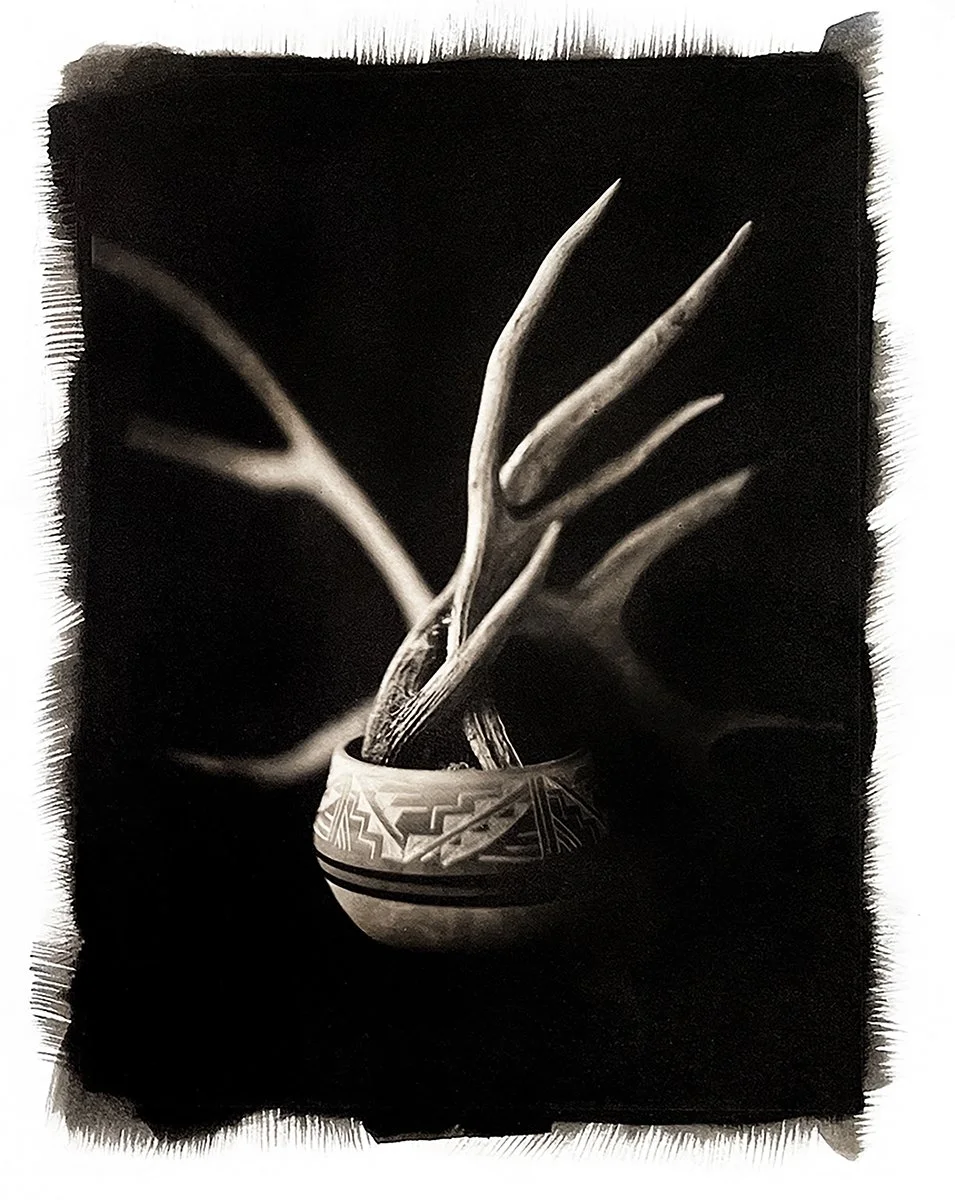
Figure 23

Antlers in a Ute Pot: Over-Evolution and the Burden of Consciousness. The photograph draws on Peter Wessel Zapffe’s account of overdeveloped consciousness and its associated coping structures, situating human awareness as a form of evolutionary excess. This image also serves as the cover of In the Shadow of Sun Mountain: The Psychology of Othering and the Origins of Evil.

Whole plate palladium print from a wet collodion negative, 2022.
Photograph by Quinn B. Jacobson.

Glass Bones - Chapter 14: The Edge of Meaning

Quinn Jacobson November 5, 2026

Ernest Becker, Otto Rank, and the Burden of Consciousness

The Creative Mind & Mortality Podcast

In this week's reading of Glass Bones: Art, Mortality, and the Human Mind, I bring Ernest Becker more fully into the conversation about the artist and the psychological consequences of mortality awareness.

In Chapter 13, I explored Otto Rank's understanding of the artist as someone caught between two powerful human needs: the desire to belong to a collective culture and the equally strong need to remain an individual. Rank believed this tension was central to the creative personality. Artists depend on culture for meaning, language, and symbolic expression, yet their work often requires them to question the very structures that provide psychological stability.

Becker takes us further into the existential implications of that tension.

He understood that human beings live with a profound contradiction. We possess symbolic minds capable of imagining permanence, significance, and transcendence, yet we inhabit biological bodies destined to deteriorate and die.

We want our lives to matter. We want continuity. We want to believe that something about us will endure.

And we know, at some level, that our physical existence is temporary.

Becker believed this contradiction shapes much of human psychology. To manage the anxiety it produces, we construct cultural systems of meaning that tell us who we are, what matters, and how our lives might contribute to something larger than ourselves. He called these cultural hero systems.

Religion, nationalism, professional achievement, social identity, and even artistic accomplishment can become ways of establishing significance in a world where permanence is impossible.

These systems provide essential psychological protection. They also create difficulties when we begin to recognize how much of our meaning depends on beliefs we've inherited or constructed.

This is where Becker's understanding of the artist becomes particularly interesting.

The Artist's Tragic Position

Becker saw the artist as someone who may experience the instability of cultural meaning more directly. The artist recognizes that the symbolic structures we depend on are human creations, yet still needs those structures to make sense of existence.

There's a difficult tension here.

We can recognize that meaning is constructed and still experience a profound need for it. We can understand that our work will eventually disappear and still feel compelled to make it.

Becker described this condition through the idea of tragic heroism.

For me, this is one of his most compelling insights.

Tragic heroism involves acknowledging our limitations, recognizing the absence of ultimate guarantees, and continuing to participate in life anyway.

In creative practice, this might mean returning to the studio knowing that the work will deteriorate, that our accomplishments may eventually be forgotten, and that nothing we make can permanently protect us from death.

And yet we continue.

Creativity and the Burden of Knowing

I've spent decades working with nineteenth-century photographic processes, particularly wet collodion, along with painting and mixed media.

These processes continually remind me of impermanence. The chemistry is unstable. Glass can break. Images can deteriorate. A photograph preserves a moment that has already passed.

I'm interested in what happens psychologically when we work with that awareness rather than immediately trying to escape it.

Rank helps explain the tension between the individual and the collective. Becker reveals the existential pressure beneath that tension: our need for symbolic significance within a finite biological life.

Together, they offer a useful framework for understanding why creative work can be psychologically demanding.

But I think there's another question worth asking.

What actually happens when an artist remains with existential uncertainty long enough for it to influence the work?

Does the creative process change our relationship with death anxiety? Can it help us metabolize experiences that might otherwise become overwhelming? And what happens when the beliefs and narratives that once sustained us begin to collapse?

These questions move beyond the artist's psychological position and into the experience of making.

Where the Inquiry Goes Next

Rank and Becker provide much of the theoretical foundation for my inquiry, but their accounts leave important questions about the actual process of creative engagement.

They help us understand why artists might experience tension with collective meaning and why mortality awareness creates such profound psychological pressure.

What remains to be examined is how that pressure unfolds.

In the chapters ahead, I'll turn toward Terror Management Theory, the instability of cultural worldviews, and the moments when familiar systems of meaning begin to fail.

I'm particularly interested in the threshold where awareness becomes difficult to contain, where the stories we've depended on no longer provide the protection they once did.

This is the territory of rupture.

For me, the central question remains whether creative practice offers a different way of encountering that instability, one that allows us to remain present without immediately constructing another protective narrative.

Becker's tragic heroism suggests that there may be dignity in acknowledging our condition and continuing to create without guarantees.

Perhaps that's one of the most important things art can offer.

A way to work with the knowledge of our impermanence, even when we cannot resolve what that knowledge means.

Glass Bones: Art, Mortality, and the Human Mind
Quinn B. Jacobson
In Chapter 14, Edge of Meaning, The Creative Mind and Mor, Ruptureology, Rupture Field Theory, Rupture, Otto Rank, New Books 2026, Glass Bones Book, Glass Bones Reading Tags chapter 14, Book Reading, Edge of Meaning, Glass Bones
Comment

The Scholar of Mortality is Still Mortal

Quinn Jacobson June 2, 2026

As I wait for the printer to ship a load of Glass Bones in June, I want to share what's next.

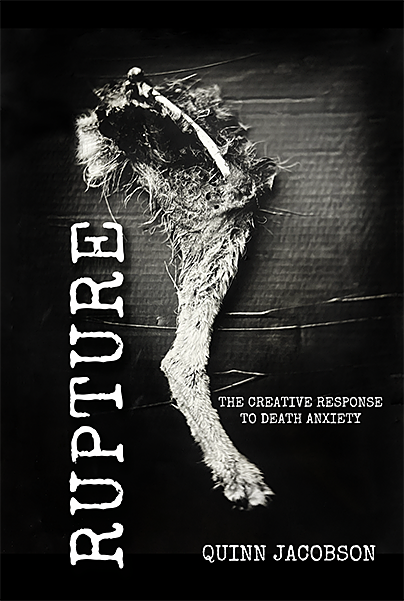
I've started a new body of work for a new book. The title is RUPTURE. The subtitle: The Creative Response to Death Anxiety.

I'm approaching this differently than Glass Bones. Creative work in the foreground. Theory in the background. The theory still matters, because I plan to do more than explain Rupture Field Theory. I want to live it out in the studio and darkroom.

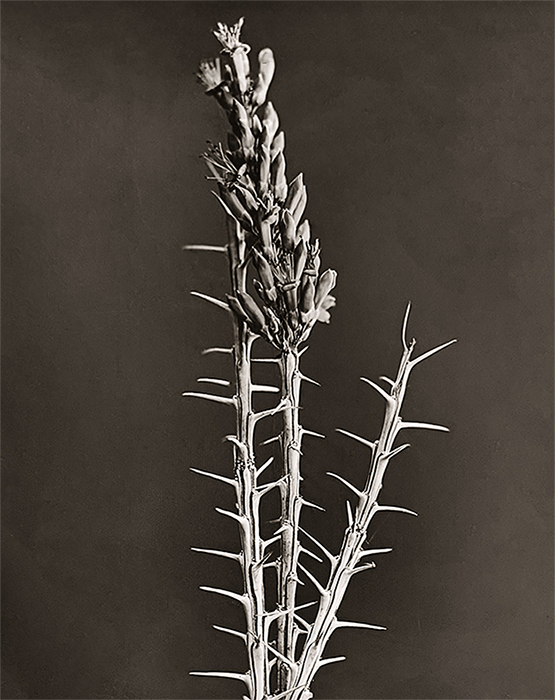
Detail Ocotillio Canes. Whole plate palladium print. 2026. This is the reference for my new painting.

Why does that feel worth doing? It hasn't been done this deliberately before, as far as I know. And it brings weight to the question of what creativity can do in the face of mortality. The buffer model is well established. Most artists work that way, whether they name it or not (Solomon et al., 2015). What I'm after is something I call practiced proximity. Staying in the transitional space between rupture and form, between exposure and image, refusing to seal it over. Just as a side note: If I wanted to name what practiced proximity looks like, you could point at these three pieces. The work isn't depicting the transitional space. The work is the transitional space, made visible across three returns.

What happens in that space? What does the art say that words can't reach?

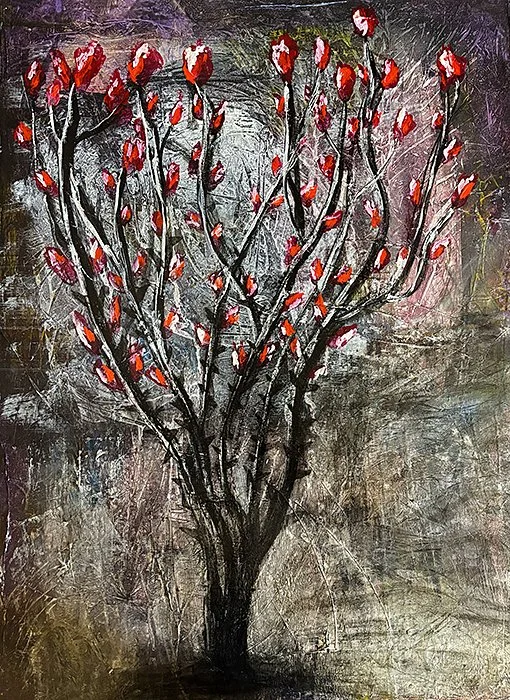
Ocotillo. 36 by 48 in. Mixed media on canvas. 2025

Those questions sit at the foundation of the book. I want to know what it means to remain there, to keep moving through the cycle of giving form to existential anxiety without converting it into protection. The harder question follows. Why not use creativity the way most people do, as a buffer for the weight of being alive while knowing we will die? What becomes possible if I stay in the rupture instead?

“Judge a man by his questions rather than by his answers.”
— Voltaire

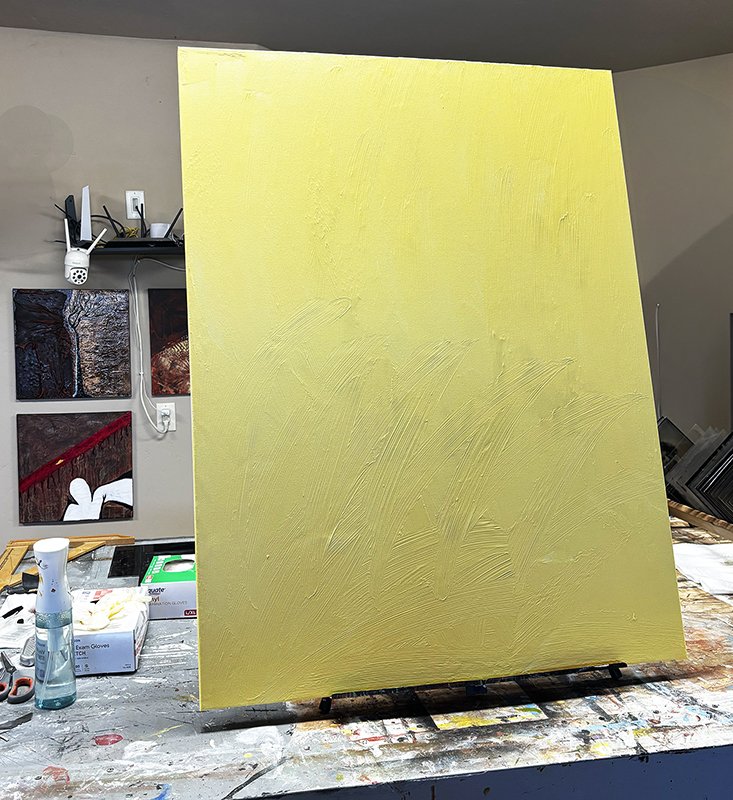
To that end, I've started a new painting. A 36 by 48 inch canvas. Today I laid the ground, a mix of gesso and sunshine yellow. I like the way the light yellow holds the surface.

The image I have in mind is a detail of ocotillo canes. I made a wet collodion negative and a palladium print of the plant that drew me here. The new painting continues one I made in 2025. Both belong to the next book. The book is where I plan to take practiced proximity into the studio and the darkroom, and see what it gives back.

36 by 48 in. yellow ground—May 27, 2026—Even my other paintings are looking on—watching the new one begin. Rupture Field Theory in action.

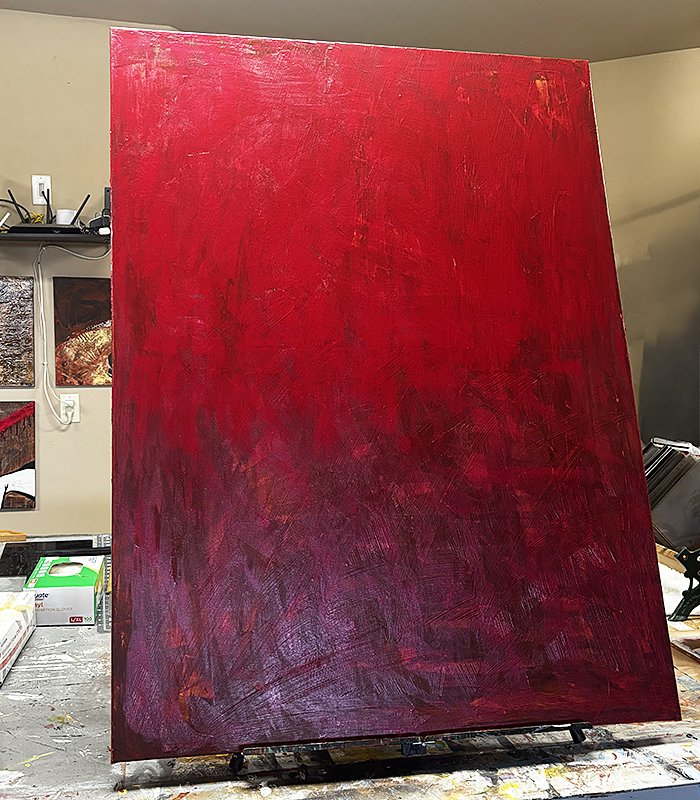
36 by 48 in. layer two—May 28, 2026. The work begins.

Rupture

It's the first thing: the moment something that held your world together gives way, and you're left standing in front of a reality you can't yet take in.

Simply put, rupture is when life stops making the sense it used to. Sometimes it's sudden: a death, a diagnosis, or a betrayal. Sometimes it's slower, more ambient. The low hum of climate dread. Political instability. The feeling that the ground beneath you has become less reliable than it once seemed. Either way, something tears. The story you were living inside no longer holds, and for a time you stand in the gap with no replacement ready.

Rupture can be acute or accumulative. It may arrive all at once, or it may build slowly through a series of disruptions that, taken individually, seem manageable. Eventually the accumulated weight exceeds the capacity of the structure to hold. What matters is not the speed of the break, but the fact that the break occurred.

What makes rupture different from ordinary stress is that it isn't a problem to solve. You can't think your way back to how things were. It is a structural break. Not a bad day or a temporary setback. The scaffolding comes apart: what is safe, what lasts, and who you are. You're left looking directly at something most of us keep at the edge of our vision: that everything is provisional, including ourselves.

Rupture is not, after all, catastrophe, and it is not trauma in the clinical sense, though it can be both. It also includes the ordinary ruptures many of us now live inside. The background instability that never arrives as a single event but still erodes the feeling that things will hold.

Rupture is the crack.

The moment a structure can no longer contain reality. The instant the surface gives way, before the anxiety rushes in and long before meaning is made.

Q:
What are you talking about when you talk about Rupture Field Theory (RFT)? What does it mean and why is it important?

A: Remaining near rupture is valuable because it allows a more honest encounter with reality, and from that encounter, new forms may emerge: meaning, art, relationships, and ethical responses. The claim withholds almost everything. It doesn’t promise healing. It neither promises growth nor transformation. Only possibility.

And that "may" is where the intellectual integrity of the theory lives: fragile, conditional, and never guaranteed. This sets it against most creativity-and-well-being literature, where the encounter with difficulty reliably yields resilience, flourishing, and post-traumatic growth. RFT declines that bargain. It treats proximity to rupture as honest before it is generative and refuses to assume the second follows from the first.

Here's what the passage is saying, plainly.

The core idea: staying close to painful ruptures—loss, breakdown, and the hard facts of being mortal—is worth doing because it puts you in more honest contact with how things really are. And out of that honest contact, good things might come, meaning art, real connection with others, and a more ethical way of acting. Might. Not will.

“The scholar of mortality is still mortal.”
— Quinn Jacobson

The second paragraph is making a point about that word "might" (which the passage writes as "may"). The entire value of the theory, which I am arguing, lies in that one cautious word. It's not promising that facing challenging things will heal you, make you grow, or transform you. It's only saying something good could come of it—no guarantee.

Then comes the contrast. A lot of popular writing about creativity and well-being makes a confident promise: go through something difficult, and you'll come out stronger, healthier, and wiser. "What doesn't kill you makes you stronger," basically. This theory refuses to make that promise. That refusal is the "bargain" it declines: the deal where pain reliably pays you back with growth.

The last sentence draws the key distinction: facing rupture is honest first and only, maybe productive second. The honesty is the real thing; any benefit that follows is a possible bonus, not a built-in reward. I won't pretend the good stuff is guaranteed just because the facing-up-to-things is valuable on its own.

So in one line: it's better to look hard truths in the face than to look away, and that's true even if doing so never makes you happier or more creative. The looking is the point; the payoff is only a maybe.

In my opinion, illustration begins with an answer, and inquiry begins with a question. Or even, illustration seeks confirmation, and inquiry seeks revelation. A lot of contemporary art is explanation disguised as discovery. The conclusion is already known. The work is assembled to support it. But the work I’m most interested in doesn't operate that way. The Rupture Field Theory was discovered more than designed. I’ve spent decades making photographs, paintings, and books; studying Becker, mortality, trauma, memory, creativity, landscape, and meaning-making. Eventually a pattern emerged that seemed to connect them. The question is, what becomes possible when we stop rushing toward closure?


References

Solomon, S., Greenberg, J., & Pyszczynski, T. (2015). The worm at the core: On the role of death in life. Random House.

In Rupture Tags Rupture the book
2 Comments

Search Posts

No results found
Archive Block
The page connected to this block was deleted. Double-click here to select a different page, or check the recycle bin for the deleted page. Learn more
Post Archive
  • Adventures
  • Spotlight
 

Featured Posts

Featured
Figure-20-Antlers copy.jpg
November 5, 2026
Glass Bones - Chapter 14: The Edge of Meaning
November 5, 2026
Read more →
November 5, 2026
knopp_door_052707-Ross.jpg
October 30, 2026
Glass Bones - Chapter 13: The Pressure of Knowing
October 30, 2026
Read more →
October 30, 2026
Suicide-Lux-Web copy 2.jpg
October 24, 2026
Glass Bones - Part One: Conclusion and Part Two: Introduction
October 24, 2026
Read more →
October 24, 2026
Quinn-Existential Artist.jpg
October 15, 2026
Glass Bones - Chapter 12: When Awareness Deepens
October 15, 2026
Read more →
October 15, 2026
Red-Yucca-book.jpg
October 9, 2026
Glass Bones — Chapter 11: Living with the Tension
October 9, 2026
Read more →
October 9, 2026
swallowing.jpeg
October 2, 2026
Glass Bones, Chapter 10: The Anxiety Beneath It All
October 2, 2026
Read more →
October 2, 2026
September 25, 2026
Glass Bones, Chapter 9: The Need to Matter
September 25, 2026
Read more →
September 25, 2026
Oragns-Clouds-Sept-16.jpg
September 17, 2026
Glass Bones, Chapter 8: When Meaning Breaks
September 17, 2026
Read more →
September 17, 2026
September 4, 2026
Glass Bones, Chapter 7: The Fragile Architecture of Meaning
September 4, 2026
Read more →
September 4, 2026
August 29, 2026
Glass Bones - Chapter 6: The Mechanics of Defense
August 29, 2026
Read more →
August 29, 2026