
Join Quinn on Wednesday evening (September 4, 2024, at 1700 MST) for a talk with Dr. Sheldon Solomon, author of The Worm at the Core: On the Role of Death in Life. Quinn and Sheldon will talk about how artists differ in their response to death anxiety. What can an artist do to harness this powerful psychological phenomenon? Can the knowledge of our impending deaths make us more creative?


The Studio Q Show LIVE! August 31, 2024
Engaging with Themes of Mortality
"Camera Lucida" by Roland Barthes
Join Quinn for a discussion on how artists can explore themes of mortality. The conversation will reference Roland Barthes' book Camera Lucida, which delves into the relationship between photography and death. The wet collodion process, commonly used in 19th-century postmortem photography, is particularly suited to these themes due to its unique aesthetic. Barthes' insights on photography and its connection to death will serve as a central point in this discussion.
"Camera Lucida" is a profound meditation on photography, but it also deeply engages with themes of mortality. Barthes reflects on the nature of photographs as they relate to the passage of time, memory, and death.
Saturday, August 31, 2024, at 1000 MST
Stream Yard: https://streamyard.com/ukhsywxuis
You Tube: https://www.youtube.com/live/SMZ_L8Zrx8I?si=fnfegB_v7KChp_19
You can read Camera Lucida here: CAMERA LUCIDA by ROLAND BARTHES
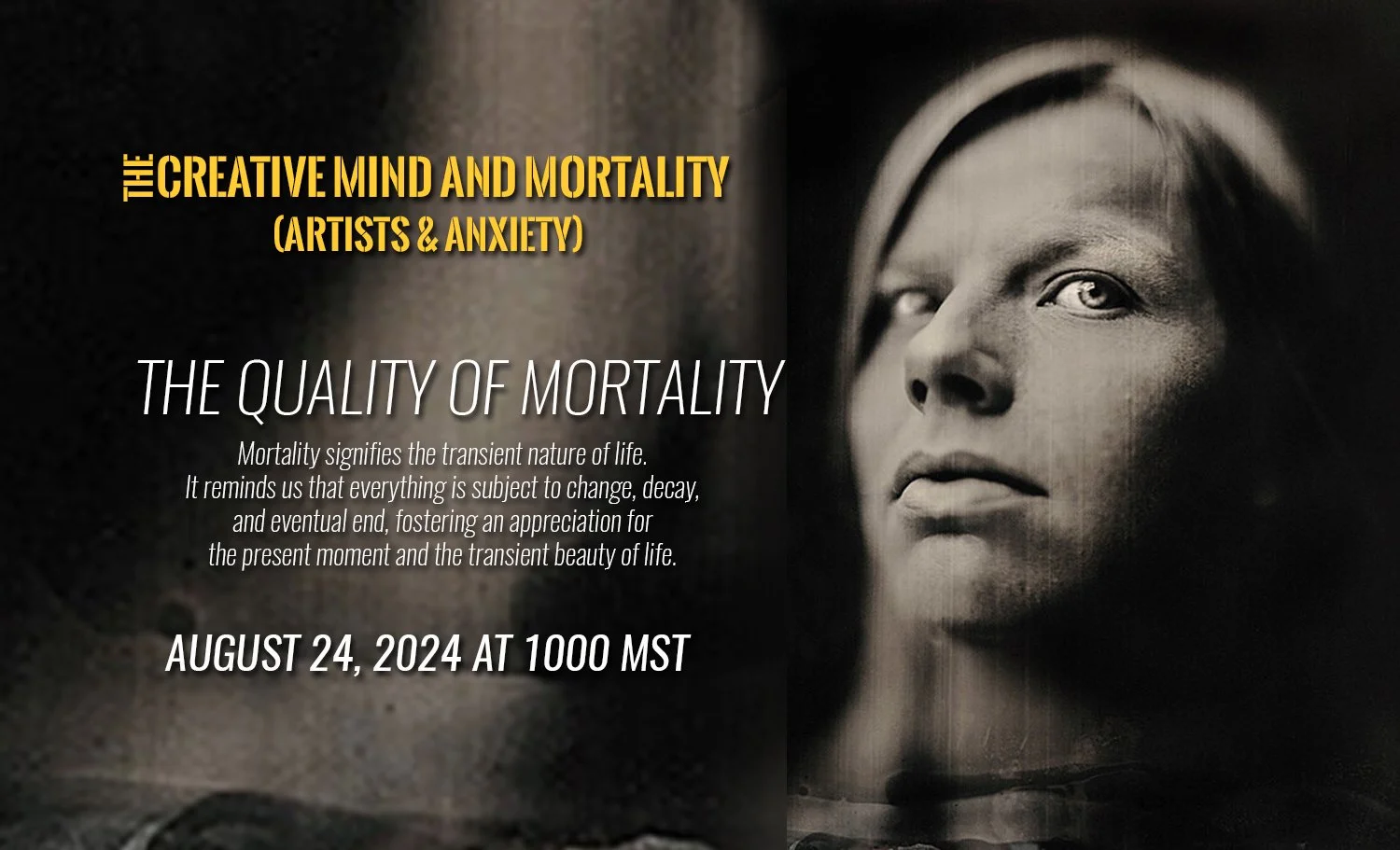
The Studio Q Show LIVE! August 24, 2024 at 1000 MST
Join Quinn on Saturday, August 24, 2024, at 1000 MST on Stream Yard or YouTube for another discussion about creativity and mortality. This week Quinn is going to address a Francis Bacon quote, "The quality of mortality." How artists struggle within cultures that don't provide sufficient illusions to buffer their existential dread.
Stream Yard (LIVE): https://streamyard.com/rgj2b62es2
YouTube: https://www.youtube.com/live/GDVcCBPu5Fo?si=npOlCTjB1hUZlKJM
The Studio Q Show LIVE! August 3, 2024 at 1000 MST
Join Quinn on Saturday, August 3, 2024, for an hour and explore the relationship between creative and non-creative people and how they cope with mortality. Quinn will cover some of Ernest Becker's thoughts on Otto Rank's breakdown of how artists manage their anxiety about death.
Stream Yard: https://streamyard.com/rdy5fe8ipy
YouTube: https://www.youtube.com/live/FPPpLUQFz7U?si=uJZIftVEZFMVHzHs


The Studio Q Show LIVE! July 27, 2024 at 1000 MST Part 3
THE CREATIVE ANIMAL??
This week, Quinn will continue the series on The Creative Mind and Mortality, Part 3."This will address artist's unique perspectives on why they create art and the struggles they face in light of existential dread or mortality.
What does it mean to have a "creative practice"?
How does creating art help with the fear of death?
Do creative people process existential terror differently? If so, how?
Ernest Becker's "The Denial of Death" and Otto Rank's book "Art and Artist."
Stream Yard (LIVE): https://streamyard.com/jc28hrjyd2
YouTube: https://www.youtube.com/live/VeLDm2Xv2K0?si=nUy1SRxfR75J481P

The Organ Mountains the other morning at 0555 on our walk/jog. The skies here are so beautiful and dramatic. It’s a painter’s paradise!
Potential Big News Coming... But First...
Hello! And hello, July!! Wow! Time is flying! It’s been over a month since I’ve posted anything here.
Life is wonderful in Las Cruces, New Mexico. Is it hot? Yes! It’s hot; so far, we’ve reached 105.5F (41C). And now we have the rainy season (they call it the monsoon season here). This will continue throughout this month and next.
We like it here a lot. We're still settling in; the garage is filled with boxes; and we're diligently working on our major home renovations, hoping to complete most of them soon. Settling in after a move can take months or even a year or two. That’s where we’re at now—just getting our legs, as they say. However, I’m posting this for a different reason.
I am on the brink of making a significant decision in my life (no, it is not relocating! LOL!). Because of this potential endeavor, I have been absent from my blog or writing here. I’m going to hold off on posting the news until I know for certain that it’s going to happen. I would like to query those who follow my YouTube channel (or this blog) and ask if they would like to engage with weekly live video streams again.
A few weeks ago, I received an email from a person who was jumping into the wet collodion process and shared how much they had enjoyed watching my YouTube videos. I appreciate these kinds of comments. I do get a few that write me and tell me they’re engaged with the 200+ videos on my channel and that they’ve found the information helpful, encouraging, or even a bit entertaining.
If you’re interested in joining a live show or even just watching the videos after they’re made, drop me an email or comment here. Let me know if this sounds valuable to you. My main goal would be to engage with the conceptual and the technical (ask questions live or send me emails to address on the show), and if I end up involved with this new venture, I’ll include that in the videos. Moreover, it would be beneficial to have a small community again engaged in talking about life, art, and making pictures.
And no, I’m not selling anything or asking for any commercial compensation; this is strictly for engaging with each other and having meaningful conversations.

Monsoon season in Las Cruces, New Mexico, June 29, 2024, 1730.

“Phrenology” - Whole Plate Black Glass Ambrotype - Viernheim, Germany 2009
A Very Fine Line: Narcissism and Self-Esteem Boosting
Every time I start to write about narcissism and self-esteem, some wires get crossed and confusion sets in, and I try to wriggle my way out of explaining the difference between the two. There is a very fine line between the two, and it’s very difficult to explain the nuances.
Self-esteem is very important for psychological security. You need it; every human being does. But what is self-esteem? Most people think that it’s feeling good about yourself. And that’s true, but it plays a much bigger role than that.
Ernest Becker said that self-esteem is as important as food to a human being. That’s quite a statement, but I think it’s true. Self-esteem boils down to a very basic need: having meaning and significance in a world that values you. Most of the time, our culture provides ways that we can bolster our self-esteem. Getting a degree, accomplishing important things at your job, raising a family, or belonging to a certain religion or political group. Even joining in with the fans of a specific sports team. All of those cultural constructs can give us the framework for boosting our self-esteem and making us feel like we’re significant in a meaningful world. That’s what we’re after (psychologically speaking), whether we’re aware of it or not, and most aren’t.
There are plenty of harmful ways we try to find that comfort, too. Ernest Becker articulated some of the malignant traits of pursuing this; he called it, “tranquilizing with the trivial.” These activities include shopping, social media, drinking, drugging, etc. These are all ways humans “turn off” (or try to) the constant gnawing of mortality. Most of the time, we try to work within our cultural worldview and boost our self-esteem by following what’s appropriate and accepted in our culture. If our culture doesn’t provide obtainable ways to bolster our self-esteem, we'll resort to tranquilizing with the trivial, or worse.
I just read an article about America's declining IQ. It’s called “Our Falling IQ Shows in the Polls” by Sabrina Haake. You can read the article here. I can’t help but see that social media has played a big role in this, among many other things (see article). I’m worried about this country. These are not new concerns; they are just more present and potent than before. And I can’t help but tie all of this back to Becker’s theories and Solomon’s empirical evidence about death anxiety and terror management theory. It’s so easy for me to see the correlation and causation. Some food for thought.
On another note: I’ve been editing my book like crazy for a few days. I try to get some editing time in every day. It’s exciting to see it get closer and closer to becoming a real, published book! I know there won’t be very many people interested in it, but for those that are, I hope you’ll find it potent and thought-provoking.
Flight From Death: The Quest For Immortality
This is a great interview. The interviewer talks to the writer of “Flight from Death.” Ernest Becker and the Denial of Death (there are two parts and hopefully a third coming out soon).

“Sacred Trees” - 2022; Whole Plate - Platinum/Palladium Print from a wet collodion negative.
On Quinn Jacobson's work "In the Shadow of Sun Mountain (Tava Kaavi): The Psychology of Othering and the Origins of Evil:" It's a poignant reflection on the historical and psychological dimensions of land ownership, colonization, and the human experience of mortality.
Jacobson's exploration of the unconscious denial of death and its connection to historical atrocities is thought-provoking. By linking these themes to the specific landscape and history of the Rocky Mountains, where he resides, he brings a personal and localized perspective to broader existential questions.
The integration of ideas from cultural anthropologist Ernest Becker and social psychologist Sheldon Solomon adds depth to Jacobson's exploration of mortality salience and existential anxiety. It's fascinating to see how these psychological theories intersect with historical and geographical contexts in his artistic practice.

“In the City of Crosses” - April 27, 2024
Agreed Madness
It’s our “one month” anniversary today. We’ve been in New Mexico for 30 days, and man, time has whizzed by!!
Between unpacking boxes and running household errands, I’ve been slowly getting back on track to work on my book. I get excited about the thought of actually completing this work. It’s no longer a hope or dream; it’s close to becoming a reality.
“Man literally drives himself into a blind obliviousness with social games, psychological tricks, and personal preoccupations so far removed from the reality of his situation that they are forms of madness—agreed madness, shared madness, disguised and dignified madness, but madness all the same.”
These theories seem simple on the surface, but it takes some deep thinking and evaluation to really understand them and, moreover, to apply them to your life. My hope is that by sharing these ideas and concepts in a book, it will inspire people (especially artists) to engage with these theories and start to share them through their art.
I wrote a while ago about someone asking me if there was a movement in art around “death anxiety.” In other words, Becker’s and Solomon's (et al.) theories could form an entire art movement based on the theories dealing with death anxiety and terror management. This is what happened in existential psychology. There are people working on PhDs in terror management theory and have been for years; why not art? Not unlike impressionism, cubism, dada, etc.
In a lot of ways, all art does address these ideas, but rarely intentionally or consciously. It’s food for thought and a wonderful way to get people to engage with these ideas.
Importance of Creativity
"Both the artist and the neurotic bite off more than they can chew, but the artist spews it back out again and chews it over in an objectified way, as an external, active, work project. The neurotic can’t marshal this creative response embodied in a specific work, and so he chokes on his introversions.
The only way to work on perfection is in the form of an objective work that is fully under your control and is perfectible in some real ways. Either you eat up yourself and others around you, trying for perfection; or you objectify that imperfection in a work, on which you then unleash your creative powers. In this sense, some kind of objective creativity is the only answer man has to the problem of life.
The creative person becomes, in art, literature, and religion, the mediator of natural terror and the indicator of a new way to triumph over it. He reveals the darkness and the dread of the human condition and fabricates a new symbolic transcendence over it. This has been the function of the creative deviant from the shamans through Shakespeare.
Otto Rank asked why the artist so often avoids clinical neurosis when he is so much a candidate for it because of his vivid imagination, his openness to the finest and broadest aspects of experience, and his isolation from the cultural world-view that satisfies everyone else. The answer is that he takes in the world, but instead of being oppressed by it, he reworks it in his own personality and recreates it in the work of art. The neurotic is precisely the one who cannot create." Ernest Becker, The Denial of Death

“Big Changes,” 3.75” x 5” acrylic, charcoal, newsprint (mixed media).
Radical Mindfulness Why Transforming Fear of Death is Politically Vital
This is a book by Dr. James Rowe that I would recommend reading if you want to understand what I’m trying to address through my artwork and my life in general (my interests). He is addressing Ernest Becker’s theories and terror management directly. I’ve never seen anyone write about the results of death anxiety applied to politics and modern and historical problems directly. My book will address these theories in detail, but I’ve made it personal. I’ve explained how the theories have driven me both creatively and psychologically.
Radical Mindfulness examines the root causes of injustice, asking why inequalities along the lines of race, class, gender, and species continue to exist. Specifically, Dr. James K. Rowe examines fear of death as a root cause of systemic inequalities and proposes a more embodied approach to social change as a solution.
Collecting insights from powerful thinkers across multiple traditions—including black radicals, Indigenous resurgence theorists, terror management theorists, and Buddhist feminists—Rowe argues for the political importance of seemingly apolitical practices such as meditation and ritual. These tactics are insufficient on their own, but when included in social movements fighting structural injustices, mind-body practices can start to transform the embodied fears that give supremacist ideologies endless fuel while remaining unaffected by most political actors.
Radical Mindfulness is for academics, activists, and individuals who want to overcome supremacy of all kinds but are struggling to understand and develop methods for attacking it at its roots.