• blog
  • in the shadow of sun mountain
  • buy my books
  • photographs
  • paintings
  • bio
  • cv
  • contact
  • search
Menu

Studio Q Photography

Exploring Human Behavior and Death Anxiety Through Art
  • blog
  • in the shadow of sun mountain
  • buy my books
  • photographs
  • paintings
  • bio
  • cv
  • contact
  • search
×

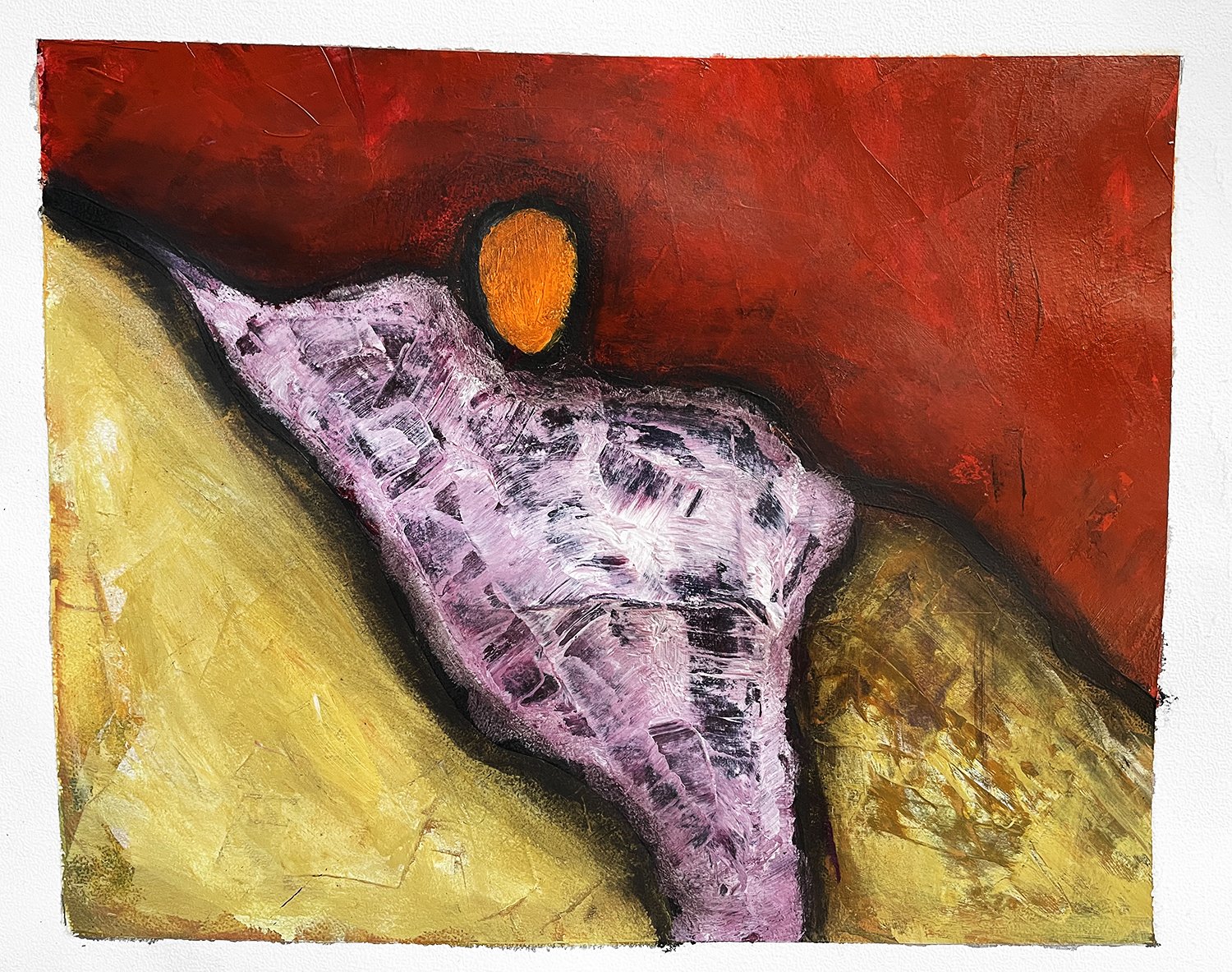
“Roman Candles,” 10” x 8” acrylic and charcoal on paper.

How We Manage Our Fears of Death

Quinn Jacobson February 8, 2024

This is a really good article that was published on Psychology Today by Jodi Wellman, MAPP. It's worth the read.

How We Manage Our Fears of Death

Terror Management Theory and Mortality Salience.

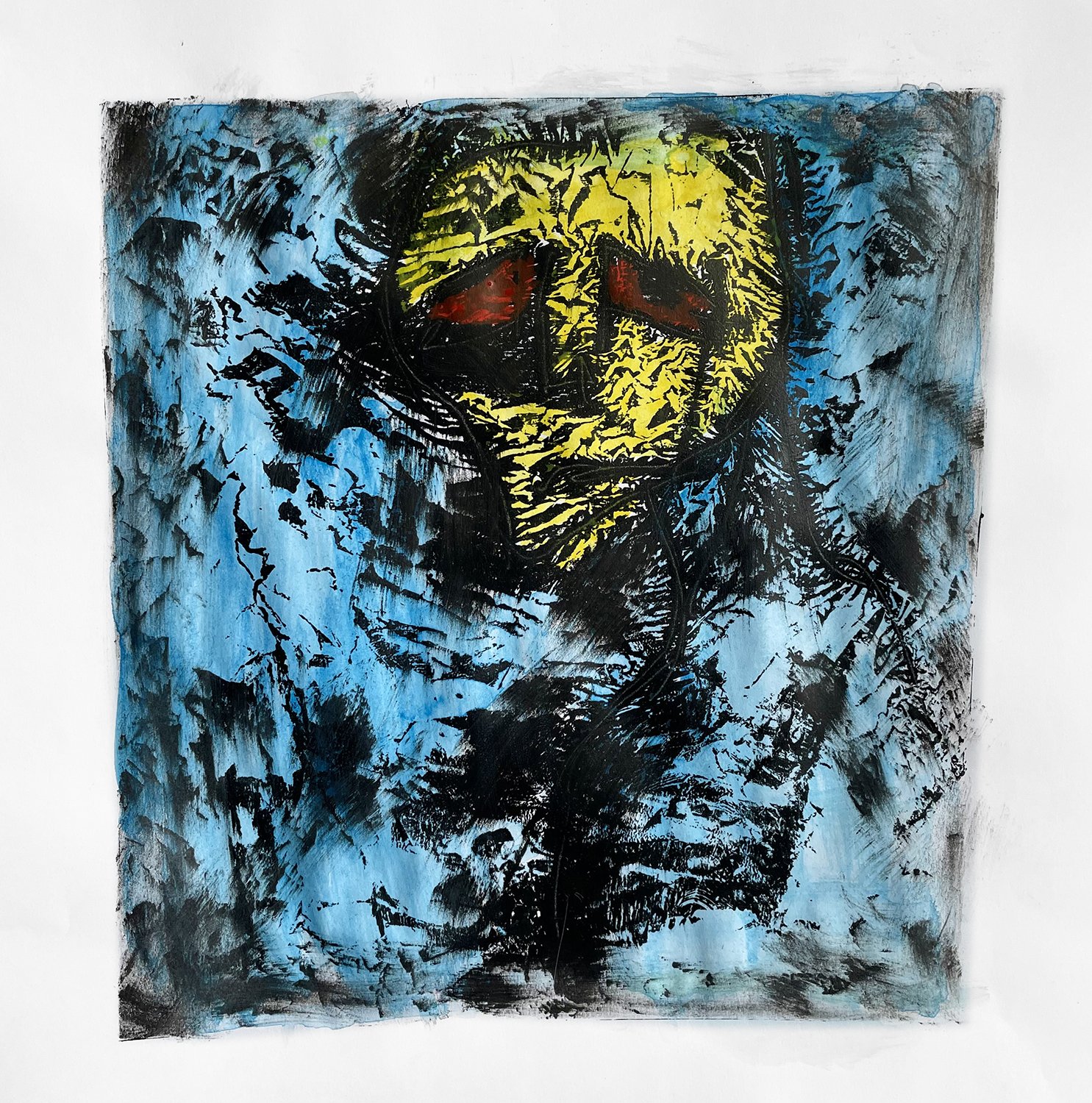
“Existential Distress No. 1," 3.75" x 5" acrylic, oil, charcoal, (mixed media) on paper.

KEY POINTS

  • When we contemplate our mortality, conditions are ripe for terror and dread to potentially fill the void.

  • Faced with "mortality salience," we find comfort in worldviews and bolstered self-esteem.

  • Death reflection is a productive, experiential way to reflect on our impermanence.

Terror management theory (TMT) is a prominent theory within death studies and is born out of the belief that, as humans, we are wired with a drive for continued existence and enduring value (George & Park, 2014). When juxtaposed against our understanding that we won’t exist forever, conditions are ripe for terror and dread to potentially fill the void (Greenberg, Pyszczynski, & Solomon, 1986).

We manage this disconcerting anxiety in two ways: we subscribe to a particular cultural worldview—a set of shared beliefs and values within an ingroup that provides order and meaning to us—and we also bolster our self-esteem, which is contingent on how well we believe we’ve adhered to the cultural worldviews we’ve adopted (George & Park, 2014).

Terror management theory allows us to suspend the disbelief of death and buy into the notion that some valued part of us will live on forever, even after we die. We might believe that we’ll literally carry on in an afterlife like heaven, symbolically seek to create a legacy through our children, or make a meaningful dent in the world in some way that will continue to exist beyond our time (Burke, Martens & Faucher, 2010).

Mortality Salience­

Mortality salience—the level of awareness we possess that we’re vulnerable to inevitable death (Greenberg, Pyszczynski, Solomon, Simon, & Breus, 1994)—evolved out of TMT to help conceptualize our behavior while we try to overcome our fears of mortality in the face of a deep need to stay alive (Mikulincer, & Florian, 2000). Studies consistently show that the act of pondering our demise causes us to cling more fiercely to our worldviews—whatever they might be—because they are the very constructs that help keep the terror of death at bay (Castano et al., 2011).

When the idea of death is made salient, study participants “double down” on their beliefs and value behaviors that align with their worldviews, while often disparaging others for presenting views that don’t match what they believe to be true (Castano et al., 2011).

Judges reminded of their mortality set an average bond of $455 in a hypothetical prostitution case, for example, compared to an average bond of $50 for the judges in a control group; by punishing others who violated their worldview beliefs, they reinforced their own worldviews to alleviate the tension caused by death priming (Greenberg, Solomon, & Pyszczynski, 1997).

Flashing the word "death" on a computer screen to American research participants, for mere fractions of a second, turned them against an author who criticized the U.S. (Solomon, Greenberg, & Pyszczynski, 2015).
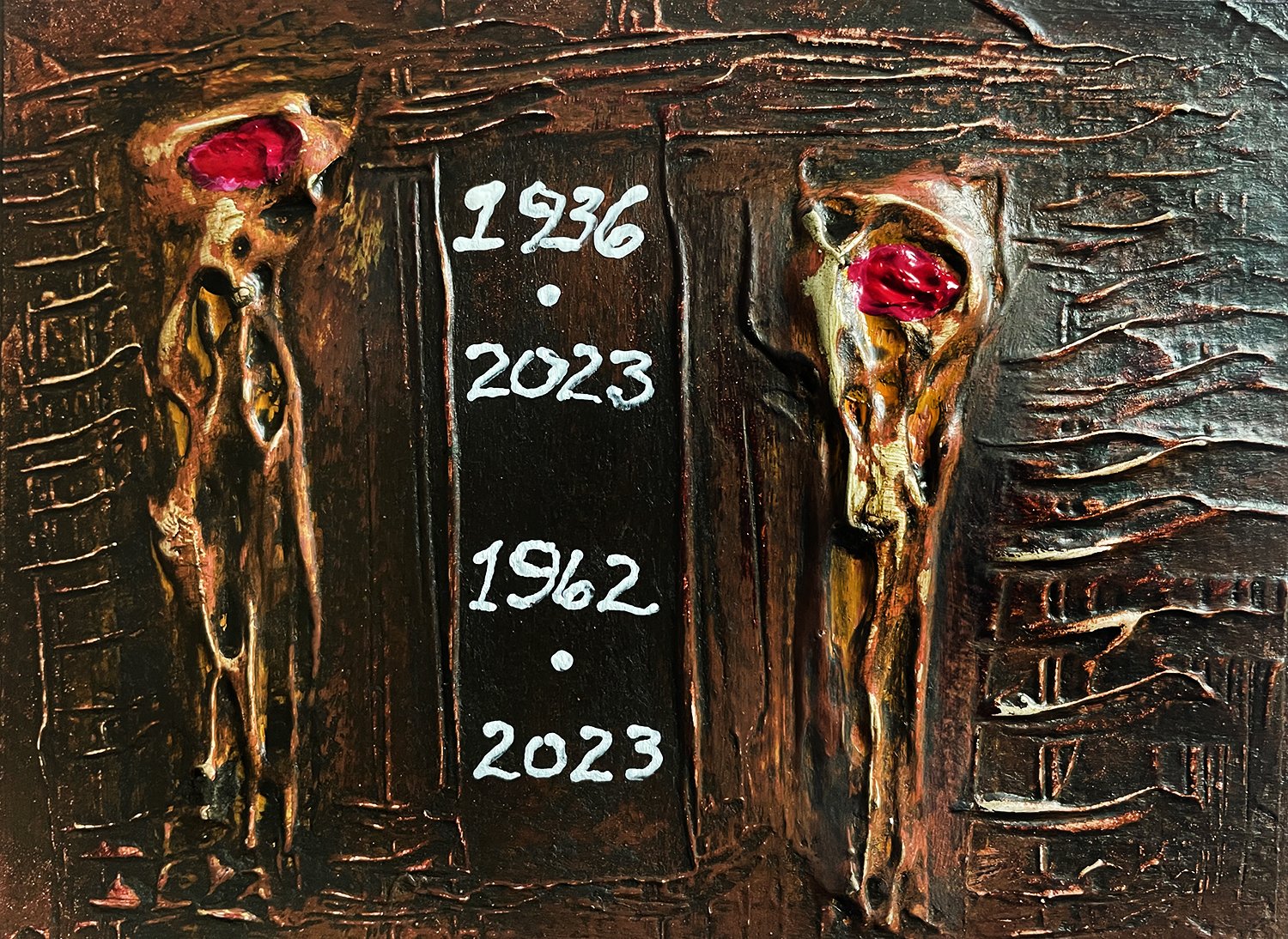
“Choctaw Bingo: Also Known as the Deaths of My Father and Brother,” 5” x 3.75” acrylic on paper.

Individuals interviewed in front of a funeral home had a more supportive of view charities than people who weren’t as interested in making donations interviewed a few blocks out of the range of the mortality prompt (Jonas, Schimel, Greenberg, & Pyszczynski, 2002).

Subtle reminders of death—like seeing an ambulance drive by, watching someone die onscreen, or even seeing wrinkles in the mirror—cause us to distance ourselves from our physicality (avoiding sex and other bodily activities that on some deep level signal that we’re so susceptibly perishable) and we turn up the dial on our symbolic value, like making our achievements, intellect and virtues shine (Solomon, Greenberg, & Pyszczynski, 2015).

Buffering the fear of death

Interestingly, there are ways to buffer ourselves from the angst of mortality salience. Heightened self-esteem reduces one’s worldview defense and has a protective quality against death concerns, as does the feeling of being powerful (Belmi & Pfeffer, 2016). Additionally, Juhl and Routledge’s (2016) research shows that people with high perceptions of meaning in life and people who define themselves as socially connected find themselves exempt from mortality salience anxieties, with no changes to their well-being (as measured by satisfaction with life and subjective vitality).

Encouraging individuals to reflect on their mortality awareness with openness, mindfulness and curiosity has also been shown to have a mediating effect on the guard they put up (Boyd, Morris & Goldenberg, 2017).

Experiencing mortality salience in the right context can ignite moral benefits like increasing tolerance of others and increasing one’s desire to be their best self (Oren, Shani & Poria, 2019); studies show that people (predominantly women) act in more prosocial ways in the week following death prompts (Belmi & Pfeffer, 2016).

Being primed with thoughts of death made study participants more likely to donate money into the future– a powerful demonstration of how inclined we are to want to leave a legacy that lets us live beyond the boundaries of our lifespans (Wade-Benzoni, Tost, Hernandez, & Larrick, 2012).

Reflecting on one’s own death also enhanced the levels of gratitude in study participants, as well as their appreciation of the simple pleasures in life (Frias, Watkins, Webber, & Froh, 2011).

Death reflection

Cozzolino (2006) notes that the typical mortality salience manipulations subjected to research participants represent death in a subliminal, generic, and abstract fashion—many steps removed from a true experience that might actually mimic a near-death experience. An alternative to mortality salience for death priming is a practice called death reflection, which has been found to be a more powerful and experiential way to get people in touch with their own death (Cozzolino, 2006).

Imagining oneself in the midst of an apartment fire—in vivid, graphic detail—elicits different death reactions than playing morbid word games or visiting funeral homes.

The implications of how we are primed to think about death are weighty: Research reveals that when we are exposed to our mortality as an abstract concept (as through traditional mortality salience experiments), we seek support in abstract ways—like bolstering our worldviews and religious and social affiliations. When we are exposed to our mortality in a specific and personal fashion (via death reflection) we derive support from internal resources—like construing goals, finding ways to meet our own needs, and seeking intrinsic growth (Cozzolino, 2006).

Furthering this logic, we’re motivated in different ways depending on whether we’ve triggered our abstract (traditional mortality salience) or specific (death reflection) information processing systems; under the auspice that we take action on things that have the potential to make our goals a reality (Carver & Scheier, 1990), we act in rather constrained ways that succumb to the norms of society when prompted by the abstraction of mortality salience (like driving by the cemetery), and we act in intrinsic, self-determined (Deci & Ryan, 1985) ways when prompted by existentially specific information, like forming plans that draw on our strengths and talents to achieve the goals we want for ourselves—not what our external worldview requires of us to fit in (Cozzolino, 2006).

Death reflection leads to unselfish, intrinsic behaviors (Cozzolino, Staples, Meyers, & Samboceti, 2004). These insights help put TMT and mortality salience research in perspective, and help shape future interventions intended to help people grow from reflecting on the inevitability of death.

References

Belmi, P., & Pfeffer, J. (2016). Power and death: Mortality salience increases power seeking while feeling powerful reduces death anxiety. Journal of Applied Psychology, 101(5), 702-720. doi:10.1037/apl0000076

Burke, B. L., Martens, A., & Faucher, E. H. (2010). Two decades of terror management theory: A meta-analysis of mortality salience research. Personality and Social Psychology Review, 14(2), 155-195. doi: 10.1177/1088868309352321

Carver, C., & Scheier, M. (1990). Origins and function of positive and affect: A control-process view. Psychological Review, 97, 19-35. doi: 10.1037/0033-295X.97.1.19

Castano, E., Leidner, B., Bonacossa, A., Nikkah, J., Perrulli, R., Spencer, B., & Humphrey, N. (2011). Ideology, fear of death, and death anxiety. Political Psychology, 32(4), 601–621. doi:10.1111/j.1467-9221.2011.00822.x

Cozzolino, P. (2006). Death contemplation, growth, and defense: Converging evidence of dual-existential systems? Psychological Inquiry, 17(4), 278–287. doi:10.1080/10478400701366944

Cozzolino, P., Staples, A. D., Meyers, L. S. and Samboceti, J. (2004). Greed, death, and values: From terror management to “transcendence management” theory. Personality and Social Psychology Bulletin, 30, 278–292. doi:10.1177/0146167203260716

Deci, E. L., & Ryan, R. M. (1985). Intrinsic motivation and self-determination in human behavior. New York: Plenum Press.

Frias, A., Watkins, P., Webber, A., & Froh, J. (2011). Death and gratitude: Death reflection enhances gratitude. The Journal of Positive Psychology, 6(2), 154–162. doi:10.1080/17439760.2011.558848

George L.S., & Park C.L. (2014). Existential mattering: Bringing attention to a neglected but central aspect of meaning? In A. Batthyany & P. Russo-Netzer (Eds.), Meaning in positive and existential psychology (pp. 39-51). New York, NY: Springer.

Greenberg, J., Pyszczynski, T., & Solomon, S. (1986). The causes and consequences of the need for self-esteem: A terror management theory. In R. F. Baumeister (Ed.), Public self and private self (pp. 189-212). New York: Springer-Verlag.

Greenberg, J., Solomon, S., & Pyszczynski, T. (1997). Terror management theory and research: Empirical assessments and conceptual refinements. In M. P. Zanna (Ed.), Advances in experimental social psychology (Vol. 29, pp. 61-139). San Diego, CA: Academic Press. doi: 10.1016/S0065-2601(08)60016-7

Greenberg, J., Pyszczynski, T., Solomon, S., Simon, L., & Breus, M. (1994). Role of consciousness and accessibility of death-related thoughts in mortality salience effects. Journal of Personality and Social Psychology, 67(4), 627–637. doi:10.1037/0022-3514.67.4.627

Jonas, E., Schimel, J., Greenberg, J., & Pyszczynski, T. (2002). The Scrooge effect: Evidence that mortality salience increases prosocial attitudes and behavior. Personality and Social Psychology Bulletin, 28(10), 1342–1353. doi:10.1177/014616702236834

Mikulincer, M., & Florian, V. (2000). Exploring individual differences in reactions to mortality salience: Does attachment style regulate terror management mechanisms? Journal of Personality and Social Psychology, 79(2), 260–273. doi: 10.1037/0022-3514.79.2.260

Solomon, S., Greenberg, J., & Pyszczynski, T. A. (2015). The worm at the core: On the role of death in life. New York, NY: Random House.

Wade-Benzoni, K. A., Tost, L. P., Hernandez, M., & Larrick, R. P. (2012). It’s only a matter of time: Death, legacies, and intergenerational decisions. Psychological Science, 23(7), 704–709. doi:10.1177/0956797612443967

In Acrylic Painting, Art & Theory, Charcoal Tags acrylic painting, charcoal, roman candles
Comment

"El Toro," 5" x 3.75" acrylic, charcoal, newsprint (mixed media) on paper.

Psychology and Art: An Interesting Question

Quinn Jacobson January 18, 2024

I recently got an email from someone in New Zealand that really caught my interest. They're in a Ph.D. program for creative writing and posed a very interesting question. I won't spill the whole email to keep things private, but here's the scoop: they wanted to know about artists influenced by death anxiety and terror management theory, seeing them as potential genres in art and literature. They gave a shoutout to my website and wished me luck in 2024. (Thanks for the email if you happen to see this post.)

I've been thinking a lot about this question. I've only come across one article about a painter diving into Becker's theories for their art. It's a fascinating question that could kick off a bit of a "movement" in the creative arts world if artists could accommodate and assimilate these theories. Most of the information on death anxiety and terror management theory is wrapped up in the world of science and academia. Most artists won't read these kinds of books and papers.

Imagine if artists from all walks of life hopped on board and started creating based on these ideas. It could add a whole new layer to humanity that other genres might miss. Sure, these ideas are a bit tricky to grasp and even tougher to apply to your own life. But once you get them, they're a game-changer.

How awesome would it be to encourage artists to dig into Becker's work and create stuff directly tied to death anxiety and terror management theory? Here's the kicker: a ton of art already revolves around these ideas; we just don't always see it that way. Death is something we all grapple with, and we're all kind of in denial that it's coming for us at some point. It's a universal theme that could make art even more relatable and powerful.

"Culturally Constructed Meat Puppets," 3.75" x 5" acrylic on paper.

In Acrylic Painting, Art & Theory, Denial of Death, Death Anxiety, Meat Puppets Tags acrylic painting, Psychology, art genres
Comment

“Existential Dread No. 8,” 8” x 10” acrylic and charcoal on paper.

Existential Dread No. 8

Quinn Jacobson January 9, 2024

“Existential Dread No. 8,” 8” x 10” acrylic and charcoal on paper.

“Existential Dread No. 8,” 8” x 10” acrylic and charcoal on paper.

“Existential Dread No. 8,” 8” x 10” acrylic and charcoal on paper.

In Abstract Painting, Art & Theory, Death Anxiety, Ernest Becker, Painting, Psychology, Shadow of Sun Mountain Tags acrylic painting, charcoal, existential psychology
Comment

“Existential Dread No. 7,” 8” x 10” acrylic and charcoal (mixed media) on paper.

Thirty Paintings a Month

Quinn Jacobson January 8, 2024

I paint every day. Sometimes, I’m able to make two or even three paintings a day. Mostly, I do “warm up” paintings: ideas for possibly larger pieces in the future. These “paint sketches” are really important for me. They do two things: first, they allow me to apply paint, make marks, and give me ideas for larger pieces (as I said). Secondly, I get better with each painting. With every painting I make, I learn something. One thing I’ve realized (probably from making photographs for years) is that I’m too “uptight” and too rigid. I’m slowly learning to reverse this; it’s difficult. In a lot of ways, I’m trying to unlearn what I did in photography. Yes, there are a lot of things that help me because of my knowledge of photography, light, composition, and even color theory. But there are a few things that make painting difficult; one of them is rigidity. I’m learning to loosen up and allow spontaneous and free-flowing movements and experiments to happen. It’s a great feeling.

I turn 60 years old this month. I was thinking about this the other day. It’s a strange feeling in some ways. It seems for the last decade I’ve been revisiting events of my youth, or at least exploring my interests as a younger adult. After my military service, I started a business making free-standing wood-burning stoves and fireplace inserts. I oversaw a shop of four welders and two finish line people. I made good money and enjoyed the work. I built hundreds of stoves myself and was efficient and skilled in metal fabrication. I was also proficient in all kinds of welding, including MIG, TIG, and stick welding, as well as brazing and other minor metal fabrication skills. This came to an end because of environmental issues concerning emissions and laws passed that prevented the sale of the stoves (the late 1980s). I ended up at the university, which, in the end, was a good thing.

A few years ago, I started metal fabrication again. I was doing blacksmithing and bladesmithing work. People asked, “Where did you learn to do this kind of thing?” They seemed to be a bit shocked and puzzled. It wasn’t either for me; it was taking a step back to my younger years and revisiting the skills and knowledge that I spent so much time doing. I’m not sure why I did it—maybe to clear my head and create in a different way. It just felt right and comfortable. I really enjoyed the nostalgia and feelings of shaping steel and working around a hot forge and welder again. It wasn’t foreign or weird to me at all.

That brings me to painting. Again, some people are wondering, "What is this all about?” Well, remember, I did four years at undergraduate school, and I majored in photography, visual art, and communication (with a minor in Spanish). In that emphasis of visual art, I did the introductions to painting, drawing, color theory, art history, etc. I also completed 8 credit hours of “studio art.” I did painting and mixed media, with a lot of photography involved. Along with those courses, I completed two courses in “painting on photographs,” a beginning course and an advanced course. And I also have a graduate degree, an M.F.A.I.A. That’s a master of fine arts in interdisciplinary art. That is self-explanatory, I think. My point is that I have a history of what I’m doing and have been doing. I’m simply revisiting my past and using it to flesh out my new work and project. And I love it. If I take up surfing or paragliding, you’ll know I’m in unfamiliar waters (no pun).

I find it interesting that people tend to want you to stay in the lane they “know you for,” and when you veer from that, it seems a bit apostate to them—some even seem disappointed. If they understood your background and life experiences, they might think differently. In the end, it doesn’t matter. I just thought I would share what I’d been thinking about entering my sixth decade on this pale blue dot. It’s not surprising that I find myself painting or making knives; at least to me, it seems like a kind of natural course of self-exploration. It’s paid off for me both mentally and conceptually. It’s given me more to work with on this project.

Thirty paintings a month. It’s not about the number; it’s not even relevant, really. It’s about commitment, learning, and growing. As I said earlier, I gain so much from each painting I do. I’m trying to be present for the journey. To really be grateful and appreciate each day and each piece of work I make. Ultimately, that’s what’s important to me. Painting, like photography, is something you have to practice to become efficient enough to accomplish what you want to accomplish. In the end, I hope to publish several of my paintings, along with my photographs, in my book to make a complete, cohesive, interdisciplinary work about human behavior and existential terror. That’s my goal.

One more thing. I’ve posted a few times about how beneficial our walks are to me creatively. You might find this article interesting if you subscribe to this theory about walking and creativity. Check it out:
How Walking Fosters Creativity

In Acrylic Painting, Abstract Painting, Art & Theory, Ernest Becker, Mixed Media, Non-objective Painting, Non-representational, Painting, Philosophy, Terror Management Theory Tags Painting, acrylic painting, Mixed Media
2 Comments

“The Color Blue and the Number Three,” 8” x 10” acrylic and charcoal on paper.

The Color Blue and the Number Three

Quinn Jacobson January 7, 2024

In some Native American cultures, the color blue represents the sky, water, and the spirit world. It can also symbolize peace, serenity, and spiritual awareness. Blue is often used in ceremonies related to prayer, meditation, and vision quests. In Native American mythology, the number three represents the vertical picture of the world. It represents the space between the Heavens and the Earth.

The Iroquois tribe also expressed the significance of the number three by smoking from a pipe three times. Traditional Native American gardeners have planted the Three Sisters (corn, beans, and squash) in many different regions of North America. Some versions of the Three Sisters legends involve the crops personified as three women who separate from each other only to find out that they are stronger together.

In Acrylic Painting, Abstract Impressionism, Art & Theory, Painting, Native American Tags acrylic painting, charcoal, native american, In the Shadow of Sun Mountain
Comment

“Existential Dread No. 5,” 8” x 10” acrylic and charcoal on paper.

Existential Dread No. 5

Quinn Jacobson January 6, 2024

There is something that I find both intriguing and fascinating about non-objective abstracts. Yesterday, I posted my representational abstract, “The Ballad of Curtis Loew,” based on a song and memory. This is a painting I did today based on an idea from within me—nothing representational or based on anything physical, at least when I started the painting. I’ll let the viewer decide what they see or feel in reference to the title. I have to say, I do love the underpainting on this. It gives the piece a lot of depth. It looks really nice in real life.

In the context of evolution, human existential crises may arise from our heightened cognitive abilities and self-awareness. As humans developed intricate thinking processes and self-reflective capacities, an increased awareness of mortality, the quest for meaning, and contemplation of one's existence became more pronounced. While an existential crisis isn't necessarily a flaw, it can be viewed as a consequence of our advanced cognitive functions. It might function as a mechanism for individuals to scrutinize and assess their position in the world, fostering personal growth and the formulation of coping strategies. In this regard, it can be perceived as a beneficial function that motivates individuals to explore purpose and meaning in their lives.

Ernest Becker said, “What does it mean to be a self-conscious animal? The idea is ludicrous if it is not monstrous. It means to know that one is food for worms. This is the terror: to have emerged from nothing, to have a name, a consciousness of self, deep inner feelings, an excruciating inner yearning for life and self-expression, and with all this yet to die. It seems like a hoax, which is why one type of cultural man rebels openly against the idea of God. What kind of deity would crate such complex and fancy worm food?” (The Denial of Death)

In Acrylic Painting, Art & Theory, Consciousness, Denial of Death, Ernest Becker, Memento Mori, Non-objective Painting, Non-representational, Painting, Psychology, Shadow of Sun Mountain Tags acrylic painting, Ernest Becker, existential psychology
Comment

“The Ballad of Curtis Loew,” 8” x 10” acrylic and charcoal. Kind of a grisaille-style painting, minus the alizarin crimson as a focal point.

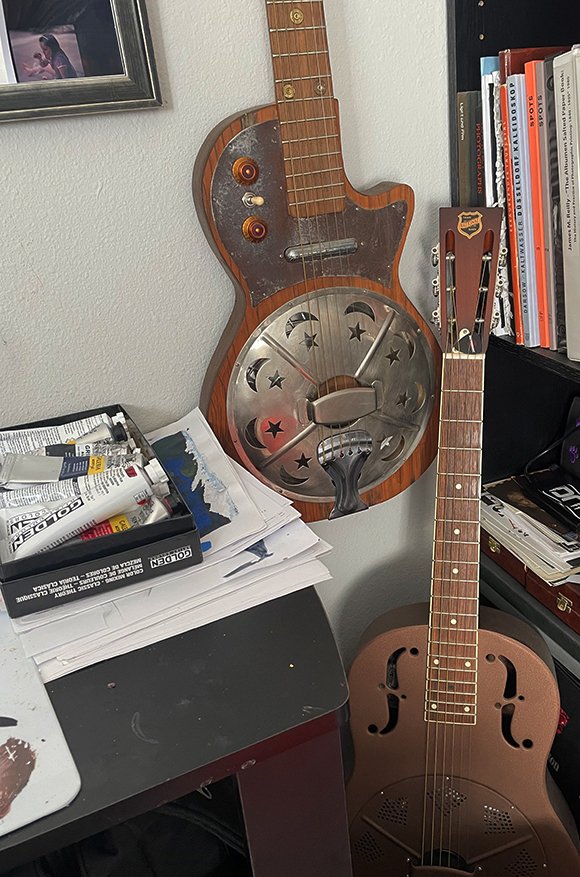
This painting is based on Lynyrd Skynyrd’s song of the same name. I love music, especially blues, and have been known to bang on my Dobro once in a blue moon. I was painting something else the other day, and this song came onto my playlist, and I looked over at my National Dobro and wanted to make a painting. The song deals with “otherness” and poverty, alcoholism as well as memory. There’s so much to unpack, but I’m moved mostly by the significance of marginalizing human beings, memory, and music. I had some similar experiences as a young boy. This song really resonates with me.

How Self-Awareness Awakens You

Quinn Jacobson January 5, 2024

Do you think you’re self-aware? How do you know if you are? Here are a couple of questions you can ask yourself:. Do you understand your strengths and weaknesses? Do you practice empathy? Do you recognize your biases? Do you seek personal growth? Etcetera.

Being self-aware is the first step in understanding both who you are and your position in the world or your culture. And yes, it does feed back to death anxiety and terror management theory. However, part of coming to terms with mortality relies heavily on self-awareness. I often quote Albert Camus; he said, "There is only one liberty: to come to terms with death; thereafter, anything is possible." The only way to do that is through self-awareness.

Have you ever been around a person who isn’t very self-aware? I have, and it’s very frustrating and annoying. When a person isn’t self-aware, you may see egotistical or even narcissistic behavior, as well as a complete disregard for other people’s intelligence or feelings. It’s a painful and disturbing experience. I’m on board for people to “toot their own horn” or share their accomplishments through the avenues where they find meaning and purpose. There’s nothing wrong with that. Where it goes off the rails for me is when they seek to “be better” or even belittle others with these accomplishments. When it becomes a competition, it can get ugly. This is the malignant result of existential dread. It’s nasty stuff. Social media is full of it.

Let’s stay on the positive side of dealing with meaning and self-awareness. Here are some questions you can ask yourself regarding this topic:. They are from a course I just completed about existential anxiety:

What are some accomplishments you have already achieved in your life that you find meaningful?

What goals or ambitions do you have for the rest of your life?

Who are the people who are most important to you in your life?

How do you demonstrate importance to these people in your life?

How do these behaviors, goals, achievements, ambitions, and intentions align with your culture and worldview?

These will help you start the process of both being self-aware and coming to terms with how you buffer death anxiety or existential dread. Which are kind of the same things or at least one leads to the other. This is the process I’ve used to become more self-aware and awaken to memories and meaning in my life. It’s the well-spring where I draw my inspiration and creative life from.

My view from my painting station. I listen to music, make marks and throw paint onto surfaces. A beautiful life.

In Acrylic Painting, Art & Theory, Dobro, Painting Tags Painting, acrylic painting, dobro, curtis loew
Comment

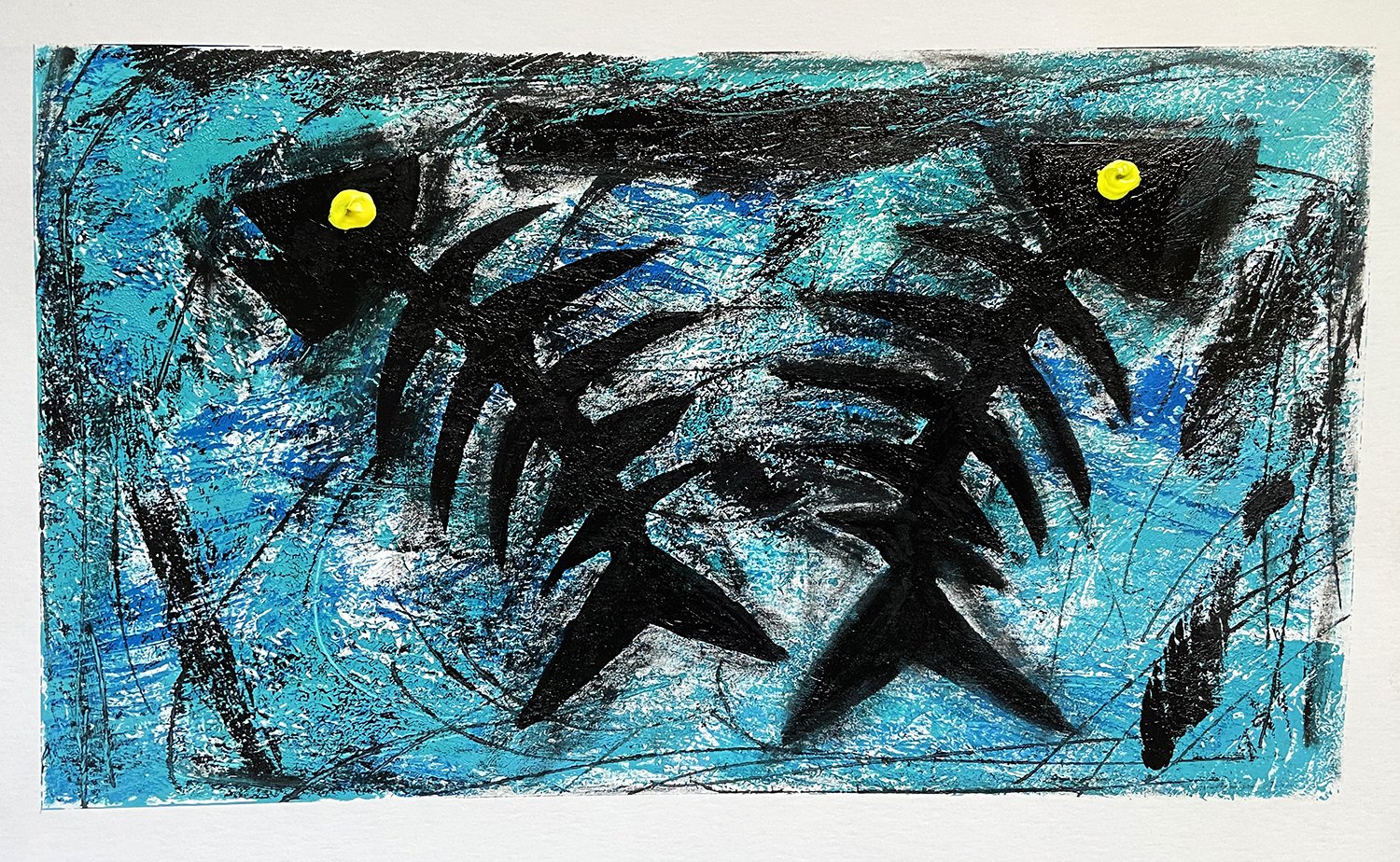
“Two Fish With Lemon Yellow Eyes No. 3,” 7” x 11” Acrylic and Oil

Two Fish No. 3

Quinn Jacobson December 7, 2023

I’m making a few paintings about fish (as you can see). I like the form and the symbol. As well as the variation you can get when painting these (as ideas for existential anxiety). Have you ever heard of ichthyophobia? The fear of fish—both dead and alive. The topic of fear interests me because it all relates to the fear of death.

In Art & Theory, Death Anxiety, Escape From Evil, Ernest Becker, Oil Paint, Painting Tags Painting, oil and acrylic painting
2 Comments

“Two Fish No. 1,” 7” x 11” Oil and Acrylic

Is it Something or About Something?

Quinn Jacobson December 5, 2023

“Fish Bones No. 1,” 6” x 6” (15 x 15 cm) Oil

Is it something, about something, or both? I’ve been trying to get my arms around avoiding the literal. It’s a difficult habit to break. Coming from photography, where everything is literal (even if it’s abstract), painting offers you a lot of freedom. Sometimes, that freedom causes you to freeze—it creates a barrier to making work that is less literal.

I have so many ideas that I want to paint; I’m just trying to find my way in with a blend of styles—impressionism and post-impressionism. Those are the movements that are most attractive to me. I would add some abstract impressionism in there too. These paintings I’m making will always be centered on Becker’s theories and terror management theory, but in a very non-literal way. Sometimes the content will be non-literal, and sometimes the ideas will be less than literal. It’s more of a personal journey than any kind of commercial process.

I said in my last post that I’m reading Rick Rubin every morning—early in the morning—and he’s been driving me to new places and trying new things. It’s liberating. He said, “Look for what you notice but no one else sees.” (Rick Rubin, The Creative Act: A Way of Being) That resonates with me deeply. I would say that is the core of my work (In the Shadow of Sun Mountain). I’m not sure that no one else notices, but the idea is to get away from the obvious, the literal, and the commonplace. I get it, and I agree.

“In terms of priority, inspiration comes first. You come next. The audience comes last.”
— (Rick Rubin, The Creative Act: A Way of Being

As I find my way through this iteration of the project, I do find my biggest obstacle to be literalism. I’m working to break the chains of photography and literalism and find my way to most representational work, even abstract in some sense. It’s a fun journey, and I encourage you to remember that you’re the creator of your work; you’re the one that needs to be happy with it. Another Rubin quote from his book is, “In terms of priority, inspiration comes first. You come next. The audience comes last.“ (Rick Rubin, The Creative Act: A Way of Being).

“Existential Dread No. 5,” 6” x 6” (15 x 15cm) Oil


In Art & Theory, Death Anxiety, Denial of Death, Ernest Becker, Oil Paint, Painting, Shadow of Sun Mountain Tags oil paint and watercolors, oil painting
2 Comments

“Existential Dread No. 1,” December 2, 2023, 6” x 6” (15 x 15 cm), Oil and Watercolor

The Implied and The Explicit

Quinn Jacobson December 4, 2023

I’ve been considering the words implied and explicit as they relate to art. When I think about photography, the word explicit comes to mind. It’s literal; it’s “of something.” Yes, it can be abstract, but it’s still something that exists. When I think about painting, sculpture, music, writing, etc., I think of the word implied. These mediums are less mechanical, most of the time. They are fashioned from nothing; the content usually doesn’t exist in “real life.” It can be an interpretation of something, but it’s always different.

“Art as a work in progress: All art is a work in progress. It’s helpful to see the piece we’re working on as an experiment.”
— Rick Rubin, “The Creative Act: A Way of Being”

My concerns and interests lie in impressionism, even abstract impressionism. To me, this form of art is the ultimate form of the word “implied.” There is so much freedom in making art that is less literal, more abstract, and less concrete. I can allow my mind to ponder the theories I’m interested in and create work that represents the ideas without being explicit. As I’ve grown older, I’m less interested in telling literal stories and more interested in exploring the emotions and feelings behind the ideas or concepts. I love photography and will continue to make photographs at some point, but for now, this is a much more powerful way for me to express my ideas.

I’ve been spending a lot of time reading and re-reading Rick Rubin’s book, “The Creative Act: A Way of Being.” He said, "Art as a work in progress: All art is a work in progress. It's helpful to see the piece we're working on as an experiment."

Photography has been a wonderful career for me. I made a living with it for many years and retired as a photographer. I’ve always loved it and appreciated it. As I’ve had time to think deeply about what I’m most interested in now, I find myself drawn to painting. For many years, I’ve threatened to start painting when photography doesn’t speak to me. I’ve dabbled in mixed media quite a lot over the years. In undergraduate school, I did a lot of experimental photography, even painting on images. But this is different for me now. I have specific ideas and themes I want to paint about. My Becker studies opened up so much for me, and I want to be free to express those ideas through post-impressionism, impressionism, and abstract impressionism. I’m no Pollock, no De Kooning, and surely no Van Gogh, but I know I have a voice in this medium.

My goal is to work through ideas and themes around death denial, death anxiety, terror management theory, gratitude, and humility. Those are the big-picture themes or ideas. I have several months now to paint because winter is here. Although I would be painting in the summer or in good weather too, it’s just a great winter activity. I’ll try to post occasionally about my progress. I’ve made 20–30 paintings so far and am still very much exploring techniques and ideas. Stay tuned!

“Existential Dread No. 1,” December 2, 2023, 6” x 6” (15 x 15 cm), Oil

“Existential Dread No. 2,” December 2, 2023, 6” x 6” (15 x 15 cm), Oil and Watercolor

In Art & Theory, Oil Paint, Painting, Philosophy, Terror Management Theory, Watercolor Paint, Creating A Body Of Work, death denial, Death Anxiety, Ernest Becker Tags painting, impressionism, oil paint and watercolors
Comment
← NewerOlder →

Search Posts

Archive Block
This is example content. Double-click here and select a page to create an index of your own content. Learn more
Post Archive
  • Photography
 

Featured Posts

Featured
Jan 27, 2026
My New Books for 2026
Jan 27, 2026
Jan 27, 2026
Jan 26, 2026
The Dimmer Switch Explained
Jan 26, 2026
Jan 26, 2026
Jan 24, 2026
Holding Pattern
Jan 24, 2026
Jan 24, 2026
Jan 19, 2026
The Sacred Didn’t Vanish - It Migrated
Jan 19, 2026
Jan 19, 2026
Jan 19, 2026
Animality: The Part of Us We Keep Trying to Forget
Jan 19, 2026
Jan 19, 2026
Jan 17, 2026
Working With Academia Without Being Rewritten
Jan 17, 2026
Jan 17, 2026
Jan 12, 2026
The Red Hand Problem
Jan 12, 2026
Jan 12, 2026
Jan 4, 2026
Immortality Projects and Creative Works
Jan 4, 2026
Jan 4, 2026
Dec 29, 2025
Interview With Dr. R. Michael Fisher: Careers of Folly and Wisdom
Dec 29, 2025
Dec 29, 2025
Dec 27, 2025
Denial: Self-Deception, False Beliefs, and the Origins of the Human Mind
Dec 27, 2025
Dec 27, 2025