The plant could be used to relieve swelling, stimulate fatigued limbs, and help with itching.
"Cat's Eye" 10" x 10" (25,4 x 25,4 cm) RA-4 Reversal Direct Color Print, July 31, 2023


"Cat's Eye" 10" x 10" (25,4 x 25,4 cm) RA-4 Reversal Direct Color Print, July 31, 2023
The plant could be used to relieve swelling, stimulate fatigued limbs, and help with itching.
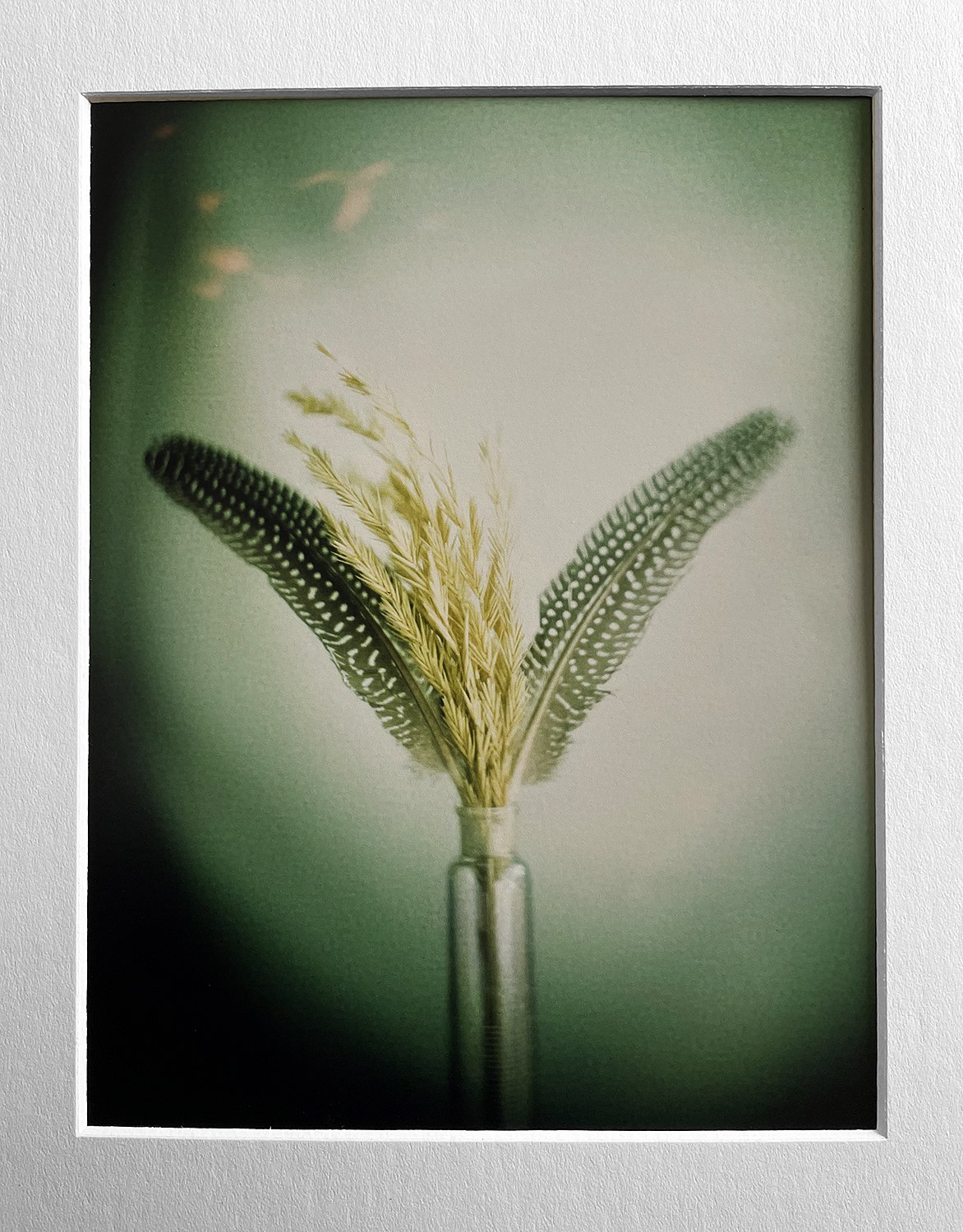
“Giving Flight” 10” x 10” (25,4 x 25,4 cm) RA-4 Reversal Direct Color Print, August 1, 2023.
In a lot of the photographic processes I’ve worked in, artifacts or defects in the process are a common occurrence. The wet collodion process is well known for these process defects. The beginners embrace them and call them “artistic.” Sometimes they are or can be, but most of the time it’s just used as a defense for poor processing techniques or a lack of understanding of the process.
I have used them in my work occasionally, but not often. The trick is control. Without control, they are simply mistakes. I won’t argue this point with people; if they like “oysters” and “comets,” so be it. Who am I to tell them any different? It’s their picture, not mine.
Having said that, I wanted to share this image. I made it today, August 1, 2023. Here’s the background (technically): After about 35 prints, which are 10” x 10” (25,4 x 25,4 cm), my Dektol developer starts to fail. When it starts to fail, I get crazy aberrations on the prints. Sometimes they are gorgeous; other times, not so much. Today, my print count was 36. I knew my developer was going to start failing. I took my chances with this print. And it turns out that the artifacts or defects are not only beautiful but also adds so much to the image.
I switched from a dark background to a pure white one. I wanted to play with the wheat and bird feathers. I wanted a painterly “light” image that would “give flight” to the objects. And check it out; there are shapes that resemble birds above the feathers and wheat. I was stunned and excited to see them!

“Mariposa Lily,” 10” x 10” (25,4 x 25,4 cm) RA-4 Reversal Direct Color Print, July 28, 2023
A tea of the plant was taken internally by Native Americans to treat rheumatic swellings and to ease the delivery of the placenta. The juice of the leaves was applied to pimples.
Cosmetics are still vitally important for “good grooming” in the twenty-first century. Women spend more money on makeup and skin care every year than the United Nations spends on all its agencies and funds. New cosmetics, new styles, and new fads come and go, but they all result in part from the age-old universal human disdain for bodies in their natural state.
But beauty comes at a high price, and achieving and maintaining it often involves both physical and financial pain. Hair receives considerable attention in all cultures. Although human hair grows prolifically, people are nowhere near as hairy as our closest primate relatives. Nevertheless, we have always hated the stuff. Hairy bodies have always been associated with uncivilized, amoral, sexually promiscuous, or perverted animality.
Google “body hair” and you will get about 33.5 million hits, nearly all related to ways to get rid of it. Hair removal or alteration, especially of the face, eyebrows, underarms, legs, and pubic regions, is an ancient and widespread practice in all cultures. The Egyptians used razors, pumice stones, and depilatory creams to get rid of body hair. Julius Caesar had his facial hair extracted with tweezers and shaved his entire body (especially before sex). In Ars Amatoria (The Art of Love), the Roman poet Ovid advised young women to “let no rude goat find his way beneath your arms, and let not your legs be rough with bristling hair.” Today, Brazilian waxes and manscaping have become de rigueur for many young women and men.
Hairstyles and makeup are part of the transformation from animal to human, but these are temporary measures. Hair grows back in unruly ways and unexpected places; makeup fades or runs. Consequently, more radical and permanent body modifications are also deployed. American parents mortified by the sight of their metal-studded offspring who need ratchet wrenches to get through airport security will perhaps be comforted by the fact that such practices are ancient and universal. Remnants of ear and nose rings from four thousand years ago have been found in the Middle East. Egyptian pharaohs pierced their navels. Roman soldiers spiked their nipples. The Aztecs and Mayans pierced their tongues. Genital piercing was widespread for both males and females. The “Prince Albert,” today’s most frequently sported penis piercing, was favored by Queen Victoria’s husband. (The Worm at the Core: On the Role of Death in Life,” page 126)

“Mariposa Lily and Deer Antler,” 10” x 10” (25,4 x 25,4 cm) RA-4 Reversal Direct Color Print, July 28, 2023
A tea of the plant was taken internally by Native Americans to treat rheumatic swellings and to ease the delivery of the placenta. The juice of the leaves was applied to pimples.

“Five Star Fibonacci Sequence: A Blooming Flower,” 10” x 10” (25,4 x 25,4 cm) RA-4 Reversal Direct Color Print, July 28, 2023
“The Fibonacci Sequence turns out to be the key to understanding how nature designs... and is... a part of the same ubiquitous music of the spheres that builds harmony into atoms, molecules, crystals, shells, suns, and galaxies and makes the Universe sing.” ~ Guy Murchie, The Seven Mysteries of Life: An Exploration of Science and Philosophy
In the Shadow of Sun Mountain: The Psychology of Othering and the Origins of Evil (expected to be published sometime in 2024)
You’re going to start seeing some "comps" posted here every once in a while. These are ideas that I have for my book. As I look through the images, some of the pairings absolutely astound me; they are more beautiful and aesthetically pleasing than I could have imagined.
I’m still undecided about how the final layout will look, but I wanted to play with mixing them up—POP with RA-4 color—living with them and running some ideas through my head. I think it looks stunning. I’ve never seen POP prints paired with Color Reversal Direct prints. Gorgeous!
Right now, it’s a 10” x 10” (25,4 x 25,4 cm) hardcover, full-color book. I expect it to be about 250 pages with over 100 images: RA-4 Reversal Direct Color Prints, Palladiotypes, Platinum-Palladium, Kallitypes (both K1 and K2 variants), Cyanotypes, Calotypes (Paper Negatives), Photogenic Drawings, and much more. The POP prints are from both wet and dry collodion as well as direct contact printing from plant material (photogenic drawings), like Salt prints.
“What do we mean by the lived truth of creation? We have to mean the world as it appears to men in a condition of relative unrepression; that is, as it would appear to creatures who assessed their true puniness in the face of the overwhelmingness and majesty of the universe, of the unspeakable miracle of even the single created object; as it probably appeared to the earliest men on the planet and to those extrasensitive types who have filled the roles of shaman, prophet, saint, poet, and artist. What is unique about their perception of reality is that it is alive to the panic inherent in creation.”

“The Great Mullein” Whole Plate Palladiotype from a wet collodion negative and a 10”” x 10” RA-4 Reversal Direct Color Print

“Antlers Are Bone: Profile,” 10”” x 10” RA-4 Reversal Direct Color Print, and “Mountain Stone Water Dish,” Whole Plate Palladiotype from a wet collodion negative.

“Three Aspens” Whole Plate Palladiotype from a wet collodion negative and “Ponderosa Pine and Five White Daisies” 10”” x 10” RA-4 Reversal Direct Color Print

“Antlers Are Bone” Whole Plate Palladiotype from a wet collodion negative and a 10”” x 10” RA-4 Reversal Direct Color Print

“Dead Ponderosa and Granite Rock Face” Whole Plate Palladiotype from a wet collodion negative and “Dead Daisies in a Glass Graduate," 10” x 10” RA-4 Reversal Direct Color Print

“Red Rock Formation-Fremont County, Colorado,” a 10”” x 10” RA-4 Reversal Direct Color Print and “The Great Aspen Man” Whole Plate Palladiotype from a Calotype (paper negative) Greenlaw’s process.

“Turkey Feathers and Antlers,” a 10”” x 10” RA-4 Reversal Direct Color Print and “Medicine Wheel," a Whole Plate Palladiotype from a wet collodion negative.

“The Great Mullein,” a 10”” x 10” RA-4 Reversal Direct Color Print and “Meadow Barley",” Whole Plate Photogenic Drawing from the plant itself (direct contact print).

A stack of prints—almost 200 prints—color, pop, calotypes (paper negatives), photogenic drawings, etc. And I still have about 3 months of image making left this year!

“Mountain Coneflowers: One is Different from the Others, European Silver, and Deer Antlers,” 10” x 10” (25,4 x 25,4cm) RA-4 Reversal Direct Color Print July 18, 2023
This photograph reminded me of Franz Jägerstätter. When I think of people that I admire and respect, he’s near the top of my list. Read about “A Hidden Life” below.
I recently read an article about Terrence Malick’s film, “A Hidden Life.” It’s based on the true story of Austrian farmer Franz Jägerstätter, who was called up to fight but refused to take a loyalty oath to Adolf Hitler and was arrested. He was guillotined on August 9, 1943.
This is a beautiful film. It’s sad and tragic, but very beautiful. The cinematography (photography) is wonderful. It’s not afraid to keep the dialogue to a minimum and allow the visuals to move you both emotionally and also create a sense of awe and wonder. It reflects life and its struggles so well for me. And it also addresses death in a powerful and confrontational way. It fits perfectly with the theories I’ve been studying for years.
This film is very Beckerian (relating deeply to the theories of Ernest Becker). Franz would have understood Becker’s theories well; he lived them. He faces death through the courage of his convictions. Choice was Franz's legacy. It was his power against the Nazis. Choice was his symbolic existence. He accepts its inevitability. He is certain to be killed, but he is also certain that the values he holds dear to him will survive and that his symbolic self will be eternal and outlive his doomed physical body.
He lived an honest, simple life. His gorgeous family was full of love and beauty; he loved them unconditionally, and they loved him back unconditionally. The film does such a good job of showing how much love he had and gave in his life. His gratitude was palpable. His honesty and conviction for truth and justice were clear, powerful and strong.
“The growing good of the world is partly dependent on unhistoric acts; and that things are not so ill with you and me as they might have been, is half owing to the number who lived faithfully a hidden life, and rest in unvisited tombs.”

“The Galaxy in a Plant or as a Neuron,” 10” x 10” (25,4 x 25,4cm) RA-4 Reversal Direct Color Print July 17, 2023
Neurons, also known as nerve cells, send and receive signals from your brain. When I saw this plant, that was the first thing that came to my neurons!
I think George Eliot is expressing the idea that positive change in the world is not solely dependent on big, notable events or the actions of famous individuals. She suggests that the well-being of society is also influenced by the countless unnoticed and unrecorded acts of goodness performed by ordinary people. These "unhistoric acts" may not be documented in history books or widely acknowledged, but they contribute to the betterment of the world.
Eliot emphasizes that the current state of affairs is not as dire as it could have been, and this is partly due to the individuals who have lived virtuous lives despite not receiving recognition or fame. These people, who lead "hidden lives" and eventually rest in "unvisited tombs," have made significant contributions to the world through their integrity, even if their impact remains largely unacknowledged.
Eliot's message underscores the importance of everyday acts of kindness, virtue, and moral responsibility, as they collectively shape the overall well-being of society and counterbalance any potential negativity or injustice that might exist.
The article said, "To lie would have meant he was someone who engaged in the misuse of language so common amongst the Nazis. It would have been a perversion of words to create a false narrative that would only further the Nazis’ violence. It is the timeless self that he wishes to preserve, not just to help him face death but to leave the legacy of choice and thinking independently. So Terrence Malick ends this provocative film with the following words of George Eliot from her masterpiece, Middlemarch: “The growing good of the world is partly dependent on unhistoric acts; and that things are not so ill with you and me as they might have been, is half owing to the number who lived faithfully a hidden life, and rest in unvisited tombs.”
“Choice was Franz’s legacy. It was his power against the Nazis. Choice was his symbolic existence.”

“Three Mountain Coneflowers Changing Color,” 10” x 10” (25,4 x 25,4cm) RA-4 Reversal Direct Color Print July 21, 2023

“Three Goatsbeard (gone to seed), a Mountain Coneflower, in an English Brass Spittoon: The Cycle of Life,” 10” x 10” (25,4 x 25,4cm) RA-4 Reversal Direct Color Print July 21, 2023
I was doing some research on Becker’s theories appearing in art—all kinds of art—and I ran across this. I was listening to a podcast when I heard the host talking about the song “Jesus Was a Capricorn.” I’d never heard of it or read about it. It was Kris Kristofferson’s 1972 song.
It sits at the heart of Ernest Becker’s theories about “othering.” Having an in-house designated inferior, as Sheldon Solomon would say. In The Denial of Death, author Ernest Becker states, "The essence of man is really his paradoxical nature, the fact that he is half animal and half symbolic." Psychologically, we try to deny our animality and live through symbolism and meaning. It's the animal part that gives us problems. It reminds us that we are going to die. In seeking meaning and importance for ourselves, we deny it to others, and especially to those “others” who threaten our truth. In the end, we all have the same goal: to raise men above nature, to assure them that in some ways their lives count in the universe more than merely physical things count” (Ernest Becker).
“In The Denial of Death, author Ernest Becker states, “The essence of man is really his paradoxical nature, the fact that he is half animal and half symbolic.” Psychologically, we try to deny our animality and live through symbolism and meaning. It’s the animal part that gives us problems. It reminds us that we are going to die.”
Here are the lyrics:
[Verse 1]
Jesus was a Capricorn, he ate organic foods
He believed in love and peace and never wore no shoes
Long hair, beard and sandles and a funky bunch of friends
Reckon they'd just nail him up, if he come down again
[Chorus]
'Cause everybody's gotta have somebody to look down on
Prove they can feel better than at any time they please
Someone doin' somethin' dirty decent folks can frown on
If you can't find nobody else, then help yourself to me
[Verse 2]
Eggheads cussin', rednecks cussin' hippies for their hair
Others laugh at straights who laugh at freaks who laugh at squares
Some folks hate the Whites who hate the Blacks who hate the Klan
Most of us hate anything we don't understand
[Chorus]
'Cause everybody's gotta have somebody to look down on
Prove they can feel better than at any time they please
Someone doin' somethin' dirty decent folks can frown on
If you can't find nobody else, then help yourself to me
[Outro]
Help yourself right on
Help yourself, Jim
Help yourself, Reverend

“Flowering Yarrow and Granite Stone,” 10” x 10” (25,4 x 25,4cm) RA-4 Reversal Direct Color Print July 17, 2023

"White Sage and Granite Stones," 10" x 10" (25,4 x 25,4 cm) RA-4 Color Reversal Print, July 16, 2023
Sage has been historically used for medicinal and culinary purposes; it is white sage that is most commonly known for its use as incense and for cleansing and purifying the air in sacred Native American ceremonies. I’ll dry this bunch out and make a smudge stick from it. I’ll photograph that too.

"Sneezeweed in an English Brass Spittoon Used for Snuff," 10" x 10" (25,4 x 25,4 cm) RA-4 Color Reversal Print, July 16, 2023
They are commonly known as 'Sneezeweed' due to the ancient use of their dried leaves in making snuff, which was inhaled to help sneeze and rid the body of evil spirits. The dried, nearly mature flower heads are used in a powdered form as snuff to treat colds and headaches. When made into tea, they are used in the treatment of intestinal worms.

“Sneezeweed” POP (palldiotype) July 20, 2022

"Western Goatsbeard," 10" x 10" (25,4 x 25,4 cm) RA-4 Color Reversal Print, July 16, 2023
Remember the yellow salisify flower from the other day? This is what it ends up being. An amazing transformation! Life and death, that’s the jam.

“Western Goatsbeard” POP (palldiotype) July 19, 2022

“Large Red Rock Formation, Fremont County, Colorado,” 10"x10" (25,4 x 25,4cm) RA-4 Reversal Direct Color Print, July 15, 2023
I couldn’t be more pleased with this image. What a color shift!! And the clouds!! I love it. This is the same large rock formation I made wet and dry collodion negatives and POP prints from - I’ll show them side-by-side in the book. The vignetting is beautiful on this too.

Without matte, a full 10” square
MAKING STUFF
I often think about the act of creating something and what it means—a photograph, making a knife (blade-smiting and blacksmithing), or writing something meaningful. What is it that drives us to create? I’ve been reading and thinking about this question for some time. It falls right in line with Becker’s theories; in fact, it’s right at home with terror management theory. Otto Rank believed that art and creativity were essential for human psychological health and development. He argued that art serves as a way for individuals to express their innermost desires, fears, and conflicts. According to Rank, the artist is a heroic figure who confronts and transcends the existential anxieties and limitations of human existence through the act of creation.
“Nothing exists until or unless it is observed. An artist is making something exist by observing it. And his hope for other people is that they will also make it exist by observing it. I call it ‘creative observation.’ Creative viewing.”
In reality, there are many reasons human beings create “things.” Most of the reasons are somewhat superficial or commercial. I feel the predominant one is rooted in the quest for immortality. We fear dying, mostly because we fear being forgotten and our lives being insignificant. Becker said, “What man really fears is not so much extinction, but extinction with insignificance.” I can understand that, at least intellectually. At times, I feel like my creative life and the objects that I create are meant for another time or different people in a different time. In the same way, I look at work created long ago that resonates deeply with me. Maybe it’s just me justifying a fear or a desire, but I think it’s rooted in my unconscious desire for symbolic immorality. There is also an immediate and significant reward; it gives my life meaning and significance. I can see the short- and long-term anxiety buffer in having a creative life.

"Three Mountain Coneflowers in Moon Rocks," 10"x10" (25,4 x 25,4cm) RA-4 Reversal Direct Color Print, July 13, 2023
Tea was made from the leaves and flower heads. Native Americans boiled prairie coneflower leaves and stems to make a solution that was applied externally to draw the poison out of rattlesnake bites. An infusion was used to relieve the pain of headaches and treat stomachaches and fevers.
BEING YOURSELF AND CREATING SOMETHING UNIQUE
Different is good, right? We hear that often. Why do we think that being different is good? It’s usually applied to people who are pushing the boundaries and challenging the status quo of something. We hear it chanted often because mediocrity breeds contempt. Meaning that the more familiar you are with something or someone, the more likely you are to find fault with it or them. Human beings thrive on diversity and uniqueness. However, a lot of people resist anything different and want things to remain known, comfortable, and predictable. The truth is that we are at our best when we challenge ourselves and get out of our comfort zones. Most people know that, but most are afraid to do it. They’re afraid to fail.
“ An artist, a man truly worthy of this great name, must possess something essentially his own, thanks to which he is what he is and no one else.” This applies to women as well - remember the context of the time.”
How can artists challenge themselves? Hasn’t it all been done before? For the most part, yes, it has all been done before in one way or another. What’s unique is how YOU are applying the concepts, ideas, processes, methods, etc. to the work and the narrative as a whole. You are the difference. Period.
You are something that’s never been before and will never be again. That’s what makes artwork unique—its creator. So, if you copy or emulate someone or something else, you lose that edge—you lose the only thing that will make your work different or unique. I know it’s tempting to always make images that are familiar and that people can easily connect to, but remember, it breeds contempt! Thinking through a compelling idea, question, or concern is the only thing that will make you stand out from all of the others making photographs of the same old stuff or trying to “wow” people by working in some obscure process or using expensive or rare equipment (especially without context or a narrative or story).
This is the reason that I rant so often about the physicality (hand-made or deeply involved connection) of making artwork. It’s the best way to ensure that human beings (you) did the work, not a machine, computer, or software—but that’s an argument for another day.
Charles Baudelaire said, "An artist, a man truly worthy of this great name, must possess something essentially his own, thanks to which he is what he is and no one else." This applies to women as well; remember the context of the time. This quote sums up the ideas that I’m talking about in this essay.
If you want to challenge yourself or push yourself, do something that you never thought you’d do. At least try it. Break some rules and try to tell your story in a different, unconventional way. Don’t follow the advice of the masses: “It’s supposed to look like this or that.” Make it yours; make it fit your story in a new and unique way. Be true to yourself; don’t allow the pressures of tradition to dictate how you express yourself. In the end, your audience is just one: YOU! It’s great if other people “get it” or appreciate it, but it’s more important that you create it in your own unique style, authentic and true, whatever that looks like.

"White Poppy," 10"x10" (25,4 x 25,4cm) RA-4 Reversal Direct Color Print, July 13, 2023
Long before Europeans discovered North America, Native Americans were aware of the biological activities of extractions from poppies and using Argemoneas source of medicines. They used concoctions derived from poppies for anesthetizing fish, sedating humans, removing warts, treating cold sores, cuts, scrapes, and congestion associated with colds and flu, and as a soporific, an emetic, and a laxative. The first Americans had other uses for poppies as well, including dyes for fabrics and tattoos.

"White Poppy," 6.5” x 8.5” Palladiotype from a Paper Negative (Calotype), September 21, 2022
Long before Europeans discovered North America, Native Americans were aware of the biological activities of extractions from poppies and using Argemonea as a source of medicines. They used concoctions derived from poppies for anesthetizing fish, sedating humans, removing warts, treating cold sores, cuts, scrapes, and congestion associated with colds and flu, and as a soporific, an emetic, and a laxative. The first Americans had other uses for poppies as well, including dyes for fabrics and tattoos.

"Three Mountain Coneflowers, Antlers (as bleached bones), Rocky Mountain Wheat Grass and European Silver," 10"x10" (25,4 x 25,4cm) RA-4 Reversal Direct Color Print, July 13, 2023
Tea was made from the leaves and flower heads. Native Americans boiled mountain coneflower leaves and stems to make a solution that was applied externally to draw the poison out of rattlesnake bites. An infusion was used to relieve the pain of headaches and treat stomachaches and fevers.

I’m starting to put these images together as diptychs. They look beautiful together—different languages saying the same thing. I love it.

“Damaged Willow Tree, Fremont County, Colorado,” 10"x10" (25,4 x 25,4cm) RA-4 Reversal Direct Color Print, July 15, 2023
The iPhone snap of this isn’t that great, but the print looks wonderful. I’m very happy with the results of this process. Lightning struck or a wind storm tore this willow tree apart. It was a very dramatic scene. I love how the clouds show up in the image. This is a very painterly image to me.

Without matte, a full 10” square

“White Poppies In a Field in Fremont County, Colorado,” 10"x10" (25,4 x 25,4cm) RA-4 Reversal Direct Color Print, July 15, 2023
I never really know exactly what I’m going to get with this color reversal process. What I hope for is either muted colors or shifted colors. Colors that are just enough to seem real or accurate but shifted just enough to make you wonder about what you’re seeing.
I was very pleased in the darkroom today to see this appear in the developer. I’m reminded of an old Polaroid or expired film from the 1960s. I really like how it evokes memories with its aesthetic. The white poppies are blooming everywhere right now. They look wonderful on the landscape.

“Yellow Salsify, Pheasant Feathers, and European Silver,” 10” x10” (25,4 x 25,4 cm) RA-4 Reversal Direct Color Print, July 10, 2023
Yellow Salsify is a plant useful for your body as it boosts your immunity, fights cancer, controls blood pressure, and supports the growth of bifidobacteria. Native Americans believed that the milky juice of salsify was useful in dissolving gallstones. They would also extract the milky juice, wait for it to curdle, and then chew it. This was used to keep the mouth moist and also aid in digestion. An extract from simmering roots was used to relieve indigestion, heartburn, poor appetite, and liver trouble. Extracts were also used for sore eyes. Young roots washed, scraped, and cut up raw in salads were believed to be good for the stomach.

Dr. Sheldon Solomon is an experimental social psychologist. He teaches at Skidmore College in New York and is a co-author of the book The Worm at the Core: On the Role of Death in Life and one of the creators of terror management theory.
The Big Announcement
Let’s get right to it! I contacted Sheldon Solomon a few days ago to ask him to come back on my YouTube channel for an interview. He said yes! We will arrange something for September. That’s far enough out that everyone can get their questions sorted out to ask him. I know I will. When I have a date and time figured out, I’ll post it. I hope we can talk about the nuts and bolts of these theories in a way that the uninitiated can understand; that’s my biggest desire.
"Rank asked why the artist so often avoids clinical neurosis when he is so much a candidate for it because of his vivid imagination, his openness to the finest and broadest aspects of experience, and his isolation from the cultural worldview that satisfies everyone else. The answer is that he takes in the world, but instead of being oppressed by it, he reworks it in his own personality and recreates it in the work of art." Ernest Becker discusses Otto Rank in The Denial of Death
“Even evil is just the fear of death. Our heroic projects that are aimed at destroying evil have the paradoxical effect of bringing more evil into the world. Human conflicts are life-and-death struggles—my gods against your gods, my immortality project against your immortality project. The root of humanly caused evil is not man’s animal nature, not territorial aggression, or innate selfishness, but our need to gain self-esteem, deny our mortality, and achieve a heroic self-image. Our desire for the best is the cause of the worst. We want to clean up the world, make it perfect, keep it safe for democracy or communism, purify it of the enemies of god, eliminate evil, establish an alabaster city undimmed by human tears, or a thousand-year Reich”

“Wild Peppergrass, Deer Antler, and European Silver,” 10” x10” (25,4 x 25,4 cm) RA-4 Reversal Direct Color Print, July 10, 2023
Native Americans used the bruised fresh plant or a tea made from the leaves to treat poison ivy rash and scurvy. A poultice of the leaves was applied to the chest in the treatment of croup. The seed is anti-asthmatic, antitussive, cardiotonic, and diuretic as well.
My photographs represent an esoteric conflict that’s rooted in our unconscious denial of death. That conflict is the psychological underpinning of the atrocities that happened on this land—the genocide and ethnocide. I’ve connected these ideas through the content of the images: their landscapes, medicinal and ceremonial plants, and some of the symbols that were used on the land. These ideas are represented both symbolically and literally. The cultural anthropologist Ernest Becker said in his 1973 book, The Denial of Death, "Even evil is just the fear of death. Our heroic projects that are aimed at destroying evil have the paradoxical effect of bringing more evil into the world. Human conflicts are life-and-death struggles—my gods against your gods, my immortality project against your immortality project. The root of humanly caused evil is not man’s animal nature, not territorial aggression, or innate selfishness, but our need to gain self-esteem, deny our mortality, and achieve a heroic self-image. Our desire for the best is the cause of the worst. We want to clean up the world, make it perfect, keep it safe for democracy or communism, purify it of the enemies of god, eliminate evil, establish an alabaster city undimmed by human tears, or a thousand-year Reich." Becker’s ideas perfectly describe the reasons for the xenophobia and genocide of the Tabeguache and all other indigenous people all over the world and throughout history.
According to Becker, individuals develop what he called "immortality projects" as a means of overcoming the terror of death. These projects are essentially belief systems or ideologies that provide a sense of meaning, purpose, and significance to our lives, offering the promise of immortality in some form. Examples of immortality projects can be found in religion, nationalism, political ideologies, a creative life, and other forms of collective identity.
Becker argues that conflicts between individuals and groups arise from clashes between these immortality projects. People invest their self-esteem and identity into their projects, and when these projects are threatened or challenged, it triggers a fear of death. This fear, in turn, leads to defensive responses, including aggression and violence, as individuals strive to protect and preserve their immortality projects.
In this context, Becker suggests that even acts that are commonly labeled as evil can be understood as manifestations of the fear of death. When people feel threatened by opposing ideologies or beliefs, they may engage in destructive actions to defend their immortality projects. Paradoxically, the very attempts to eliminate evil and establish a perfect world can lead to more conflict and suffering because they stem from our fear of death and the need to maintain a heroic self-image. This is a perfect analogy of what my project is about.
Ultimately, Becker argues that the root cause of humanly-caused evil is not inherent human nature but rather our deep-seated psychological need to gain self-esteem, deny our mortality, and construct a heroic self-image through immortality projects. Our pursuit of the best, the ideal, and the perfect can inadvertently result in the worst outcomes, perpetuating a cycle of conflict and suffering. Most atrocities are committed or acted out from this viewpoint.
While I find this very compelling, it is important to note that these ideas put forth by Ernest Becker are just one perspective on the nature of evil and human behavior. Alternative theories and philosophies provide alternative explanations, and the subject of evil is complex and multifaceted, and academics and thinkers from various disciplines continue to explore and debate it.

A Recent Interview on “Tin Questions”
I was interviewed by Chad Shyrock from Tin Questions; you can listen to that here if you’re interested.
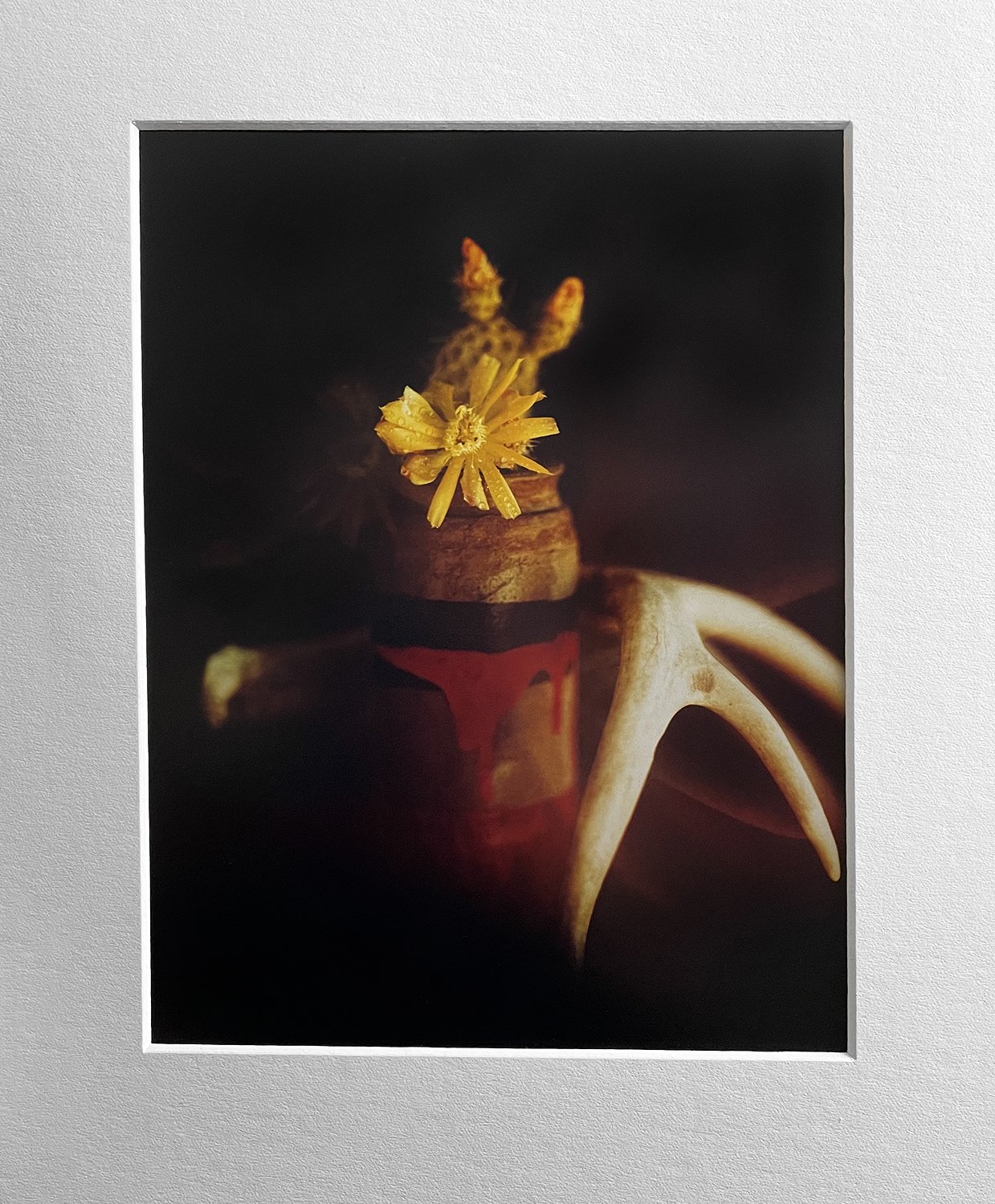
“Flowering Prickly Pear Cactus, Water Vase, and Antlers,” 10” x 10” (25,4 x 25,4 cm), RA-4 Reversal Direct Color Print, July 7, 2023. If you look close, you can see what I’m experimenting with. I exposed the paper backwards—exposing through the paper—and then exposed it again with the emulsion forward. It looks really great in your hand.
“Did you know the uniquely human fear of death has a pervasive effect on human beings’ thoughts, feelings, and behavior? Humans manage the terror of death by adhering to culturally constructed beliefs about reality that provide a sense that one is a person of value in a world of meaning and thus eligible for either literal or symbolic immortality. The quest for immortality underlies some of humankind’s most noble achievements. It also, however, engenders some of our most ignominious affectations, including hostility and disdain for people with different beliefs; attraction to ideological demagogues; indifference to, or contempt for, the natural environment; and the mindless pursuit of material possessions—which, if unchecked, may render humans the first form of life responsible for their own extinction.”
Sheldon Solomon, PhD, Author of "The Worm at the Core: On the Role of Death in Life"
Last year, I had Sheldon as a guest on my YouTube channel. We had a discussion about the importance of Becker's theories for creative individuals, especially photographers. It was a great conversation, and I would like to have him on again.
I have two main objectives for my book: firstly, I want to explain these theories in simple terms that anyone can understand. Secondly, I want to show how these theories were directly involved in the mass killings and massacres of Native Americans during the nineteenth and twentieth centuries in the western United States. Additionally, I explore how these theories impact artists and other creative people, albeit in a slightly different way.
“Did you know the uniquely human fear of death has a pervasive effect on human beings’ thoughts, feelings, and behavior? Humans manage the terror of death by adhering to culturally constructed beliefs about reality that provide a sense that one is a person of value in a world of meaning and thus eligible for either literal or symbolic immortality. The quest for immortality underlies some of humankind’s most noble achievements. It also, however, engenders some of our most ignominious affectations, including hostility and disdain for people with different beliefs; attraction to ideological demagogues; indifference to, or contempt for, the natural environment; and the mindless pursuit of material possessions—which, if unchecked, may render humans the first form of life responsible for their own extinction.”

I’m making most of these color flora prints with the 10” x 10” Chamonix camera and an 1874 Dallmeyer 3B lens.
Let's talk about the concept of meaning in life. For me, meaning implies that our existence has a purpose and makes sense. On the other hand, significance refers to being noticed and considered important. Our greatest fear is to live in a world that lacks meaning and significance, often referred to as "death anxiety." Essentially, we are unconsciously terrified of impermanence and insignificance.
Throughout thousands of years, humans have undergone psychological evolution as part of their overall development. Our brains have evolved to have a large neocortex, but we have also suppressed the awareness of our mortality in order to function in our daily lives. Thomas Ligotti, in his book "The Conspiracy Against the Human Race," said, "For the rest of the earth’s organisms, existence is relatively uncomplicated. Their lives are about three things: survival, reproduction, death—and nothing else. But we know too much to content ourselves with surviving, reproducing, dying—and nothing else. We know we are alive and know we will die. We also know we will suffer during our lives before suffering—slowly or quickly—as we draw near to death. This is the knowledge we “enjoy” as the most intelligent organisms to gush from the womb of nature. And being so, we feel shortchanged if there is nothing else for us than to survive, reproduce, and die. We want there to be more to it than that, or to think there is. This is the tragedy: Consciousness has forced us into the paradoxical position of striving to be unself-conscious of what we are—hunks of spoiling flesh on disintegrating bones." It is a paradox. We possess incredible intelligence, yet we are aware that we will eventually die. This is a difficult reality to accept, and we tend to deny and reject it. However, death is an inevitable part of life for all of us.

The “scene” photographed with an iPhone to give you an idea of my working environment.
So, how do we deal with this existential dilemma? The answer lies in culture. Every culture, and there are countless diverse cultures around the world, provides its people with ways to alleviate their death anxiety or existential dread. These "cultural worldviews," as Becker calls them, serve as intricate distractions or illusions that prevent us from consciously dwelling on the subject of death (especially our own). You may be reading this right now and thinking, "What is he talking about? I rarely think about death; I don’t have death anxiety!" Exactly. That means you have a cultural worldview you are clinging to tightly and are ensconced in—protected from the thoughts of death by the cultural constructs you believe in and participate in—and it works well!
What are these cultural worldviews? They are anything that your in-group shares as reality. It’s what you and the people around you believe to be important. The most potent are religion, politics, nationalism, family (having children), money, fame, looks, etc. These worldviews usually provide ways to gain symbolic or literal immortality and give us a road map to follow in our lives. Ernest Becker said, "No wonder men go into a rage over fine points of belief: if your adversary wins the argument about truth, you die. Your immortality system has been shown to be fallible; your life becomes fallible." Cultures reward good behavior (things that the group believes in) and punish bad behavior. Remember, what’s “good” or “bad” in your culture may be very different from someone else's. Read about the “Flute Ceremony” versus the “Bar Mitzvah” in Sheldon’s book “The Worm at the Core: On the Role of Death in Life.” This is where the conflict begins.
In order for us to get out of bed in the morning, we need meaning. And we need to feel like we are part of something important. If we don’t have meaning and significance, there’s a good chance we’ll fall into depression and other mental health issues. The takeaway is this: Be conscious of what you’re choosing to lean on—your cultural worldview—to bolster your self-esteem and stave off existential dread; it can lead to good things or bad things. It’s very easy to adopt the malignant worldviews of racism, hate, scapegoating, and othering. It’s easy to fall into the cultural trap of treating people who are different from you badly. If we’re conscious of these psychological pressures, we can make good choices and allow other people to find good, healthy, non-destructive ways to buffer their death anxiety. Awe, gratitude, and humility go a long way as buffers and do no warm to other people.
“For the rest of the earth’s organisms, existence is relatively uncomplicated. Their lives are about three things: survival, reproduction, death—and nothing else. But we know too much to content ourselves with surviving, reproducing, dying—and nothing else. We know we are alive and know we will die. We also know we will suffer during our lives before suffering—slowly or quickly—as we draw near to death. This is the knowledge we “enjoy” as the most intelligent organisms to gush from the womb of nature. And being so, we feel shortchanged if there is nothing else for us than to survive, reproduce, and die. We want there to be more to it than that, or to think there is. This is the tragedy: Consciousness has forced us into the paradoxical position of striving to be unself-conscious of what we are—hunks of spoiling flesh on disintegrating bones.”

“Flowering Prickly Pear Cactus and Water Vase,” 10” x 10” (25,4 x 25,4 cm), RA-4 Reversal Direct Color Print, July 7, 2023. If you look close, you can see what I’m experimenting with. I exposed the paper backwards—exposing through the paper—and then exposed it again with the emulsion forward. It looks really great in your hand.