• blog
  • in the shadow of sun mountain
  • buy my books
  • photographs
  • paintings
  • bio
  • cv
  • contact
  • search
Menu

Studio Q Photography

Exploring Human Behavior and Death Anxiety Through Art
  • blog
  • in the shadow of sun mountain
  • buy my books
  • photographs
  • paintings
  • bio
  • cv
  • contact
  • search
×

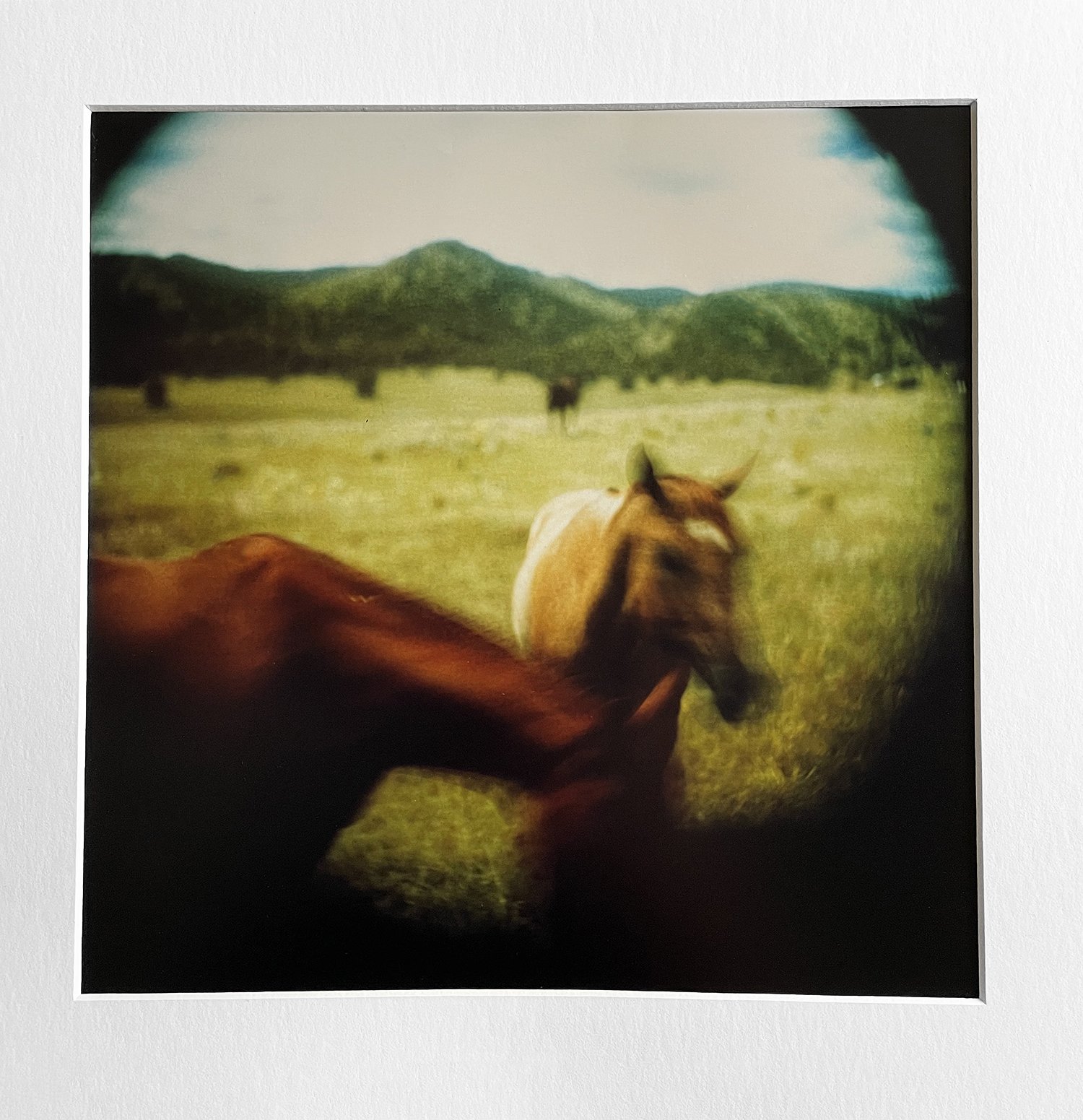
“Three Magic Dogs in the Rocky Mountains of Colorado,” 10” x 10” (25,4 x 25,4 cm) RA-4 Reversal Direct Color Print, August 15, 2023.

The Tabeguche-Ute were skilled horsemen. They were the first to get horses from the Spanish in the 17th century. They called horses “magic dogs.”

Don't Worry About Other People's Opinion of Your Work

Quinn Jacobson August 23, 2023

Over the past few weeks, I’ve had a few conversations with people about making art. One topic seemed to always come up in these chats. In essence, they ask or imply, “What if people don’t like what I do or don’t understand it?” Or even, “People don’t like what I do, and they don't understand it. I don’t get very many likes or comments on social media.”

Addressing the issue of people not liking or responding to your work (social media “likes” and “comments") can be a big deterrent. And it can be a bit depressing and frustrating too. But that’s only if you give it credence or value. It’s your choice, whether you do or not. I can say with some certainty that it’s a waste of time to be concerned with what other people think about your creative endeavors, whether on social media or not; their feedback, for the most part, is meaningless. There’s an old quote attributed to a lot of different people that says, "When you’re 20, You care what everyone thinks. When you’re 40, You stop caring what everyone thinks. When you’re 60, You realize no one was ever thinking about you in the first place." I’ll be 60 years old soon and can relate to the wisdom here. Apply it to your creative life. It will make you a better artist.

This is looking west-southwest from our house. We were walking back from the top of our property and saw this. The “circle” of clouds and the ray of light on Saddleback Mountain (the far peak) were magnificient.

My response to this dilemma has always been the same: Make your work for an audience of one: YOU. That’s all that matters. This only applies if you’re making personal, fine art work. Commercial work is a different story. With that, you are bound to please a much larger audience, and it’s in pursuit of money (that’s its purpose). It’s very easy for me to separate the two. Personal work has a strong, compelling narrative. Commercial work pays no mind to that. It’s pretty and popular. It’s a transaction for money, not an expression of an idea, concern, question, interest, etc. What the masses want is something familiar and safe. Something that takes no chances and is rarely ever different. It’s what sells. Money is the object, not expression. Period. Remember the difference; that’s an important piece of understanding what you’re trying to do.

“When you’re 20, You care what everyone thinks, When you’re 40, You stop caring what everyone thinks, When you’re 60, You realize no one was ever thinking about you in the first place.”
— Unknown

That brings me to my second point. If you make creative work with the intention of selling it, you’re probably off to a dubious start. Influence is incessant. Making money can really mess with accessing your own creative desires. You can see how easily you’d cross that line into commercial work. And once you cross over, you’re not making work for yourself; you’re making work for them. It kills your creative vibe (in a personal sense).

I’ve said it a million times: I have nothing against commercial work. Good on you if you do it and it fills your bank account. My concerns are about not conflating commercial work with personal expression, narrative, or personal fine art. I couldn’t care less for commercial work. I have absolutely no interest in it. I’m not in the least bit concerned about selling, showing, winning awards, or anything else with my work. I make it for personal reasons, reasons that I’ve explained many times in these essays.

Carry on doing work that motivates you. If others like it or can appreciate it, great! But never make that a priority. And I would recommend that you separate making money from your creative life. Keep your creative spirit free from the poison of commerce. It destroys your soul in that context. Earn your money some other way; keep your artmaking separate and special. Enjoy every day that you can create something, or even try to create something. Reveal the failures, learn from them, and be grateful. You will be amazed at where you find yourself mentally and creatively.

In the next few weeks, I’ll share what I’ve been working on in the studio. I guess you could call it an evolution of this work. I’m super excited about it. Stay tuned!!

In Art & Theory, Color Prints, New Book 2023, Project Work, Quinn Jacobson, Quinn's New Book 2024, RA-4 Reversal Positive, Shadow of Sun Mountain, Magic Dogs Tags In the Shadow of Sun Mountain, Qunn Jacobson, Magic Dogs, Rocky Mountains Colorado, RA-4, direct-color positive prints
Comment

“Dead Foxtail and My History on My Arm,” 10” x 10” (25,4 x 25,4 cm) RA-4 Reversal Direct Color Print August 12, 2023

This was an exciting image for me to make. Jeanne helped me do it (she did a great job). I wasn’t going to do any “human” photographs for this project. However, I’ve lived these stories and felt that a self-portrait might be a powerful addition to the work, I’m over-the-moon about this print. You’ll see a version of it in the book, for sure.

The Human Flight from Death: The Driving Force of Civilization

Quinn Jacobson August 12, 2023

In the Shadow of Sun Mountain: The Psychology of Othering and the Origins of Evil}


The people who follow my writing here know that the concept of my project and book is based on Ernest Becker’s theories of death anxiety and the denial of death. Additionally, Sheldon Solomon, Jeff Greenberg, and Tom Pyszczynski—the creators of terror management theory (TMT) and authors of "The Worm at the Core: On the Role of Death in Life"—have had a significant influence on it.

My objective is to describe or explain these theories in relation to the genocide, removal, and general marginalization of the Tabeguache-Ute (known today as Uncompahgre-Ute) indigenous people. I live on their land in the Rocky Mountains of Colorado, U.S.A.

I'm using art to accompany the theories. And I'm also exploring my own dilemma of coming to terms with death. This work is multifaceted, but the main objective is to communicate WHY these kinds of things happen in the world, past and present. Moreover, there are reasons why they will never stop happening.

Death: It’s a difficult topic to talk about, and we’ve evolved to repress and deny it. We've had to psychologically repress this knowledge; if we weren't able to, we would be paralyzed with anxiety and dread. We use culture to do this. All kinds of pursuits help us distract ourselves from thinking about our impeding death, which could happen at any time for any reason, unknown to us. This has a lot more implications than we realize. I recently read an article by John Gray on Substack.com. He is clear, concise, and hits all of the points of both Becker and The Worm at the Core psychologists, Solomon et al.

He wrote:

“An idea of an afterlife emerged along with human beings.

Around 115,000 years ago, graves were being fashioned containing animal bones, flowers, medicinal herbs, and valuables such as ibex horns. By 35,000–40,000 years ago, complete survival kits—food, clothing, and tools—were being placed in graves throughout the world. Humankind is the death-defined animal.

As humans became more self-aware, the denial of death became more insistent. For the American cultural anthropologist and psychoanalytical theorist Ernest Becker (1924–74), the human flight from death has been the driving force of civilization. Fear of death is also the source of the ego, which humans build in order to shield themselves from helpless awareness of their passage through time to extinction.

More than most, Becker’s life was formed by encounters with death. At the age of eighteen, he joined the army and served in an infantry battalion that liberated a Nazi extermination camp.

When he was dying of cancer in hospital in December 1973, he told a visitor, the philosopher Sam Keen: ‘You are catching me in extremis. This is a test of everything I’ve written about death. And I’ve got a chance to show how one dies.’

Becker’s theories were set out in The Denial of Death (1973), for which he received a posthumous Pulitzer Prize in 1974, and developed further in Escape from Evil, which appeared two years after his death.” (John Gray)

“Granite & Quartz Rock, Dead Foxtail, and Purple Thistles,” 10” x 10” (25,4 x 25,4 cm) Reversal Direct Color Print August 12, 2023

In Art & Theory, Colorado, Death Anxiety, Direct Color Prints, Denial of Death, Philosophy, Project Work, Psychology, Quinn Jacobson, Quinn's New Book 2024, RA-4 Reversal Positive, Shadow of Sun Mountain, John Gray Tags In the Shadow of Sun Mountain, death anxiety, denial of death, john gray, Ernest Becker, sheldon solomon, color direct prints
Comment

“Wheat, Granite Rock, and Berries,” 10” x 10” (25,4 x 25,4cm) RA-4 Reversal Direct Color Print, August 7, 2023.

Change is the Only Constant: Evolution of a Project

Quinn Jacobson August 9, 2023

The ancient Greek philosopher Heraclitus observed that the natural world was in a constant state of movement. People age, develop habits, and change environments. You can't step into the same river twice; even rocks are subject to changes by the elements over time. Change is the only constant. It’s the same way when making art. A large project will evolve over time. If you’ve followed mine, you know that’s true.

I started this project (In the Shadow of Sun Mountain: The Psychology of Othering and the Origins of Evil) in September of 2021. It’s fast approaching two years now. That’s not very long for me to work on something photographically or on any kind of creative project. The time isn’t relative to me. I couldn’t care less if it took me one year or ten years to complete a project or bring my ideas to some kind of meaningful creation. My point is that this project is ever-evolving, as it should be, and may have one more huge evolutionary step taking place over the next few months.

Lately, I’ve found myself wanting to push the work in this project farther. The words “tactile” and “tangible” come to mind often as I look at the work. I’ve loved the craft of photography for decades. It’s given me so much, and it’s always been a great outlet and very therapeutic for me. However, over the past ten years or so, I’ve wanted to push my art-making farther. And this project has revealed that this is the perfect time to do that.

“It is better to fail in originality, than to succeed in imitation.”
— Herman Melville author of Moby Dick

So how do you make photography tactile or tangible? That’s the question I’ve been thinking about a lot. I see art-making as a series of problems to solve. It’s a lot like life itself. We’re faced with a series of problems to resolve every day. My tactile problem centers around two ideas. The first is to represent (abstractly) the landscape here. Specifically, the great mountain Tava-Kaavi. This is a big challenge. The second is to represent the colors. In essence, it’s the textures and colors of the land that I’m addressing. I don’t want the photographs to be taken out of context. These are the problems that I’ll be trying to resolve over the next month or so.

I’ve been reading Otto Rank’s book, “Art and Artist.” How the artist uses material to transfer their anxiety into and onto it is a powerful idea, but it does have some downsides (such as rejecting cultural constructs and being ostracized).

Ernest Becker’s interpretation of Rank’s writing in his book “The Denial of Death” has greatly influenced me as well. I really connect with Becker’s conclusion about his theories—the best answer that he could give. He said, “The most that any one of us can seem to do is to fashion something—an object or ourselves—and drop it into the confusion, make an offering of it, so to speak, to the life force.” I’ve been thinking deeply about that idea. It’s affected the way I want to approach this work.

I have to be honest and say that “straight” photography is a little bit repetitious for me. Don’t misunderstand me; I love photography, and I’m over the moon about the work I've been able to make for this project. I just feel that these ideas need more than straight photography to be represented in a meaningful and powerful way. I’ve been working on ideas to try to make that happen.

“Just as conscious contents can vanish into the unconscious, other contents can also arise from it. Besides a majority of mere recollections, really new thoughts and creative ideas can appear which have never been conscious before.

They grow up from the dark depths like a lotus, and they form an important part of the subliminal psyche.

Forgetting is a normal process in which certain conscious contents lose their specific energy through a deflection of attention.When interest turns elsewhere, it leaves former contents in the shadow, just as a searchlight illuminates a new area by leaving another to disappear in the darkness.

This is unavoidable, for consciousness can keep only a few images in full clarity at one time, and even this clarity fluctuates, as I have mentioned. "Forgetting" may be defined as temporarily subliminal contents remaining outside the range of vision against one's will.

But the forgotten contents have not ceased to exist. Although they cannot be reproduced, they are present in a subliminal state, from which they can rise up spontaneously at any time, often after many years of apparently total oblivion, or they can be fetched back by hypnosis.

Besides normal forgetting, there are the cases described by Freud of disagreeable memories which one is only too ready to lose. As Nietzsche has remarked, when pride is insistent enough, memory prefers to give way. Thus, among the lost memories we encounter, not a few owe their subliminal state (and their incapacity to be reproduced at will) to their disagreeable and incompatible nature. These are the repressed contents.”

Carl Jung

“Five-Star Flower and Berries,” 10” x 10” (25,4 x 25,4cm) RA-4 Reversal Direct Color Print, August 7, 2023.

I only get this light in my studio between 0800 and 0830 in the morning (this time of year). I was so pleased when I saw this come up in the darkroom. It’s emotional to me; I can feel the geometry in the flower and the light. The small circle of light (reflected onto the background) feels like an alien looking on.

In Art & Theory, Color Prints, New Book 2023, Project Work, Shadow of Sun Mountain Tags In the Shadow of Sun Mountain, color direct prints, Colorado Mountains, project work, evolution of a project, Quinn Jacobson, ra\
2 Comments

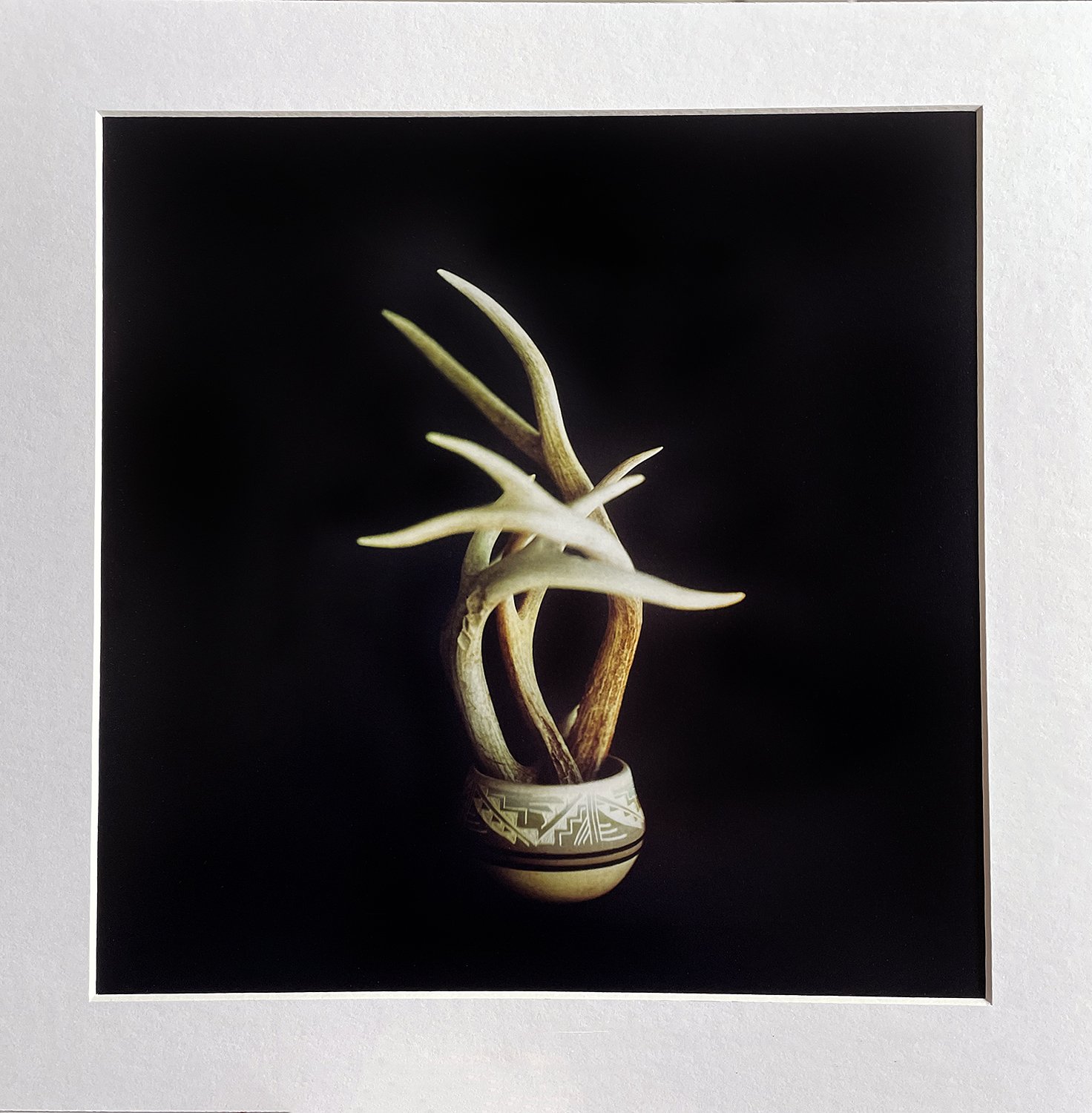
“Deer Antlers in Ute Pot: Print #1,” 10” x 10” (25,4 x 25,4 cm) RA-4 Reversal Direct Color Print August 5, 2023

I’ve always found the shape of antlers interesting. The function of them fascinates me too. Mule deer are all around me in this area. I see them every day. All of the bucks are in "velvet" now. Velvet antler is defined as a growing antler that contains abundant blood and nerve supply and has fully intact skin with a covering of soft, fine hair. As the antlers develop, they're covered by a nourishing coat of blood vessels, skin, and short hair known as velvet—this supplies nutrients and minerals to the growing bone. When antlers reach their full size in late August or September, the velvet is no longer needed.

Shaping Objects With Light and Making Ideas Real

Quinn Jacobson August 6, 2023

Art gives us the ability to create ideas and physically manifest them. Think about that: the ability to make something that exists only as a thought or an idea. That is mind-twisting! In my opinion, it’s a good definition of the word magic. See Becker’s quote below.

“Man has “a mind that soars out to speculate about atoms and infinity, who can place himself imaginatively at a point in space and contemplate bemusedly his own planet. This immense expansion, this dexterity, this ethereality, this self-consciousness gives to man literally the status of a small god in nature... Yet, at the same time... man is a worm and food for worms.”
— Ernest Becker, The Denial of Death

It can be any form of expression—writing, sculpting, painting, music, photography, etc. Something that engages one or several of our senses. When I was young—10 or 12 years old—I wanted to be a figure sculptor. I got very interested in wax as a material. I visited a wax museum in Orlando, Florida, and I believe it was converted to Madame Tussauds a few years ago.

I was hooked. It was something about seeing the human figure re-created in such a way that you could really study it—almost feel its presence. There were Star Trek figures there; that’s what got me. I had my Polaroid portrait made with Spock. I still have that picture. It moved me tremendously.

One of my favorite things to do is use light to shape objects and bring out the essence of what they are or could be. So many people simply expose a picture and hope for the best. I think that takes so much of the creativity away. It turns creating something into a mechanical exercise.

“Deer Antlers in Ute Pot: Print #2,” 10” x 10” (25,4 x 25,4 cm) RA-4 Reversal Direct Color Print August 5, 2023

"The tragedy of a species becoming unfit for life by over-evolving one ability is not confined to humankind. Thus, it is thought, for instance, that certain deer in paleontological times succumbed as they acquired overly-heavy horns. The mutations must be considered blind; they work and are thrown forth without any contact of interest with their environment. In depressive states, the mind may be seen in the image of such an antler, in all its fantastic splendor, pinning its bearer to the ground."

Peter Zapffe, The Last Messiah

The species of deer that Zapffe has in mind is the Irish elk (Megaloceros giganteus), which thrived throughout Eurasia during the ecological epoch known as the Pleistocene (2.6 million to 11,700 years ago). The Irish elk had the largest antlers of any known deer, with a maximum span of 3.65 meters. Historically, the explanation given for the extinction of the Irish elk was that its antlers grew too large: the animals could no longer hold up their heads or feed properly; their antlers, according to this explanation, would also get entangled in trees, such as when trying to flee human hunters through forests.

A surplus of consciousness and intellect is the default state of affairs for the human species, although unlike the case of the deer that Zapffe alludes to, we have been able to save ourselves from going extinct. Zapffe posits that humans have come to cope and survive by repressing this surplus of consciousness. Without restricting our consciousness, Zapffe believed the human being would fall into “a state of relentless panic” or a ‘feeling of cosmic panic’, as he puts it. This follows a person’s realization that “[h]e is the universe’s helpless captive”; it comes from truly understanding the human predicament. In the 1990 documentary To Be a Human Being, he stated:

"Man is a tragic animal. Not because of his smallness, but because he is too well endowed. Man has longings and spiritual demands that reality cannot fulfill. We have expectations of a just and moral world. Man requires meaning in a meaningless world."

The Irish elk (Megaloceros giganteus), which thrived throughout Eurasia during the ecological epoch known as the Pleistocene (2.6 million to 11,700 years ago). The Irish elk had the largest antlers of any known deer, with a maximum span of 3.65 meters.

In Art & Theory, Book Publishing, Color Prints, Consciousness, Death Anxiety, Denial of Death, Evolution, Irish Elk, Memento Mori, New Book 2023, Peter Wessel Zapffe, Philosophy, Quinn's New Book 2024, Quinn Jacobson, RA-4 Reversal Positive, Shadow of Sun Mountain, Deer Antlers Tags In the Shadow of Sun Mountain, peter wessel zapffe, deer antlers, deer elk, the last messiah, using light to shape objects
Comment

"Cat's Eye" 10" x 10" (25,4 x 25,4 cm) RA-4 Reversal Direct Color Print, July 31, 2023

Cat's Eye

Quinn Jacobson August 3, 2023

The plant could be used to relieve swelling, stimulate fatigued limbs, and help with itching.

In Art & Theory, Color Prints, Shadow of Sun Mountain Tags In the Shadow of Sun Mountain, cat's eye
Comment

10" x 10" Color Prints Matted

Quinn Jacobson August 2, 2023

I finally received 50 conservation mat boards and clear bags for my color prints. They are 12” x 12” (30 x 30 cm) with a 9.5” x 9.5” opening (24 x 24 cm). I’m very happy with them. That will give me 100 matted prints (the final edited prints) with the POP prints. These will all be published in my book.

Rick Rubin on Creativity and Making Great Art

In Matted Photographs, Writing, Worm at the Core, Sun Mountain, Shadow of Sun Mountain, Color Prints Tags In the Shadow of Sun Mountain, Matted photographs, final prints
Comment

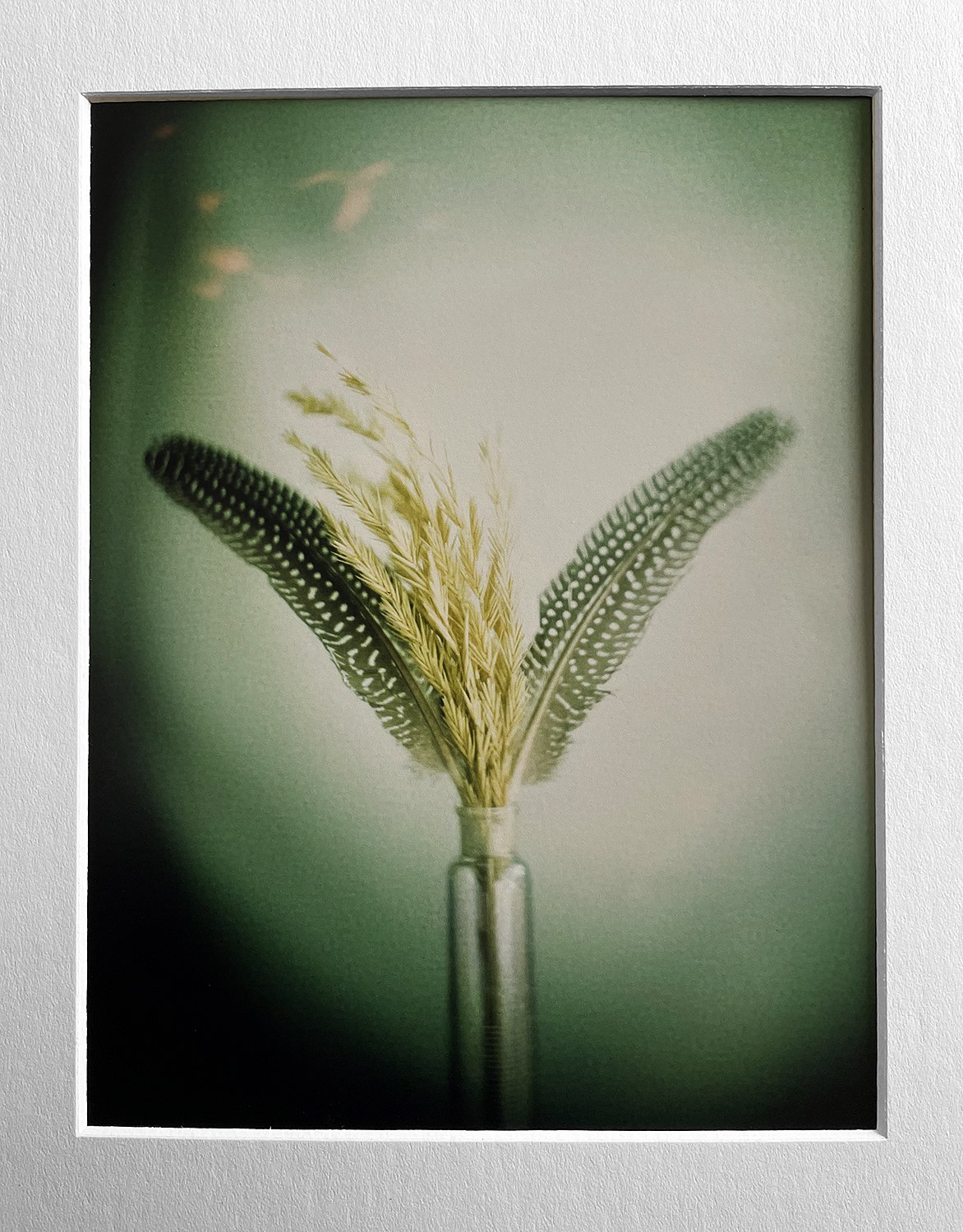
“Giving Flight” 10” x 10” (25,4 x 25,4 cm) RA-4 Reversal Direct Color Print, August 1, 2023.

When Process Artifacts Work

Quinn Jacobson August 1, 2023

In a lot of the photographic processes I’ve worked in, artifacts or defects in the process are a common occurrence. The wet collodion process is well known for these process defects. The beginners embrace them and call them “artistic.” Sometimes they are or can be, but most of the time it’s just used as a defense for poor processing techniques or a lack of understanding of the process.

I have used them in my work occasionally, but not often. The trick is control. Without control, they are simply mistakes. I won’t argue this point with people; if they like “oysters” and “comets,” so be it. Who am I to tell them any different? It’s their picture, not mine.

Having said that, I wanted to share this image. I made it today, August 1, 2023. Here’s the background (technically): After about 35 prints, which are 10” x 10” (25,4 x 25,4 cm), my Dektol developer starts to fail. When it starts to fail, I get crazy aberrations on the prints. Sometimes they are gorgeous; other times, not so much. Today, my print count was 36. I knew my developer was going to start failing. I took my chances with this print. And it turns out that the artifacts or defects are not only beautiful but also adds so much to the image.

I switched from a dark background to a pure white one. I wanted to play with the wheat and bird feathers. I wanted a painterly “light” image that would “give flight” to the objects. And check it out; there are shapes that resemble birds above the feathers and wheat. I was stunned and excited to see them!

In Art & Theory, Book Publishing, Color Prints, Feathers, Turkey Tags In the Shadow of Sun Mountain, color direct prints, turkey feathers, wheat
Comment

Somedays In the Studio Are...

Quinn Jacobson August 1, 2023

Unbelievable! I’m so grateful for days like today. I really am. All of my photographs in this flora series are constructed. I have figure out what I’m going to do and why. I have thoughts and ideas, usually on our walks in the mornings, about what kind of photograph I want to make. What photograph best describes, literally or conceptually, the story I’m telling. All of these are constructed from live plants and other objects and materials relevant to the work. I’ve figured out this direct color positive process: what time of day is best (quality and color of light), what processing times are best, etc etc. I can get exactly what I want with it. The control is wonderful!

Days like today, where I see the image exactly the way I want it in my mind and it appears exactly like that in the darkroom. They are rare days, but wonderful when they happen. These are examples of what I’m talking about. I wasn’t going to share them, but I decided I had to in hopes of encouraging anyone struggling with making work that means something to you. Keep going! Keep making photographs—try new things, new light, a new process. Find what works by actually doing it!

Comment

“Mariposa Lily,” 10” x 10” (25,4 x 25,4 cm) RA-4 Reversal Direct Color Print, July 28, 2023

A tea of the plant was taken internally by Native Americans to treat rheumatic swellings and to ease the delivery of the placenta. The juice of the leaves was applied to pimples.

Gunnison's Mariposa Lily and Fibonacci Star Blossom

Quinn Jacobson July 28, 2023

Cosmetics are still vitally important for “good grooming” in the twenty-first century. Women spend more money on makeup and skin care every year than the United Nations spends on all its agencies and funds. New cosmetics, new styles, and new fads come and go, but they all result in part from the age-old universal human disdain for bodies in their natural state.

But beauty comes at a high price, and achieving and maintaining it often involves both physical and financial pain. Hair receives considerable attention in all cultures. Although human hair grows prolifically, people are nowhere near as hairy as our closest primate relatives. Nevertheless, we have always hated the stuff. Hairy bodies have always been associated with uncivilized, amoral, sexually promiscuous, or perverted animality.

Google “body hair” and you will get about 33.5 million hits, nearly all related to ways to get rid of it. Hair removal or alteration, especially of the face, eyebrows, underarms, legs, and pubic regions, is an ancient and widespread practice in all cultures. The Egyptians used razors, pumice stones, and depilatory creams to get rid of body hair. Julius Caesar had his facial hair extracted with tweezers and shaved his entire body (especially before sex). In Ars Amatoria (The Art of Love), the Roman poet Ovid advised young women to “let no rude goat find his way beneath your arms, and let not your legs be rough with bristling hair.” Today, Brazilian waxes and manscaping have become de rigueur for many young women and men.

Hairstyles and makeup are part of the transformation from animal to human, but these are temporary measures. Hair grows back in unruly ways and unexpected places; makeup fades or runs. Consequently, more radical and permanent body modifications are also deployed. American parents mortified by the sight of their metal-studded offspring who need ratchet wrenches to get through airport security will perhaps be comforted by the fact that such practices are ancient and universal. Remnants of ear and nose rings from four thousand years ago have been found in the Middle East. Egyptian pharaohs pierced their navels. Roman soldiers spiked their nipples. The Aztecs and Mayans pierced their tongues. Genital piercing was widespread for both males and females. The “Prince Albert,” today’s most frequently sported penis piercing, was favored by Queen Victoria’s husband. (The Worm at the Core: On the Role of Death in Life,” page 126)

“Mariposa Lily and Deer Antler,” 10” x 10” (25,4 x 25,4 cm) RA-4 Reversal Direct Color Print, July 28, 2023

A tea of the plant was taken internally by Native Americans to treat rheumatic swellings and to ease the delivery of the placenta. The juice of the leaves was applied to pimples.

“Five Star Fibonacci Sequence: A Blooming Flower,” 10” x 10” (25,4 x 25,4 cm) RA-4 Reversal Direct Color Print, July 28, 2023

“The Fibonacci Sequence turns out to be the key to understanding how nature designs... and is... a part of the same ubiquitous music of the spheres that builds harmony into atoms, molecules, crystals, shells, suns, and galaxies and makes the Universe sing.” ~ Guy Murchie, The Seven Mysteries of Life: An Exploration of Science and Philosophy

In Art & Theory, Book Publishing, Color Prints, Fibonacci Sequence, Golden Ratio, Writing, Ute, Terror Management Theory, Tabeguache Ute, Sun Mountain, RA-4 Reversal Positive, Philosophy Tags In the Shadow of Sun Mountain, gunnison's mariposa lily, fibonacci sequence, five star flower, RA-4, color direct prints
Comment

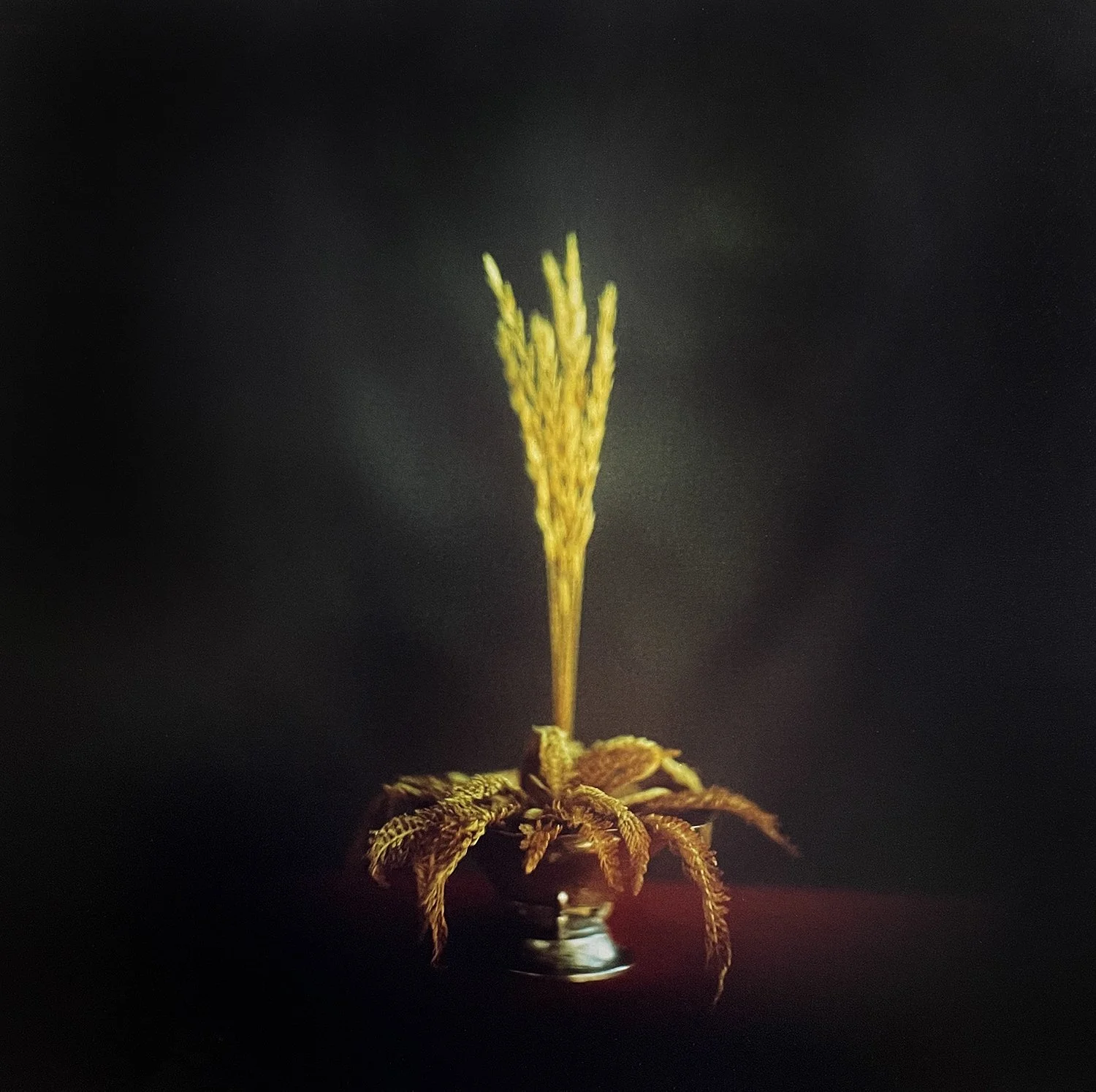
“Sunflower, Foxtail Barley, and European Silver,” 10” x 10” (25,4 x 25,4 cm) RA-4 Reversal Direct Color Print, July 27, 2023

Tava Kaavi or Sun Mountain

Quinn Jacobson July 27, 2023

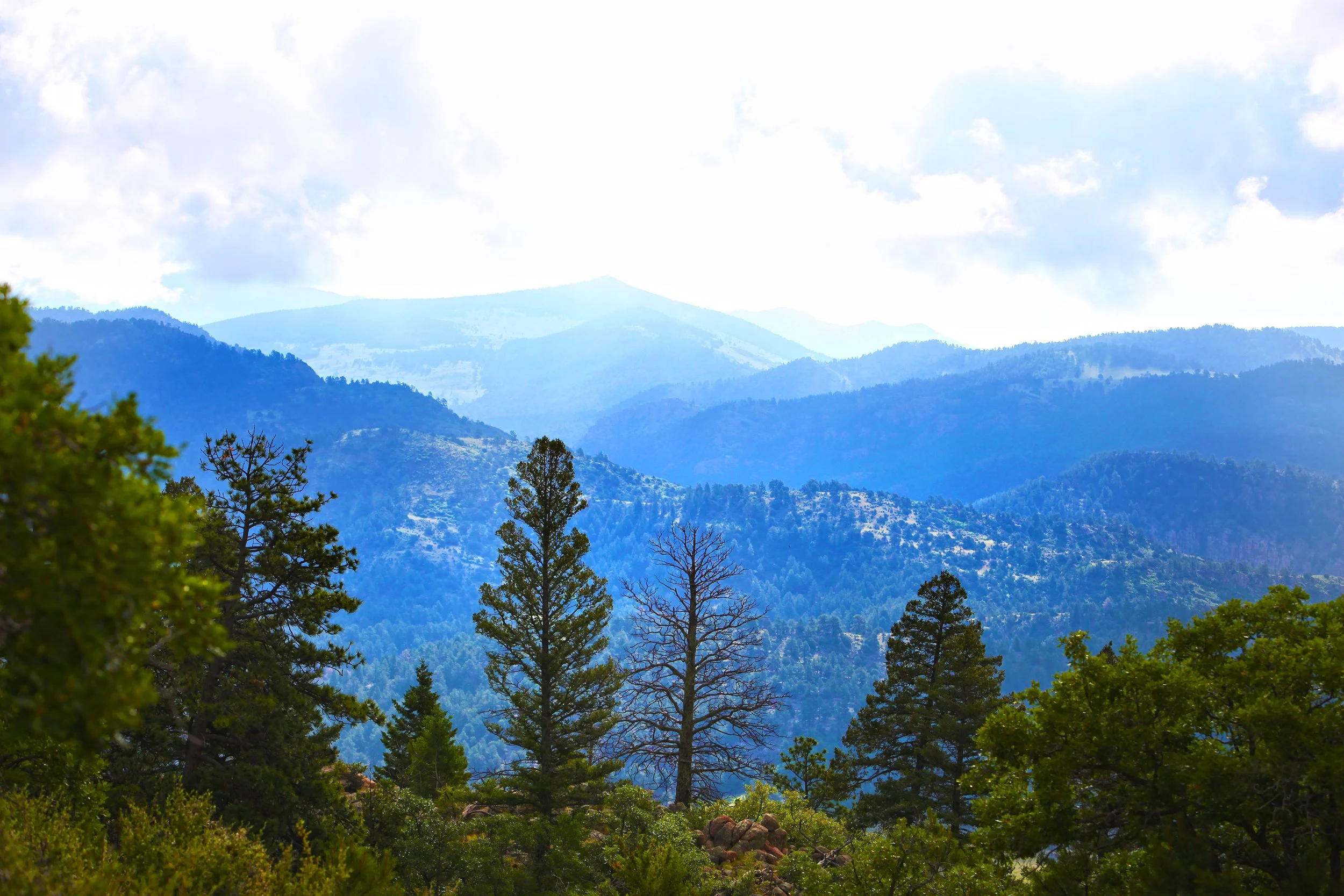
The view east from our place shows the volcanoes that were active millions of years ago—they’re beautiful. We’ve had a lot of rain this year, and I’m very grateful for that. The landscape is lush and green, and the wildlife is healthy and well-fed. There is always a risk of wildfires up here, but when you stay wet and green, it lowers the chances of that happening by a lot.

Tava Kaavi, or Sun Mountain, is over 14,000 feet (4.000 meters) above sea level. The colonized name is Pikes Peak. It’s the mountain you can see in the background. The Tabeguache were also called “The People of Sun Mountain.” If you were a bird, you could fly to the peak of Tava from where we live, and it would be 14 miles, or 22 kilometers. That’s the reason I call my project “In the Shadow of Sun Mountain: The Psychology of Othering and the Origins of Evil.” I live in the shadow of the great mountain.

We go for a walk around the mesa every day. Usually early in the morning. I saw this scene on our walk the other morning and had to grab a digital photo of it. So beautiful and majestic! You feel so small up here when you look at nature and your place in it. It’s so easy to lose sight of that when you’re living in cities and suburbs.

A wider shot on a less rainy day. You can see Mt. Pisgah and Tava both.

“Sunflower, Foxtail Barley, and European Silver-Detail,” 10” x 10” (25,4 x 25,4 cm) RA-4 Reversal Direct Color Print, July 27, 2023

In Tava Kaavi, Sun Mountain, Shadow of Sun Mountain Tags tava kaavi, tava, sun mountain, in the
6 Comments
← NewerOlder →

Search Posts


Featured Posts

Featured
Apr 16, 2026
My Book: The Final Stages of Glass Bones
Apr 16, 2026
Apr 16, 2026
Apr 13, 2026
Terror Management Theory: The Mechanics Beneath Belief
Apr 13, 2026
Apr 13, 2026
Apr 11, 2026
To Buffer or Not to Buffer?
Apr 11, 2026
Apr 11, 2026
Apr 6, 2026
Worldviews: The Stories That Hold Us Together
Apr 6, 2026
Apr 6, 2026
Apr 1, 2026
The Creative Mind & Mortality Podcast - S1 E7: Culture As Armor
Apr 1, 2026
Apr 1, 2026
Mar 30, 2026
Holding the Unresolvable: Mortality and Form in a Kallitype Portrait
Mar 30, 2026
Mar 30, 2026
Mar 28, 2026
Arts-Based Research Methodology
Mar 28, 2026
Mar 28, 2026
Mar 25, 2026
The Creative Mind & Mortality Podcast—S1E6: The Beginning of Denial
Mar 25, 2026
Mar 25, 2026
Mar 24, 2026
Ocotillo, Chihuahuan Desert
Mar 24, 2026
Mar 24, 2026
Mar 23, 2026
Metabolizing the Polycrisis: The Rupture Field Approach
Mar 23, 2026
Mar 23, 2026