
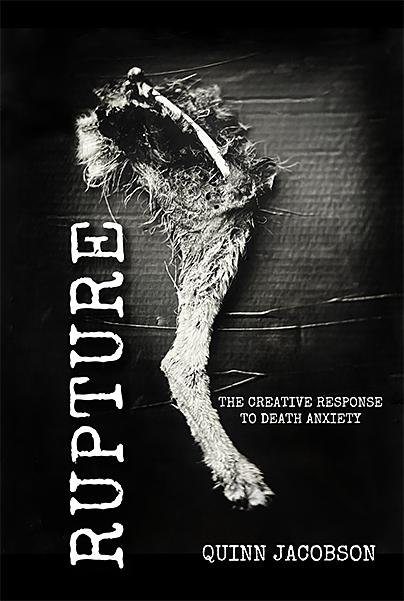
As I wait for the printer to ship a load of Glass Bones in June, I want to share what's next.
I've started a new body of work for a new book. The title is RUPTURE. The subtitle: The Creative Response to Death Anxiety.
I'm approaching this differently than Glass Bones. Creative work in the foreground. Theory in the background. The theory still matters, because I plan to do more than explain Rupture Field Theory. I want to live it out in the studio and darkroom.
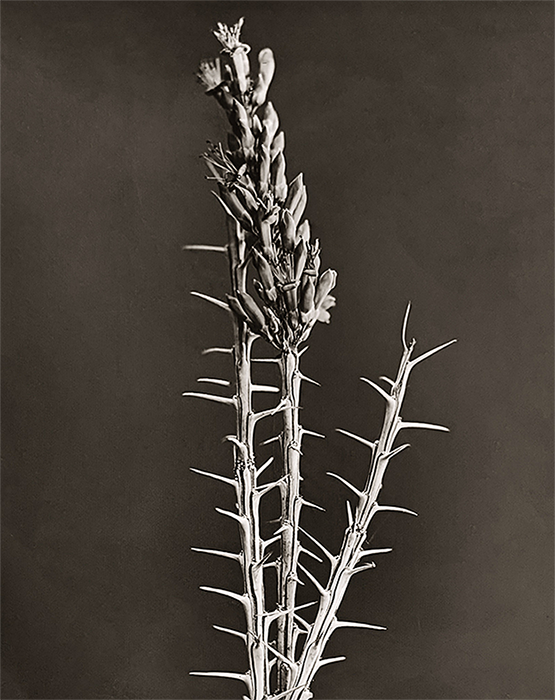
Detail Ocotillio Canes. Whole plate palladium print. 2026. This is the reference for my new painting.
Why does that feel worth doing? It hasn't been done this deliberately before, as far as I know. And it brings weight to the question of what creativity can do in the face of mortality. The buffer model is well established. Most artists work that way, whether they name it or not (Solomon et al., 2015). What I'm after is something I call practiced proximity. Staying in the transitional space between rupture and form, between exposure and image, refusing to seal it over. Just as a side note: If I wanted to name what practiced proximity looks like, you could point at these three pieces. The work isn't depicting the transitional space. The work is the transitional space, made visible across three returns.
What happens in that space? What does the art say that words can't reach?
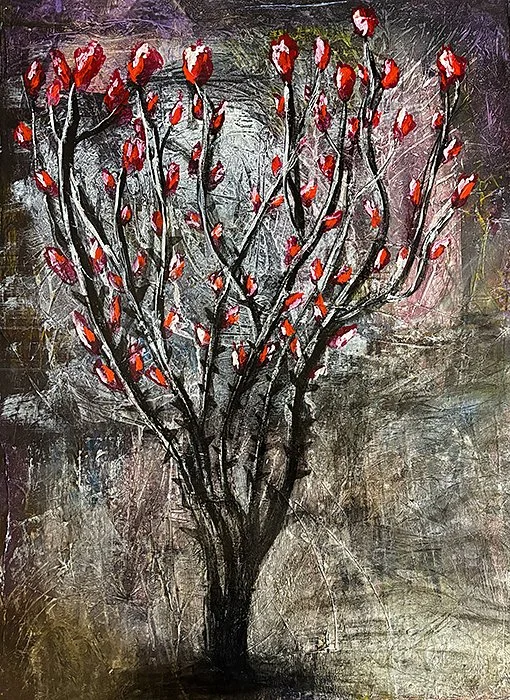
Ocotillo. 36 by 48 in. Mixed media on canvas. 2025
Those questions sit at the foundation of the book. I want to know what it means to remain there, to keep moving through the cycle of giving form to existential anxiety without converting it into protection. The harder question follows. Why not use creativity the way most people do, as a buffer for the weight of being alive while knowing we will die? What becomes possible if I stay in the rupture instead?
“Judge a man by his questions rather than by his answers.”
To that end, I've started a new painting. A 36 by 48 inch canvas. Today I laid the ground, a mix of gesso and sunshine yellow. I like the way the light yellow holds the surface.
The image I have in mind is a detail of ocotillo canes. I made a wet collodion negative and a palladium print of the plant that drew me here. The new painting continues one I made in 2025. Both belong to the next book. The book is where I plan to take practiced proximity into the studio and the darkroom, and see what it gives back.
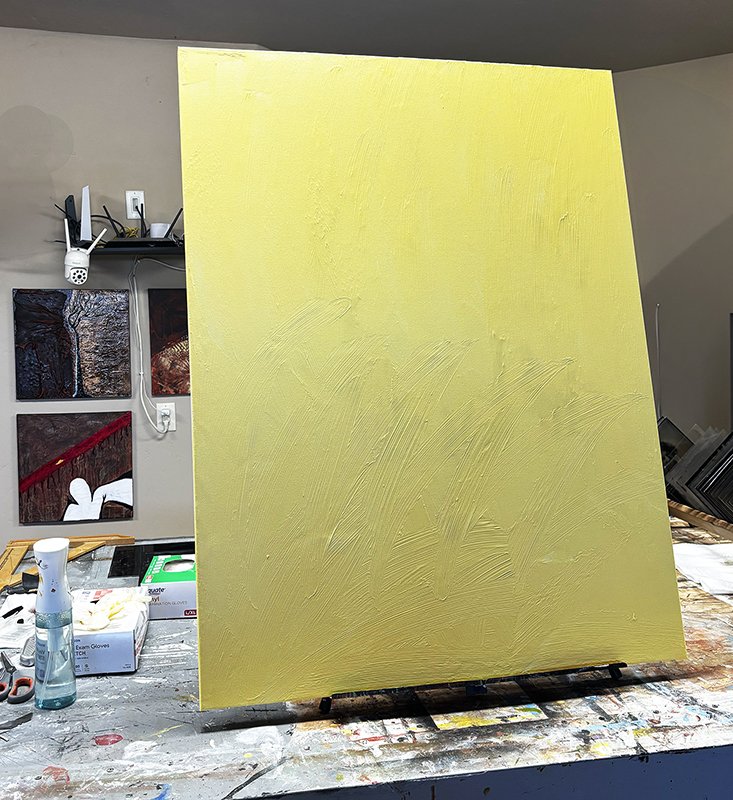
36 by 48 in. yellow ground—May 27, 2026—Even my other paintings are looking on—watching the new one begin. Rupture Field Theory in action.
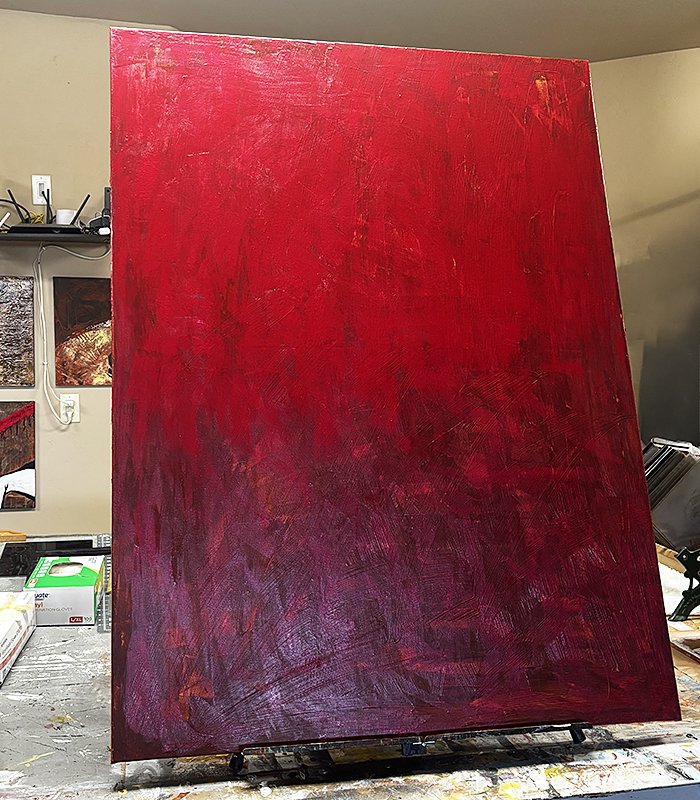
36 by 48 in. layer two—May 28, 2026. The work begins.
Rupture
It's the first thing: the moment something that held your world together gives way, and you're left standing in front of a reality you can't yet take in.
Simply put, rupture is when life stops making the sense it used to. Sometimes it's sudden: a death, a diagnosis, or a betrayal. Sometimes it's slower, more ambient. The low hum of climate dread. Political instability. The feeling that the ground beneath you has become less reliable than it once seemed. Either way, something tears. The story you were living inside no longer holds, and for a time you stand in the gap with no replacement ready.
Rupture can be acute or accumulative. It may arrive all at once, or it may build slowly through a series of disruptions that, taken individually, seem manageable. Eventually the accumulated weight exceeds the capacity of the structure to hold. What matters is not the speed of the break, but the fact that the break occurred.
What makes rupture different from ordinary stress is that it isn't a problem to solve. You can't think your way back to how things were. It is a structural break. Not a bad day or a temporary setback. The scaffolding comes apart: what is safe, what lasts, and who you are. You're left looking directly at something most of us keep at the edge of our vision: that everything is provisional, including ourselves.
Rupture is not, after all, catastrophe, and it is not trauma in the clinical sense, though it can be both. It also includes the ordinary ruptures many of us now live inside. The background instability that never arrives as a single event but still erodes the feeling that things will hold.
Rupture is the crack.
The moment a structure can no longer contain reality. The instant the surface gives way, before the anxiety rushes in and long before meaning is made.
Q: What are you talking about when you talk about Rupture Field Theory (RFT)? What does it mean and why is it important?
A: Remaining near rupture is valuable because it allows a more honest encounter with reality, and from that encounter, new forms may emerge: meaning, art, relationships, and ethical responses. The claim withholds almost everything. It doesn’t promise healing. It neither promises growth nor transformation. Only possibility.
And that "may" is where the intellectual integrity of the theory lives: fragile, conditional, and never guaranteed. This sets it against most creativity-and-well-being literature, where the encounter with difficulty reliably yields resilience, flourishing, and post-traumatic growth. RFT declines that bargain. It treats proximity to rupture as honest before it is generative and refuses to assume the second follows from the first.
Here's what the passage is saying, plainly.
The core idea: staying close to painful ruptures—loss, breakdown, and the hard facts of being mortal—is worth doing because it puts you in more honest contact with how things really are. And out of that honest contact, good things might come, meaning art, real connection with others, and a more ethical way of acting. Might. Not will.
“The scholar of mortality is still mortal.”
The second paragraph is making a point about that word "might" (which the passage writes as "may"). The entire value of the theory, which I am arguing, lies in that one cautious word. It's not promising that facing challenging things will heal you, make you grow, or transform you. It's only saying something good could come of it—no guarantee.
Then comes the contrast. A lot of popular writing about creativity and well-being makes a confident promise: go through something difficult, and you'll come out stronger, healthier, and wiser. "What doesn't kill you makes you stronger," basically. This theory refuses to make that promise. That refusal is the "bargain" it declines: the deal where pain reliably pays you back with growth.
The last sentence draws the key distinction: facing rupture is honest first and only, maybe productive second. The honesty is the real thing; any benefit that follows is a possible bonus, not a built-in reward. I won't pretend the good stuff is guaranteed just because the facing-up-to-things is valuable on its own.
So in one line: it's better to look hard truths in the face than to look away, and that's true even if doing so never makes you happier or more creative. The looking is the point; the payoff is only a maybe.
In my opinion, illustration begins with an answer, and inquiry begins with a question. Or even, illustration seeks confirmation, and inquiry seeks revelation. A lot of contemporary art is explanation disguised as discovery. The conclusion is already known. The work is assembled to support it. But the work I’m most interested in doesn't operate that way. The Rupture Field Theory was discovered more than designed. I’ve spent decades making photographs, paintings, and books; studying Becker, mortality, trauma, memory, creativity, landscape, and meaning-making. Eventually a pattern emerged that seemed to connect them. The question is, what becomes possible when we stop rushing toward closure?
References
Solomon, S., Greenberg, J., & Pyszczynski, T. (2015). The worm at the core: On the role of death in life. Random House.