An Ambrotype Plugin for Photoshop

First of all, Happy New Year (2009)! I hope all of your dreams, goals and aspirations come to pass. Most of all, I wish you peace. It feels like we're going to need a lot of it in 2009.

Collodion and the Making of Wet-Plate Negatives I've been reading Geoffrey Batchen's book, "Each Wild Idea". I was very moved by the idea of protophotographers and the theories he proposes about the invention of photography and the identity of photography. This got me thinking (again) about wet plate and how we see it today, its past and even its future. What it all means, and why we're even interested in it. It's an ongoing thing with me, I'm still trying to get my head around it and formulate some thoughts about it - forgive me if this is redundant.

I have about ten books (technical) about the Wet Plate Collodion process. The majority of them are from the 19th century. I have one from the Eastman Kodak Company, published in 1935 called, "Collodion and the Making of Wet-Plate Negatives". It's really good, loaded with great information. I've found bits and pieces about the process here and there in various other 20th century books, like "Light and Film". That's where I found Joel Snyder a couple of years ago and his wet-plate revival work that no one has ever talked about. He responded to my email and said this:
 
Dear Quinn,

Thanks for your note.

I produced a permanent exhibition for the Department of the History of Photography of the Smithsonian Institution in 1967. I was in my mid-20s. The exhibit contained 16 examples of important photographic processes, including three forms of wet collodion. In 1976, Doug Munson and I co-founded the Chicago Albumen Works. CAW is now doing all sorts of work preserving, archiving, and replicating negatives for major institutions in the US and Europe. It has been printing in albumen, salt paper, platinum, and POP since 1976. CAW has had printing commissions from MoMA (we printed about 300 Atget negatives on albumen paper for its 4 Atget exhibits 1979-1983), the Met (NYC), etc.

I've been a historian of art at the University of Chicago since 1977. I've no idea why others have received the credit for being first to use use the collodion process in recent times, but it isn't something that concerns me. Doug and I taught ourselves to work with collodion. I was very lucky to meet John Ryan, a retired photoengraver (for R.R. Donnelley, a major printer in the US) who had used collodion for plate-making until the late 1950s. He gave me bottles of Eastman Kodak collodion and Eastman chemicals for making "hard-working" (straight iodides) and "soft working" (iodides, chlorides and bromides) collodion. Most people don't know that Eastman produced collodion for the photomechanical trade. Ryan gave me a few useful tricks for aging collodion rapidly, and for varying the acidity of silver baths in order to get variations in the properties of the sensitized collodion. I still have the bottles, tightly sealed and unused.

Best,
Joel Snyder, Professor
Department of Art History
University of Chicago

Joel Snyder's project in the book, "Light and Film".

Which brings me to my point; A long time ago, I realized that everything that we know about the wet plate collodion process today, we know because of the 19th and 20th century literature. Even the guys working in the 1920s, 30s, and 40s, used that literature. I haven't found one thing, not a thing, that I can't show you in the old manuals that's being used today - recipes, techniques, vocabulary, methodologies, etc. There's absolutely nothing new! Every one of us teaching wet plate today, is simply regurgitating what all of the photographers in the 19th century knew. We're not inventing anything new, nor are we offering anything that can't be found, for free, in the old manuals.

 "Flowing the plate with Collodion"Before you send me emails telling me I'm wrong, I know that they didn't have hair dyers, Rapid Fix, and suction cups back (or did they?) then, so I want to be clear; I mean there's nothing new in the core of the process. Yes, we have some new fancy gadgets to make things a little bit easier today, but there's nothing fundamentally different in the process at all.

That's a very cool thing to think about. Something so good, and so desirable, and yet we can't improve on it after 158 years! We can't make it obsolete! Even my computer is replaced after a couple of years! I know what you're thinking, you're saying, "C'mon Quinn, dry plates, film and now digital have all replaced the wet plate process, so your theory is bunk!" I suppose you could say that. However, I'm talking about the drive to get the same "look and feel" - the same aesthetic, and maybe even the same experience (actually going through the process). It doesn't seem to have become outdated or undesirable. Or am I just looking at this from a tiny, delusional worldview? I suppose I could be writing about Atari Pong, or some other small, obscure niche group, couldn't I? After all, that's what this is.

With today's technology, why can't we, or why won't we, replicate the aesthetic of wet plate? There's a demand for it, no doubt about that. But is there enough demand to profit from it? There are all kinds of filters and effects in Adobe Photoshop - watercolor, canvas, crosshatch (my favorite), dry brush, film grain, fresco, neon glow, plastic wrap, and a lot more - why not one for wet plate? If there was an Ambrotype Plugin for Adobe Photoshop, would you stop using the process? Or are you after something more, something beyond Photoshop?

 

These Collodion Videos Are Kicking My Ass

They really are. This is why I know I could never make movies. This is much, much bigger than I anticipated. One thing after another is going wrong. I think I get prepared and something I didn't think of happens. Today, it was the batteries dying in the wireless microphone system.

I shot all of the intros to every chemical yesterday, two hours of tape, and the battery was dead in the receiver in 90% of it! I didn't know until today when I went to capture the tape. I almost had a breakdown! And today, the battery died in the transmitter halfway through the video on making varnish! I can't get anything finished! Why is all of this happening? It's like bad joojoo is living in this project. It upsets me and makes me sad all at the same time.

It's too bad that I don't have access to a college or university. I could recruit three or four interns that would love to work on this project with me. It's a shame that no one here is interested. I could use the help!

Anyway, I'll do my best to move forward with this project and make it happen. However, I don't see it being completed at the first of the year (as I had originally intended). With any luck, I'll open the web site, send off the master DVD and the book for publication sometime in January. And hopefully, I'll look back on all of this and laugh.

I'm off to go buy some batteries!

God, The Holocaust & Aerosol Cheese: Things That Are Difficult To Understand

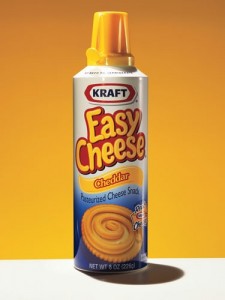
Cheese in a can - cheddar flavor! Who are you, and who am I? Isn't that what we're trying to figure out? It's frustrating when things like money and ego get in the way of our understanding and joy. How is it that we seem so confused about what's important? Is it fear? Does fear keep us from love, peace, and joy in our lives?

It’s difficult to comprehend most things in life, especially the big things. Things like God, the Holocaust, and aerosol cheese (okay, aerosol cheese isn't big, but it's difficult to understand). It’s difficult, because most of us never give enough thought to anything to even start to understand it, let alone make any effort to research it or read other’s thoughts on it. We seem apathetic and lazy. We, mostly Americans, seem obsessed with the superficial and the innocuous, things that won’t mean anything in six months, or a year from now. I don’t believe that we don’t care or that we’re lazy, I think it’s because we’re afraid. We’re scared. We’re afraid to know. We’re afraid of getting old. We’re afraid of getting fat. We’re afraid of going grey. We’re afraid that we’re not smart enough, good looking enough, thin enough, rich enough, strong enough, desirable enough, healthy enough, funny enough, never enough, enough, etc. etc. We’re afraid. And we do crazy things to hide and disguise that fear so we never have to face it.

Think about the pressure we feel to live up to other people’s expectations. Like the pressure to buy a big, beautiful house that we can’t afford or a nice, new car that we don’t really need. Things that we put a lot of “ourselves” into, at the very least, things that we anchor some portion of identity to. Think about what that means – saying that a big house or a new car is “me”, or that they represent “me”, is repulsive when you think about it. However, the need to say, “Look, I’m good enough, see!” is overwhelming and powerful.

How about the power of having money, that’s a big one. It’s sad, you could say you scrubbed toilets for a living but got paid $250,000 a year for it and people would be asking, “How do you qualify for that kind of job?” and, “Where can I apply?”.

We seem overly eager and very willing to sell out and prostitute ourselves for money. We’ll work at a job we hate for 20 or 30 years and be miserable every day, but we never really give our passions or our dreams a chance. Why is that? Do we still believe what our parents told us growing up? “You should be a doctor or lawyer; those professions earn a lot of money!” They said that because they were close enough to the “Great Depression” that they still carry all of that angst and anxiety and aren’t afraid to share it with us. Just because they never followed their dreams, doesn’t mean we shouldn’t follow ours.

I’m tired of being afraid. It’s back in the air now, credit crisis, bad economy, etc. We moved from the fear of terrorists to the fear of having no job. I’m tired of it. I want peace and joy back into my life and I want to follow my passions and dreams.

Pursue your passion, not your pension!

The Transports

Train tracks in DachauMy friend, Caron, gave me a great idea for my Kristallnacht project. She suggested that I make images of train tracks and stations that were instrumental in moving Jews to the concentration camps. "The Final Solution" could not have happened without the railways, without the trains making the mass transport possible. The Germans sent 30,000 Jewish men to Dachau and Sachsenhausen on Kristallnacht by way of trains.

The photo on the left is one I snapped at Dachau one year ago (December 2007). I remember thinking, "These are the rails that carried all of those people to their death". It was profoundly sad and visually striking to me.

This is a very insightful and interesting idea on many levels. It resonates with me simply for the fact of how much we us railroad metaphors and how they take on a whole new meaning here in Germany. For example, "derailed"or "derailing", "track wreck", "just the ticket", "off track", "one track mind", "railroaded", "fast track", "express", "letting off steam", "blowing your stack", "tunnel vision", "bells and whistles" and "end of the line". I see trains here in that kind of context.

The transports were usually cattle cars. At times, the floor of the car had a layer of quick lime which burned the feet of the human cargo. There was no water. There was no food. There was no toilet, no ventilation. Some boxcars had up to 150 people stuffed into them. It did not matter if it was summer, winter, boiling hot or freezing cold. And an average transport took about four and a half days. Sometimes the Germans did not have enough cars to make it worth their while to do a major shipment of Jews to the camps, so the victims were stuck in a switching yard - "standing room only" - for two and a half days. The longest transport, from Corfu, took 18 days. When the train got to the camps and the doors were opened, and everyone was dead.

Nazis Spread The Hate Around

I'm a lot more sensitive to these kinds of acts now. It's always been disgusting to me, but it's taken on a new level. It makes me want to become a full-time activist.

It's irrelevant who this kind of hate is directed toward. In the end, it all comes back on humanity. If there's anything to learn from the Holocaust (Shoah), (and for the record I don't think there is) it's that we're all responsible for these kinds of things. Indifference and ignorance being the greatest crimes. I ask myself everyday if I'm part of the problem, or part of the solution.

Destruction of a Muslim cemetery in Paris. PARIS — A Nazi swastika symbol is seen among desecrated tombs in the Muslim section of the Notre-Dame-de-Lorette military cemetery near Arras, northern France, Monday Dec. 8, 2008. Officials say that several hundred tombs of Muslim soldiers who fought in World War I, have been desecrated in northern France in an act the French president denounces as "repugnant racism". The desecration comes at the start of the Muslim festival of Eid al-Adha. There is no translation for the letters which mark the tombstones.(AP Photo/Michel Spingler).

Vandals desecrated at least 500 tombs of Muslim soldiers in northern France on Monday _ an act President Nicolas Sarkozy denounced as "repugnant racism."

The desecration near the town of Arras appeared timed with the start of Eid al-Adha, the most important holiday in the Muslim calendar.

The administration for the Pas-de-Calais region said the damaged tombs were in the Muslim section of the Notre-Dame-de-Lorette cemetery, a well-groomed burial ground for World War I soldiers. Some had swastikas scrawled on the tombstone, others had lettering whose meaning was unclear.

There are 576 graves in the Muslim section of the cemetery, where more than 30,000 soldiers are buried.

Sarkozy, in a statement, said the "abject and revolting act" equates with "repugnant racism against France's Muslim community" and insults the memory of all World War I combatants.

Inspect Your Worst, I Mean Wurst

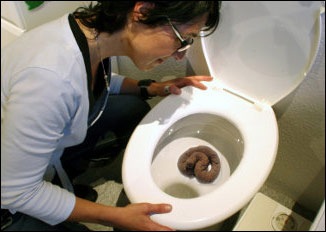
German "platform toilet" - inspect your WurstPlatform toilets. These are toilets that allow you to inspect your "Wurst" (Sausage) - translation: your shite. Germans are infatuated with them. I first saw them in Berlin. I thought, "Wow, this is weird, I'm shatting on a porcelain platform." It reminded me of seeing a pile of dog shite on the sidewalk, just completely out of place!

This is from Portnoy Stammtisch on the topic of "poo platforms". It was "World Toilet Day" on November 19. No kidding.

To most newcomers to this fine country, the contraption is an enigma. Who would want a shelf, just inches from your backside, that collects your business while allowing you to revel in your own stench? Not even a mercy flush is much help with this thing. And, to make matters worse, it's almost impossible to get rid of what you want to get rid of without the manual assistance of a toilet brush.

Germans, perhaps tired of having to defend this terrible device to perplexed outsiders, usually just shrug if you bring it up.

It wasn’t until I’d lived here for several years that I finally found one who I believed would give me a straight answer. In a newsroom of mixed nationalities, we were blessed with a German colleague of questionably fervent patriotism (let’s not use the adjective “brown” in this context, okay?) with an amazing knowledge and love of Teutonic culture. I would never have managed to squeeze out a question about the platform on my own but emboldened by my other English-tongued colleagues, I let it fly.

"It’s so you can inspect your poo. You can tell if you’re eating right," he told us in all seriousness. Rolf (name changed) was über-German – I've only ever met Dutch or Swiss who can speak with less irony. Actually, I’m being too kind. What he really said was: “It’s so you can inspect your Wurst.”

Building A Better Mouse Trap, German Style

When we were in Vienna, I was listening to my podcasts of, "This American Life" (TAL). It's one of my favorite shows. It's both funny and full of crazy, interesting information. You know, the stuff that makes the you ponder the world and everyone in it. I couldn't believe what I heard that night listening to a segment called, "Building a Better Mouse Trap".

The host, Ira Glass, talks with Andy Woolworth, an executive vice president in charge of new product development at the world's largest manufacturer of mousetraps, Woodstream Corporation, in Lititz, Pennsylvania. About once a month, Andy is contacted by someone who thinks he's invented a better mousetrap. He and Ira review some of the ideas that seemed particularly bad. The one that caught my attention is especially bizarre. I clipped it out of the program - this is an MP3 of it (1.2MB give it a minute to download into your browser). Get your head around that one!

Let The Video Podcasting Begin!

"I can't be everywhere, all the time! Or, can I?"

I'm going to immerse myself into online education. Not as a student, but as a teacher. I have this (brilliant?) idea to teach Wet Plate Collodion via video podcasts. And it's not only to educate, but to also build community.

I've fallen big-time for audio podcasts over the last few years. I have a whole heap of them that I listen to almost daily. Ira Glass, "This American Life", Joe Frank's radio show, Bill Moyers, Bill Maher's HBO piece, NPR bits and pieces, etc. I'm amazed at the amount of information we take in. Sometimes, I think my head is going to explode. There's never a dull moment in the 21st century, is there? Remind me to tell you about the Ira Glass story about building a better mouse trap - OMG! You'll freak!! I digress.

My theory is that if we use this technology the right way, everyone wins. Not to get off into politics, but look at the presidential election. It was all about Barack's presence online and especially the email campaigns his staff organized and executed. I for one, am very happy they could reach so many and that so many responded, as I said in a previous post, we have a chance! I digress, again.

I'm home for a while now and will be finishing up my new book and completing the video workshop series on Wet Plate Collodion. I'm being quite anal about the text and information in these publications. I'm trying real hard to listen to what people want to learn and write about it in an articulate, "easy" way. The last book (2006) was "sky-blue" stuff... nothing to go off of but instinct and my own experience, it was just the basics. This time, I have a lot to say about the history of the process as it applies to my work and, moreover, all kinds of new, modern gadgets and tricks to use in the process to make it easier. I'm psyched about it.

On January 1, 2009 (or a few days before), I'm going to allow access to a large amount of video data on the Wet Plate Collodion process. This will be the very first complete workshop online. It will be a series of "on demand" videos broken down into chapters. Subscribers will be able to view them anytime they login, jump to any part and watch them as much as they want. It's going to be uber cool!

It's about time, really. I get at least 4 -5 emails a week, sometimes more, asking about resources to learn the process. I hope to accomplish several things by doing this. One of the big ones is to quickly and easily point people to a high-quality, cost effective way to learn the process. This will be so sweet.

There are a few places in the United States where you can learn the process, but more and more, people are using the web to gather information and communicate about it. There are a lot of people that learn it on their own now. This is in large part due to the massive amount of information online now. My Wet Plate Collodion forum board has over 500 members and almost 15,000 posts. It's posted to daily. My point is that it's about time I do this. I know that it will be successful and fulfill a huge need out there. Not to mention, it will be fun as hell to do.

So, if you are interested in learning the Wet Plate Collodion photographic process and have $99 bucks, on January 1, 2009 go to The Contemporary Wet Plate Collodion School and signup! Within a couple of minutes you'll be watching videos and learning the process! See you in class!

Jewish Cemetery Vandalised With Pig's Head & Blood


Gotha, Germany Jewish Cemetery
Pictures of a shocking Nazi hate attack on a Jewish cemetery in the town of Gotha have horrified Germany.


A bloody pig’s head was found stuck to the middle of a Star of David on the graveyard gate at 5.30am yesterday. A sheet next to it, smeared with blood, held a chilling message: "6 million lies".


Nazism and hatred toward Jews (and people that are "different") is alive and well here in Germany. For those that think otherwise, you are completely misinformed. As this Bild article says, there were over 17,000 of these kinds of crimes committed last year here, 18 involving cemeteries. To desecrate cemeteries and disrespect the dead like this, speaks volumes to me. In a way, I feel sorry for these uneducated, misinformed souls. I would relish the opportunity to teach them about the history of the Jewish people - that would be wonderful.  


These kinds of things motivate me to "turn up the volume" on my project. I want to read about people that are trying show the truth and create discourse to help people learn the truth. The other side doesn't seem to get fair play on this topic. We'll see if we can change that.


This is a link to the Bild article (in English). Thank you Caron.
Credit: By OLIVER LÖHR and JAN MEYER

It just never stops....

Former E. German Synagogue Defaced
November 19, 2008

BERLIN (JTA) -- A newly renovated synagogue in the former East Germany was defaced with anti-Semitic graffiti, police reported.

It was the third act of vandalism against a Jewish site reported in the former East Germany in the last  two days.

According to reports, perpetrators painted anti-Semitic statements and illegal symbols in yellow on the front door of a synagogue in Goerlitz covering more than a square yard. The vandalism was discovered Monday.

Reached in Vienna, Alex Jacobowitz, the chairman of Goerlitz’s small Jewish community, said he would comment after seeing the police report.

The synagogue in Goerlitz, originally dedicated in 1909, was the only synagogue in the state of Saxony to survive the Kristallnacht pogrom of 70 years ago. It was reopened to the public following extensive renovations on the anniversary of Kristallnacht, Nov. 9.

Also Monday, two Jewish cemeteries in the former East German state of Thuringia were found defaced with red paint. In one case, the bloody head of a pig was hung on the cemetery’s iron gates. Police reportedly were able to retrieve evidence at the cemeteries in Gotha and Erfurt.

Welcome To Wien (Vienna), Austria

Rolls Royce in Wien!We arrived in Wien last night. It was a longer drive than expected due to a 2 hour Stau in Germany. However, we survived.

We have a nice apartment right off of Simmeringer Hauptstasse. The S-Bahn and U-Bahn are close and we explored downtown Vienna a little bit tonight. I saw where Hilter was rejected from (Academy of Art) and made me wonder how the world may have been different had they let him in here - great novel/screenplay waiting to be written. 

The workshop went very well today. One more day (tomorrow) and we'll wrap it up. The participants are motivated and off to a grand start! There are four students; Fritz, Reinhard, Stefan and Zoltan. Three are Austrian and Zoltan is from Budapest, Hungary.

Hypo versus KCN!

Remember, here in Vienna, I'm less than an hour from Bratislava, Slovokia and about 2 hours from Budapest, Hungary. I would like to take a week off and just go!

These are images from the workshop today. Showing the difference between sodium thiosulfate fix and potassium cyanide fix - amazing!


A sampling of the workshop plates.


Reinhard Reidinger