The Last Day of 2010

Sometimes we find ourselves in a place where everything is ending. Or at least it feels that way.

It’s a bitter-sweet thing. I’m in one of those places right now and wondering how it all happened so fast and what will fill the “hole” on the other side of the pond. While endings can be sad, they can also open the door to opportunities; and that’s where I have to keep my head, or at least try.

Today, I’m reflecting on leaving Europe after five years, Summer’s evolution into adulthood (the loss of “my little girl”) and just the overall loss of what I know now – my life – if you will. The year is ending, too. That’s what started me writing. I thought I could use the last day of the year as a metaphor for my life right now.

I was in my studio/darkroom yesterday and I was trying to devise a plan of where to start to break it down. It made me sad. In a lot of ways I don’t want to go back to America. In other ways, I can’t wait. It’s a roller coaster of emotions, to say the least. I walked out of my darkroom full of anxiety and didn’t touch a thing. I need to get in there today and start packing!  

We’ve met and befriended some of the finest human beings on this big blue ball (you know who you are) here. Europe and the Europeans have been very good to me and my family. This has been, without question, the best part of my life. The people, the experiences and the personal and professional growth has been amazing. I’ve learned more about myself and about life in these five years than the previous forty. I hope I can take some of that back with me and am able to share it without sounding arrogant or condescending. Americans could learn a lot from Europeans, I know I have.

I’ve been treated like a king here. And I’ve been respected and acknowledged for my work. I’m afraid that I will lose that returning to the States. No one knows me and no one cares what I’ve done here. It feels like I’ll be starting over in a lot of ways.  I’m okay with that; I just don’t want to keep taking one step forward and then three back.

I have to thank Centre-Iris Gallery (Olivier and Pierre) and all of the fine Parisians that supported me this year. What a wonderful experience! Merci beacoup! To have a gallery in Paris that supports you like Centre-Iris is overwhelming. I’m very grateful and will return every two years with new and exciting work to show Paris. A big thank you to our friend, Benoît Boucherot, too! He made a wonderful documentary about me (see the previous post). 

To every studio, cultural center, art school and individual artists in Europe (Barcelona, Reus, Gothenburg, Budapest, Dresden, Cologne, Vienna, Glasgow, London, Amsterdam, Berlin, Brussels, and many, many more) that I’ve had the pleasure of visiting and teaching at (and there have been a lot of them); thank you! You’ve allowed me to grow and taught me more than I taught you. I’m eternally indebted to the hundreds of people that I’ve had the opportunity to meet, teach and befriend; thank you! I wish I could stay another five years.

Summer and Jesse just spent three weeks with us. They flew back yesterday and are back in America today (31 December 2010). I was able to get them in the head brace for a plate during a private workshop with Bernd Radtke. We had fun; we went to Amsterdam, Belgium (Lummen) and Aachen (Germany) to see friends and have some fun.

I miss my life here already. 
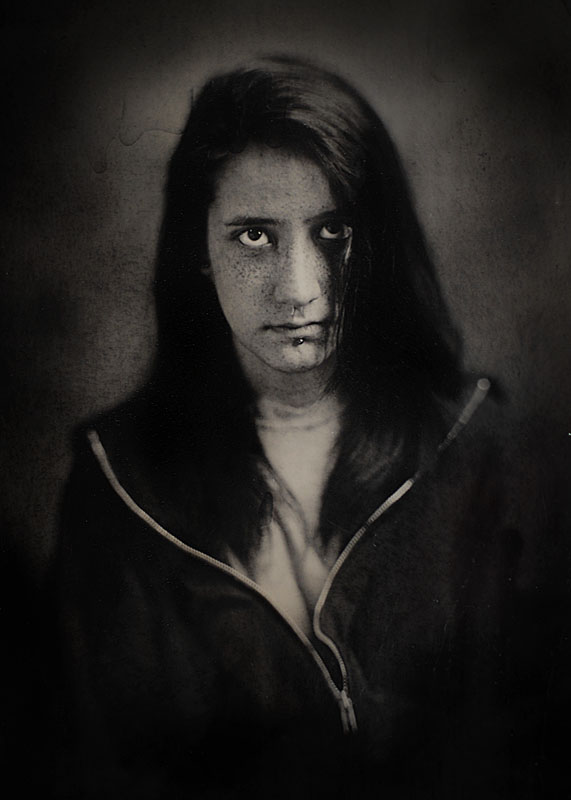
Summer Joy Jacobson - December 18, 2010 Viernheim, Germany 5" x 7" Black Glass Ambrotype

Jesse Vriens - December 18, 2010 Viernheim, Germany Half Plate Clear Glass Ambrotype


"A Photographic Heritage" by Benoît Boucherot

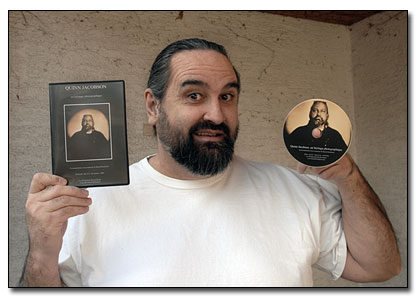
Yesterday afternoon I received a call from Jeanne. She told me I had a surprise in the mail and wanted me to guess what it was. I had no idea. As I rifled through my mind, trying to think what it could possibly be, she said, "It's the DVD from Benoît and it is amazing!" I couldn't wait to see it. 

The backstory goes something like this: When I was in Paris this year (March - June, 2010), I was approached by an artist/filmmaker named Benoît Boucherot. He asked if I would be interested in allowing him to make a documentary about my time in Paris and my photographic/artistic life. He explained to me what he would do and what his intentions were and I said, "Yes".

The result of his hard work and incredible talent is this, a 44 minute documentary about me, my family, my work and my time in Paris. I think he did an outstanding job capturing the feeling and the passion behind all of the hard work and incredible fun we had in Paris. 

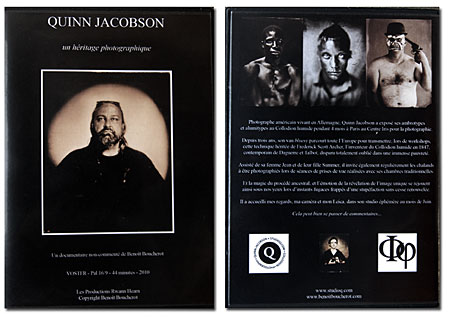
When I get permission, I'll upload a clip or two from the DVD. I hope to offer this in my store at some point, too. The front and back of the DVD. It's in English and French, depending on who's talking.

Un documentaire non commenté de Benoît Boucherot
44 minutes - HD 16/9e PAL - VOSTFR
2010 - Les productions Rwann Hearn

" Photographe américain vivant en Allemagne, Quinn Jacobson a exposé ses ambrotypes et alumitypes au Collodion humide pendant 4 mois à Paris au Centre Iris pour la photographie. Depuis trois ans, son van bluesy parcourt toute l’Europe pour transmettre, lors de workshops, cette technique héritée de Frederick Scott Archer, l’inventeur du Collodion humide en 1847, contemporain de Daguerre et Talbot, disparu totalement oublié dans une immense pauvreté. Assisté de sa femme Jean et de leur fille Summer, il invite également régulièrement les chalands à être photographiés lors de séances de prises de vue réalisées avec ses chambres traditionnelles. Et la magie du procédé ancestral, et l’émotion de la révélation de l’image unique se rejouent ainsi sous nos yeux lors d’instants fugaces frappés d’une stupéfaction sans cesse renouvelée. Il a accueilli mes regards, ma caméra et mon Leica, dans son studio éphémère au mois de Juin. Cela peut bien se passer de commentaires... "


Mercury Pot

So here we are, at the heart of the operation. Although you can fail miserably before this step, this piece of equipment is critical to calculate both time and temperature. I'll post on safety in a different entry, let's just say that you do not use this unless it's in a well-designed, vented, tested, fume hood.

After the plate is polished, fumed and exposed, it comes to this unit. Here. the plate is fumed again but this time with heated mercury - Hg. There are many methods, times and temperatures, but the general rule is 100 C (212 F) for 2 minutes. The mercury is heated with an alcohol lamp - this is quicker and the "cool down" is quicker, too. I have nothing against electrical heaters for mercury - if that's what you like, go for it.

With René's design, I can inspect the plate through the "safe windows". Again, you can do this by time and temperature only, and a lot of people do, I prefer the visual, if I can get it.


All material © 2010 Studio Q - Quinn Jacobson Photography and René Smets.

 Designed and built by Rene Smets.


Trays & Pans

You might ask why are you posting on trays and pans? Good question! I'm doing this because of the unique construction (addtion, really) that Rene's trays come with.

The little "lift" in the tray really helps the Daguerreotypist from damaging the plate when trying to lift it out of the tray. Fingernails and fingers damage the (tender) surface easily!

 I highly recommend this design if you do it. The plastic strips in the bottom of the tray act as ribs to keep the plate from "sticking".

Everything you need for trays in Daguerreotypy. Whole Plate and Half Plate dummies sit inside the trays.

Fuming or Sensitizing Boxes

This part of the Daguerreotype equipment is very important (but then again, what part isn't?). This is where the plate is sensitized, or becomes like film - sensitive to light. The final surface is an amalgum of silver and mercury. The first fuming is over Iodine Crystals. The plate is fumed until you have a rose color (checked under reflected white light and fumed again for a few seconds to mitigate that exposure) and then it's off to the Bromine for fuming. No Bromine fume, no "speed" or ISO.

These are very special fuming boxes. They are designed with NO metal in them and to seal extrememly well when fuming and in storage.


Iodine and Bromine Fuming Boxes

Detail of the Iodine Box - designed and built by Rene Smets.

In the "fuming" position.

In the "resting" position.Open top anc slide on the Iodine Box. These are the Corian boxes that store the Iodine and Bromine. These are "sealed" for storage.

Detail of the "sealed" storage box with handle!

I needed three sets of inserts; Iodine, Bromine and Mercury - Whole Plate and Half Plate size. This is why I decided to go with the "Lift System" versus the "Vise System". You can see the "gaps" and issues with the "Vise System".

Gilding & Drying Stand

People always want to know waht the most difficult part of making Daguerreotypes is - the answer is gilding.  There seems to be some correlation to the varnishing step in Wet Collodion and Gilding in Daguerreotypy. It's a strange and difficult thing to explain in writing. These are all visual processes, every step, you watch and adjust. It's visual and intuative.

Rene designed a "traditional" Gilding Stand for me with the built in feature of being a Drying Stand, too. See the photos/illustrations. Rene thought that this was a better option than using BBQ tongs. I'm also making larger plates - Whole Plates won't fit in BBQ tongs.

Gilding Stand/Drying Stand - this will accommodate both Whole Plate and Half Plate sizes. The drying stand post is removed and the left gilding post is moved into its place and the rack supports Half Plate. In this configuration, it supports Whole Plate. A "Whole Plate" sitting on the Gilding Stand with catch pan for when the meniscus breaks.

Here you see an illustration of me "working the stand". I wish I would have put my pony tail a little higher on my head, but this was in Belgium, and that's the custom there.

The Drying Stand holding a Whole Plate piece of glass.

Electroplating Box

Making Silver Plates for Daguerreotypy:

There a couple of ways to go about covering the copper plate with silver. The first way is to send the polished and preped copper plates to a plater. There are several good ones in the United States. Search the FAQ database for those. The second way, the way that keeps you independent is cladding or electroplating the copper plates. I've chosed electroplating.

I haven't found a lot of good information on this topic online. You can search the FAQ database for specifics, but the general idea is that you use an anode (pure silver plate) and cathode (copper plate) in a solution of silver and cyanide. An electrical current is sent through the plates and the silver is transferred and "plated" onto the copper - electroplating.

This is my electroplating tank and plate hangers:

Whole Plate Electroplating Tank designed and constructed by Rene Smets.

Plans for the plate hangers - holds Whole Plate and Half Plate.

Cathode Hanger - Holds Whole Plate and Half Plate.

Copper Plate Preparation

I am going to publish a series of posts about the Daguerreotype equipment that René Smets of Lummen, Belgium built for me.

All of this equipment is all based on his design and his work. Of course, I told him what I wanted and customized it where I could. And I gave feedback throughout the project, but the credit goes to René.

All material is copyright © 2010 Studio Q - Quinn Jacobson Photography and René Smets.


The plan showing how the Copper Polishing Vise will be used.

 Copper Plate Vise - this is an important piece of equipment. The surface of the copper plate dictates, to a large extent, the quality of surface that you will have on the silver plate.

My Final Workshop in Germany

Jasmine & Abel - 6"x6" Black Glass Ambrotype - 7 Nov., 2010It's bitter-sweet. I just finished my last Wet Plate Collodion workshop I'll do in Germany. Two photography teachers from Brussels came down; Erwin and Frederick. We had a good time. It's always fun, and I'll miss it terribly. However, there is a time to call it and this was it. I could be weeks away from being back in the United States and I need time put things away, both literally and psychologically. I need to separate a little bit. Time will do this.

Jeanne asked a friend, Jasmine, to come over so that Erwin and Frederick would have someone to make portraits of - other than each other or me. Although, they made plenty of images of one another. Jasmine brought her boyfriend, Abel. They were patient and kind, I ended up making this portrait for them.

There will be more teaching and more exciting things in the U.S. for me, I know it. I'm already looking forward to it!