
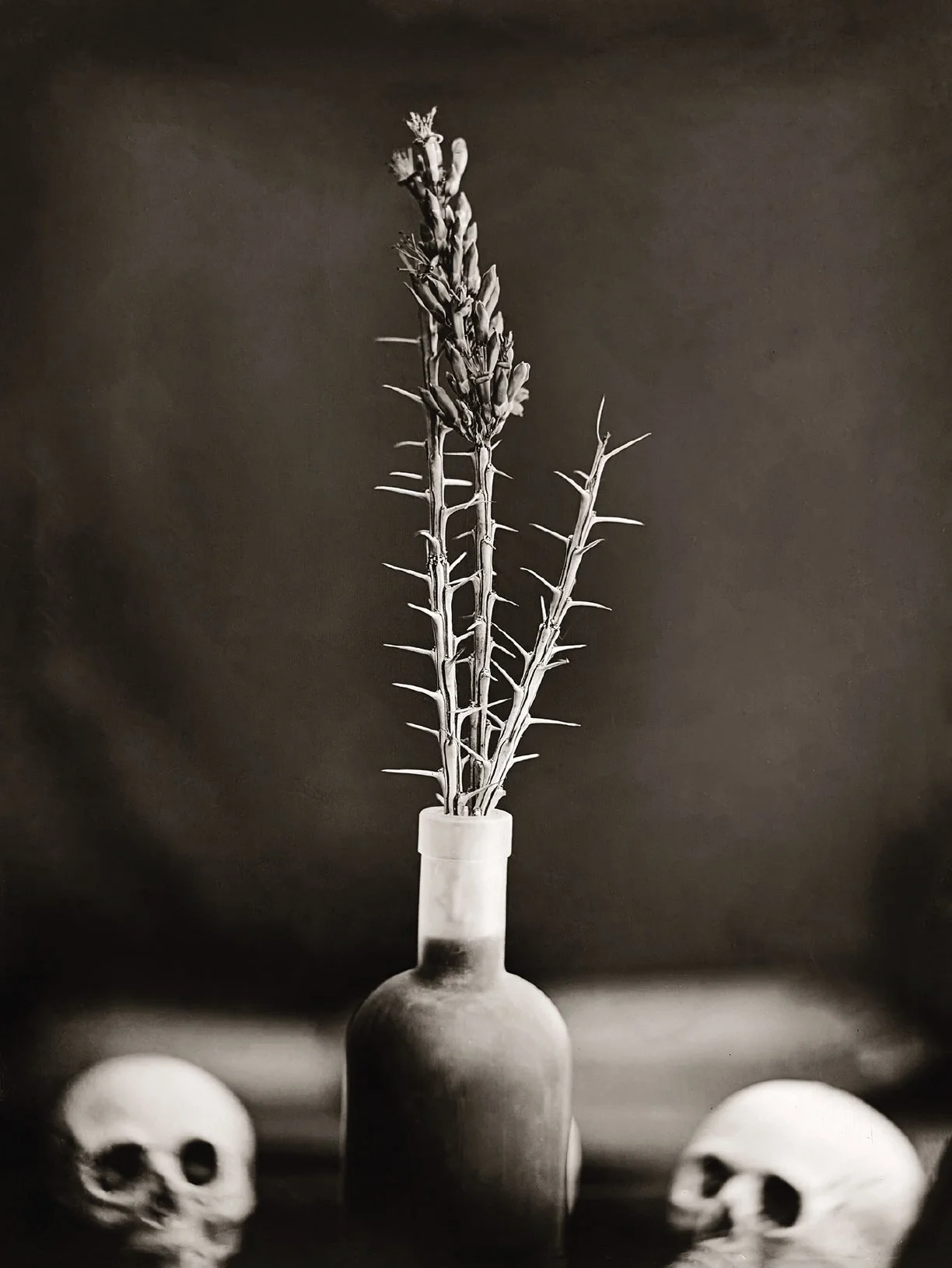
The Creative Mind & Mortality Podcast | Glass Bones, Chapter 17
When does a work of art actually begin?
Is it when we make the first photograph, apply the first layer of paint, or write the first sentence? How much of the creative process has already taken place before anything becomes physically visible?
After more than three decades of making art, I've become increasingly interested in the psychological experiences that precede the emergence of creative form.
Much of my work begins with something I can’t adequately explain. A historical encounter, a memory, a confrontation with mortality, or a seemingly insignificant experience can unsettle my understanding of the world. Sometimes the feeling remains with me for months or years before I recognize its relationship to the work.
In Chapter 17 of Glass Bones: Art, Mortality, and the Human Mind, titled “Where the Work Begins,” I examine this process in detail. I explain the 12 stages of this encounter, from Rupture to Return. It's where much of the theoretical inquiry developed throughout the book begins to take shape as a phenomenological account of creative practice.
From Theory to Lived Experience
Otto Rank understood artistic creation as a way of transforming psychological conflict into symbolic form. Ernest Becker examined the artist's relationship with existential anxiety and the fragile cultural structures that protect us from mortality awareness.
Terror Management Theory provides an empirical framework for investigating how reminders of death influence our attachment to beliefs, identities, and cultural worldviews.
Together, these perspectives help explain the psychological conditions surrounding creativity.
My interest extends into the experience itself.
What happens internally when an artist encounters something that destabilizes meaning? How does that experience become workable? What takes place between the initial psychological disturbance and the eventual emergence of a photograph, painting, or other creative form?
These questions have led me to identify twelve interconnected stages that describe a recurring pattern in my own practice.
The Twelve Stages of Creative Transformation
Rupture → Exposure → Anxiety → Threshold → Holding → Metabolization → Residue → Trace → Form → Witness → Provisional Meaning → Return
I've separated these experiences into stages to make them more visible. In practice, they overlap considerably. The process is cyclical and recursive, and its duration is unpredictable.
Rupture, Exposure, Anxiety, and Threshold
The process begins with rupture, a break in the symbolic structures through which we understand ourselves and the world.
I've experienced this while standing at historical massacre sites, reading accounts of violence against the Ute people, and even watching collodion separate from a glass plate in the darkroom.
Sometimes rupture is a quiet recognition that something I thought was settled is no longer settled.
What follows is exposure. The psychological protection provided by a familiar belief or explanation begins to thin, bringing us into more immediate contact with uncertainty.
Exposure generates anxiety.
I've learned to pay particular attention to the quality of that anxiety. When I experience a persistent unease or an unexplained attraction to a subject, an image, or a place, it often indicates that something deserves further inquiry.
Anxiety becomes information.
Eventually, I arrive at what I call the threshold, the psychological space where an established meaning has failed and another has yet to emerge.
There is very little certainty here. I may have no idea what the work will become.
Holding, Metabolization, Residue, and Trace
Holding is one of the most demanding aspects of my creative practice.
It requires active attention without a predetermined outcome. I have to resist the temptation to explain the experience prematurely, impose a narrative on it, or force the work toward a resolution.
Sometimes holding involves looking at a failed photographic plate for an extended period. Other times, it means returning to the same subject repeatedly without understanding why.
I think of holding as patience with not-knowing.
Over time, metabolization begins. Through sustained engagement with the material, the psychological pressure gradually becomes something I can work with.
I've experienced this while making dozens of photographs at historical sites before beginning to understand what those places were revealing to me. I've experienced it in painting as well, working through layers of material over weeks or months.
Something remains from these encounters. I call it residue.
Residue is the image I cannot stop seeing, the feeling that follows me home, or the unresolved experience that wakes me at three in the morning.
Eventually, that residue may become trace.
A first photograph, a mark on a canvas, a fragment of writing. These tentative gestures bring something previously internal into the physical world, where it becomes possible to encounter it differently.
Form, Witness, Provisional Meaning, and Return
As traces accumulate, the work begins to acquire form. It develops its own coherence and presence.
At some point, I can stand before a photograph or painting and experience it independently of the psychological conditions that produced it.
This is what I call witness.
The distance between myself and the work allows me to encounter something I couldn't fully recognize while making it.
From that encounter, provisional meaning may emerge.
I use the word provisional deliberately. Whatever understanding the work provides remains temporary, subject to further experience, interpretation, and change.
Eventually, the questions reopen. A finished body of work may begin to feel insufficient. I find myself returning to familiar subjects with a different awareness.
The cycle begins again.
Creativity as an Existential Practice
I consider this framework an interior map of creative experience, developed through years of working with mortality, impermanence, historical trauma, and the fragility of human meaning.
It also reflects a larger question that has occupied much of my research: do creative individuals metabolize death anxiety differently?
I suspect that sustained creative practice can cultivate a particular relationship with existential uncertainty. The repeated experience of working without predetermined answers may influence how we respond when our familiar psychological structures become unstable.
This remains an inquiry. I make no claim that artists are inherently more perceptive or psychologically resilient, or that creative work guarantees the successful transformation of suffering.
There are significant psychological costs associated with remaining close to difficult material. Those costs deserve serious attention, particularly when we consider how much energy human beings ordinarily devote to protecting themselves from existential anxiety.
The Foundation for RUPTURE
Chapter 17 also establishes much of the conceptual foundation for my second book, RUPTURE: A Phenomenological Encounter.
Where Glass Bones develops the theoretical and psychological context for understanding art and mortality, RUPTURE will examine the experience more directly through the work itself.
I'm interested in the interval between existential exposure and the formation of meaning. What becomes possible within that interval? How does the material participate in the inquiry? What can an image disclose that theoretical language struggles to articulate?
These questions continue to shape what happens in my studio and darkroom.
I've come to understand that the beginning of a work of art can be remarkably difficult to locate. Sometimes it begins years before I recognize it, in an experience that leaves me unsettled and unable to return comfortably to a previous understanding.
Learning to recognize those moments and developing the patience to remain with them has become central to my creative life.
The work begins there.
Watch or listen to Chapter 17, “Where the Work Begins”: