
When Awareness Deepens
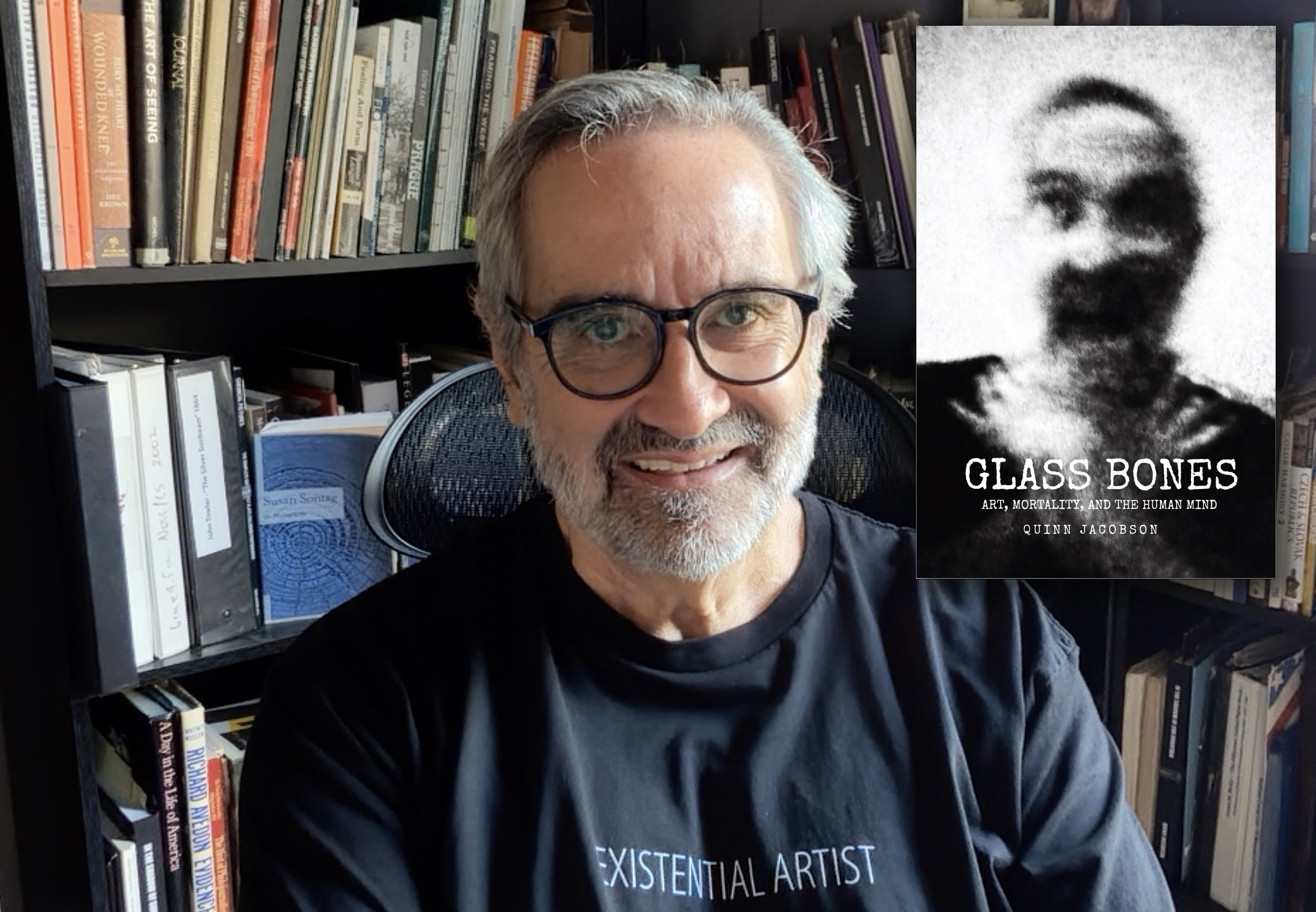
I wear this t-shirt in public, and people ask me what it means. I tell them, “It means I make art to distract myself from the void, but I still have to pay taxes." I also need a haircut!
I've spent a good portion of my life thinking about mortality, both through my artwork and through the philosophical and psychological questions that have shaped my research. One of the things I've come to understand is that our relationship with death changes as we grow older and accumulate experience.
We lose people we love. Our bodies change. Things that once seemed important begin to lose their significance. We become increasingly aware that time is limited, and that awareness can change how we see ourselves and the world around us.
Chapter 12 of Glass Bones, “When Awareness Deepens,” explores what happens when our psychological defenses against mortality begin to loosen.
Ernest Becker argued that human beings construct elaborate systems of meaning to protect themselves from the anxiety associated with knowing they will die. These systems include our cultural beliefs, identities, religious convictions, achievements, and the many ways we attempt to establish significance in a temporary world.
They serve an important psychological function. We need them to navigate everyday life. Yet there are moments when these protections become less convincing, when the reality of our impermanence becomes difficult to ignore.
What happens when we begin to see through some of the stories we've spent our lives believing?
This is where existential philosophy becomes particularly relevant.
Martin Heidegger described human existence in terms of being-toward-death. His argument was that mortality is fundamental to how we experience existence. Our awareness of death shapes the possibilities available to us and the decisions we make within the time we have.
Heidegger believed that much of human life is spent absorbed in the expectations and conventions of others. We inherit beliefs, follow cultural scripts, and organize our lives around assumptions we rarely question.
Recognizing our finitude may interrupt this pattern. It can encourage us to examine whether we're actually living according to our own values or simply following the expectations we've inherited.
Jean-Paul Sartre approached this problem through freedom and responsibility. His famous proposition, existence precedes essence, suggests that human beings are not born with a predetermined purpose. We create meaning through our choices, actions, and commitments.
That freedom can be unsettling. It places responsibility for our lives directly in our hands.
I find these ideas especially relevant to creativity.
When I enter my studio or darkroom, I'm confronted with uncertainty. I can prepare the materials, control certain variables, and bring decades of experience to the process, but I cannot guarantee the outcome.
A wet collodion plate is temporary in its own peculiar way. The chemistry changes, the light shifts, and the image must be made within a narrow window of time. Every exposure reminds me that control has limits.
Painting presents similar problems. I begin with an idea, but the work often moves in directions I didn't anticipate. Sometimes the most meaningful discoveries occur when I allow the process to unfold without forcing it into a predetermined outcome.
These experiences have taught me something about the relationship between awareness and creativity. The more comfortable I become with uncertainty, the more willing I am to remain present with what is happening.
I suspect something similar may be possible in our relationship with mortality.
Terror Management Theory has demonstrated that reminders of death can intensify our attachment to cultural worldviews and self-esteem. When the systems that provide meaning feel threatened, we may become more defensive, rigid, or hostile toward people who challenge our beliefs.
Yet research also suggests that the effects of mortality awareness depend partly on how that awareness is experienced and processed. Under some circumstances, reflecting on death may encourage more deliberate choices, greater appreciation of life, and a reconsideration of personal values.
This possibility interests me.
I've become increasingly aware of my own defensive responses, particularly when an idea challenges something I believe. I can sometimes recognize the impulse to defend my position before I've fully considered what is being said.
That moment of recognition matters.
It creates a small interval between the experience of threat and my response to it. Within that interval, I may have an opportunity to examine the fear, uncertainty, or attachment beneath my reaction.
This is closely related to the ideas I'm developing in my next book, Rupture: The Creative Response to Death Anxiety.
Rupture is concerned with the phenomenology of the interval between existential threat and symbolic defense. I'm interested in what happens when we recognize our defenses while they're forming and whether that awareness might allow us to respond differently.
I don't imagine that we can eliminate death anxiety or somehow escape the psychological conditions that make us human. Becker's work suggests that such an ambition would misunderstand the very nature of consciousness.
What interests me is the possibility of becoming more aware of how these mechanisms influence our lives.
Perhaps deeper awareness allows us to become a little less rigid in our beliefs, a little more compassionate toward others, and more attentive to the brief experience of being alive.
Mortality is the condition under which everything we value exists. Our relationships, creative work, memories, and experiences all unfold within the limits of time.
For me, that recognition has become increasingly important as I grow older.
I want to spend my remaining years making meaningful work, being present with the people I love, and paying attention to the world around me. I'm less interested in the cultural expectations that once seemed so important and more interested in understanding what it means to live consciously inside a temporary existence.
That's what Chapter 12 is about.
When awareness deepens, we may begin to recognize that meaning is something we participate in creating every day.
Our mortality gives that participation its urgency. Our choices give it form.
And perhaps the most important question we can ask ourselves is a relatively simple one:
Knowing that my time is limited, how do I want to live?
In this installment of The Creative Mind & Mortality Podcast, I read Chapter 12 of Glass Bones: Art, Mortality, and the Human Mind and explore how a deeper awareness of death may change our relationship with meaning, creativity, and everyday life.