• blog
  • in the shadow of sun mountain
  • buy my books
  • photographs
  • paintings
  • bio
  • cv
  • contact
  • search
Menu

Studio Q Photography

Exploring Human Behavior and Death Anxiety Through Art
  • blog
  • in the shadow of sun mountain
  • buy my books
  • photographs
  • paintings
  • bio
  • cv
  • contact
  • search
×

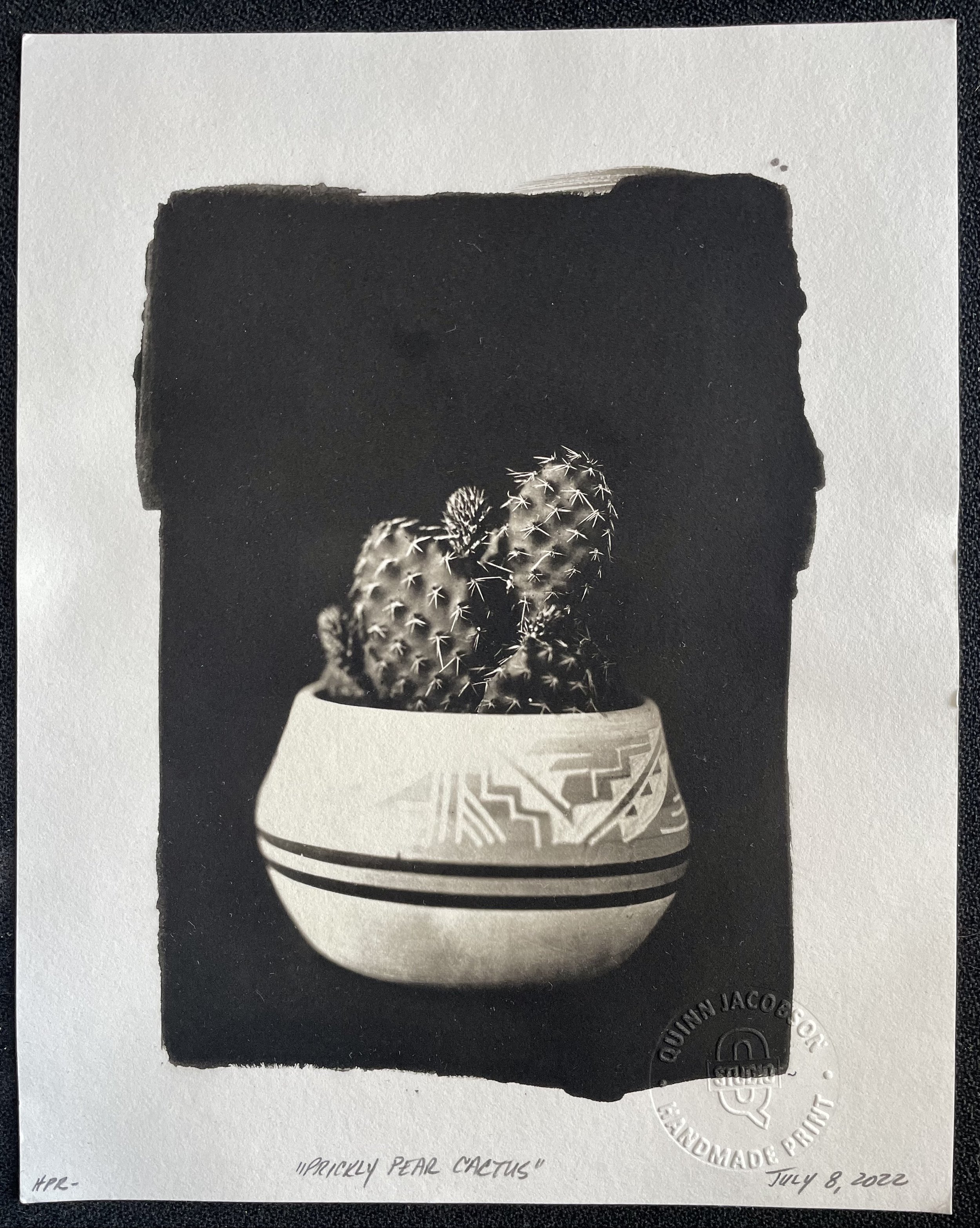
THE PRICKLY PEAR CACTUS

Prickly pear fruit and nopales were used by American Indians to treat a variety of physical ailments. Nopales in particular were split and applied to open wounds on both humans and animals. Roasted nopales were held on the side of the neck or below the chin to treat rheumatism and mumps. Spines from prickly pear pads were commonly used as needles by many tribes. The deep reds and purples of the tunas were extracted as juice and used to dye textiles.

The Prickly Pear Cactus

Quinn Jacobson July 8, 2022

I see the flora portion of this work taking shape. I work on it about 30 hours a week. Not including research and reading. It’s the best “job” I’ve ever had.

There’s still a lot to do. The weather is so nice here, I struggle between working in the studio and getting out to do so more remote work. I worry about making images on Tava-Kaavi - Sun Mountain (the colonized name is Pikes Peak) or at the Garden of the Gods. I’m not interested in the “chocolate box” photographs. In fact, I’ve had a lot of success staying right here in my backyard so to speak. It’s difficult for me to do "traditional” work. I’ve said it a thousand times, I’m not interested in the standard landscape image. They bore me to death - so tiresome. I need to resolve these issues and making plates is how I resolve the problem. All in time!

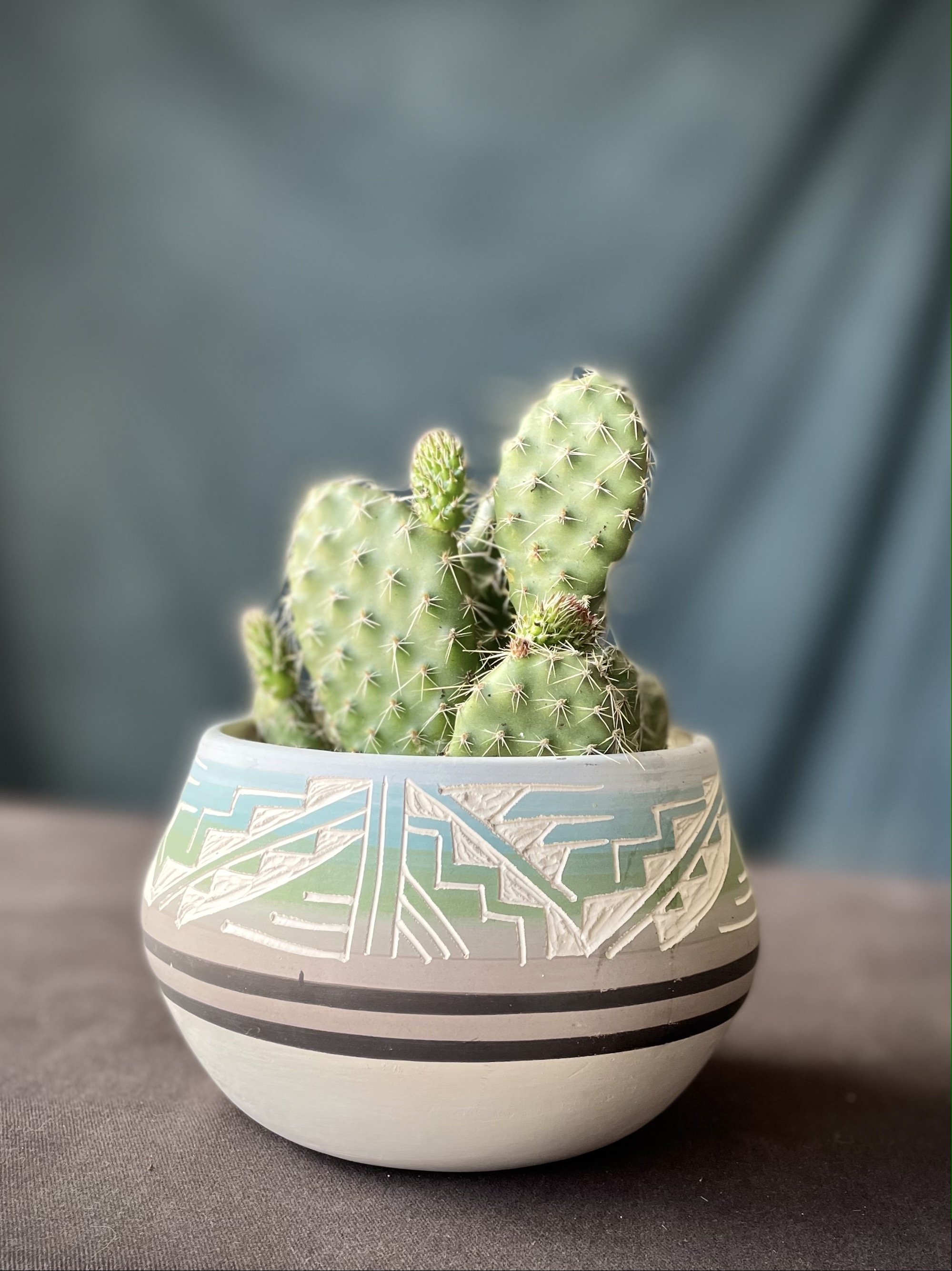
A digital snap of the cactus.

In Sun Mountain

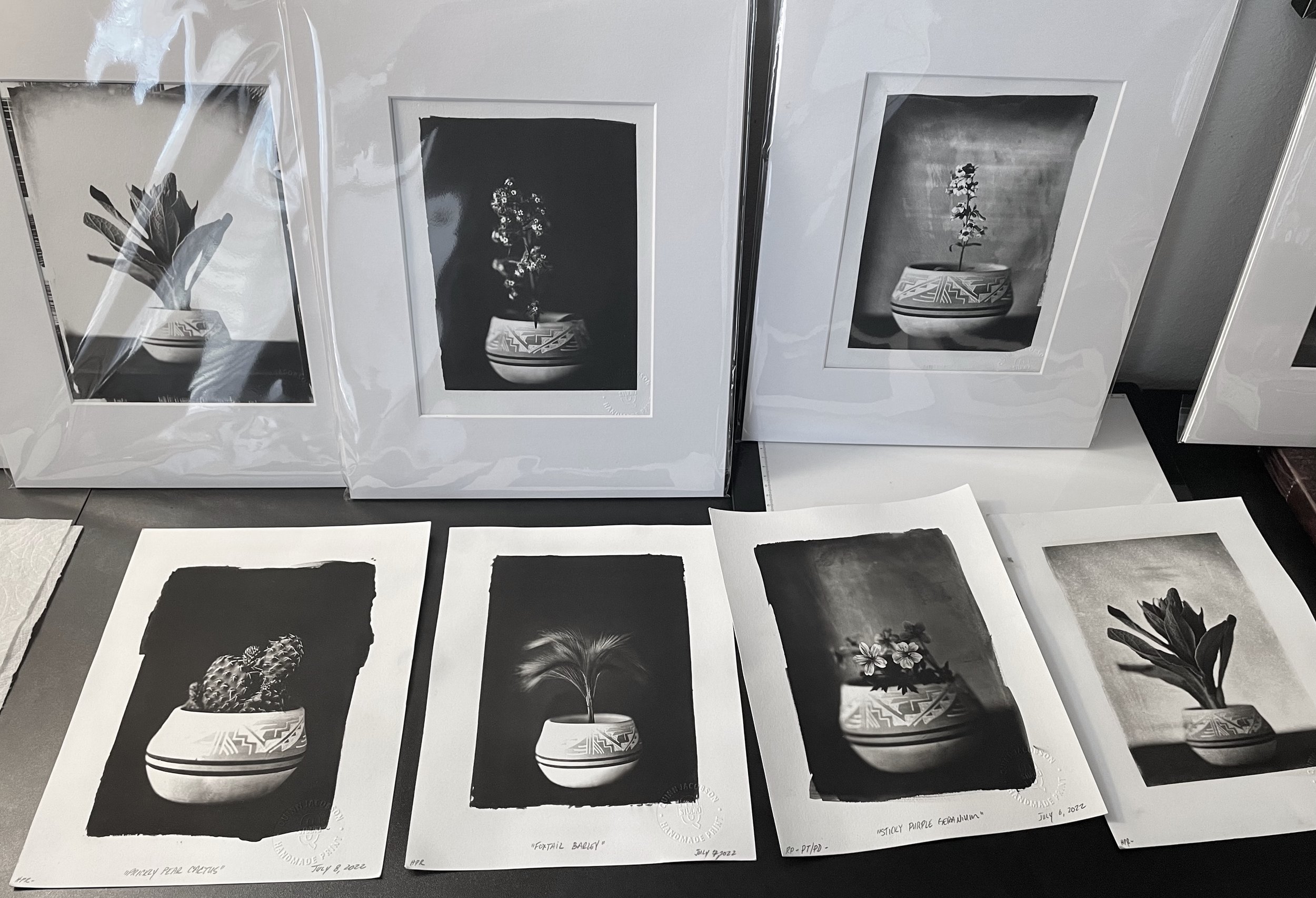
“Foxtail Barley” - American Indian tribes had several uses for foxtail barley. The dried and moistened root was applied as a compress for eye inflammation and the seeds were pounded into a meal and eaten.
Palladium Platinum print on HPR paper from a whole plate wet collodion negative.

The Making of the Foxtail Barley Plate

Quinn Jacobson July 7, 2022

THURSDAY JULY 7, 2022
Life is good on the mountain. I was in the studio early today. The light is so beautiful in the early morning here. I have a 10’ x 10’ (3 x 3m) window that faces north. I use that opening to make these flora images.

I was in the mood to listen to something interesting and powerful. Jeanne and I just re-watched “Smoke Signals” (a great film) and Robbie Robertson had a song in it. It reminded me that 30 years ago, we picked up his album, “Music for the Native Americans” (Coyote Dance linked below). So I started playing that as I prepared some glass for making negatives.

"Dispossessed, of their ancestral homelands by successive invasions of Europeans, the first real Americans have long been cloaked in a veil of myth and legend that has hidden from us the true richness and diversity of Indian civilizations and cultures. This newly unfolding legacy represents an unparalleled body of untapped wisdom, which even now provides fresh perspectives on very modern problems. The astonishing reality of Indian history, presented here for the first time from the perspective of native Americans, will deepen our understanding of what it really means to be an American. The archaeological history of the native peoples of the Americas goes back more than 30,000 years. By the time Columbus landed in this "New" World, it was a very old world that already had seen entire civilizations rise and fall through the centuries. These linked continents were by then populated by some 75,000,000 people who spoke 2,000 distinct languages and had developed a rich diversity of separate cultures, all joined in trade by a venerable network that covered the entire northern continent. Here, in a fresh look at the Americas, is a view of this "new" world's magnificent sweep of history through the eyes of its original inhabitants. It is an inspiring story of their amazing adaptability to a challenging land, especially in the past five hundred years when native Americans were forced to cope with the introduction into their environment of the most rapacious predator they had ever faced: white European invaders. Spanning a thousand generations, from the time Ice Age man first set foot on this continent to the present, and beautifully written by five well-known authorities on Indian history and culture, this volume is lavishly illustrated with photographs, maps, and, the work of both historic and contemporary artists."--Publisher's description.

I remembered a book we picked up around that same time. It’s called, “The Native Americans An Illustrated History”. I grabbed it out of my library and opened it up. The first thing I saw was this paper with my handwriting on it.

I really like the second paragraph, it said,

“What do we do with this history? I say we embrace it, study it, wrestle with it and transform it into a weapon for the human spirit, one that will enlarge our sense of empathy, and responsibility, alleviate human suffering and strengthen our moral resolve.”

I opened the book and saw this writing from almost 30 years ago.

It was like I was meant to see this almost 30 years later working on this project now. It’s powerful to me. I’m glad I wrote the words down. I have no idea where they came from but I know these issues have been on my mind for a long time.

CONCEPT OF THE WORK?
How do you approach a body of work? What considerations do you make? I’ve recently been writing a lot about how to make this project authentic while still making it accessible and interesting. Sometimes, if we’re not careful, we can get too deep into the “weeds” and lose people. In other words, it’s important we translate the esoteric stuff into plain, understandable language. I’ve always said that I need to explain my intentions so that an elementary school student can understand them. At the very least, the basic concepts of the work. I’m trying to work that portion out now about this work.

BEAUTY AND TRAGEDY - GOOD AND EVIL
So, what are my intentions? I would start by saying that my primary intention is to keep the history, the people, and the events present and alive. Always be aware that there were people here for thousands of years before the colonizers. They were slaughtered and removed from this land. This needs to be in the consciousness of the viewers. And equally, I want to esteem the Ute/Tabegauche peoples, their land, their plants, and their wildlife. They are here, alive and living their lives. My goal is to make beautiful and interesting work that accomplishes both of these objectives. It’s a battle of beauty and tragedy. Good and evil. Those are the ideas that I want the narrative to ride on.

I recently had a long conversation with a friend who happens to be a native and an artist/educator. I reached out to him because I was concerned about my approach to this work and wanted to hear his perspective. It was a valuable conversation. He gave me a lot of good advice. And I was happy to hear that he thought it was good that I was making the work. My big takeaway from the conversation was to try to involve the Tabegauche members in some way. I’m not sure what that will be, but I'll try to make it happen. I’m going to contact the Ute Indian Museum and try to start a dialogue about what I’m doing.

I’m always cautious about treading in territory that I shouldn’t be in - making work that I have no business making. I feel that we’ve (the United States) done enough damage. We’ve caused tremendous suffering and created loss beyond comprehension. I don’t need to appropriate their culture and give romantic views of “the Indians”.

I still struggle with white men exploiting indigenous people through “art”. I struggle with living on indigenous, stolen land, too. I’m very aware of my privilege that way. I know what’s been done and I know it’s over and there’s nothing we can do to change the past. However, I don’t want to be part of the continual exploitation of indigenous peoples or any people. I want to be an asset, not a liability in this context. I’m very aware of who I am and what I’m doing. That’s why I constantly examine myself. I’m a big believer in the Socratic method. Critical thinking and being aware, or conscious of the context in which you are working is very important. This type of work carries a lot of baggage, there’s a long history that needs unpacking when we address these issues. It’s not simply looking at images and saying if you like them or not.

WHERE DOES THE ART HAPPEN?
Where does the art happen? I’ve had a somewhat unique, or maybe different, perspective on this question for a while. I feel like the photographs, or whatever media, are kind of a residue or leftover of when the art happened. In other words, when I’m making the image, that’s where the art happens. The connection, the emotions, the thoughts, the feelings, all of it in that moment is THE ART! The negatives and prints are the evidence of that experience. In the end, the prints are important, but they are only records of ideas and emotions. They help us understand the bigger picture (no pun intended).

DETAIL - “Foxtail Barley” - American Indian tribes had several uses for foxtail barley. The dried and moistened root was applied as a compress for eye inflammation and the seeds were pounded into a meal and eaten.
Palladium Platinum print on HPR paper from a whole plate wet collodion negative.

DOES ART HAVE A PURPOSE?
I would encourage you to think about how you approach work. What considerations do you make and why? There’s no question I could simply make “chocolate box” pictures, print them and show them and sell them. That would be simple and a lot easier to do. I’m not considering that approach at all. I really don’t have any commercial concerns. At the end of the day, my biggest concern is making work that embodies the ideas I’ve laid out with the hope that some viewers “get it” and it will have some kind of impact. Just being aware of these things is half of the battle. If art can do that, it’s done its job.

"In the 21st Century, photography is not a stale sight for sore eyes, but the inquiry into what makes something an image. As such, photography is the most essential task of art in the current time."
- Dr. Daniel Rubinstein is the course leader of MA Photography at Central Saint Martins and editor of the Journal Philosophy of Photography.

Notice the purple tops on the barley? They translate bright in collodion.

Title: “Sticky Purple Geranium”
Date: July 6, 2022

Sticky Purple Geranium

Quinn Jacobson July 6, 2022

STICKY PURPLE GERANIUM

The roots and leaves of Sticky Purple Geranium were used by Native American tribes. An infusion of the leaves, plus a sweat bath with the leaves, has been used as a treatment for colds, and as a gargle in the treatment of sore throats. An infusion of the leaves or the roots has been used as a wash for sore eyes. A poultice of the leaves or roots has been applied to cuts, sores, etc.

This is a new image for my project, “In the Shadow of Sun Mountain”. The work is about the places where the Ute (Nuuchiu) specifically, the Tabagauche tribe lived and thrived for thousands of years. The Tabeguache ((Ute language: Tavi'wachi Núuchi, Taveewach, Taviwach, and Taviwac), or “People of Sun Mountain,” was the largest of the ten nomadic bands of the Ute and part of the Northern Ute People.
This is a Platinum Palladium print on Revere Platinum paper from a whole plate wet collodion negative. I distressed the glass and changed the background a bit. I made two negatives today, I’ll print the other one tomorrow. More distressed and a brighter background.

Sticky Purple Geranium.

The Great Mullein - “In the Shadow of Sun Mountain” - 2022

The Value of Making Things

Quinn Jacobson July 5, 2022

I like what Cannupa Hanska Lugar said about making art it’s "the medicine of making things."

I’ve addressed these topics a couple of times on my YouTube show. There are two books that really stand out for me concerning the ideas of manual work, the philosophy of value, and meaning. “Shop Class as Soulcraft” (2009) by Matthew B. Crawford and “Zen and the Art of Motorcycle Maintenance” (1974) by Robert M. Pirsig.

For me, these ideas and philosophies are directly related to working in the 19th and early 20th-century photographic processes. The processes are hands-on and laborious. And they have a high rate of failure. There is real skill and knowledge involved to make successful images - they are not simply handed to you. Almost the exact opposite of the 21st-century photography world today. So why would anyone choose to do such difficult and arduous work? I hope to address that question in this post.

Let me start by addressing a couple of ideas from each of the books. The first is from “Shop Class as Soulcraft” (from LifeClub):

MAKING THINGS
Can you recall the last time you worked on your car, built a piece of furniture from scratch, or made your own clothing? Chances are it’s probably been a while – if you’ve ever done it at all.

That’s because the modern world is full of devices that discourage users from repairing or even understanding them. Many modern products are so complex and delicate that the majority of people are too intimidated to attempt repairing them. Just imagine trying to fix a problem with your flat-screen TV.

In addition, many contemporary products are designed to conceal their messy inner workings with a seamless facade. For instance, if you open the hood of a new German car you won’t see an engine but a plastic case.

Products are even put together in such a way as to discourage their disassembly. For instance, they might come with extra hardware that can only be loosened with uncommon tools.

Part of the reason we’ve become more passive and dependent on other people to fix things is due to these changes. We used to make things; now we buy them. We used to fix things; now we throw them away.

It’s not just that we’re discouraged from making repairs – we might also have the feeling that doing things ourselves is economically wasteful. After all, imagine all the time and effort that would go into knitting an imperfect sweater when you could buy a perfectly good one for a few bucks.

However, the interest in manual work is slowly but surely on the rise. It’s clear that people are growing increasingly discontent with not understanding the products they use and depending on businesses to provide them with everything from food to clothing.

On top of that, the rapidly deteriorating state of the economy is demanding more self-reliance. As a result, we’re seeing people grow their own food, fix things themselves, and even raise chickens on the rooftops of New York City.

DISENGAGED WORKFORCE

Schools today are less focused on teaching – resulting in a disengaged workforce.

Did you know that manual trades are now looked down upon by most schools? Shop classes have been slashed over the last 20 years, as educators fear that students working with tools and their hands will distract them from their real goal: becoming knowledge workers.

In fact, many schools actively discourage students from choosing a career in the trades, instead urging them to focus on becoming knowledge workers. Although the latter is more likely to be the route to a lifetime of job insecurity, educators are still inclined to prepare their students for theoretically oriented jobs.

That’s because they assume these jobs will provide better career options than craft training, which is still viewed as limiting a person’s potential if they want to switch professions down the road. This narrow focus means that many students go into higher education regardless of their true passions and talents. These students end up earning a degree that fails to prepare them for any specific career and locks them into a potentially lifelong struggle to hold a job.

But that’s not the only change taking place in schools. As we know, knowledge work itself now depends less on knowledge, and the knowledge workers of tomorrow are well aware. As a result, high schools are no longer working to impart knowledge to their students. Schools now have more of a social function: they award degrees and grades that are more like merit badges, granting their bearers access to further courses of study and theoretical professions.

That means schools have become focused on competing with each other for grades, instead of actually teaching. In a climate like this, it’s no wonder that students are disengaged with their schoolwork when their schools are so disengaged with learning!

And from the book, “Zen and The Art of Motorcycle Maintenance” (from Cambridge Assessment):

HIGH-QUALITY ENGAGEMENT VERSUS THE GUMPTION TRAP

Robert Pirsig has a lot to say about high-quality engagement, indeed the main idea he presents is that this is the secret to a fulfilled life. What lessons does this hold for schools?

According to Pirsig being engaged is a necessary condition for excellence. The feeling of being a subject separate from an object disappears when we are profoundly absorbed in what we are doing. Pirsig uses the term ‘quality’ to describe an experience that he likens to the original meaning of the ancient Greek concept of arête. Roughly translated, arête is the act of living up to one’s full potential through engagement, virtue, and wisdom.

Individuals can most easily find quality in areas of their passions and talents. Examples might include solving a mathematical problem, overcoming technical or business challenges, making a team work well together or diagnosing and treating illness. For others creating art or music, experiencing the improved well-being of others through service or climbing a new technical route on a mountain might be the stimulus. Sportspeople sometimes refer to the experience of engaged effortless perfection as ‘flow’ or ‘being in the zone.’

The opposite of this high-quality experience– poor engagement is what Pirsig describes as a gumption trap. Pirsig gives the example of a friend who loves riding his motorbike and has high-quality experiences doing so, but he gets very upset and impatient when it breaks down. He does not have the mindset and values needed to engage with motorcycle maintenance and he will never solve the problem until he accepts this and deals with his values.

Being in a gumption trap becomes a big problem when a lack of engagement becomes our default state of living. We go through the motions of living and experience tolerable boredom at best. We work on automatic. For many people, this becomes the default state of their working lives. Psychologists sometimes call this learned helplessness and it is becoming endemic in the modern world.

THE VALUE OF MAKING THINGS

So what’s the point? Hard work, failure (learning things through experience and suffering), and making things gives meaning and purpose to your life. Four lines of thought have emerged as the principal ways in which philosophers and artists have explained the importance of art. These can be given convenient labels: hedonism, aestheticism, expressionism, and cognitivism. Briefly, the first holds that art is valuable for the pleasure derived from it; the second that art is valuable as a source of beauty; the third that art is valuable as a vehicle for expressing an emotion; and the fourth that art is a source of knowledge and understanding equivalent to, but distinct from, science and philosophy.

“The Great Mullein” - HPR paper - Whole Plate Palladium Platinum print from a wet collodion negative. Gold-toned for 3 minutes.

The Great Mullein Gold Toned

Quinn Jacobson July 4, 2022

I really enjoy trying new things. It never crossed my mind to gold-tone a Palladium Platinum print. I mean, gold would be a step down *wink *wink.

I ran a print of The Great Mullein plant today and gold-toned it. My initial reaction; it’s interesting. It seemed to cool the image in color and the print gained density. Along with that density, it gained some detail too. I do like the “texture” it added to the image. Almost painterly - I really like that effect. You can see that in the detail (forgive the iPhone snaps).

In all fairness, I did add 10 seconds of exposure to this print. My original was 4:55 and this was 5:05. So, will I continue to gold-tone my Palladium Platinum prints? I’m not sure. I’ll run another print tomorrow at 4:55 and tone it longer to see if there's any difference. I think it’s worth exploring. Tim Layton suggested I try this - thanks, Tim.

Detail: “The Great Mullein” - HPR paper - Whole Plate Palladium Platinum print from a wet collodion negative. Gold-toned for 3 minutes.

“Pointed Cat’s Eye” a medicinal plant used by the indigenous peoples of the Rocky Mountains. Gold and Platinum Palladium toned Argyrotype from a wet collodion negative. A nice pictorial image; from the series, “In The Shadow Of Sun Mountain”.

Argyrotypes: In The Shadow Of Sun Mountain Work

Quinn Jacobson July 2, 2022

I’m always interested in trying different POP and printing methods with the negatives I’m making for this project. I made about 120 ml of Argyrotype sensitizer and only made a couple of prints a few months ago. I was planning to print “The Great Mullein” in platinum palladium and gold tone it - I’m interested to see what that will do. Tim Layton and I have been talking about his project on wild horses and he mentioned I should try it. I was going to today, but I ran out of palladium. I’ll make some more tomorrow. I’m not really into platinum or even heavy leanign platinum prints. I love palladium. Mine are 70%+ palladium and about 30% platinum.

Having said that, I broke out my Argyrotype sensitize and puddle pushed a couple of prints. I really like the “softness” of this print. Very pictorialist in look and feel. I’m curious if it will render all of my negatives this way or is it the paper I’m using? This is Revere Platinum from Legion paper. I’d need to do some more testing, but I do like the look a lot.

Argyrotype printing out - print them deep!

Fully printed out - now, wash, tone, fix, and wash again.

The Great Mullein plant - Platinum Palladium print from a Whole Plate wet collodion negative. Plate #18

The Great Mullein (Verbascum thapsus)

Quinn Jacobson June 30, 2022

Plate #18: The Great Mullein (Verbascum thapsus)

Many tribes employed the use of mullein leaf tea for coughs, colds, and rheumatism. They considered it to be analgesic, anti-inflammatory, antispasmodic, and expectorant. The astringent and demulcent properties of the leaf tea were found useful in cases of diarrhea.

The Great Mullein plant - Platinum Palladium print from a Whole Plate wet collodion negative. Plate #18

Pointed Cat's Eye (Cryptantha Muricata)

Quinn Jacobson June 28, 2022

Plate #17
Cat’s Eye (Cryptantha Muricata) - plant applied or plant used as a lotion for snakebites.

Rawlins Oil Print Transferred to Paper: One of my “experimental” images. I poured gelatin on a sheet of acetate, sensitized it with dichromates, let t dry removed it from the acetate and made this image on it. I washed the dichromate from the gelatin and placed it on a piece of paper to ink it - it all went well until it stated to dry and lifted a bit when I was inking it. I’m going to try it again with some adjustments. I really like the look of the image.

Walter Benjamin, "A Short History of Photography" (1931)

Quinn Jacobson June 28, 2022

When I start a new body of work, I go through the process of writing about what I’m doing and why I’m doing it. That involves a lot of research, reading, and scouting locations (for this project). I try to include an overarching message or idea as well. It can be very difficult and frustrating at times. Trying to articulate a feeling or an idea and tying history and humanity in with it is not easy. And actually making the images change my perspective on what I want to do and what I want to address with the art. It’s a fluid process, changing directions in subtle ways all of the time. Finding solid, authentic ground is difficult.

It’s always a struggle trying to talk about photography. When I say “talk about” I mean the concepts behind the work. The ideas. It’s heavy lifting as they say. In a lot of ways, it’s illogical or irrational to talk about. Photographs should “speak” for themselves, right? That’s what we always hear. In reality, there’s more to the story and it’s not that simple. Look at Kracauer’s quote below. Photography is a difficult and frustrating medium to create work in for this reason; it’s controversial. It’s controversial on many levels too. Some question if it’s even possible to make art with it because it’s so mechanical. Others argue how literal it is and that it can’t be taken seriously. A lot of these arguments have merit. Obviously, I don’t agree with the main premise that it can’t be art, but there are pieces of the arguments that are valid and need to be considered.

This is my position; we should be asking photographs, or any visual art, to “speak” to us after we know the context and intention of the creator. That’s the part that’s always missing in these conversations. The creator, or artist, should have something to say about the creation. In fact, I believe that is where “art” is created. It’s the intention behind the work that makes it work or not, not the random or pretty picture. I’m rational, or at least I try to be, and without that information, I’m simply projecting my own feelings, thoughts, and ideas onto/into the work. Is that the way art should be made? Is it for the viewer to decide what the meaning is? Is it the viewer that designates its value? I suppose you could argue those points and you might even come up with some rational premises to support them. In the end, however, I think it would be an argument for “mechanical” work. In other words, if the artist’s input, i.e. context and intention, is irrelevant, or doesn’t exist, what’s the purpose of having the artist create the work? It’s like a monkey or elephant with a paintbrush and canvas. Is that art? I could argue the point of artificial intelligence and commercial work from this perspective too. If you believe the artist’s input is important, then we have to consider the work from a different perspective. One that is artist-centered, not viewer centered. I don’t believe artists (fine art) should make viewer-centered work. I call that commercial work.

WALTER BENJAMIN

A friend sent me an email asking for clarification on a passage in a book he was reading. The book is called, “Photography: History and Theory" by Jae Emerling. It’s a very interesting read. I believe the part about discourse is extremely important. Here’s some of what he sent:

Walter Benjamin said, “The illiteracy of the future," someone has said, "will be ignorance not of reading or writing, but of photography." But shouldn't a photographer who cannot read his own pictures be no less accounted an illiterate? Won't inscription become the most important part of the photograph? He added, “What we must demand from the photographer is the ability to put such a caption beneath his picture as will rescue it from the ravages of modishness and confer upon it a revolutionary use value”. These are from his writing called, “A Short History of Photography” (1931).

AURA

Aura: The distinctive atmosphere or quality that seems to surround and be generated by a person, thing, or place. Benjamin talks a lot about Atget and “aura”. These ideas really resonate with me. He said that the emergence of photography brought about the renewal of artistic language and intensified formal explorations: "As the scope of communications increased, the informational importance of painting diminished. The latter began, in reaction to photography, firstly to emphasize the colored elements of the image. As Impressionism gave way to Cubism, painting created for itself a broader domain, into which for the time being photography could not follow it."

EUGENE ATGET

What is aura? A strange web of time and space: the unique appearance of a distance, however, close at hand. On a summer noon, resting, to follow the line of a mountain range on the horizon or a twig which throws its shadow on the observer, until the moment or hour begins to be a part of its appearance—that is to breathe the aura of those mountains, that twig. Now to bring things themselves closer—and closer to the masses—is as passionate a contemporary trend as is the conquest of unique things in every situation by their reproduction. Day by day the need becomes greater to take possession of the object—from the closest proximity—in an image and the reproductions of an image. And the reproduction, as it appears in illustrated newspapers and weeklies, is perceptibly different from the original. Uniqueness and duration are as closely entwined in the latter as transience and reproducibility in the former. The removal of the object from its shell, the fragmentation of the aura, is the signature of a perception whose sensitivity for similarity has so grown that by means of reproduction it defeats even the unique.

Atget almost always passed by the “great sights and the so-called landmarks.” He did not, however, pass by a long row of boot lasts, or by the Parisian courtyards where from evening until morning hand-wagons stand in rows and groups; or by the uncleared tables and the uncollected dishes, which were there at the same time by the hundred thousand all over; or by the bordello at rue . . . no. 5, whose gigantic five appears in four different places on the facade. More noticeably, however, almost all of these pictures are empty. The Porte d’Arcueil fortifications are empty, as are the regal steps, the courts, the terrace cafes, and as is appropriate, the Place du Tertre, all empty.

AUGUST SANDER

August Sander put together a series of faces that in no way stand beneath the powerful physiognomic galleries that an Eisenstein or a Pudovkin revealed, and he did so from a scientific standpoint. “His total work forms seven groups, which correspond to the existing order of society, and are to be published in about 45 portfolios of 12 photos each.”d Sander goes from farmers, the earthbound men, and takes the viewer through all levels and professions up on one hand to the highest representatives of civilization and down on the other to idiots. The creator came to this task, not as a scholar nor instructed by racial theoreticians or social researchers, but, as the publisher says, “from direct experience.” The observation is certainly an unprejudiced one, but clever, also, and tender and sensitive in the sense of Goethe’s statement: “There is a sensitive empiricism which makes itself most inwardly identical with the object and thereby becomes genuine theory.” Therefore it is completely in order that an observer like Döblin struck straightaway onto the scientific aspects in this work and remarked: “As there is a comparative anatomy by virtue of which we come to a conception of nature and a history of organs, so this photographer pursues comparative photography and thereby achieves a scientific standpoint above and beyond that of photographic details.” (ArtForum)

SUSAN SONTAG

Susan Sontag has written some very good books about photography. She was a deep thinker, an intellectual for sure. I often draw on her writing for my own work. One of her books called, “Regarding the Pain of Others“ has some very relevant thoughts concerning my work. She said, “All memory is individual, unreproducible - it dies with each person. What is called collective memory is not a remembering but a stipulating: that this is important, and this is the story about how it happened, with the pictures that lock the story in our minds.” To me, this is at the core of my objectives with this work. She also reiterates what we all know, “Wherever people feel safe (...) they will be indifferent.” And we know what indifference leads to.

“Rocky Mountain Beardtongue”
I work in wet and dry collodion (negatives) and use a variety of paper. I’m printing this work in Platinum Palladium. Mostly palladium (70%) and platinum (30%). This is Revere Platinum from Legion paper. This is from a wet collodion negative. You can see my “minute marks”. I ended up exposing this print for 4:50 - I used a warm K-Oxalate for the developer and cleared it with EDTA.
The image is made with north light in my studio - the exposure was 6 seconds at f/5.6 - the negative was developed for 1:20 and no redevelopment. Varnished and printed.

Testing Exposure for Platinum Palladium

Quinn Jacobson June 24, 2022

There’s no easy way to get a well exposed print without spending some chemical and paper money. These are expensive prints as far as photographic prints go. I’m not sure what the exact cost is but it’s in the neighborhood of $8 - $15 USD per print (8”x10”) depending on the paper used and when/where you buy the platinum and palladium.

I just looked and one ounce (28.35g) of palladium on the precious metal market will set you back $1,875 USD. The highest it hit was in March 2022. It was $3,440 USD per ounce! Platinum is just over $1,000 USD per ounce today. The highest it reached was back in March 2008. It hit $2,270 USD per ounce. Everyone used to complain about platinum, now it’s about palladium.

Regardless, I won’t stop making these prints. It is a “perfect” process for the work. I will end up with about 150 final prints in this body of work. You can do the math.

← NewerOlder →

Search Posts

No results found
Archive Block
The page connected to this block was deleted. Double-click here to select a different page, or check the recycle bin for the deleted page. Learn more
Post Archive
  • Adventures
  • Spotlight
 

Featured Posts

Featured
August 21, 2026
Glass Bones Chapter 5 - The Stories That Hold Us
August 21, 2026
Read more →
August 21, 2026
August 17, 2026
Glass Bones Chapter 4 - Culture As Armor
August 17, 2026
Read more →
August 17, 2026
August 12, 2026
Glass Bones: Chapter 3- The Beginning of Denial
August 12, 2026
Read more →
August 12, 2026
August 1, 2026
Glass Bones: Chapter 2 - When We Knew We Would Die
August 1, 2026
Read more →
August 1, 2026
July 24, 2026
Glass Bones: Chapter 1 - Thr Problem We Don't Admit
July 24, 2026
Read more →
July 24, 2026
July 17, 2026
Glass Bones: Chapter 0 - On Existential and Aesthetic Literacy
July 17, 2026
Read more →
July 17, 2026
Jimmy-2003.jpg
July 16, 2026
End of the Road Podcast
July 16, 2026
Read more →
July 16, 2026
July 9, 2026
Preface and Introduction - First Reading: Glass Bones
July 9, 2026
Read more →
July 9, 2026
books-blog.jpg
June 27, 2026
Working On Rupture: The Creative Response to Death Anxiety
June 27, 2026
Read more →
June 27, 2026
Book-Stack.jpg
June 16, 2026
Glass Bones is Shipping
June 16, 2026
Read more →
June 16, 2026