• blog
  • in the shadow of sun mountain
  • buy my books
  • photographs
  • paintings
  • bio
  • cv
  • contact
  • search
Menu

Studio Q Photography

Exploring Human Behavior and Death Anxiety Through Art
  • blog
  • in the shadow of sun mountain
  • buy my books
  • photographs
  • paintings
  • bio
  • cv
  • contact
  • search
×

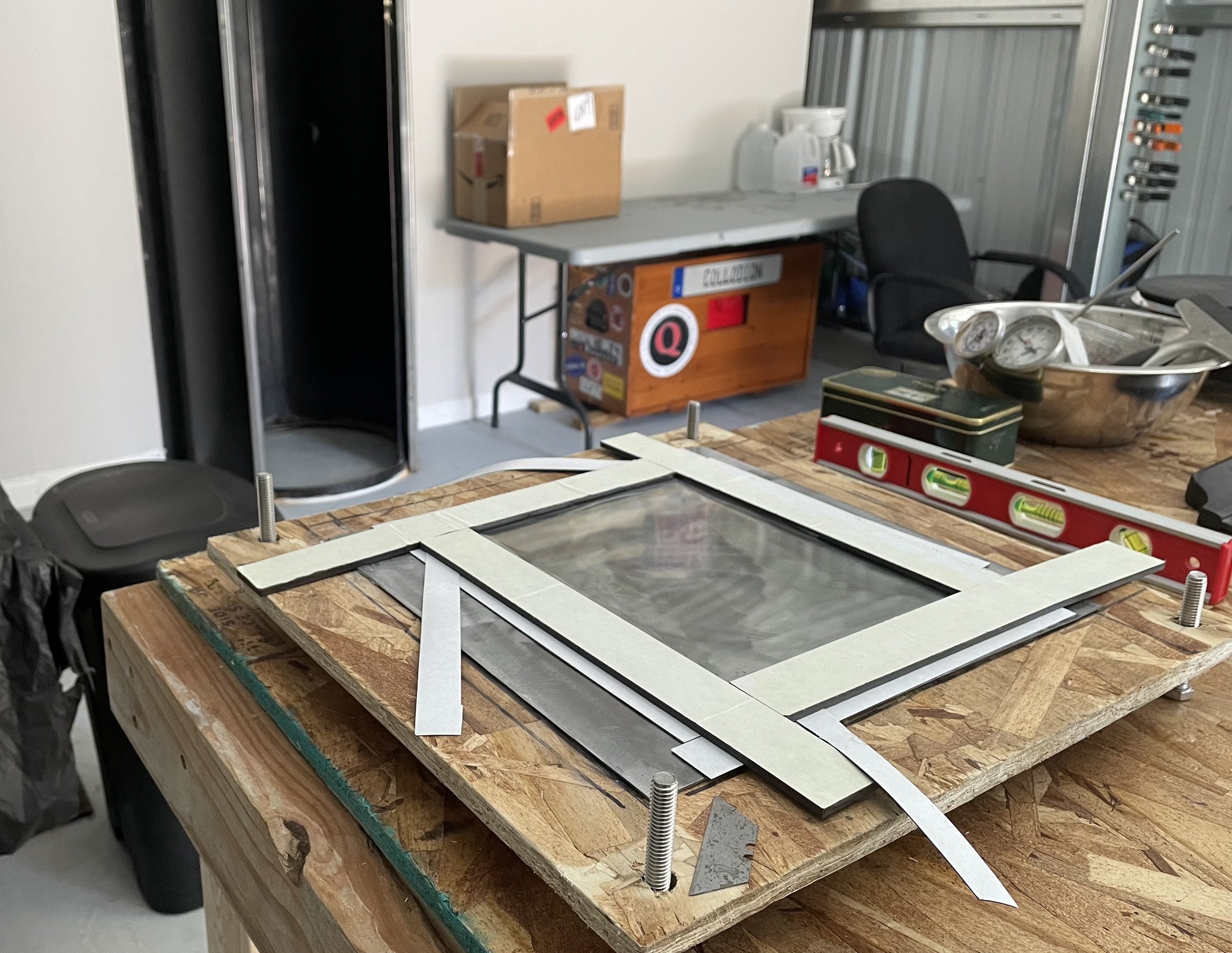
My gelatin pouring station.

Pouring Glass Plates for Oil Prints

Quinn Jacobson May 8, 2022

I’m ready to move to my goal of making this work on glass (prints from negatives). These are Rawlins Oil prints, but they’re on 8” x 10” (20,3 x 25,4 cm) glass plates. The negatives are Whole Plate and look wonderful matched to that format for printing. They will end up in 11” x 14” (28 x 35 cm) mats.

I’ve found a way to pour gelatin onto the glass with thick magnets and my level pouring board. It works really well. I was happy to find the right magnets! That took a while. The glass is 2mm thick, so the average magnetic strip stuff does not work. I have a great system down now that allows me to pour about 5 plates in an hour. That’s pretty good.

Tomorrow, I’ll sensitize the gelatin and ink up these three plates. My end goal is to have the work I make for this project all printed on glass. It’s super beautiful and kind of transcends photography - almost multimedia in a way. I like that. I have an idea for framing this work that should be interesting too.

These will be printed from wet and dry collodion negatives, and I’ll eventually find a way to ink them in a subdued color that works.

Not an easy thing to do, getting the gelatin to the right temperature and then having it stay in your cordoned off areas with magnets.

You can see how thick the gelatin is on these glass plates.

Chemistry anyone? If this isn’t enough, there’s more in the darkroom!

Nobody Cares About Your Photography!

Quinn Jacobson May 5, 2022

I’m sure that’s not the first time you’ve heard this statement. It’s an old trope, but in a lot of ways, it’s true. In the strictest definition, no one really does care about your photography/art. And you should be okay with that. Here’s why.

A few days ago, I posted a video on my Chemical Pictures board about why no one needs to see your photography and why believing that they do is making you unhappy. The video addresses Vivian Maier and her complete anonymity (in her lifetime) and never showing her work. It also addressed social media, and the influence it has on photographers and artmakers. If you have time, you should watch it. He makes some good points about the environment we live in today.

This is a tough pill to swallow for some. I try to be cognizant that no one really cares if I ever make another photograph or not. I’ve said that publically many times. And yes, some would say that they like my work and that I should continue to do it, but that’s more of a passing comment, there’s no real “meat” behind it. In other words, they really don’t care.

I’m okay with that. In fact, I’ve often thought of stopping what I do as far as sharing my work online. The educator in me always wants to help, so I’m somewhat compelled on that level to share. If I did stop, no one will be distraught or upset and it won’t change anyone’s life if I never made another post. The question is why would I stop? I’ve been thinking a lot about that question.

When you examine your life as an artist, that is, someone who creates meaning and communicates ideas visually, you must consider why you are doing it. I’ve always had a desire, or need, to pursue certain narratives. Mostly centered around marginalized communities. And specifically marginalized groups in history. My interest lies in telling stories, through images, that address questions about genocide and injustice.

There’s also expression. I want to express these ideas in my own way. From the materials I choose to work with as well as the way I present and write about the work. Those are very important elements for me. It’s the way I find closure to a story - meaning through materials, ideas, and questions. My work is never about answering questions, only proposing questions and ideas.

Having said that, I’m not sure I need an audience for my work, at least when I’m alive. I say that with some trepidation. On the surface, we all feel like art is created to be seen, specifically to be seen by other people. I’ve been reconsidering that position for a while about my work. Primarily, my work is made for me. It satisfies something deep inside of me (keep reading for the answer). It helps me process ideas, questions, and concerns that I’m addressing. It’s like talking about the proverbial “elephant in the room” for me. It is, in fact, cathartic for me in a lot of ways. I’m always hoping my work will help me change as a human being. I’m hoping it will help me address my shortcomings and help me be a better human to other humans and all living creatures (that sounds intense!).

After reading Dr. Ernest Becker’s book, “The Denial of Death”, I now realize my need to make art is to quell my death anxiety. The knowledge that I’m going to die drives my need to make art. Dr. Sheldon Solomon was on one of my YouTube shows talking about Terror Management Theory (TMT). He’s a great guy and happens to be one of the authors of, “The Worm at the Core: On the Role of Death in Life”. We talk about TMT and death anxiety for artists on that episode. These theories are very important for artists to understand. They put things in perspective. They disavow the superficial reasons for making art and really explain the reasons we make art. Hint: it’s not to sell pictures to wealthy people or to get “likes” on social media. I encourage you to dive into these theories and learn about the driving force behind what you do. You might come to the conclusion that nobody cares about your photography but that it plays a big role in your life and death.
POP Platinum Palladium or The Ammonium Print Out Method?

Quinn Jacobson May 1, 2022

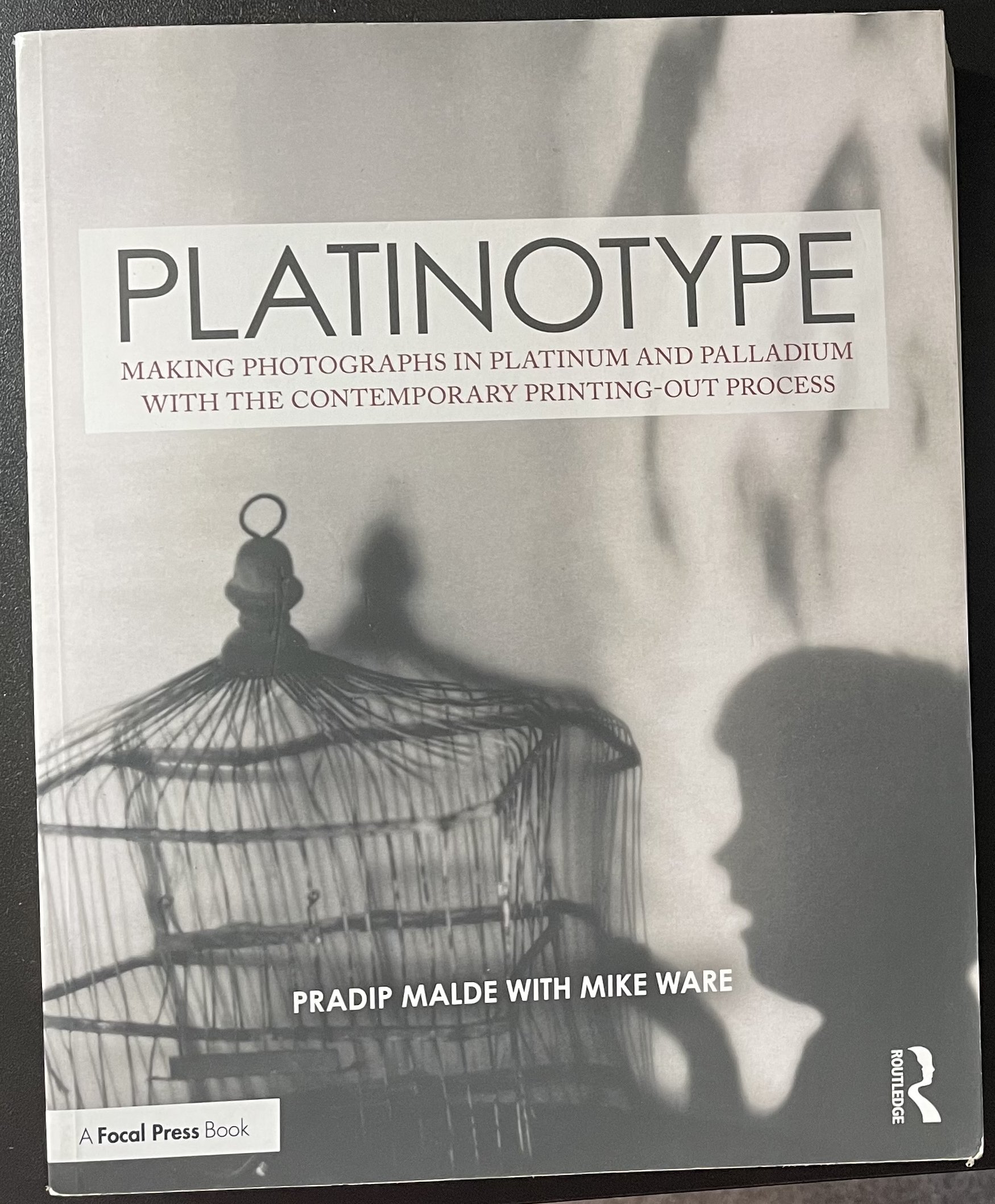
First and foremost, this process is available today thanks to Pradip Malde and Mike Ware. Full acknowledgments to them.

What is the POP Platinum Palladium or The Ammonium Print Out Method? To begin with, it’s not a develop-out process (DOP). The traditional Platinum Palladium printing process uses a developer, like Potassium Oxalate, to develop the picture. Like Albumen, Salt, Collodio-Chloride, etcetera, the Print-Out Platinum Palladium, or The Ammonium Print Out method uses the sun (or UV light) to develop the picture.

This is from Pradip’s website, “In recent years platinum-palladium printing has regained its place at the summit of alternative photographic practice, renowned for the subtly nuanced tonal qualities of its images, formed by totally permanent ‘noble’ metals in the matte surface of artists’ paper. Willis’s traditional platinotype and palladiotype were development processes, and capable of beautiful results in skilled hands, but they suffered from some chemical inconsistencies. The method described here employs a better-behaved iron sensitizer, derived from the ‘print-out’ platinum process due to Giuseppe Pizzighelli in 1887. Read Mike Ware’s technical comparison of the modernized version with the earlier processes.

This modernized version has some advantages in economy, accessible chemistry, and exposure control. Using the procedures described in these notes, platinum or palladium may be used individually or mixed in any proportion, providing a choice of the image hue between neutral grey-black and rich sepia. A controlled degree of humidity is allowed in the sensitized paper to promote the formation of a printed-out image in platinum/palladium during the exposure, requiring little or no development. A carefully-devised clearing sequence ensures that all the iron is removed from the paper.”

Mike Ware wrote a technical comparison. Here’s an excerpt from the writing, “Thus a ‘print-out’ process results, in which the final image is formed substantially during the light exposure, and no ‘development’ bath is required, simply ‘clearing’ baths to remove the excess soluble chemicals. This enables a modus operandi quite different from the traditional method, and more economical in time, effort, and materials. Images may be printed satisfactorily ‘by inspection’, without prior calibration. The print-out process is ‘self-masking’, in that the blackening of the shadow tones inhibits their further darkening by light, so a long density range in the negative may be accommodated, and the control of contrast is more relaxed. By regulating the relative humidity of the paper before exposure, better image colors result with palladium, because the metal nanoparticles are allowed to grow larger, and can furnish even a neutral black. Provided that a suitable paper substrate is chosen, the method can also yield an excellent print in pure platinum.

In conclusion, it might be observed that, for many artists, the intrusion of technical minutiae into the creative workflow can tend to inhibit their endeavors. If the science can be predesigned to work as transparently and unobtrusively as possible, so much the better for art. Artists deserve the best science.”

Another book I would recommend if you don’t have it is “Coming Into Focus” by John Barnier. Both are excellent for information on semi-obscure historic processes.

Paradise Cove, Colorado, U.S.A. POP Palladium Platinum (Malde-Ware Process) from a Collodion Dry Plate Negative.

Thinking About Aesthetics

Quinn Jacobson April 30, 2022

Aesthetics is a discipline concerned with the perception, appreciation, and production of art. Aesthetic experiences, such as looking at paintings, listening to music, or reading poems, are linked to the perception of external objects, but not to any apparent functional use the objects might have.

Atmospheric: Creating a distinctive mood, typically of romance, mystery, or nostalgia. A great way to talk about what I want to do with this work. I consider each plate that I make a study. To look at closely in order to observe or read. Observation is key. Understanding light, the conditions, and making an image “talk” to evoke emotions and tell a story.

My hope is with this body of work to be less literal. In other words to add some mystery and poetry to the work. It’s very difficult to tell a story this way, but a narrative can be told without being so straightforward. Art to me is a series of problems that need to be resolved. Words can only go so far. I want to leave the words to a minimum and allow the story to be told through the work itself.

I’ve been studying landscape painting a lot lately. I’ve also looked at a lot of 19th and early 20th-century landscape photographs. I’m approaching this work with an open mind and trying my best to work until I “see” the images that I really want. It should be a good body of work when I’m finished. We’ll see.

Paradise Cove, Colorado, U.S.A. POP Palladium Platinum (Malde-Ware Process) from a Collodion Dry Plate Negative. I really like this image. It starts to convey the ideas I talk about above.

Paradise Cove, Colorado, U.S.A. Collodion Dry Plate Negative.

Paradise Cove, Colorado, U.S.A. Collodion Dry Plate Negative.

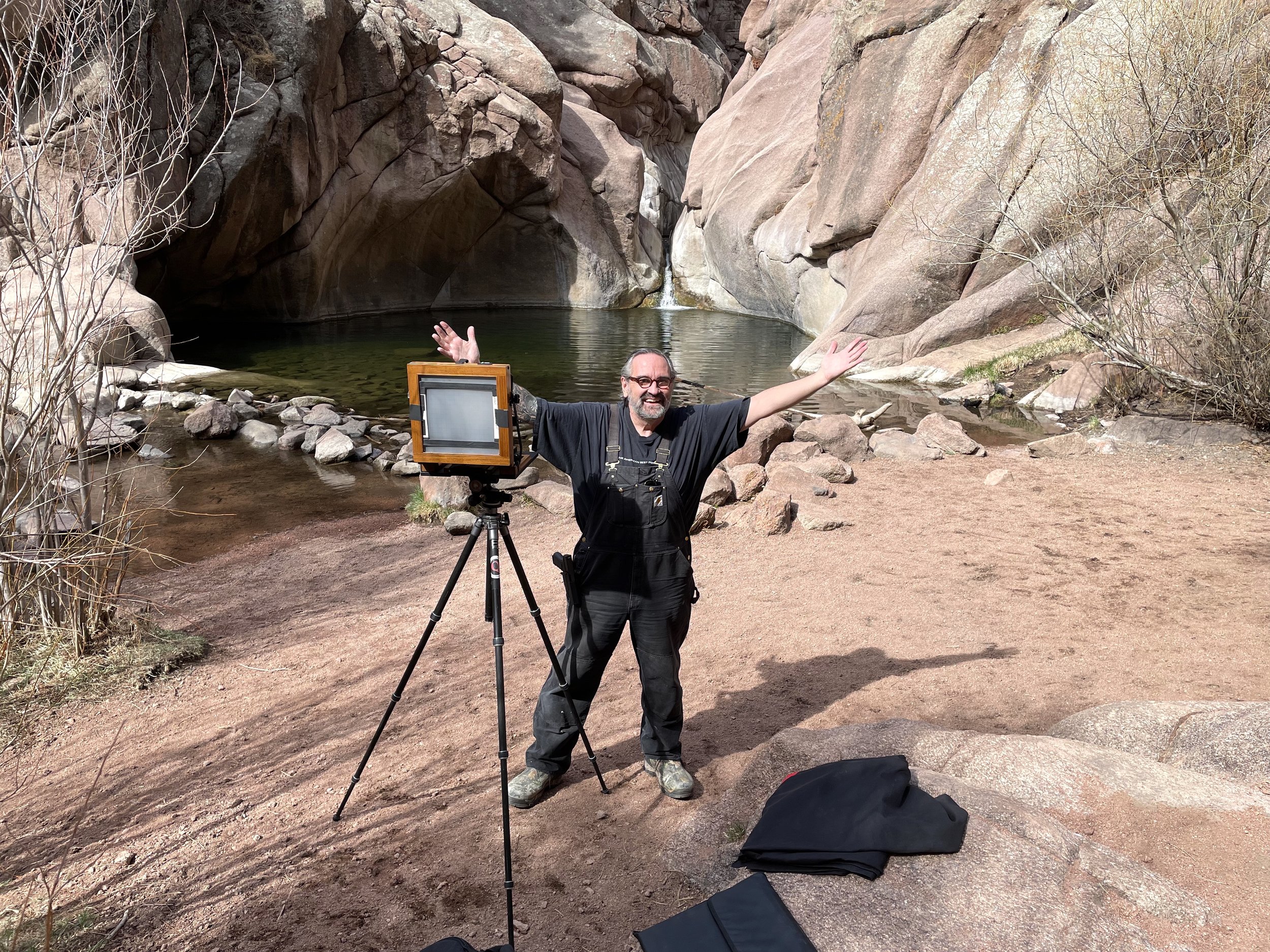
Welcome to Paradise Cove! Photo by Jeanne Jacobson

Paradise Cove - The Hike In For Collodion Dry Plate Work

Quinn Jacobson April 28, 2022

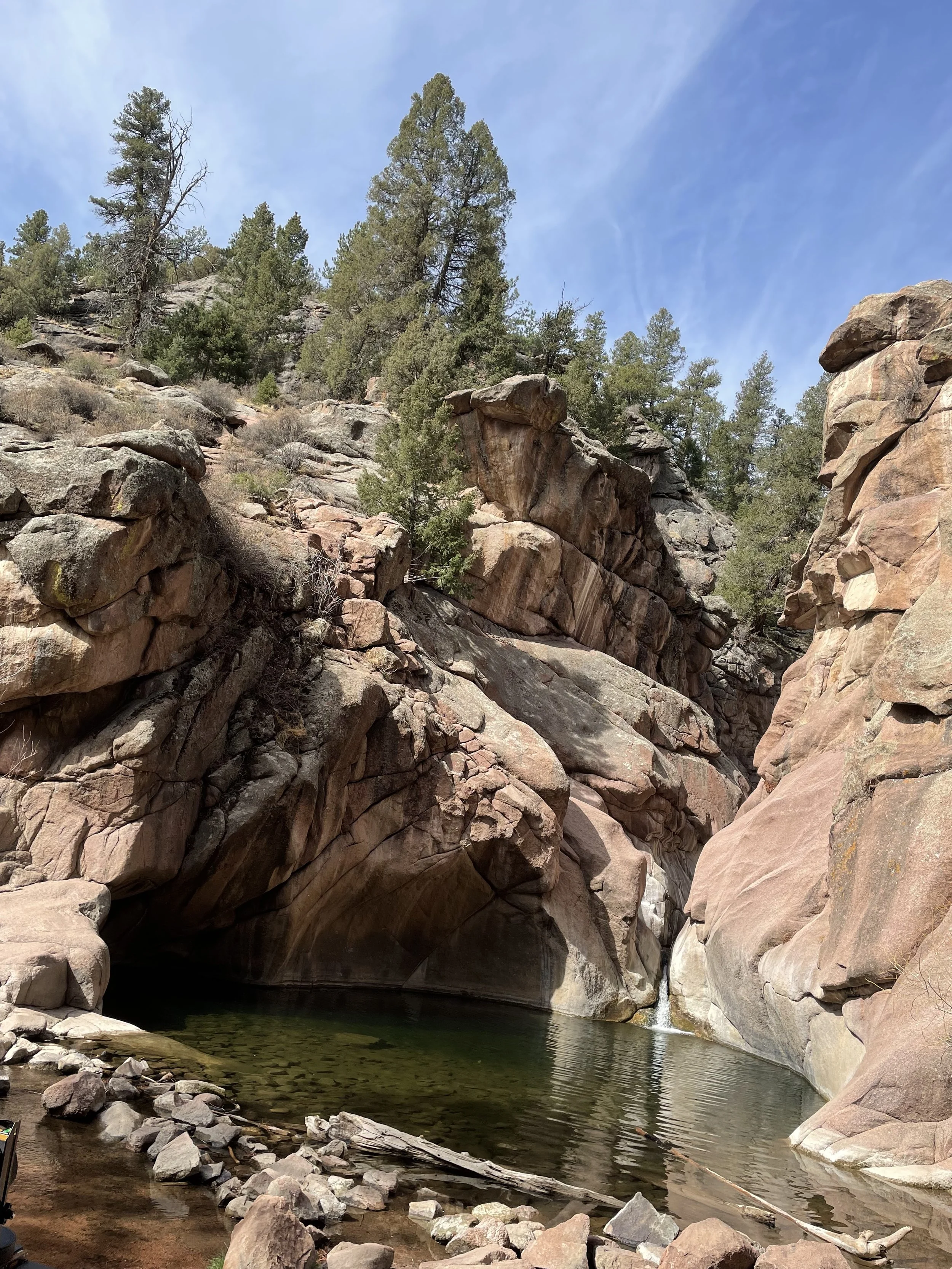
It was beautiful weather today. Jeanne and got prepared and took off this morning for a hike back into the 4 Mile Creek area to Paradise Cove. This place is only 4 miles (6.5 kilometers) from our property, a quick drive to the trail head and off we went.

We started at about 0930. There’s a steep beginning to the trail and then another big drop into the cove. All rock, you have to be like a mountain goat, sure footed. This is about 9,000- 10,000 feet (2.750 - 3.000 m) above sea level. Not for everyone if you’re over 40 years old, or from sea level. We took our time and enjoyed the scenery. Makes me want to paint when I see beauty and awe like this - and we get to live here! So grateful for that.

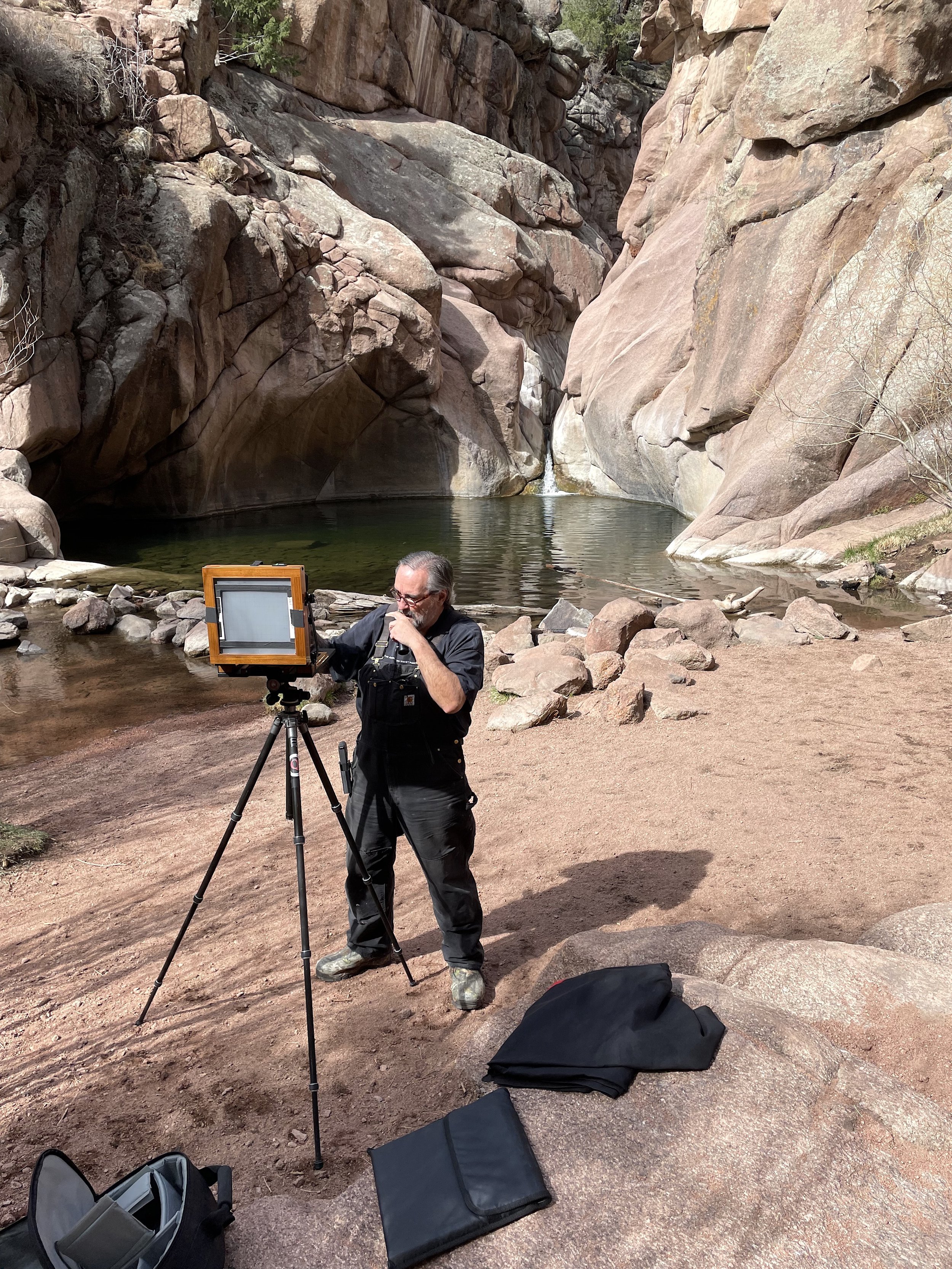
I packed my 10x10 Chamonix camera, ground glass, lenses, loupes, timers, and tripod in and Jeanne packed a couple of dry plates. I can fit one plate in my f/64 backpack with my camera, but that’s it. We packed in a total of three plates.

Setting up and looking at the ground glass immediately made me want a wide angle lens. It would have been nice to capture the enveloping feeling of the rock surrounding you. I did what I could and I’m sure I’ll be happy with the negatives.

I’m too tired today to process the plates. I’ll do that tomorrow and over the next few days, begin to print these. If they are what I think they will be, these will be some of the first plates of my project. We’ll see.

A big thank you to Jeanne for the photos she shot and for packing in some plates.

The start of the hike.

The flat part of the journey.

There’s a reason they call it the Rocky Mountains.

I’m not sure if there’s anything better than a walk in the mountains. Quiet, peaceful, and the solitude is priceless!

We’re getting closer to the cove.

Welcome to Paradise Cove.

Hmmm, what f/stop??? Photo by Jeanne Jacobson

Photo by Jeanne Jacobson

Paradise Cove - Colorado, U.S.A. Photo by Jeanne Jacobson

I’m carrying everything I need to make Collodion Dry Plate Negatives (Whole Plate). You could never get a darkroom in where we went today - maybe you could, but it would be sheer hell trying to set up and make Wet Collodion Negatives. This was a great hike and hopefully a fruitful venture for the project. Photo by Jeanne Jacobson

Collodion Dry Plate Negative & Print

Quinn Jacobson April 28, 2022

Me holding the negative after development. You can see the citric acid and KCN influence in the color.

The Bausch & Lomb Tessar and Collodion Dry Plate Negative

Quinn Jacobson April 27, 2022

I took the Bausch & Lomb Tessar out today and made a collodion dry plate negative. It’s absolutely beautiful. It was made February 24, 1903. It’s an 8” x 10” lens (12” x 10” when using smaller f/stops). It covers my Whole Plate (6.5” x 8.5”) wonderfully.

Two things l love about it; 1) it’s speed. It’s an f/4.5 lens. 2) The coverage. I wanted something that I can use for landscapes and easily cover the plate. This does that with room to spare. I love the speed, too. I made this negative at f/4.5 for a 6 minute exposure at 1000 hrs (morning). The sun was hidden behind some soft, wispy clouds - beautiful light. If you look close, you can see the rim light on the top of the trunk. The light is coming from the east and my camera was facing south.

Next on the agenda is to make a Platinum Palladium print and an Oil Print from this negative. Really exciting stuff for me. I absolutely love it!

Digital snap of the scene as the exposure was being made.

Digital snap inverted, unfortunately this gets compressed by some algorithm - The detail is spectacular! I’ll post the prints when I get them.

Getting Closer the The "Look & Feel" I Want

Quinn Jacobson April 24, 2022

First things first, in that order.

I want to make a body of work that has a certain aesthetic or “look and feel”. In order to do that, I need to know what kind of negatives I need for the printing processes that this work will be made on. It’s a long journey, in some ways. It even comes down to the optics. Of course, the biggest factor is LIGHT! We tend to forget that equipment or gear will only go so far. You do need the correct equipment/gear to make the work, but the LIGHT is the biggest factor. We bow to it and everything we do is in service of it.

My goal with these two images was to expose them in the early morning light. Having the light act as almost a backlit scenario or front-lit scenario. I wanted an “otherworldly” look. Something that is foreign and beautiful. Words that come to mind are soft, delicate, beautiful (in a new way), and alien.

I’m getting closer with every negative I make and every print I produce. A great journey! I’m trying to stay focused and think, think, think. Execute, execute, execute. Stay tuned!

Take a look at this video. He makes some really good points about Pictorialism.

Two sheets of gelatinized paper drying. They will be ready to sensitize tomorrow.

Sorting Out Oil Printing Equipment & Gelatinizing Paper

Quinn Jacobson April 23, 2022

If you want to make Rawlins Oil Prints, you’ve got to sort out the equipment and find a strategy that works. Like all historic photographic processes, you need to find your own way of doing things. The cleaner and the more organized you are will give you better results.

Part of the printing process involves preparing the paper. Here, I’m using Arches Oil paper (300 gsm or 140 lbs.). It’s a great paper for oil printing. I also like Hahnemühle Platinum Rag and Revere Platinum. All great papers for this process.

The process of getting gelatin on the paper can be accomplished in a couple of different ways. I prefer this method. You can use a cookie sheet and submerge the paper let it dry and submerge again. I don’t care for that for several reasons, the biggest is getting gelatin on the back of the paper. Also, I like a “thick” concentrated layer to work with.

You also need to figure out how to prevent the paper from curling up into a tube when it’s dried. I made the wooden cut-out frames and clamp the corners. I’ve developed a new way of doing this that I will show in another blog. I’m waiting on some materials to make it happen. This is a big deal. The paper is impossible to sensitize if you can’t lay it flat.

My ultimate goal is to be able to prepare 10 sheets of paper at a time. That would give me enough to work with for about 2 weeks. I’m trying to make 15 - 20 prints per month. I will edit the images at the end of the year. I’m planning two years’ worth of work. Big goals! Let’s see what happens!

These are wonderful magnets. It took me three years to finally find ones that really work well. These do!

Freshly poured gelatin setting up on the pouring table.

You can see how thick the gelatin is - even and clean!

It will take some practice to get this right. A lot of it has to do with your workflow and equipment.

Two sheets of gelatinized paper drying. They will be ready to sensitize tomorrow.

Garden of the Gods - Colorado Springs, Colorado - Rawlins Oil print (1903) from a collodion dry plate negative.

Vinculum

Quinn Jacobson April 22, 2022

Sally Mann is a wonderful human being, a great artist, and a powerful intellect. If you haven’t seen her video called, “Vinculum”? Do yourself a favor and watch it.

She inspires me. She makes me think. I am motivated when I read her writings, watch her films, and look at her work. I owe a lot to her. In “Vinculum” she ties the process she’s working in, the type of film and printing, to the concepts and ideas she’s interested in exploring. I think this is the most important thing an artist can do. If work is missing this, I don’t think it can be very successful. It can be pretty, it can be cool, it can be technical, and it can even be sophisticated. But it can’t be a story. Sally ties these ideas and concepts together so well that you can almost feel the ideas. And that is what vinculum means, “a unifying bond”.

My goal has always been to tie a strong narrative to my work. I’m not talking about photojournalism, but personal concerns, questions, ideas, etcetera. I’m trying to make work with this project that does what Sally talks about in her video. I want to bind the people today (us) to the people of the past and present. And I want to do that through the land and making landscape pictures that feel a certain way. I feel like I’m getting a handle on what I want to do, but it will take some time.

Lately, I’ve tried to limit the technical support and social media stuff, so I can concentrate and give this work what it needs to be successful. I like sharing what I’m doing, but I don’t want to wear the badge of “technical support” much anymore. It’s time-consuming and mind-consuming. I do support people who support me. That will never change.

I wanted to share another image I’m working on in the Rawlins Oil Printing process as well as a “new” lens I’m going to be taking out for a test drive soon. Once again, I apologize for the less-than-quality iPhone snaps, but you can get the idea.

Garden of the Gods - Colorado Springs, Colorado - Rawlins Oil print (1903) from a collodion dry plate negative.

Trying to she the relief - Garden of the Gods - Colorado Springs, Colorado - Rawlins Oil print (1903) from a collodion dry plate negative.

Trying to she the relief - Garden of the Gods - Colorado Springs, Colorado - Rawlins Oil print (1903) from a collodion dry plate negative.

We built a 4’ x 6’ work table for the studio. It’s very nice to do oil prints on!

A “new” lens that I’m taking out next time to make some negatives with. It was made on February 24, 1903, at the height of Pictorialism. It’s a Bausch & Lomb Tessar lens. It covers 12 x 10 at a distance and has an aperture range of f/4.5 to f/32.

I use gaffer’s tape to cover any “joints” or connections on old lenses. I’m always conscious of light leaks, especially outdoors up here!

← NewerOlder →

Search Posts

No results found
Archive Block
The page connected to this block was deleted. Double-click here to select a different page, or check the recycle bin for the deleted page. Learn more
Post Archive
  • Adventures
  • Spotlight
 

Featured Posts

Featured
August 21, 2026
Glass Bones Chapter 5 - The Stories That Hold Us
August 21, 2026
Read more →
August 21, 2026
August 17, 2026
Glass Bones Chapter 4 - Culture As Armor
August 17, 2026
Read more →
August 17, 2026
August 12, 2026
Glass Bones: Chapter 3- The Beginning of Denial
August 12, 2026
Read more →
August 12, 2026
August 1, 2026
Glass Bones: Chapter 2 - When We Knew We Would Die
August 1, 2026
Read more →
August 1, 2026
July 24, 2026
Glass Bones: Chapter 1 - Thr Problem We Don't Admit
July 24, 2026
Read more →
July 24, 2026
July 17, 2026
Glass Bones: Chapter 0 - On Existential and Aesthetic Literacy
July 17, 2026
Read more →
July 17, 2026
Jimmy-2003.jpg
July 16, 2026
End of the Road Podcast
July 16, 2026
Read more →
July 16, 2026
July 9, 2026
Preface and Introduction - First Reading: Glass Bones
July 9, 2026
Read more →
July 9, 2026
books-blog.jpg
June 27, 2026
Working On Rupture: The Creative Response to Death Anxiety
June 27, 2026
Read more →
June 27, 2026
Book-Stack.jpg
June 16, 2026
Glass Bones is Shipping
June 16, 2026
Read more →
June 16, 2026